
The chapter to start with
When You Are Not All Right
For parents whose own mental health is part of what’s going on at home.
19 min read
Read the chapter Your first chapter is free to read in full.
↑ ↓ to moveEnter to openEsc to close
Looking after yourself

This section is about you, the adult. Parents tend to come to it last, though the rest of family life depends on how you are. It’s for the mother running on four hours of sleep, the father who can’t remember the last time he was alone in a room, and the parent who has stopped recognising their own life.
What to do first, what helps and who else can help are free to read and to print. So is the first chapter you open.
What the library holds on parent wellbeing
From the therapists
You’re the most reliable person in your child’s life, and nobody can keep that up for long when they’re exhausted. Looking after yourself is part of looking after your child, and you don’t have to earn it.
From the chapters
A bright screen in a dark bedroom works against sleep. Charge devices in the kitchen overnight.
Go through bath, teeth, pyjamas, reading and low lights in the same order each night. The brain reads the sequence as “sleep is coming” and starts releasing melatonin, so it’s the predictability that makes it work.
29 on parent wellbeing
The long reads, each on one situation, written by a therapist.
The chapter to start with
For parents whose own mental health is part of what’s going on at home.
19 min read
Read the chapter Your first chapter is free to read in full.
Nothing on this shelf is written for that age yet.
40 on parent wellbeing
Short pieces for the moment in front of you, each with things to try.
Parent wellbeing
Agree a plan with your children in a good week, so nobody has to guess on a bad day.
Try this
From the tip
Coram Family Lives suggests agreeing a plan with your children for the bad times, and we’d add only that it’s best made in a good week, calmly, perhaps over a weekend breakfast. Agree who they can call, who will do the school run if you can’t, and what you’ll say to each other on a hard day, so that nobody has to guess. And one simple rule for an emergency: if they cannot wake you, you are hurt, or they think you are in danger, they call for emergency help first and ring a named adult second.
Parent wellbeing
A specific request for help gets a yes or a no; a general one gets sympathy.
Try this
From the tip
“Can I drop them at yours on Saturday morning while I see the GP?”
Parent wellbeing
Many parents fear that asking for help will cost them their children, but what usually follows asking is help.
Try this
From the tip
If you are not safe, or not sure you can keep yourself or your children safe, do not wait for the GP: use the routes under “If you need help right now”, at the foot of this page. Say if your child is with you; it means the person helping can think about your child as well as you.
For most people, the first step is the GP.
More quick tips on parent wellbeing
Parent wellbeing
Losing touch with friends happens gradually, and the way back starts with a quick, low-stakes message.
2 min read
Parent wellbeing
Sunday-evening dread is a sign that you’ve been doing more than you can recover from.
2 min read
Parent wellbeing
A child who is told nothing makes up their own explanation, and in it they are often to blame.
2 min read · Ages 5 to 16
Parent wellbeing
Lying awake night after night is a sign of overload, and a reason to see your GP.
2 min read
Parent wellbeing
After you’ve snapped at your child, go back, apologise and put it right.
2 min read
Parent wellbeing
A child under five needs a short, calm explanation and care they can rely on.
1 min read · Under 5
Family transitions
A short, slightly distracted first call from university is a good sign that your child is settling in.
2 min read · Ages 13 and over
Family transitions
The week before your child leaves for university is one of the hardest; do less than you think it needs.
2 min read · Ages 13 and over
Big feelings
Early help shortens recovery, so don’t wait until your child seems sick enough to need it.
2 min read · Ages 5 to 11
Neurodiversity
When a friend says it’s just a phase, one short, warm sentence can close the conversation.
2 min read
Neurodiversity
Keep the evening before an assessment as much like any other evening as you can.
2 min read · Ages 5 to 13
Family dynamics
While one child struggles, the other may become very easy to live with and keep their worries to themselves.
2 min read · Ages 5 to 11
Bodies & growing up
In their first decade, a child’s body image is built almost entirely from what they hear adults say.
2 min read · Ages 7 to 11
Neurodiversity
Many parents feel relief, then grief, when the diagnosis they half-expected finally comes.
2 min read
Family dynamics
The grandparent who looked after the children now needs looking after.
2 min read
Parent wellbeing
Irritability can be a sign of poor sleep, low mood, anxiety or perimenopause, so a shortened fuse is worth looking into.
2 min read · Under 19
Health and difference
A twelve-year-old doing the family’s supermarket shop needs to hear that they can still be a child.
2 min read · Ages 9 to 16
Health and difference
In the days after a diagnosis, tell your child often that the condition doesn’t change who they are.
2 min read · Ages 5 to 13
Health and difference
For the parent who has not named their own medication out loud.
2 min read · Ages 7 to 16
Health and difference
During a parent’s long treatment, accept practical help, keep one family ritual and lower the bar on everything else.
1 min read · Ages 5 to 16
Family dynamics
Early-years twins are more exhausting than most people realise, so cut back on everything else.
2 min read · Under 7
Family dynamics
When money gets tight, get help with the numbers and decide what the children will be told.
1 min read · Ages 5 to 16
Bodies & growing up
If your child is too wound up to sleep, slow yourself down at bedtime.
2 min read · Ages 5 to 9
Bodies & growing up
Some early waking can be changed and some can’t, and a two-week sleep diary will show you which you have.
2 min read · Under 7
Family transitions
The summer holiday as the only parent is draining, so plan for what you can keep up.
2 min read · Ages 5 to 16
Big feelings
An anxious high achiever can look exactly like a teenager with healthy ambition.
2 min read · Ages 11 to 18
Parent wellbeing
Children notice when a job or income is lost, so give them a short, honest explanation.
2 min read · Ages 7 to 16
Parent wellbeing
If your shouting tends to come at the same hour, changing that hour may help more than resolving to be patient.
2 min read · Under 16
Family dynamics
Tell your child about your recovery at their level, and take your own feelings about it to other adults.
2 min read · Ages 7 to 16
Health and difference
Fit what you tell the children to their age, and expect to come back to it over weeks.
1 min read · Ages 5 to 18
Health and difference
After a serious diagnosis, let the children know something is happening; the full conversation can wait a few days.
1 min read · Ages 5 to 16
Family dynamics
Your child has noticed, and without an explanation they will imagine something worse than the truth.
2 min read · Ages 7 to 16
School & pressure
Whatever your teenager’s GCSE grades, respond warmly, and if the results are disappointing, leave decisions for another day.
2 min read · Ages 13 to 18
School & pressure
Put the admissions file away three evenings a week, so your child isn’t doing the test for two people.
2 min read · Ages 9 to 11
Family dynamics
When one twin is struggling, the other is often overlooked just when they need to be noticed.
2 min read · Ages 7 to 16
Online life
If your child confides in a chatbot, tell them what it is and keep them talking to real people.
1 min read · Ages 11 to 18
Family dynamics
Being hurt by your own child is not a secret to keep, and there is help for both of you.
3 min read · Ages 9 to 18
The rest of each tip, with more to try and why it works, is in the library.
Nothing on this shelf is written for that age yet.
4 on parent wellbeing
Small, repeatable things to do with your child, with what to watch for and when to get help.
To do together · About 30 min
A one-page plan, made calmly with your children: who they can call, who does the school run, and what you say to each other on a hard day.
What it is for. This is for a parent living with low mood, anxiety or another condition that comes and goes. A bad day is easier on everyone when the family has already thought about what happens on one.
Safety. The printable carries only the emergency route; the names and numbers of the adults who can help are for you to write in together.
When to get help. If you are not safe, or not sure you can keep yourself or someone else safe, do not wait for the plan: use the routes under “If you need help right now”, at the foot of every page, straight away. For everything else, the GP is the first step, and in England you can refer yourself to NHS Talking Therapies.
The other three steps, and your part in it, are in the library.
More to do together
To do together
On one sheet of paper, map the people and places your family can turn to, then choose one person to ask for help this month.
About 30 min · Under 18
To do together
One day a week, and a few evenings, with no papers, no practice and no talk of the test. Keep it most weeks, and let it go when a week slips.
A day, and three evenings · Ages 9 to 16 · With a sheet to print
To do together
For one week, the family tries one easy thing for each of the NHS’s five steps to mental wellbeing: connecting with people, being active, learning something, giving, and paying attention to the moment.
About 20 min · Ages 5 to 18 · With a sheet to print
Nothing on this shelf is written for that age yet.
62 on parent wellbeing
Made to be printed, kept, and handed on.
To print and keep
What to do first, what helps, a few things to try and who else can help, together in one guide. Free to print and keep, or to hand to the other parent, a grandparent or the school.
Who else can help with parent wellbeing, on a sheet of its own.
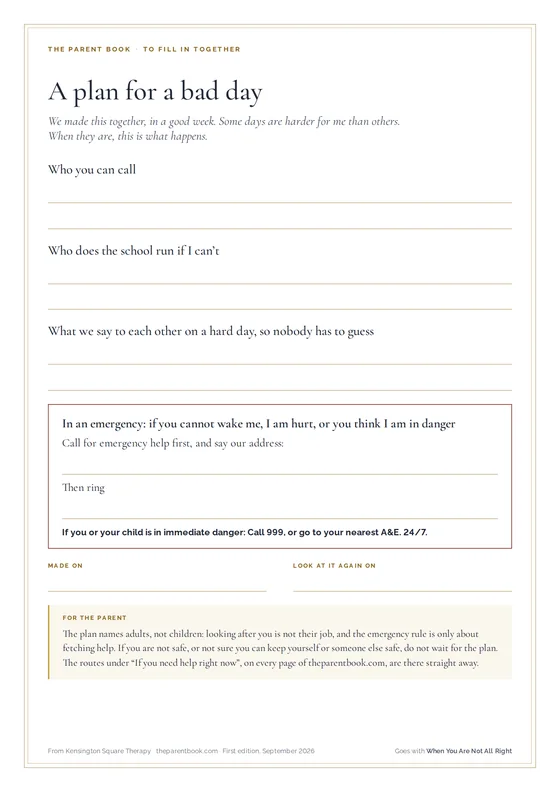 A plan for a bad day
To fill in together · A4 · Free
A plan for a bad day
To fill in together · A4 · Free
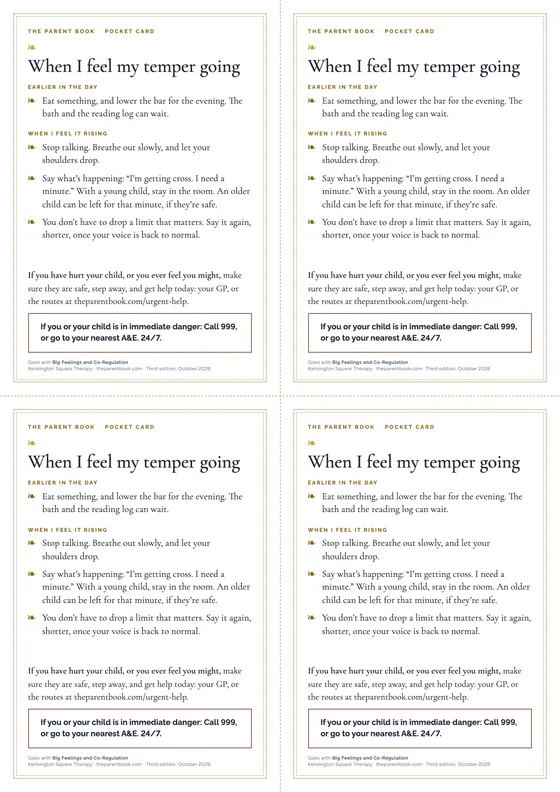 Putting it right
Pocket card · A4, four cards to cut, two sides · With a subscription
Putting it right
Pocket card · A4, four cards to cut, two sides · With a subscription
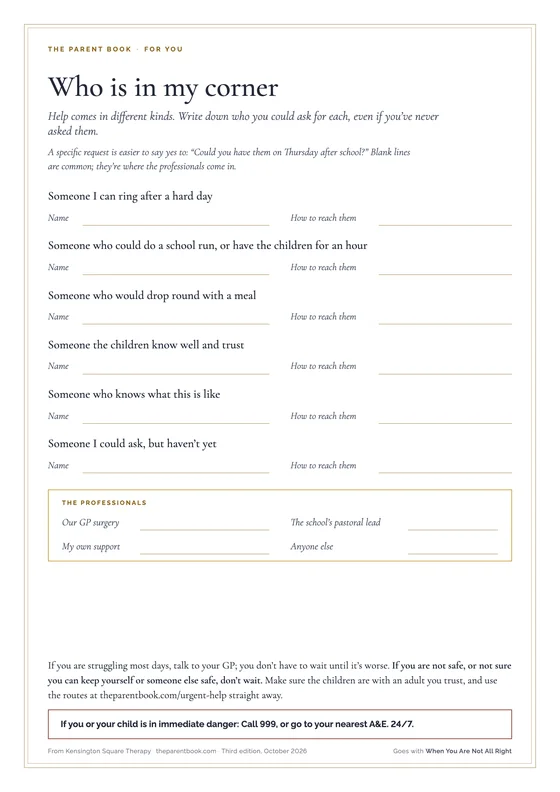 Who is in my corner
For you · A4 · With a subscription
Who is in my corner
For you · A4 · With a subscription
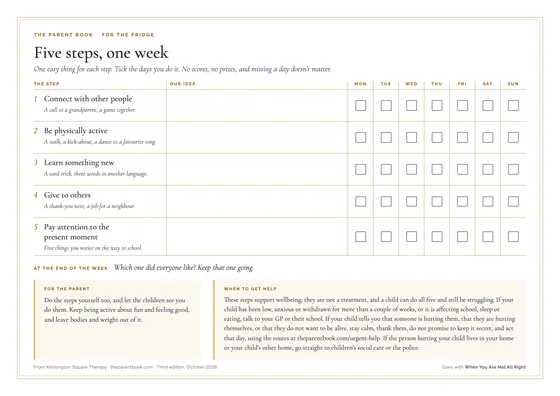 Five steps, one week
For the fridge · A4 landscape · With a subscription
Five steps, one week
For the fridge · A4 landscape · With a subscription
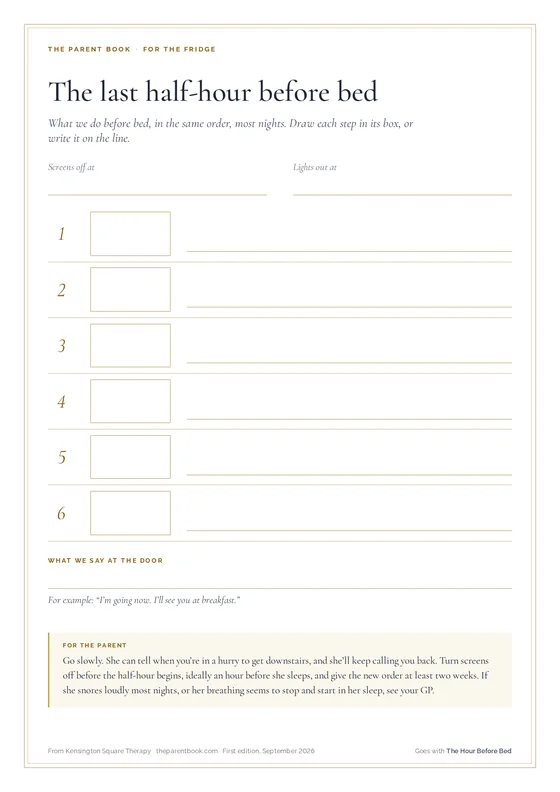 The last half-hour before bed
For the fridge · A4 · Free
The last half-hour before bed
For the fridge · A4 · Free
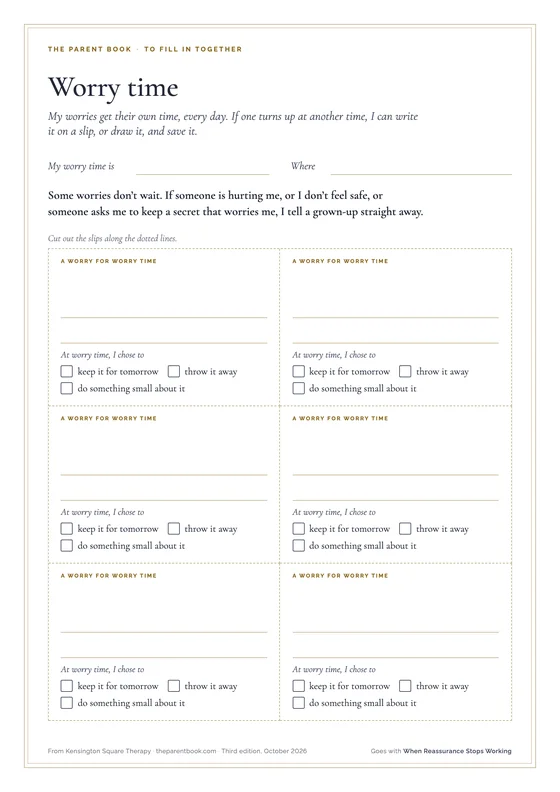 Worry time
To fill in together · A4, two pages · With a subscription
Worry time
To fill in together · A4, two pages · With a subscription
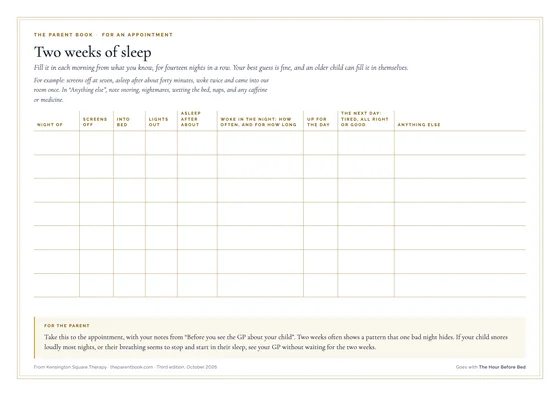 Two weeks of sleep
For an appointment · A4 landscape, two pages · With a subscription
Two weeks of sleep
For an appointment · A4 landscape, two pages · With a subscription
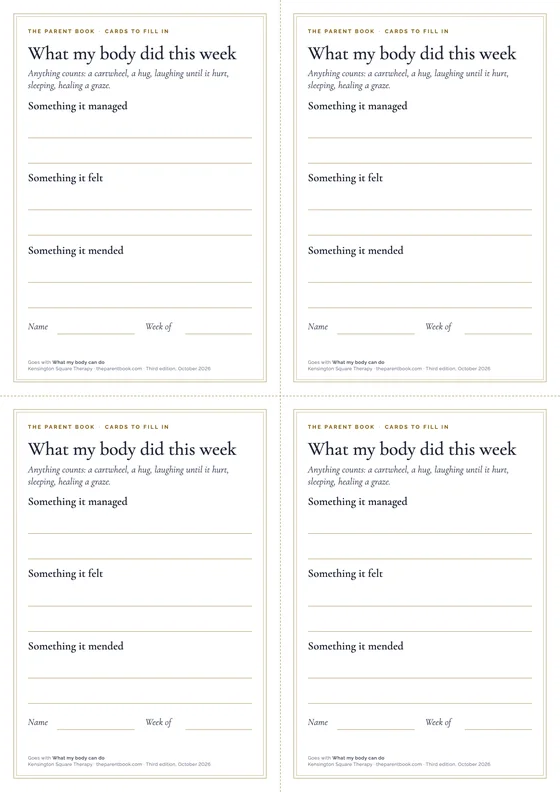 What my body can do
Cards to fill in · A4, two pages: four cards, and a page for you · With a subscription
What my body can do
Cards to fill in · A4, two pages: four cards, and a page for you · With a subscription
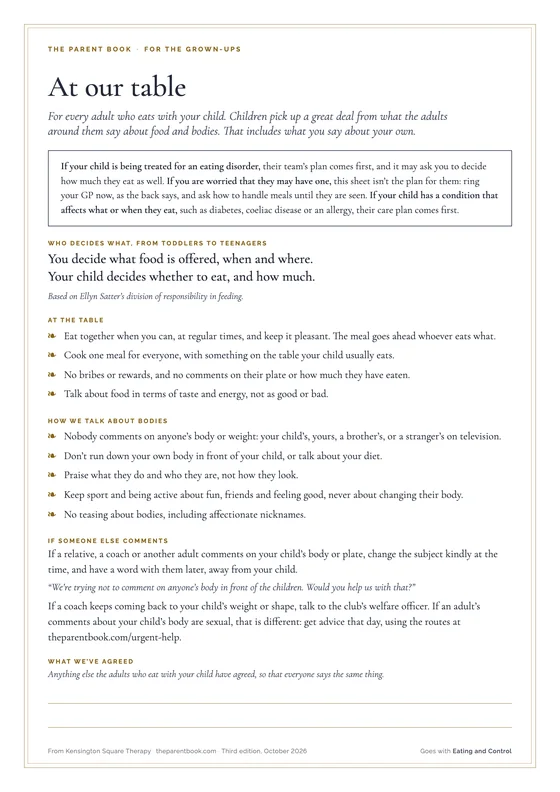 At our table
For the grown-ups · A4, two sides · With a subscription
At our table
For the grown-ups · A4, two sides · With a subscription
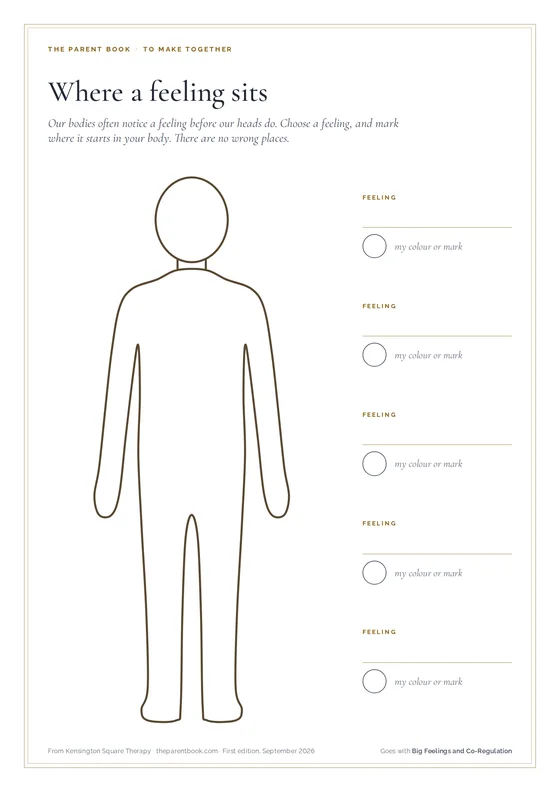 Where a feeling sits
To make together · A4, two sides · With a subscription
Where a feeling sits
To make together · A4, two sides · With a subscription
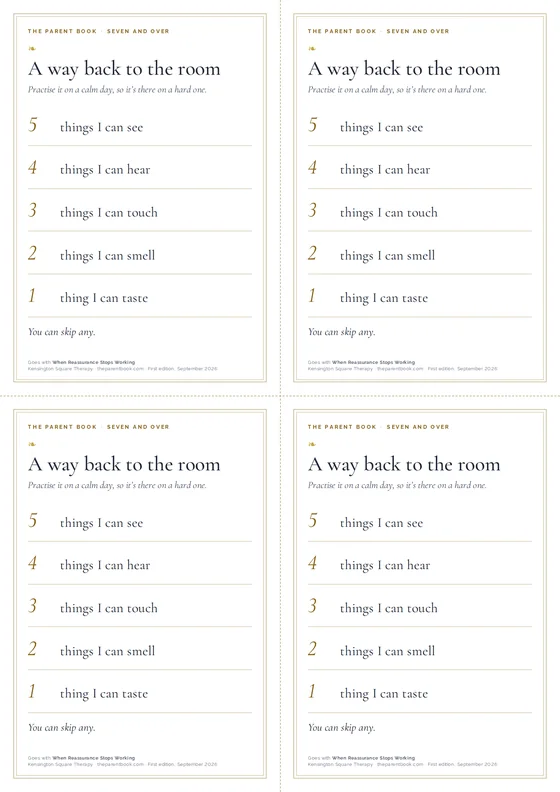 A way back to the room
Pocket card · A4, four cards to cut, two sides · With a subscription
A way back to the room
Pocket card · A4, four cards to cut, two sides · With a subscription
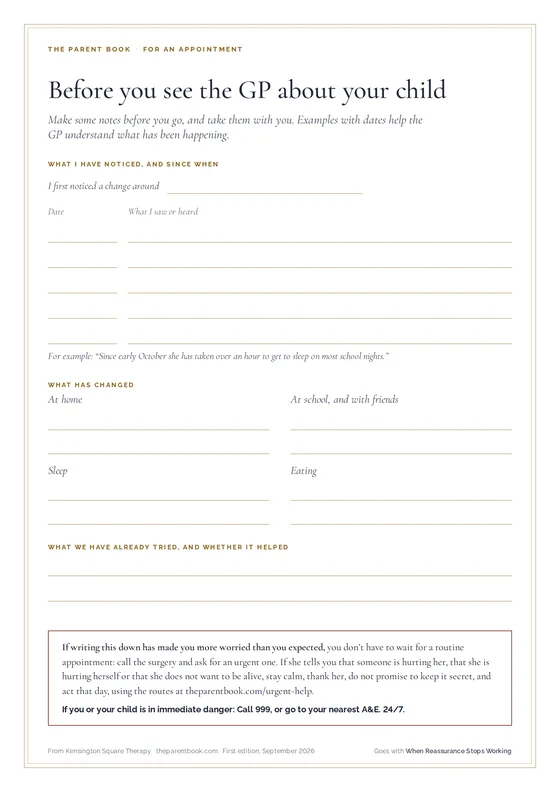 Before you see the GP about your child
For an appointment · A4, two sides · Free
Before you see the GP about your child
For an appointment · A4, two sides · Free
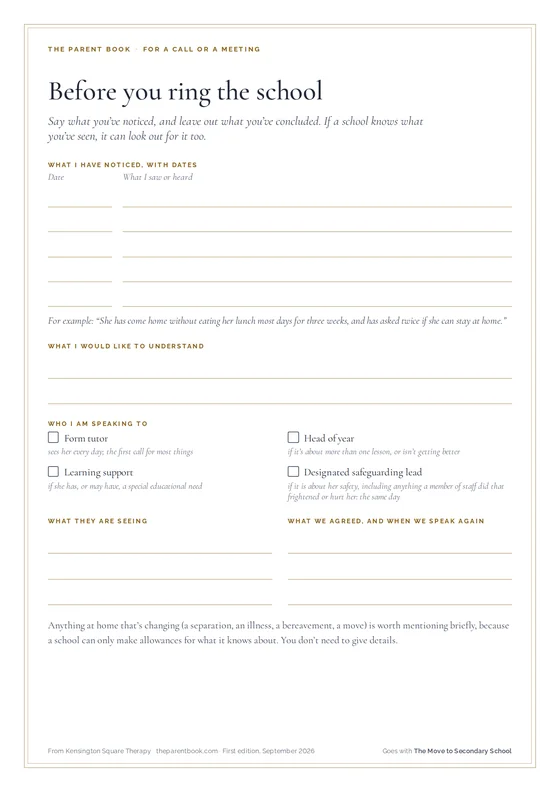 Before you ring the school
For a call or a meeting · A4 · Free
Before you ring the school
For a call or a meeting · A4 · Free
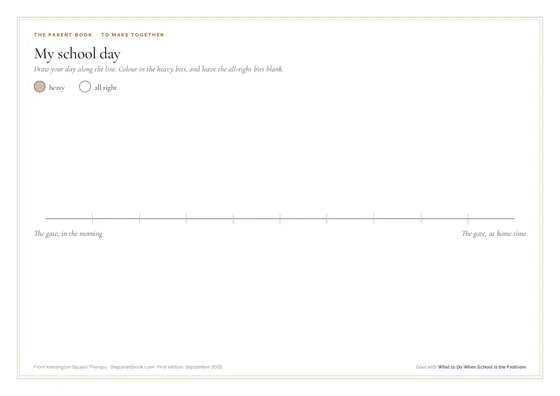 The school day, drawn as a line
To make together · A4 landscape, two pages · With a subscription
The school day, drawn as a line
To make together · A4 landscape, two pages · With a subscription
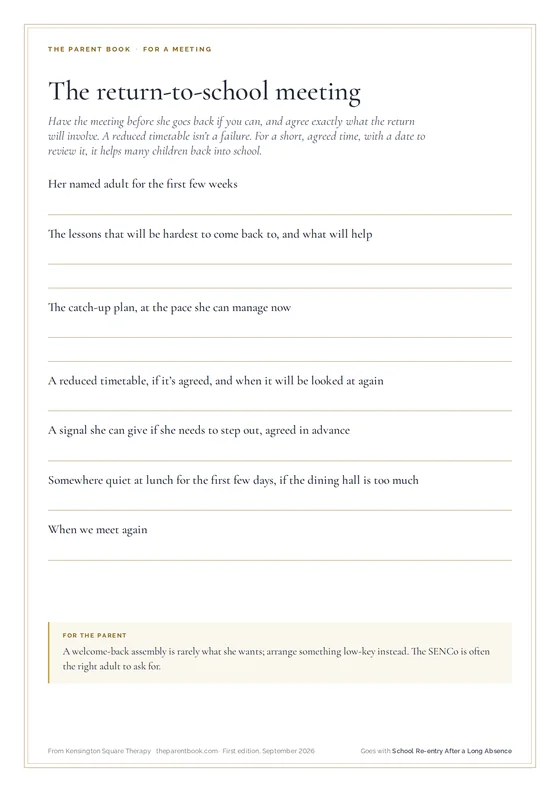 The return-to-school meeting
For a meeting · A4 · Free
The return-to-school meeting
For a meeting · A4 · Free
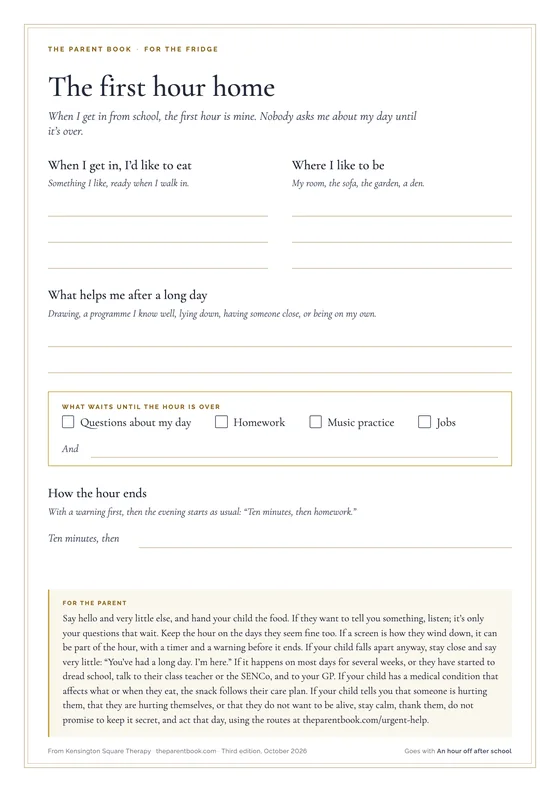 The first hour home
For the fridge · A4 · With a subscription
The first hour home
For the fridge · A4 · With a subscription
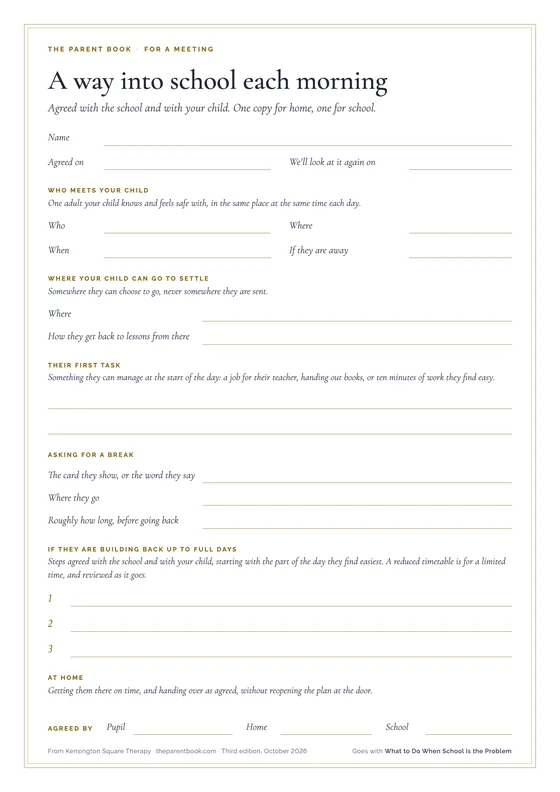 A way into school each morning
For a meeting · A4, two pages · With a subscription
A way into school each morning
For a meeting · A4, two pages · With a subscription
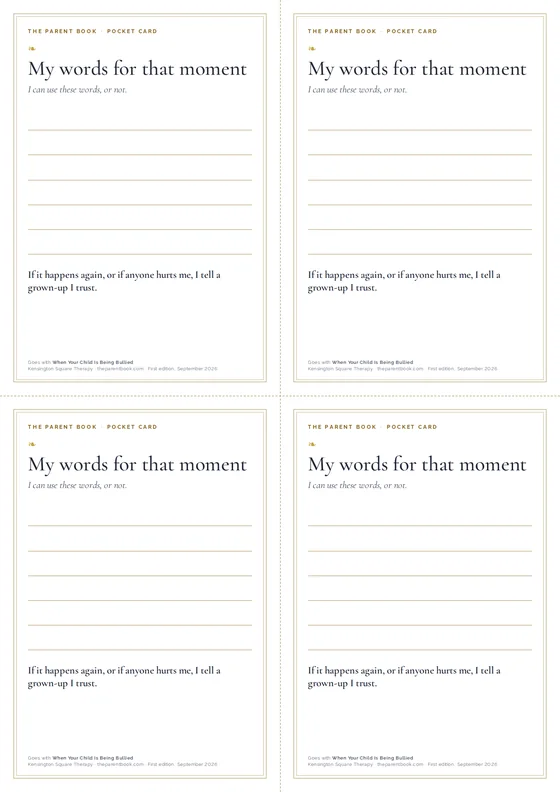 My words for that moment
Pocket card · A4, four cards to cut · With a subscription
My words for that moment
Pocket card · A4, four cards to cut · With a subscription
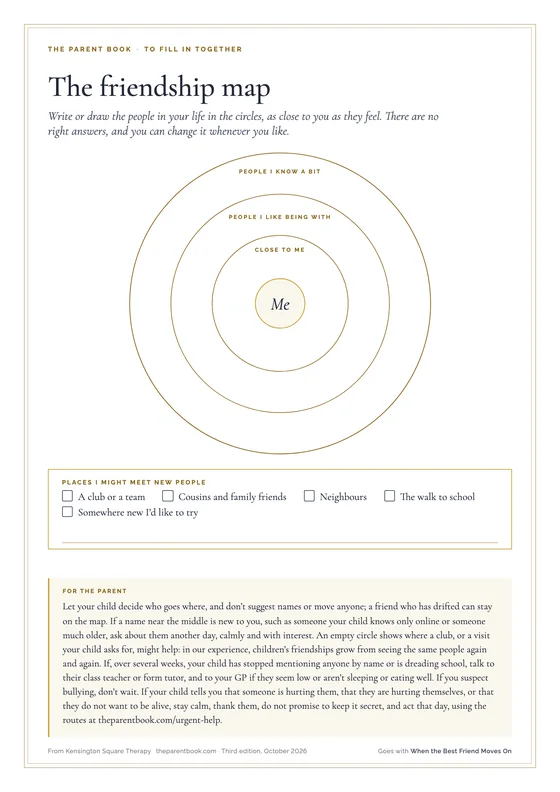 The friendship map
To fill in together · A4 · With a subscription
The friendship map
To fill in together · A4 · With a subscription
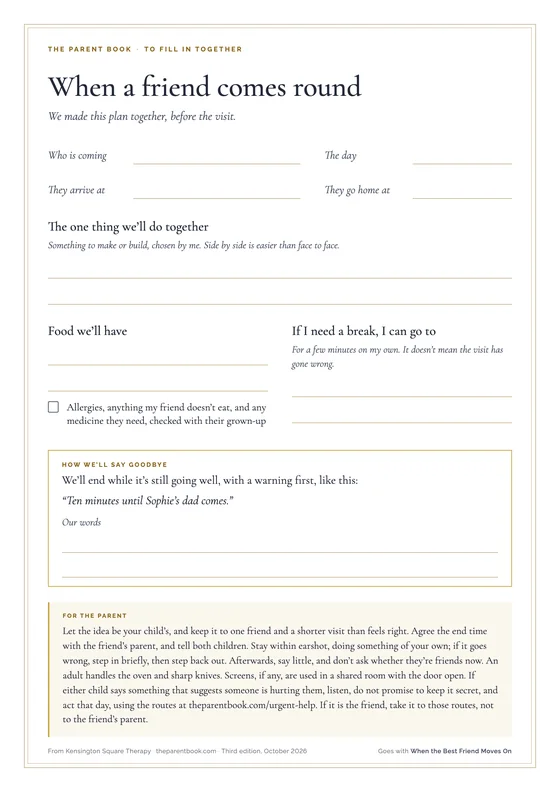 When a friend comes round
To fill in together · A4 · With a subscription
When a friend comes round
To fill in together · A4 · With a subscription
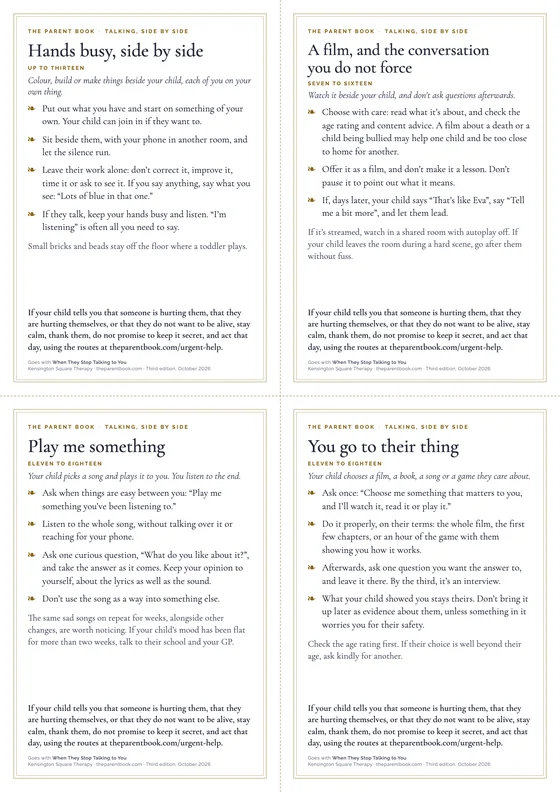 Talking, side by side
Cards to cut out · A4, four cards to cut · With a subscription
Talking, side by side
Cards to cut out · A4, four cards to cut · With a subscription
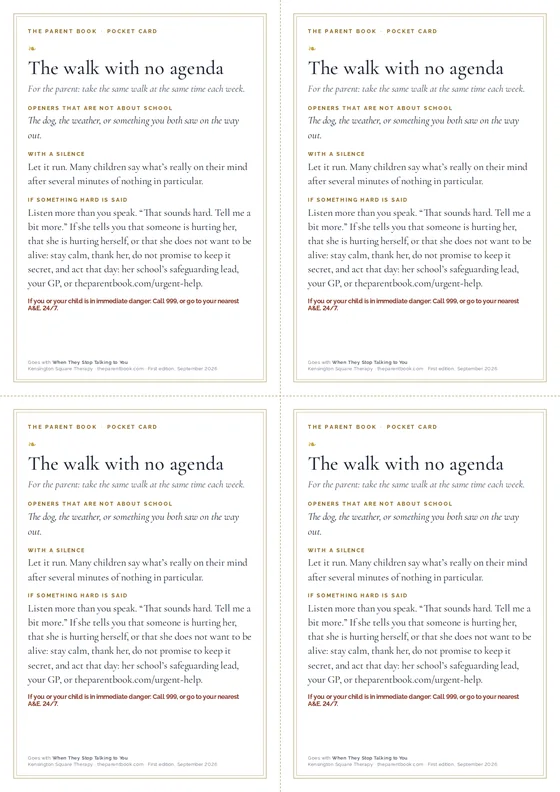 The walk with no agenda
Pocket card · A4, four cards to cut · With a subscription
The walk with no agenda
Pocket card · A4, four cards to cut · With a subscription
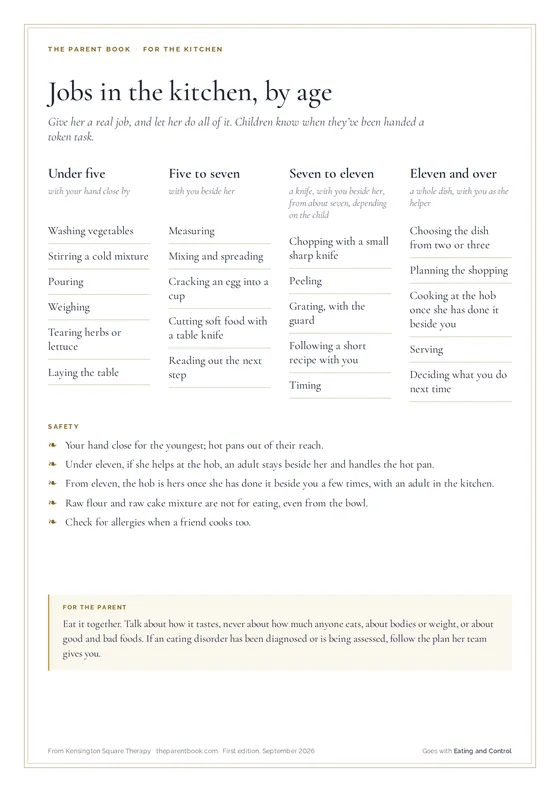 Jobs in the kitchen, by age
For the kitchen · A4 · With a subscription
Jobs in the kitchen, by age
For the kitchen · A4 · With a subscription
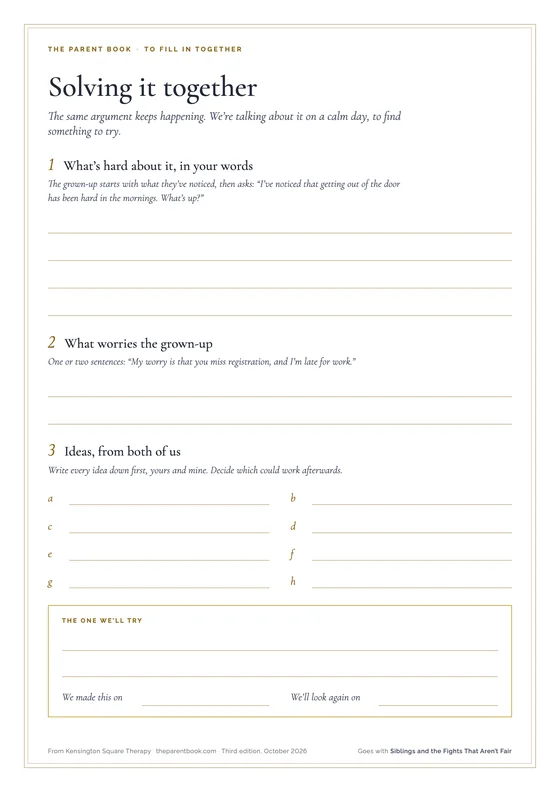 Solving it together
To fill in together · A4, two sides · With a subscription
Solving it together
To fill in together · A4, two sides · With a subscription
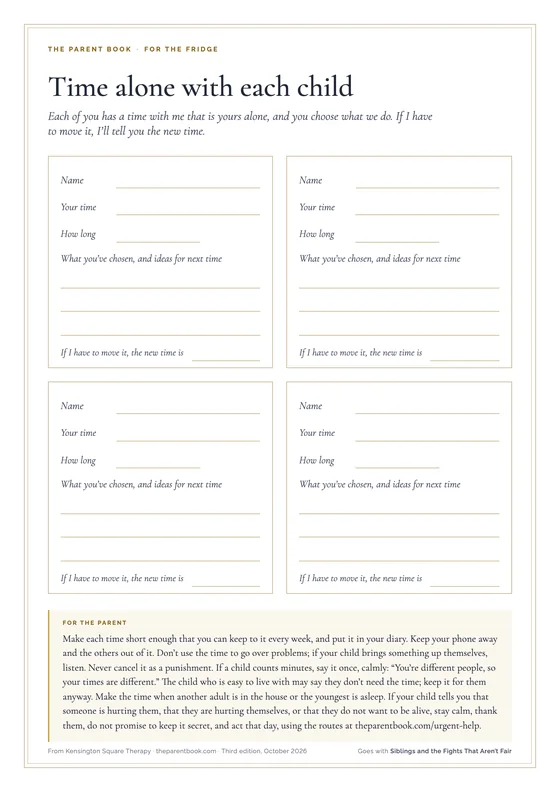 Time alone with each child
For the fridge · A4 · With a subscription
Time alone with each child
For the fridge · A4 · With a subscription
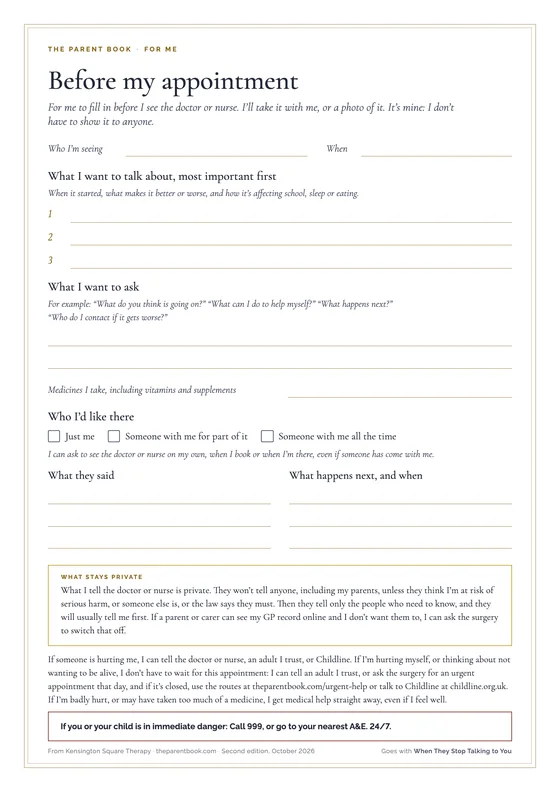 Before my appointment
For an appointment · A4, two pages · With a subscription
Before my appointment
For an appointment · A4, two pages · With a subscription
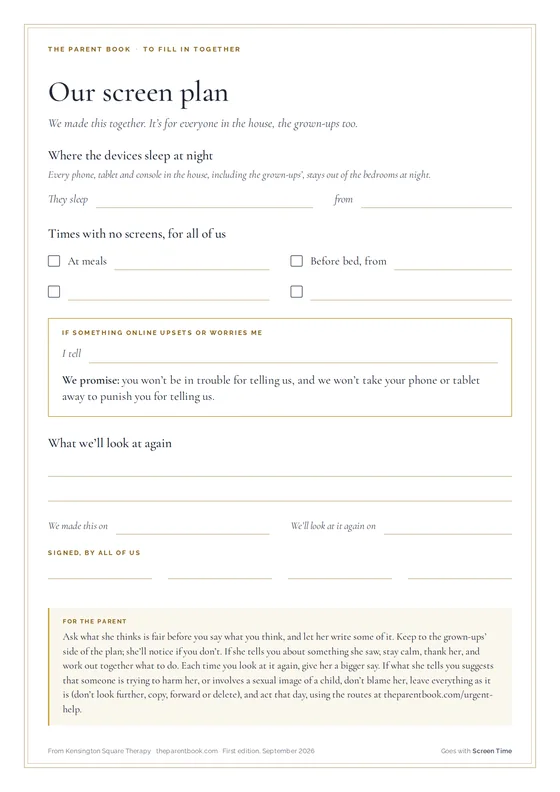 Our screen plan
To fill in together · A4 · With a subscription
Our screen plan
To fill in together · A4 · With a subscription
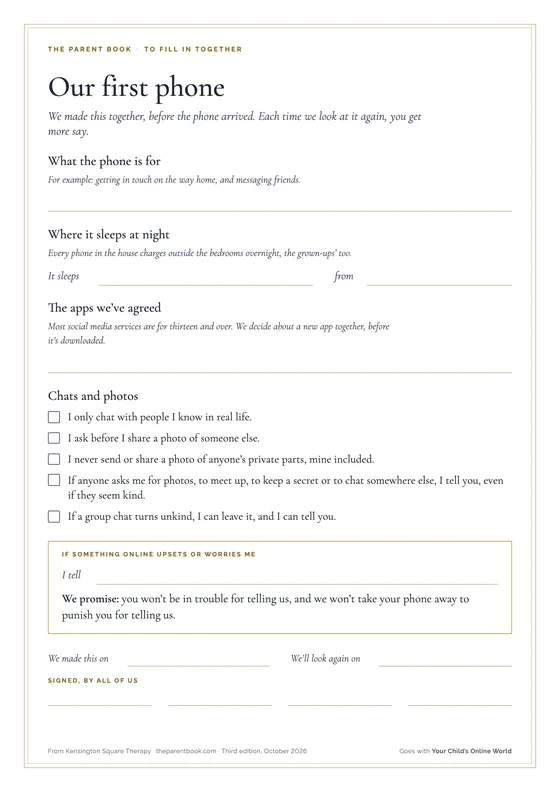 Our first phone
To fill in together · A4, two sides · With a subscription
Our first phone
To fill in together · A4, two sides · With a subscription
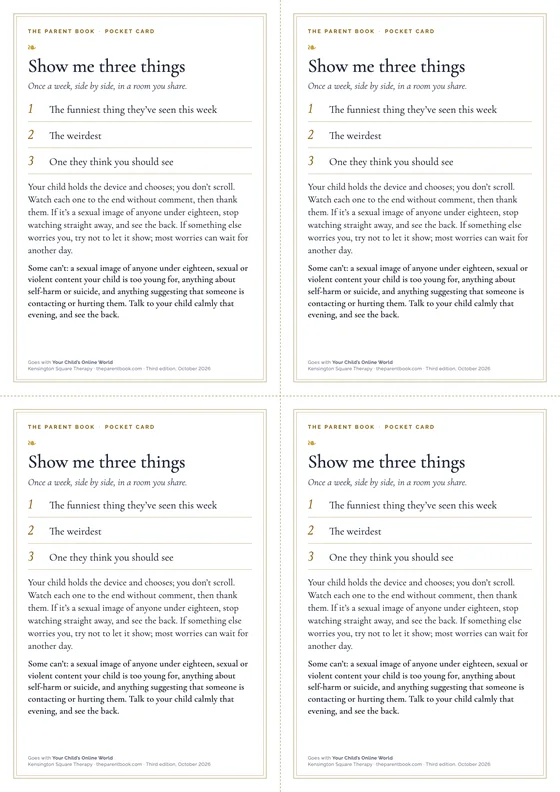 Their online world
Pocket card · A4, four cards to cut, two sides · With a subscription
Their online world
Pocket card · A4, four cards to cut, two sides · With a subscription
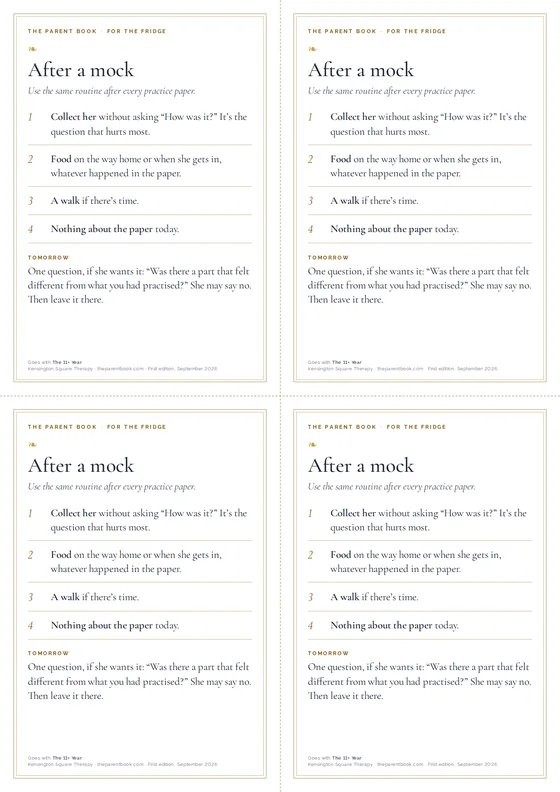 After a mock
For the fridge · A4, four cards to cut · With a subscription
After a mock
For the fridge · A4, four cards to cut · With a subscription
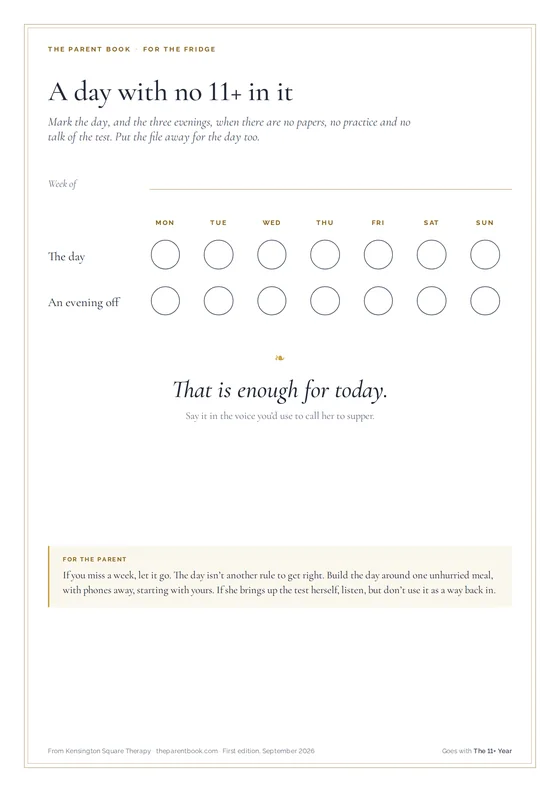 A day with no 11+ in it
For the fridge · A4 · With a subscription
A day with no 11+ in it
For the fridge · A4 · With a subscription
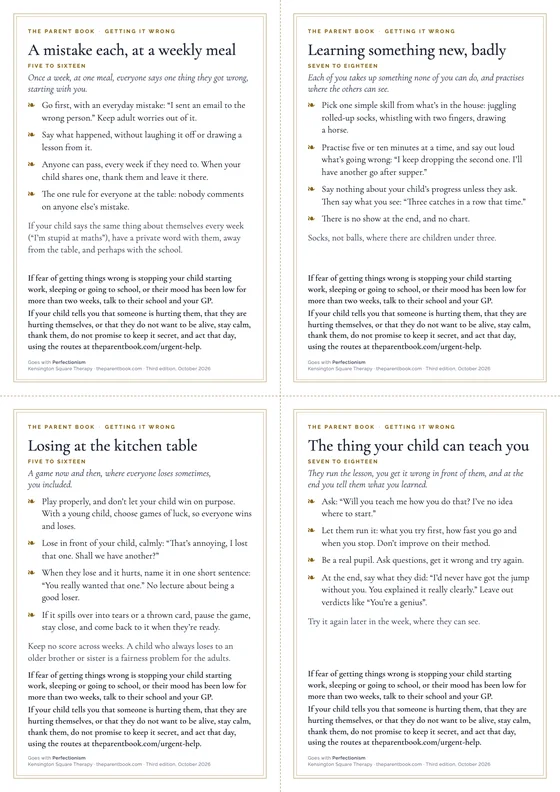 Getting it wrong
Cards to cut out · A4, four cards to cut · With a subscription
Getting it wrong
Cards to cut out · A4, four cards to cut · With a subscription
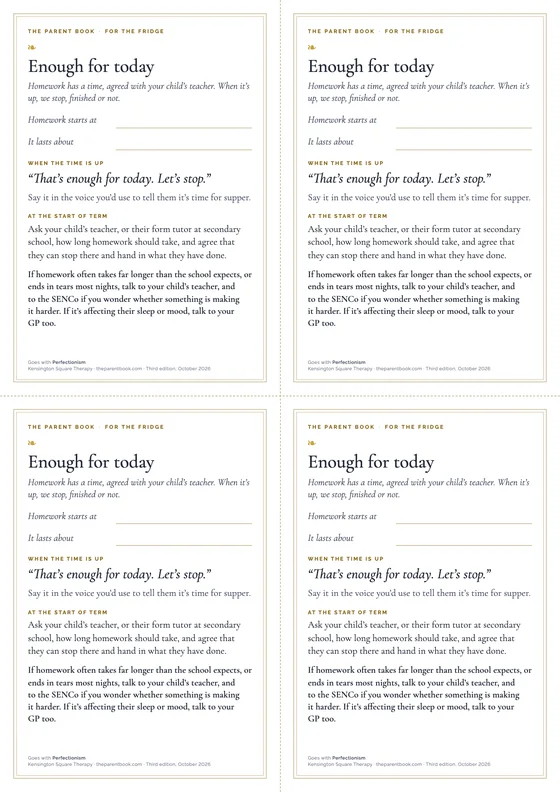 Enough for today
For the fridge · A4, four cards to cut · With a subscription
Enough for today
For the fridge · A4, four cards to cut · With a subscription
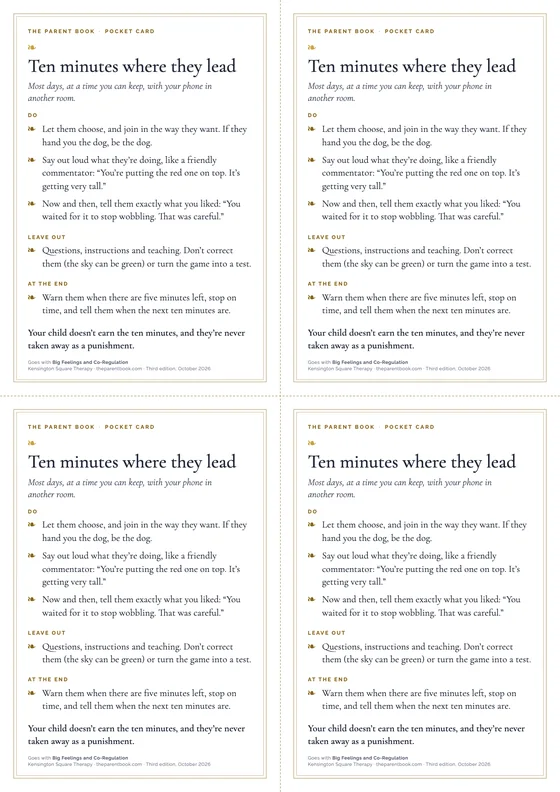 Ten minutes where they lead
Pocket card · A4, four cards to cut, two sides · With a subscription
Ten minutes where they lead
Pocket card · A4, four cards to cut, two sides · With a subscription
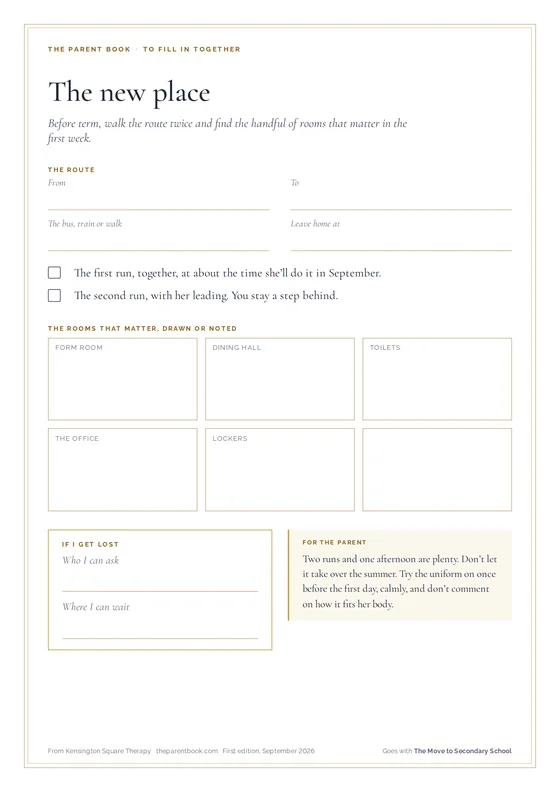 The new place
To fill in together · A4 · With a subscription
The new place
To fill in together · A4 · With a subscription
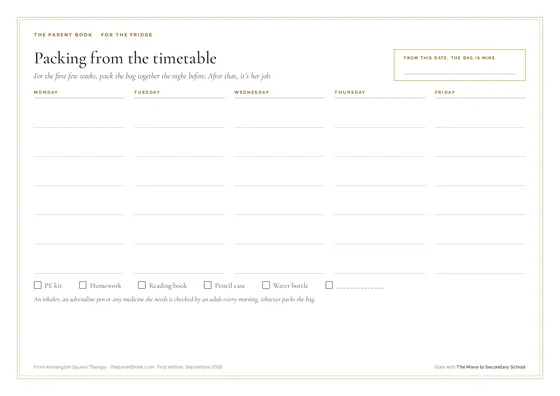 Packing from the timetable
For the fridge · A4 landscape · With a subscription
Packing from the timetable
For the fridge · A4 landscape · With a subscription
 What I will miss
To keep · A4, two pages · With a subscription
What I will miss
To keep · A4, two pages · With a subscription
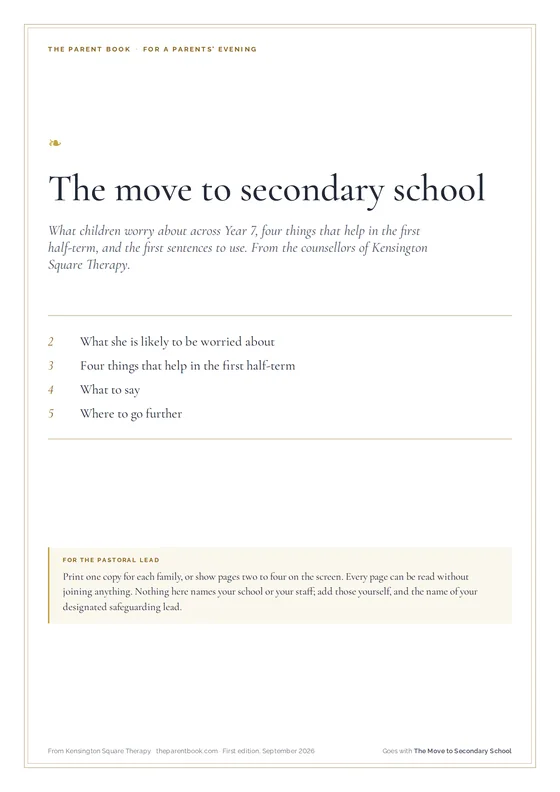 The move to secondary school, for a parents’ evening
For a parents’ evening · A4, five pages · Free
The move to secondary school, for a parents’ evening
For a parents’ evening · A4, five pages · Free
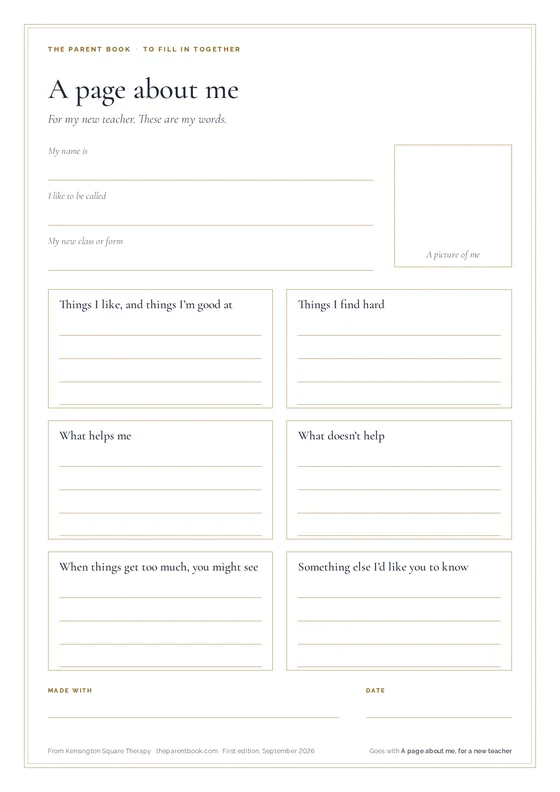 A page about me
To fill in together · A4, two pages · With a subscription
A page about me
To fill in together · A4, two pages · With a subscription
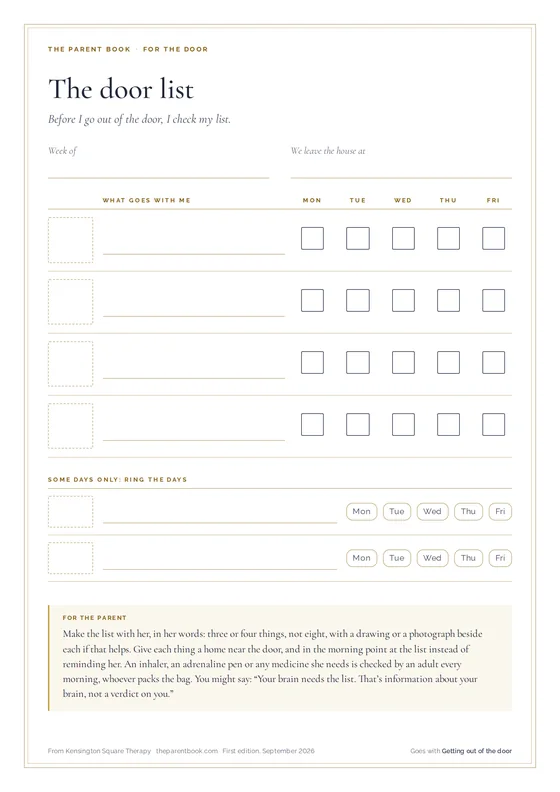 The door list
For the door · A4 · With a subscription
The door list
For the door · A4 · With a subscription
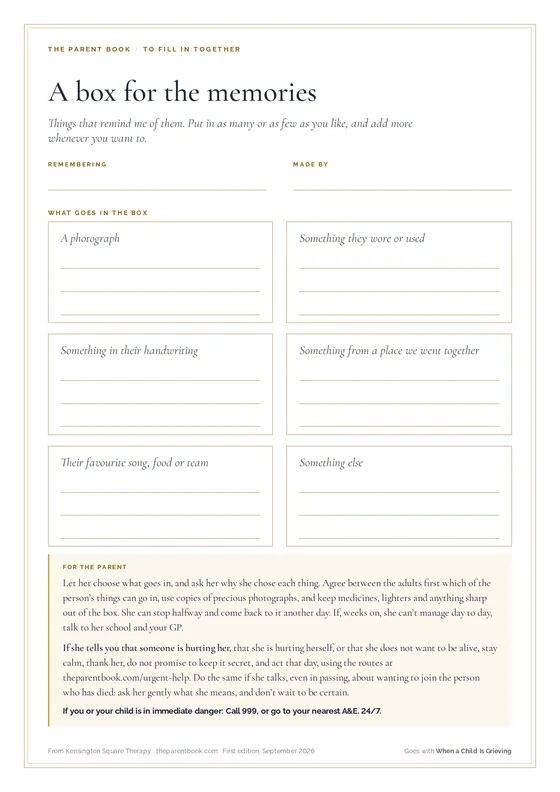 A box for the memories
To fill in together · A4, two pages · With a subscription
A box for the memories
To fill in together · A4, two pages · With a subscription
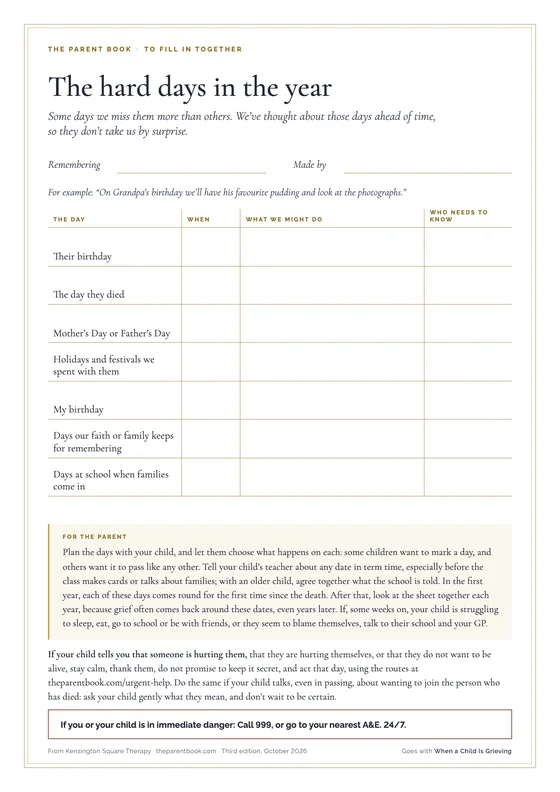 The hard days in the year
To fill in together · A4 · With a subscription
The hard days in the year
To fill in together · A4 · With a subscription
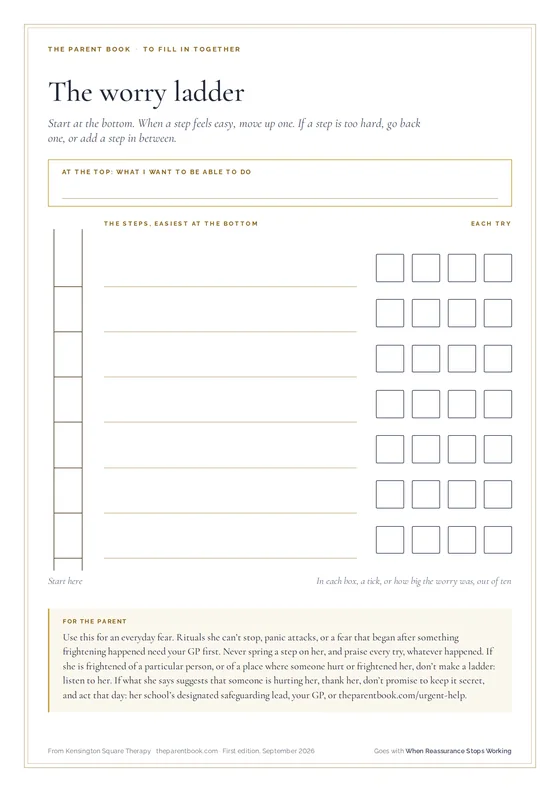 The worry ladder
To fill in together · A4 · Free
The worry ladder
To fill in together · A4 · Free
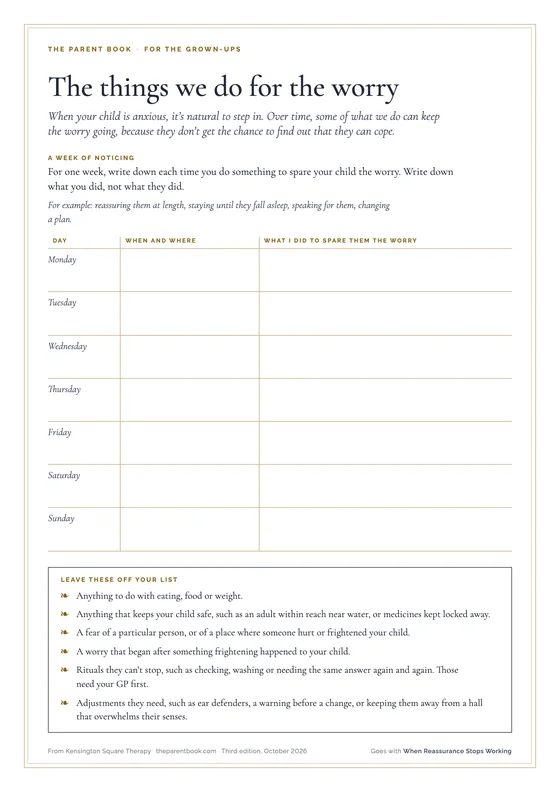 The things we do for the worry
For the grown-ups · A4, two sides · With a subscription
The things we do for the worry
For the grown-ups · A4, two sides · With a subscription
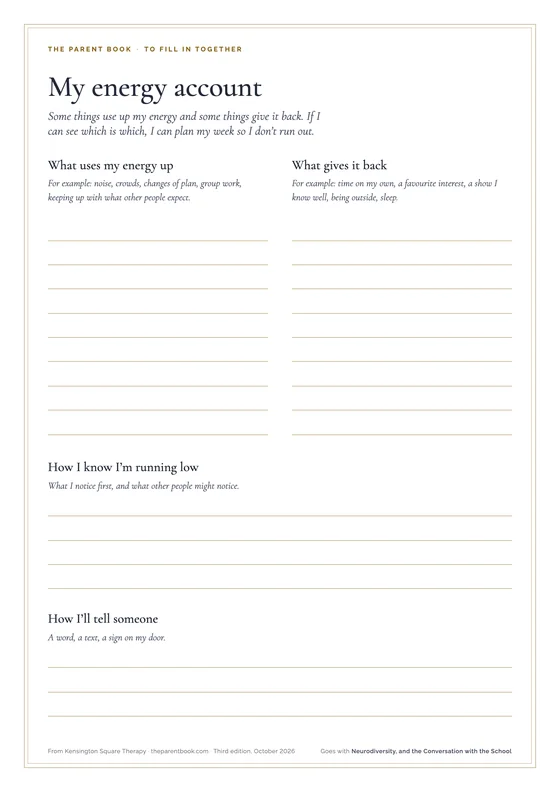 My energy account
To fill in together · A4, two sides · With a subscription
My energy account
To fill in together · A4, two sides · With a subscription
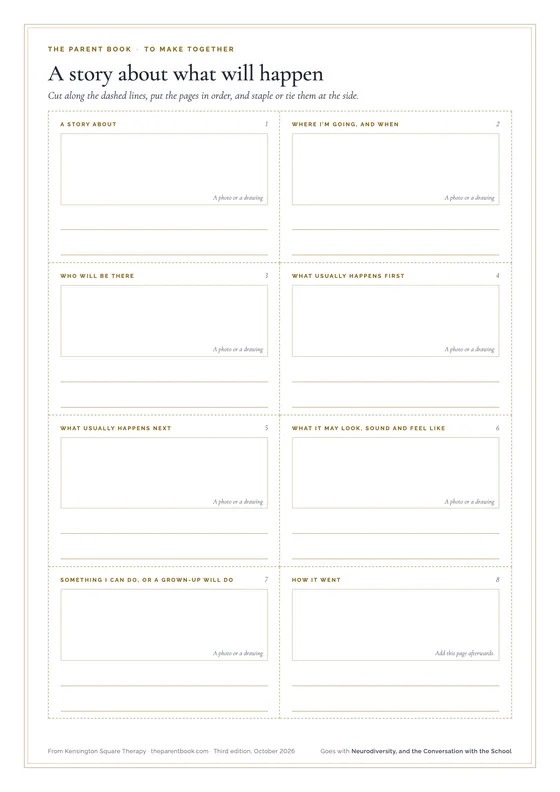 A story about what will happen
To make together · A4, two pages · With a subscription
A story about what will happen
To make together · A4, two pages · With a subscription
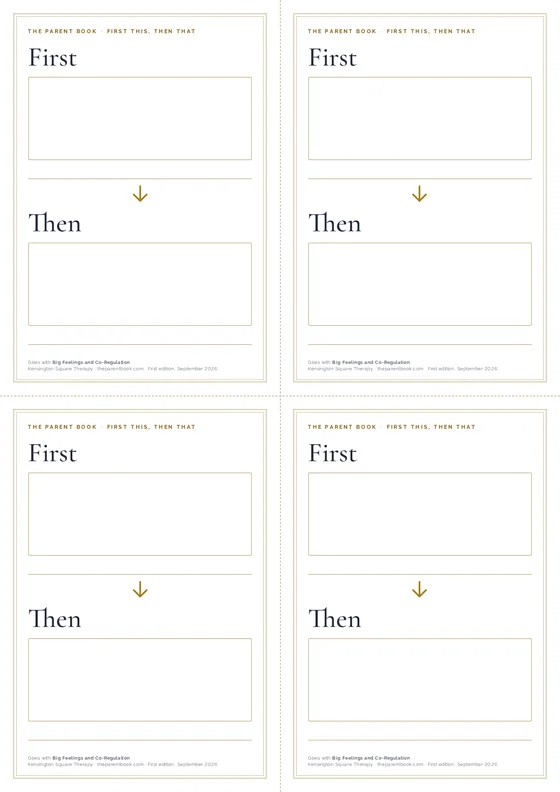 First this, then that
Cards to cut out · A4, four cards to cut, two sides · With a subscription
First this, then that
Cards to cut out · A4, four cards to cut, two sides · With a subscription
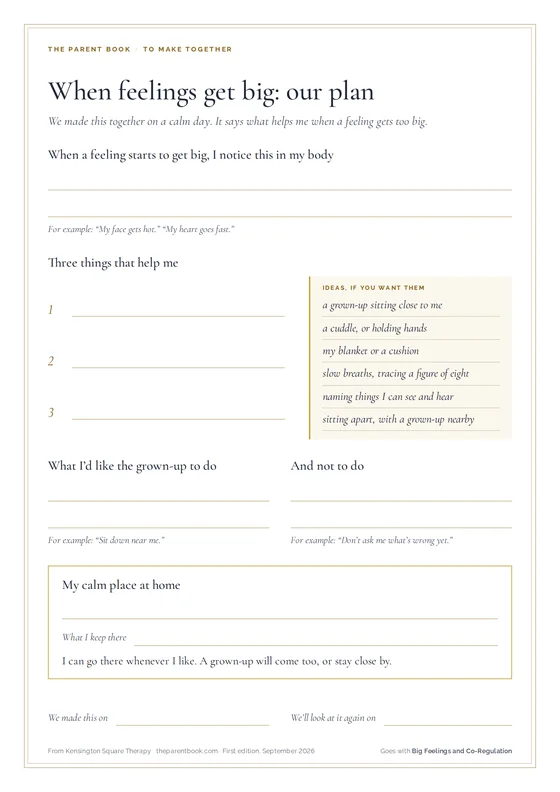 When feelings get big: our plan
To make together · A4, two sides · With a subscription
When feelings get big: our plan
To make together · A4, two sides · With a subscription
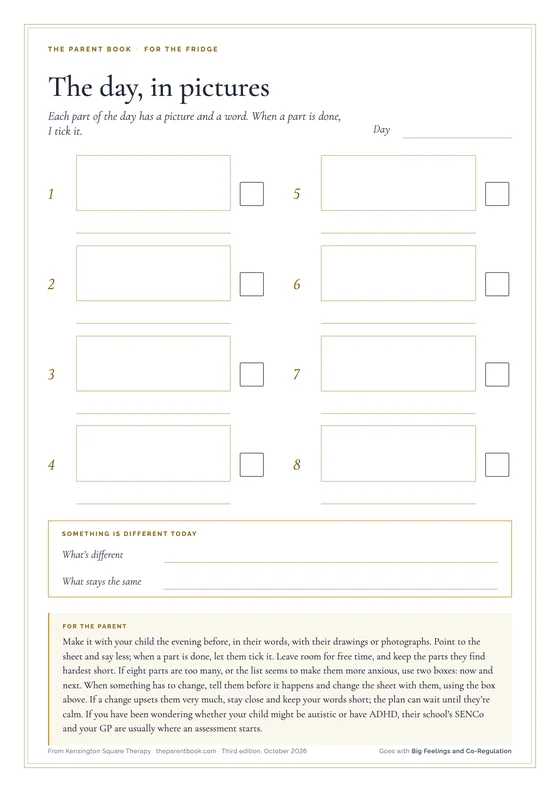 The day, in pictures
For the fridge · A4 · With a subscription
The day, in pictures
For the fridge · A4 · With a subscription
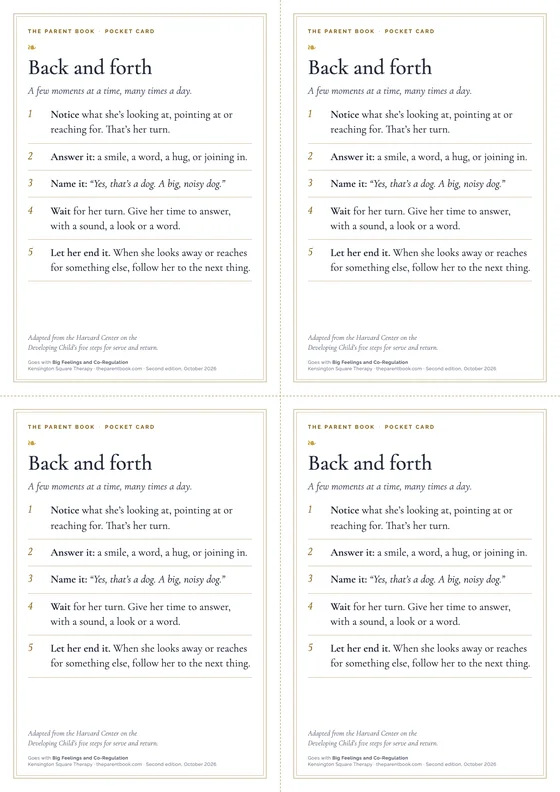 Back and forth
Pocket card · A4, four cards to cut, two sides · With a subscription
Back and forth
Pocket card · A4, four cards to cut, two sides · With a subscription
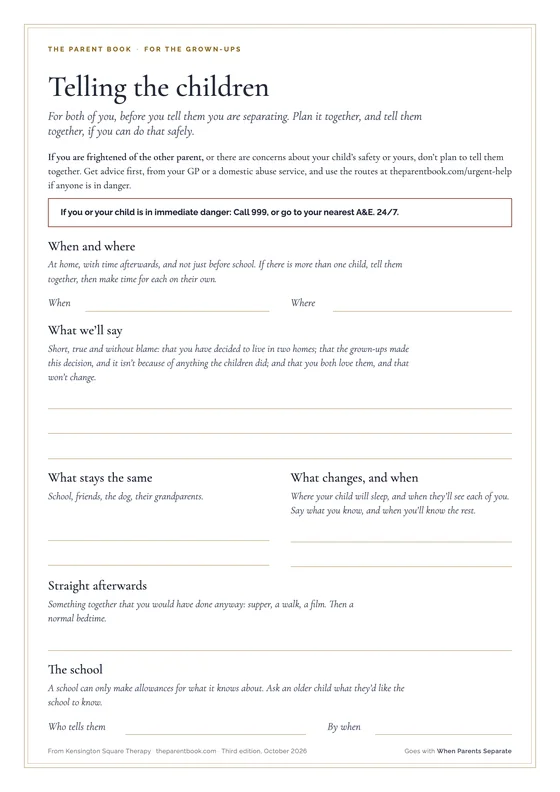 Telling the children
For the grown-ups · A4, two sides · With a subscription
Telling the children
For the grown-ups · A4, two sides · With a subscription
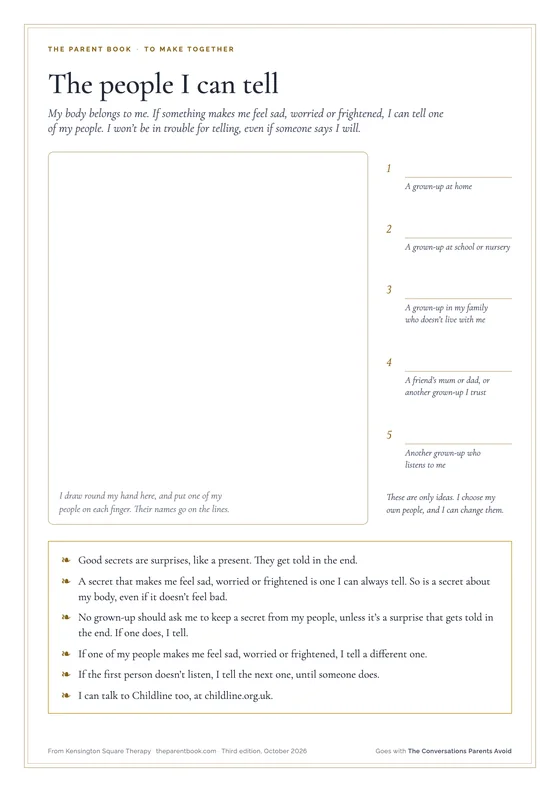 The people I can tell
To make together · A4, two pages · Free
The people I can tell
To make together · A4, two pages · Free
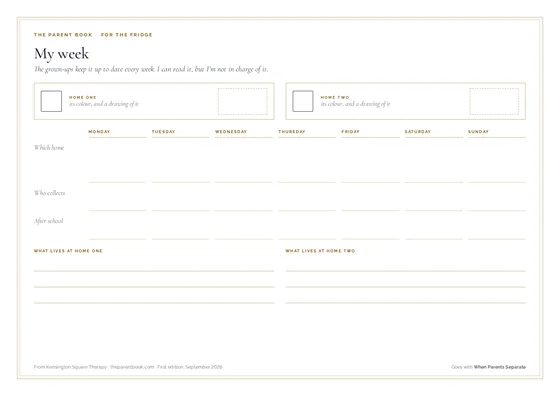 A week across two homes
For the fridge · A4 landscape, two pages · With a subscription
A week across two homes
For the fridge · A4 landscape, two pages · With a subscription
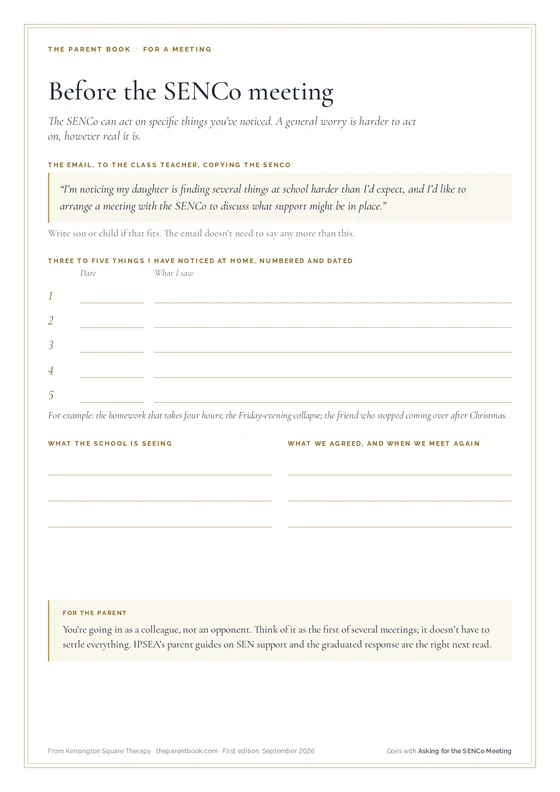 Before the SENCo meeting
For a meeting · A4 · Free
Before the SENCo meeting
For a meeting · A4 · Free
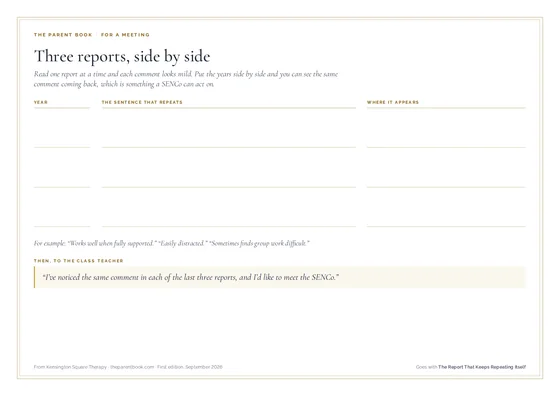 Three reports, side by side
For a meeting · A4 landscape · Free
Three reports, side by side
For a meeting · A4 landscape · Free
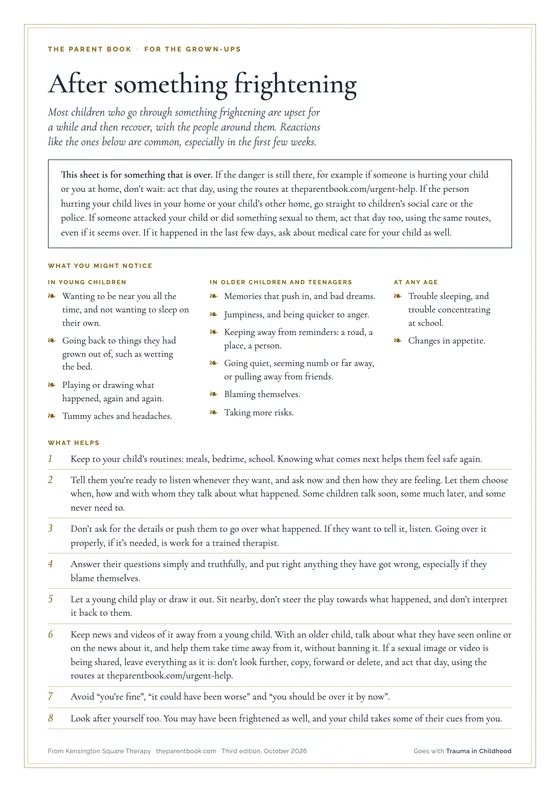 After something frightening
For the grown-ups · A4, two sides · With a subscription
After something frightening
For the grown-ups · A4, two sides · With a subscription
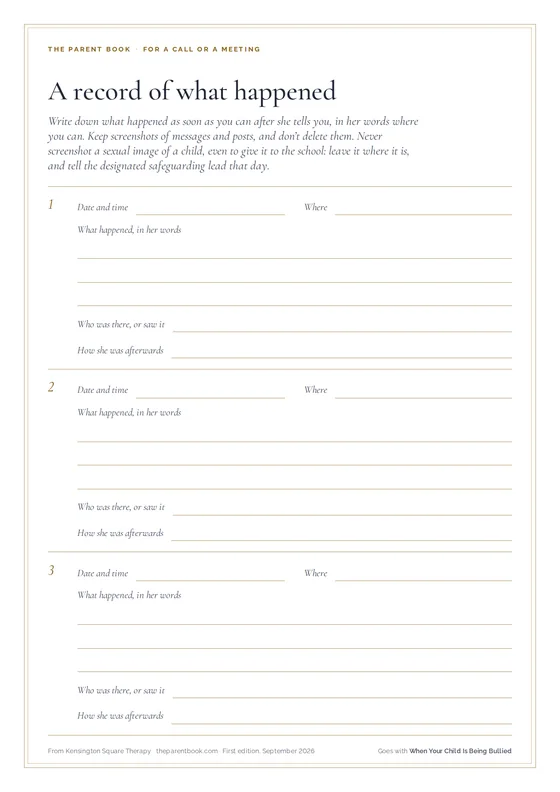 A record of what happened
For a call or a meeting · A4, two pages · Free
A record of what happened
For a call or a meeting · A4, two pages · Free
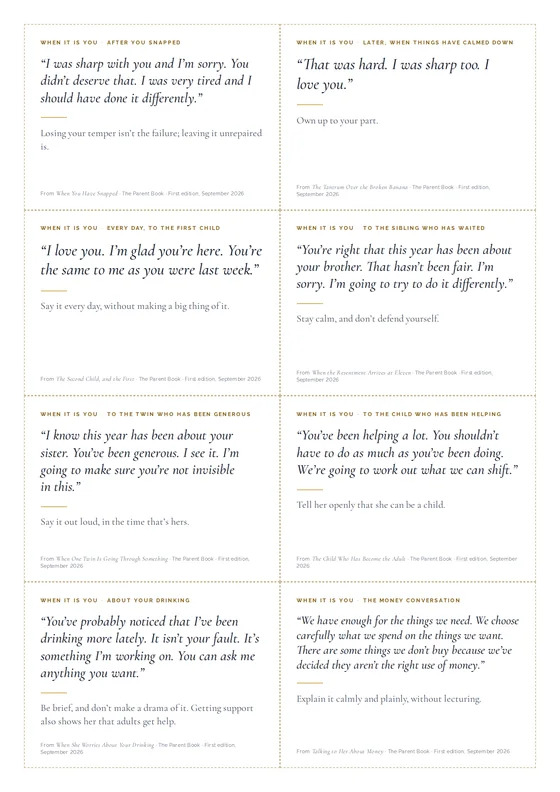 What to say: when it is you
Cards to cut out · A4, eight cards to cut · With a subscription
What to say: when it is you
Cards to cut out · A4, eight cards to cut · With a subscription
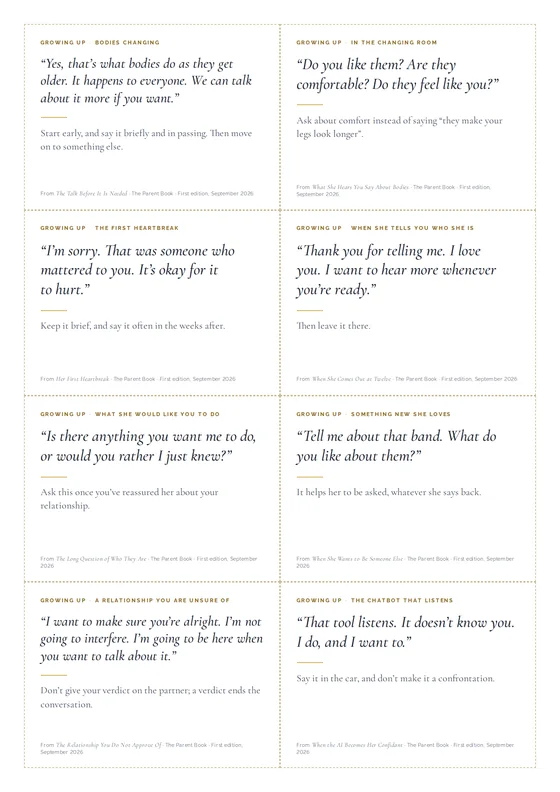 What to say: growing up
Cards to cut out · A4, eight cards to cut · With a subscription
What to say: growing up
Cards to cut out · A4, eight cards to cut · With a subscription
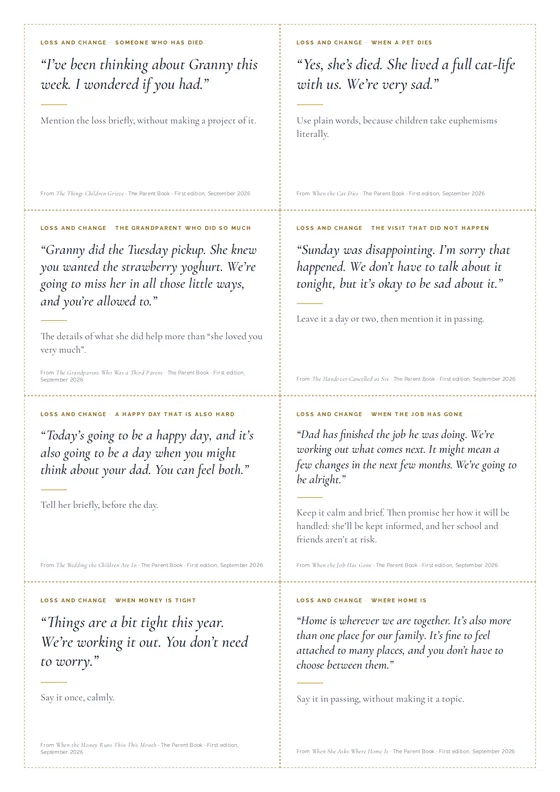 What to say: loss and change
Cards to cut out · A4, eight cards to cut · With a subscription
What to say: loss and change
Cards to cut out · A4, eight cards to cut · With a subscription
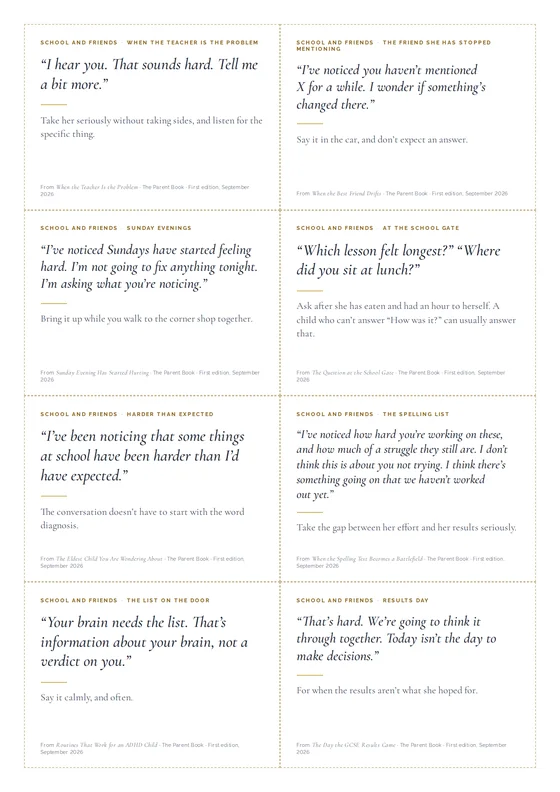 What to say: school and friends
Cards to cut out · A4, eight cards to cut · Free
What to say: school and friends
Cards to cut out · A4, eight cards to cut · Free
41 on parent wellbeing
Chosen by the therapists who write the library: books for you and to read with your child, and pages from organisations we trust.

Also on this shelf




And 32 more. Every book on the shelf, with a therapist’s note on what it is good for, is in the library.
Anna Freud
A short, kind page on why looking after yourself is part of looking after your child, with small realistic steps: asking for help, protecting sleep, and saying no without guilt.
Child Mind Institute
For the anxious parent of an anxious child. It explains how children learn from what they see us do with worry, and why saying how you cope, out loud, can help them.
YoungMinds
For a parent living with their own mental illness: how it can shape family life, how to talk to your child about it at their level, and where support exists for both of you.
ZERO TO THREE
Why a young child borrows an adult’s calm before they can make their own, and how parents can steady themselves first when a toddler is falling apart.
Nothing on this shelf is written for that age yet.
18 on parent wellbeing
Podcast episodes, talks and films, each chosen for a reason.
Anna Mathur
Therapist Anna Mathur’s listener-question show on anxiety, guilt, resentment and early motherhood. It has finished, but the archive remains good company for a parent who is struggling themselves.
Also on this shelf
All in the Mind
Get a Grip - Evidence-Based Conversations for Parents and Educators
Raising Good Humans
Get a Grip - Evidence-Based Conversations for Parents and Educators
And five more. Every episode on the shelf, with a therapist’s note on what it is good for, is in the library.
YouTube · 3 min
NHS, YouTube
An NHS film on how postnatal depression differs from the baby blues, what the signs are, and why speaking to a GP or health visitor early matters. Calm and unfrightening.
Also on this shelf
YouTube · 6 min
BBC Stories, YouTube
TED · 20 min
Dr Brené Brown, TED
TED · 21 min
Dr Lisa Damour, TED
YouTube · 7 min
Philippa Perry, YouTube
And three more. Every film on the shelf, with a therapist’s note on what it is good for, is in the library.
Nothing on this shelf is written for that age yet.
You can refer yourself. You do not need anyone’s permission, and you do not need to be in crisis to qualify.
Where to start
Free NHS therapy for adults in England, for anxiety and low mood. You can refer yourself; you do not need to go through your GP first.
For the parent. A great many of the parents we sit with are carrying something of their own, and waiting for someone to ask.
www.nhs.uk/service-search/mental-health/find-an-NHS-talking-therapies-service
The gateway to everything the NHS offers a child: paediatric assessment, a referral to CAMHS, and support for you as the parent.
Ask for a double appointment. Describe the pattern over weeks rather than the worst single day, and say plainly what you are worried about. Bring a written list; the ten minutes go quickly.
A registered counsellor or psychotherapist, found through the BACP or NCPS directories. Waiting lists are shorter than the NHS and you choose who your child sits with.
When waiting is the problem, or when you want a particular kind of help. What to look for, and what to expect, is set out in our guide to finding a therapist.
For parent wellbeing
The UK’s mental health charity. Pages written for parents of a struggling young person, an Infoline that points you to the right service, and a Support Line that will simply listen.
When your own reserves are running low and you want to talk to someone who is not the GP, your partner or a friend. Not for a crisis.
If tonight is urgent, use the numbers under “If you need help right now”, at the end of this page.
Charged at your standard call rate, not free.
Mind Infoline 0300 123 3393 · Mon-Fri 9am-6pm (except bank holidays) · Mind Support Line 0300 102 1234, Mon-Fri 9am-6pm, for emotional support rather than signposting · Outside those hours the line is closed. Samaritans answer at any hour on 116 123, and Shout answer if you text the word SHOUT to 85258.
A free, confidential helpline for any parenting or family worry, by phone, live chat, WhatsApp or email, staffed by trained family support workers.
When you need to talk it through with someone, about your child or about how you are managing, and you do not need a specialist to do it.
Coram Family Lives helpline 0808 800 2222 · Mon-Fri 9am-9pm; weekends 10am-3pm; closed bank holidays · Live chat and WhatsApp 07441 444125 at the same hours; email askus@coramfamilylives.org.uk · Outside those hours the line is closed. Samaritans answer at any hour on 116 123, and Shout answer if you text the word SHOUT to 85258.
www.coramfamilylives.org.uk/how-we-can-help/confidential-helpline
A free helpline for adults on family relationships, conflict, parenting, caring and money, by phone, text, email or chat, with befriending or short counselling if it would help.
When the strain is on you and there is no one to say it to.
FamilyLine 0808 802 6666 · Mon-Fri 9am-5pm; closed bank holidays. Out of hours, text FAMILYACTION to 85258
A free evening line, webchat and WhatsApp for anyone over eighteen who is struggling or having suicidal thoughts, and for anyone worried about someone who is.
Between 5pm and midnight every day.
CALM Helpline and Webchat 0800 58 58 58 · Daily 5pm-midnight, 365 days a year · Webchat and WhatsApp at the same hours · Outside those hours the line is closed. Samaritans answer at any hour on 116 123, and Shout answer if you text the word SHOUT to 85258.
Trained volunteers who visit families with young children at home, week by week, and local groups. You can refer yourself.
When the early years are harder than anyone told you and what you need is another adult in the house. What is offered varies by area.
The local branch is the right first call, and can tell you how long the wait is.
Every organisation for parent wellbeing, and when each is the right call Finding a therapist