The Parent Book.
Therapist-written support for parents
Urgent help

The Parent Book·From the library

When Your Child Is Being Bullied

A chapter for parents whose child has named something serious.

A thirteen-minute read · Published 25 May 2026

The ten-year-old is sitting on the side of her bed on a Thursday evening with her hair still wet from the shower, and she has, in a voice rehearsed in the bathroom mirror, said the sentence she has been carrying. There is a girl at school. She has been doing things. She has been doing them since before Easter. The ten-year-old does not want her mother to ring the school. She does not want her father to know. She does not want anyone to make it worse.

The mother on the edge of the bed has registered three things at once: that her child has been carrying something secret for the better part of a term, that the adult plan she has imagined for this moment is useless, and that her own heart is making a noise in her chest she has not heard for a very long time.

In our work, parents arrive in some version of this Thursday often. The picture varies. What does not vary is the parent’s activation, and the fact that what the parent does next is, more than almost any other parental moment we see, the moment that matters.

What is actually happening

Bullying is repeated, intentional, and involves a power imbalance. The first row in a friendship is not bullying. A week of being left out of a group chat is not, in itself, bullying. The argument with a sibling is not bullying, even when sustained and ugly. Bullying is the pattern in which one child, or a group, repeatedly targets another, the targeting is deliberate, and the targeted child cannot, in any practical sense, stop it from happening.

The distinction matters because the response to ordinary friendship pain is different from the response to bullying. A child whose best friend has moved on is grieving; the chapter for that is elsewhere in this book. A child being bullied is being injured, and the injury is being inflicted by someone whose intent the child knows.

Bullying in the current decade rarely looks like the playground confrontation of the cultural imagination. It is, far more often, the slow exclusion an adult walking through a corridor would not see. The seat at lunch quietly closed off. The group chat she has been removed from on a Wednesday afternoon. The comments calibrated to stay below the threshold a teacher would catch. The whispered campaign. The online dimension is, in most cases we see, the same problem with a different surface; the cruelty in the WhatsApp group is the cruelty in the lunch hall continuing on the bus home and through the night.

Children rarely report bullying as bullying. What they have, instead, is the stomach ache, the Sunday-evening collapse, the friend’s name that has stopped being mentioned, the new resistance to going to school, the device put face down on the counter. The bullying is, often, in the body and the sideways behaviour for weeks before it is, in the child’s own sentence, named.

What it does to the child, and the long shadow

The wound is not the surface injury but the slow, sustained message a child receives, over weeks, that there is something about her that has been measured by her peers and found unacceptable. The child being bullied is internally accumulating evidence that she is not the kind of person other people want to be around. Children, who have no comparative data on their own social acceptability, take the message at face value. This is the territory Brené Brown’s writing on shame names most clearly: the difference between “I did a bad thing”, which is guilt and can be acted on, and “I am bad”, which is shame and lives in the body until something or someone helps disassemble it. The bullied child has been taught, by the sustained social exclusion, the second sentence; the long recovery is, in large part, the repeated experience of being received as the first.

Recovery is therefore more than the cessation of the bullying; it is the slow undoing of the internalised verdict. A child bullied for two terms who moves to a new school where she is welcomed is still, internally, the child who was bullied. The repair happens through accumulated experience and, in many cases, through someone (a parent, a teacher, a counsellor) helping her see that what was being communicated about her was not, in fact, true.

The shadow of being bullied is real. Adults who were bullied carry, in many cases, a residue: the expectation of being measured, the flinch in social situations, the difficulty trusting that the friendship offered is real. None of this is destiny. The residue is something the child you have now can be helped through.

What the parent feels

The parent on the edge of the bed is having a response that has nothing to do with the calm adult she would like to be. The activation has, often, a history. Many parents we sit with have a bullying history of their own. The mother who was bullied at twelve is, for a moment, twelve again, and the fury rising in her chest is partly her child’s and partly her own, displaced across thirty years.

This is information, not a problem. The parent who notices that some of what she is feeling belongs to her own past is best placed to keep her response calibrated to the present. The parent who cannot notice it tends to over-act: she rings the other parent that evening, marches into the school the next morning, demands a meeting with the headteacher by Friday. Each is the activated past reaching for the resolution the past did not get.

The opposite failure is the parent who minimises: who was told as a child to stand up to bullies and who now repeats the line. “Stand up to her. Hit her back. Do not let her see you cry.” These sentences feel like strength in the parent’s mouth. The child hears them as abandonment. The child has, in saying anything at all, taken a risk. A reply that requires her to manage the situation herself confirms her worst suspicion: that the adult will not, in fact, do anything useful with what she has been told.

The right move, in the first minutes, is smaller than either extreme. Listen. “Thank you for telling me. I am glad you said it out loud. I am going to think carefully about what we do next, and I am going to talk to you about it before I do anything.” The reassurance the child needs is not a promise of resolution but evidence that the parent has received the information and is not, in this moment, going to make it worse.

What to do, and what not to do

The single most common parental error in bullying situations is the call to the other parent. The instinct is understandable; the call almost never produces what the parent hopes for. The other parent defends her own child, then talks to her child about the conversation, with the result that the bullying child knows, the next morning, that your child told. The targeted child is, in those next twenty-four hours, in a worse situation than the day before. Parents who have made this call against our advice have, more than once, reported back that we were right.

The route that works is through the school, as a partnership rather than an attack. The opening is the email to the class teacher, or in secondary the head of year, saying calmly what your child has told you, asking what the school has observed, and requesting a meeting. “Ella told me last night that there has been a sustained pattern of being excluded by Maya and the group around her over the last several months. I am sure there is more context I do not have. I would like to come in and talk it through with you.” Collaborative; in person; not about whose child is at fault, but about what is going on and what the school and you can do, together, to change it.

What the school can do is more than most parents realise. Most UK schools have an anti-bullying policy, a pastoral structure, and several adults whose job it is to handle exactly this. What the school cannot always do is see bullying without being told. The information you bring into the meeting is, very often, information the school did not have.

If the school’s response is inadequate, put the concern in writing to the headteacher, ask for the school’s policy on bullying, and request a meeting under it. Schools respond more carefully to a written record than to a corridor conversation. Most local authorities have a guidance framework on serious bullying; ask for it if you need it.

For parents who have been through the school process and the picture has not changed, the specialist resource we send parents to is Kidscape, the UK’s specialist anti-bullying charity. The Kidscape Parent Advice Line is one of the few specialist routes in the country that still helps where the school’s first attempts have not. Their phone, WhatsApp and email service is open on Mondays and Tuesdays from 9.30am to 2.30pm, with messages picked up outside hours. The line is staffed by people who hear this conversation every day. They are also the right pointer when the bullying has an online dimension you are not sure how to address.

In parallel, the NSPCC’s pages on bullying are the right wider safeguarding pointer when the picture has tipped beyond what the school can handle. The YoungMinds parent pages on bullying are the clearest single primer we know on the mental-health dimension. Place2Be, where the school has an in-house counsellor or partners with them, is often the right route for in-school support; ask the pastoral lead.

What is rarely useful: telling the child to stand up to the bullies. The bullying has a power imbalance built into it by definition; if she could stop it by standing up to them, she would have done so by now. Equally rarely useful: telling her she must not let it bother her, that it is just children being children, that she should rise above it. These sentences communicate that her experience is being filed under not-important. What the targeted child needs is the opposite: the experience filed under important enough that an adult is going to do something about it, with her, over the next few weeks.

At different ages

What bullying looks like, and the practical move that helps, shifts with the child. The bands below are descriptions, not boxes.

If your child is between four and seven. Sustained bullying is rarer in early years; what you usually see is small children working out social rules. Involve the reception class teacher directly. Do not prime your four-year-old in retaliation strategies. Ask the school to step up its supervision.

If your child is between seven and nine. Exclusion patterns sharpen in lower KS2. The targeted child often presents with stomach aches on Sunday evenings and reluctance to attend an after-school activity. The way in is the sideways conversation in the car, in which you ask not whether she is being bullied but who she sat with at lunch. Take the fragments to the class teacher; lunchtime supervisors are an underused source of information.

If your child is between nine and eleven. Pre-secondary self-consciousness has arrived. The bullying at this age often has a leader and a small chorus, and the chorus matters because the target’s previous friendships are being absorbed into it. Ask for the meeting with the class teacher and the pastoral lead, in writing, in advance, with specifics. If a school transition is on the horizon, the choice of secondary becomes a different conversation: not the academic one but the social one.

If your child is in early secondary, eleven to thirteen. The peer group has reorganised, the online dimension has arrived in full force, and the bullying in a Year 7 corridor is, in most cases, continuing in the WhatsApp group after school. The first step is the email to the head of year asking for the named pastoral adult for your child. Do not, in the first instance, ask her to leave the group chats; the social cost is, in her calculation, often higher than the bullying she is enduring. Ask the school to help with the in-school environment first; the online environment, in our experience, follows.

If your child is in mid to late secondary, thirteen to sixteen. Bullying in this band is often part of a more complicated picture. Identity becomes a target: a child whose sexuality is becoming visible, whose ethnicity is being remarked on, whose neurodiversity is now in the open, can be bullied in ways calibrated to what she is in the process of becoming. What this band needs is the adult-on-adult conversation with the school, supported where the picture warrants by an outside specialist; Kidscape’s advice line is, for many parents we have sent there, the moment the situation has first been taken seriously by someone who has seen it before. Where the bullying touches protected characteristics, the school’s safeguarding lead and the local authority’s anti-bullying officer are the right route.

Your own bullying, and the longer arc

The adult listening to her ten-year-old sometimes has a twelve-year-old self of her own listening too, who was bullied and did not get the adult intervention she now wants to give. Being the adult her ten-year-old needs means, in part, keeping her own twelve-year-old in mind separately. The right move, where the resources are there, is your own counsellor, your own trusted friend, your own quiet half-hour. Bullying carried into adulthood is, in the families we see, one of the things we work with most.

The child does not need her parent to be untouched by the disclosure. She needs her parent to be touched by it and still functional. The parent who pretends to be unmoved reads as not believing. The parent who falls apart is the parent the child has to manage. The parent who lets the child see that this matters, and is also visibly in charge of the next steps, is the parent the child is watching herself become.

The bullying, in the great majority of cases we have seen, ends. Sometimes through the school’s intervention. Sometimes through a change of school. Sometimes through the slow rearrangement of the year group as the children grow. The recovery is slower than the bullying ending. You are the person who, over the months that follow, helps her recompose a sense of herself that is not the one her tormentors offered her. “I noticed you laughing with Ava in the kitchen yesterday. It is good to have her in the house.” Said while passing through. Small. Specific. True.

The ten-year-old, with the wet hair and the rehearsed sentence, did the brave thing in telling you. Your job this week: thank her for telling you, do not panic, do not make it worse, get the school in the room, find Kidscape if you need them, and stay close while the situation slowly becomes a thing in her life rather than the thing in her life.

She will, in time, be alright. So will you.

NOTES

  1. Brown, Brené. Daring Greatly. Avery, 2012. Brown’s account of shame and vulnerability.
  2. Sunderland, Margot. What Every Parent Needs to Know. DK, 2016. Sunderland’s developmental neuroscience for parents: body before brain, and the regulated nervous system as the regulating tool.

Where to go further

Brené Brown, Daring Greatly A research-grounded primer on shame, vulnerability, and the difference between “I did something bad” and “I am bad”. The frame that helps a parent understand what the bullying has been depositing in her child, and what the slow repair is actually undoing.

Margot Sunderland, What Every Parent Needs to Know A UK clinical psychologist’s illustrated primer on what drives childhood emotion. The sections on emotional first aid, on the parent as the calm presence, and on what helps a child carrying something hard pair well with Kidscape’s parent-side material.

What helps when your child is being bullied

The activated parent wants to act tonight. The moves that change the picture are slower and run through the school.

  • Do not ring the other parent. The call almost never produces what you hope for, and by morning the bullying child usually knows yours told. The route that works is the school.
  • Go in as a partner, not a prosecutor. Email the class teacher or head of year: what your child has told you, what the school has observed, and a request to meet. In person, and not about whose child is at fault.
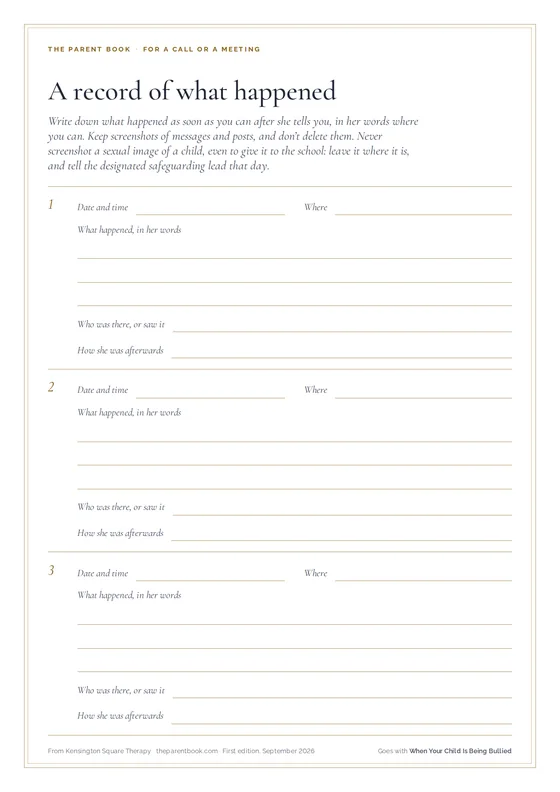
  • Bring specifics, and keep a written record. The school often cannot see bullying without being told; your information is frequently new. If the response is inadequate, write to the head and ask for the anti-bullying policy.
  • Call the specialists if it will not shift. Kidscape’s Parent Advice Line holds exactly this territory for parents who have been through the school process and the picture has not changed.

More one-minute pieces, for when you need one

External support

Coram Kidscape

The UK’s specialist anti-bullying charity.

0300 102 4481 · Mon-Tue 9.30am-2.30pm; voicemail, email and WhatsApp accepted outside hours

coramkidscape.org.uk

NSPCC

The UK’s leading child-protection charity.

0808 800 5000 · Mon-Fri 10am-4pm by phone; email 11am-4pm, seven days a week. An email sent when the service is closed is not received.

If the NSPCC service is closed and the concern cannot wait, call the police on 101. You can also contact the child’s local out-of-hours children’s social care, social work or social services team. If a child is in immediate danger, call 999.

nspcc.org.uk

YoungMinds

The leading UK youth mental health charity.

0808 802 5544 · Mon, Thu, Fri 9.30am-4pm; Tue, Wed 9.30am-6pm

youngminds.org.uk

Kensington Square Therapy is a specialist therapy service for the independent school sector and the editorial home of The Parent Book. The Parent Book is written by qualified therapists registered with the BACP and NCPS, drawing on over a decade of clinical work with children, young people, parents, and schools across the prep and senior school years.

If you need help right now Tap for helplines
If you need help right now
If you or your child is in immediate danger999 · Call 999 · Go to your nearest A&E · 24/7
If you, or your child, is in mental health crisisNHS 111 · England, Scotland and Wales: call 111 and choose the mental-health option. Northern Ireland: call Lifeline on 0808 808 8000 · 24/7
If your child or young person is having thoughts of suicidePapyrus HopeLine 24/7 · 0300 102 2470 · text HOPE to 88247 · 24/7, every day · pat@papyrus-uk.org · Text and email replies may take up to 24 hours.
If your child needs to talk to someone themselvesChildline · 0800 1111 · 24/7
If you are worried that a child is being harmed or is at riskNSPCC Helpline · 0808 800 5000 · Mon-Fri 10am-4pm by phone; email 11am-4pm, seven days a week. An email sent when the service is closed is not received. · help@nspcc.org.uk · If the NSPCC service is closed and the concern cannot wait, call the police on 101. You can also contact the child’s local out-of-hours children’s social care, social work or social services team. If a child is in immediate danger, call 999.
If you would prefer to text rather than speakShout · Text SHOUT to 85258 · 24/7
If you are struggling yourself and need to talkSamaritans · 116 123 · 24/7

The rest of the library

This is one chapter of a library written by therapists.

The Parent Book is a library of chapters, quick reads and audio, written by therapists who work with children and parents every week. If this one helped, the rest is here.