The Parent Book·From the library
When a Child Is Grieving
For parents whose child has lost someone, or something, that was there last week.
A ten-minute read · Published 25 May 2026

A seven-year-old comes into the kitchen on a Wednesday in February and asks where the cat is. Her father, who has been dreading the question all afternoon, tells her the cat died at the vet’s this morning. The child looks at him for what seems a long time and then says, in a voice with no particular sadness in it, that her sleeves are wet. She goes upstairs and doesn’t cry, and she doesn’t mention the cat that evening. Two and a half weeks later, in the back of the car on a Friday, she asks out of nowhere whether the cat is buried or burnt.
In our work, we see this kind of response more often than the usual story about children and grief would predict. Sometimes the loss is bigger than a cat and sometimes it’s smaller, but children respond in much the same way. Adults expect grief to look like it does in films. In children, it almost never does.
What is actually happening
Children grieve more things, and more often, than adults give them credit for. When people talk about grief in childhood, they tend to mean the death of a person, usually a grandparent. Clinically, the range is much wider. A child can grieve a pet whose being there every day was part of what made home feel safe. They can grieve a nanny who has left, an au pair who has gone home or a class teacher who is changing schools, and feel it with an intensity adults rarely notice, because few people think of a nanny as someone a child might grieve for. A child can grieve a friend who has moved abroad, a house their family has left, or something lost on the train back from Cornwall and mourned for three weeks. This is how attachment works: something the child had come to rely on is no longer there, and they have to find their bearings without it.
Children rarely call it grief. Either they don’t have the word, or they do and it doesn’t seem to match what they feel. They show it in other ways: the wet sleeves and the question about burial, or a sudden, fierce attachment to a different cuddly toy. Donald Winnicott called a toy like this a transitional object, something a child can hold that stands in for the bigger thing that is no longer there. It can also be a tummy ache, sleep that goes wrong, or unprovoked fury about something else entirely. Grief shows in a child’s body and in indirect questions before it shows in anything they say that you would recognise.
Children don’t grieve in stages. They grieve in waves: the loss is forgotten for an hour, an afternoon or two weeks, then comes back in a question, and then is forgotten again. The forgetting isn’t denial, and a calmer spell doesn’t mean the grief has gone. Your child may be pacing themselves, taking in only as much as they can bear. A child who seems fine for a fortnight after a death is grieving in episodes, with the rest of childhood going on in between. Child Bereavement UK, which Winston’s Wish is now part of, calls this puddle jumping, and it’s the most useful image we have come across for what you are actually watching.
What children of different ages do with loss
Advice that tries to speak to a four-year-old and a sixteen-year-old in the same sentence ends up helping neither, so we take each age in turn.
If your child is between four and seven. Magical thinking is in full force. They may ask, in a flat voice, whether their grandfather is in the ceiling, whether the cat will come back at Christmas, or whether the nanny is sad in the country she has gone to. There’s nothing morbid about these questions; a child this age is working out how something new fits into their world. Answer briefly and truthfully, in the same voice you’d use to tell them where the socks live. “Granddad’s body has stopped working and he isn’t going to come back. We can still talk about him.” Don’t rely on euphemisms (gone to sleep, passed, gone away). Your child will take them literally, and gone to sleep makes bedtime a small panic, that night and for a year.
If your child is between seven and nine. Their thinking is becoming more concrete. They want to know what happens to the body, whether other people they love will die, and whether you might. Your child is beginning a long, private reckoning with the fact that people die. Let them ask, and don’t flinch. Yes, everyone dies eventually. Almost everyone lives a long time first. Then put a hand on your child’s shoulder and go back to whatever you were doing. What reassures them is seeing that the question didn’t break you.
If your child is between nine and eleven. They are starting to grieve more privately. They know their sadness affects the people around them, and may decide it’s their job not to add to yours. The signs are indirect: your child goes suddenly flat, gets irritable with their siblings, or hardly speaks when you’re driving them somewhere. Talking while you are both doing something else works better than sitting them down. “I’ve been thinking about Grandma this week. I wondered if you had.” Say it while you’re washing up, with both of you facing away. It tells them they can talk about Grandma too, and it doesn’t matter whether they do that day.
If your child is in early secondary, eleven to thirteen. What friends think now shapes how your child handles any feeling. A twelve-year-old who has been crying about the cat, or their grandfather, or the friend whose family has moved to Singapore, may not want those friends to know. Take the loss seriously, but don’t make the grief a household project. A brief word before they leave for school, such as “I know today might be a hard one”, strikes the right note. Loud sympathy at the breakfast table strikes the wrong one.
If your child is mid to late secondary, thirteen and beyond. Grief at this age looks more like adult grief, with one difference: your teenager is in the middle of separating from their family at the same time as they are being asked to rely on it again. Their response will be contradictory. They may want to be on their own, and then want you in the room two hours later. Be available, but don’t push. Most of it gets said at home, late at night.
What to do, and what not to do
Across all these ages, the single most useful thing you can do is make it possible to talk about the loss. Don’t insist on the conversation or schedule it; just make sure it can happen. A child who hears their dead grandfather’s name said now and then at home, without ceremony, learns that the dead can be talked about, and that his name hasn’t become something the family avoids. The silence around a death does more damage than talking about it ever does.
With a younger child, you may find it helps to keep one or two small reminders of the loss where the child can see them: a photograph on a shelf, or the cat’s collar in a drawer they know about. The reminders are there to show it’s all right to remember, not to make a shrine. Without any words, the object says “this happened, and we don’t pretend it didn’t”.
What rarely helps is making your child be sad on schedule: going to the funeral they don’t want to attend, sitting through the assembly they don’t want to sit through, or having the conversation on the anniversary because the adults have decided it’s the right day. Children’s grief doesn’t keep to a calendar. Offer the choice and accept the answer. A child who skips the funeral is protecting themselves, and they’re right to; they aren’t avoiding their grief.
Filling the silence with a better place, watching from heaven or “wouldn’t want you to be sad” rarely helps either. These phrases make the adult feel the right thing has been said, but in our experience they don’t reach the child. Most children find a simple “I don’t know why this happened, and I’m very sad about it too” more bearable.
Almost without exception, the organisation we send parents to is Child Bereavement UK. Its approach to children’s grief is calm and generous with practical help in a way we haven’t found in any other UK source, and its pages on telling a child that someone has died, and on supporting a child through a funeral, are the clearest guides we know of in the country. It also covers the death of a parent or a baby, and whole families grieving together. Its Helpline is 0800 02 888 40, free, Monday to Friday 8am to 8pm, excluding bank holidays, and it is warm and unhurried.
If you are considering bereavement counselling for your child, the BACP and NCPS directories let you filter for counsellors working specifically with children and with grief; the Child Bereavement UK Helpline will, in many areas, also know local services. Asking for help is not a verdict on how the grief is going.
Your own grief, and the longer arc
In many cases, you are grieving too. The grandfather was your father, the cat came into your life before the children did, and the nanny was the person who helped you get through the early years. Your child is watching you, more closely than they let on, to learn what grief can look like in your family.
You don’t have to be stoic, with it all in hand. Your child needs a parent who is sometimes sad in front of them and lets them see the tears without asking them to do anything about it, and who is also, the rest of the time, the person they can lean on. If the two of you are sad together while one of you makes toast, you haven’t failed as a parent. That is what grief at home looks like.
What no one tells you, in the middle of it, is how long it goes on. The first six months are often the most intense. The second six months are often harder, because the family around you has stopped asking. Anniversaries, the empty chair at Christmas and the smell of a particular coat will bring back things you thought you had put behind you. That is how grief works over the years, and it doesn’t mean you have gone backwards.
Three Wednesdays later, the seven-year-old who asked whether the cat was buried or burnt is starting to turn the cat into a story. She still thinks about it, but differently. She is finding a way to keep the cat in her life now that it isn’t in the house. You make that possible by being unsurprised when she mentions it and unsurprised when she doesn’t. It takes time, and for most children a parent who responds like this is enough.
NOTES
- Sunderland, Margot. What Every Parent Needs to Know. DK, 2016. Sunderland’s developmental neuroscience for parents: body before brain, and the regulated nervous system as the regulating tool.
Where to go further
Julia Samuel, Grief Works: Stories of Life, Death and Surviving A UK therapist and Founder Patron of Child Bereavement UK on what grief does to a person over months and years. It’s the clearest book on adult grief we know, and the chapters on the death of a parent, a partner and a child are the ones we send parents to.
Margot Sunderland, What Every Parent Needs to Know An illustrated guide, by a UK child therapist, to what drives children’s emotions. The sections on loss, on bedtime and on the rituals of repair work well alongside Child Bereavement UK’s material if you are helping a grieving child through it at home.
What helps a grieving child
Children’s grief doesn’t follow a timetable. Your job is to make the loss something that can be talked about, and to let your child set the pace.
- Keep saying their name. Mention your child’s grandfather by name occasionally, without ceremony, and they learn that the dead can be talked about. Silence does more damage than talking ever does.
- Keep a reminder where your child can find it. It might be a photograph on the shelf, or the cat’s collar in a drawer your child knows about. It doesn’t need to be a shrine. It tells them this happened and that you’re not pretending it didn’t.
- Offer the choice and accept the answer. Let your child choose whether to go to the funeral or have the anniversary conversation, and accept it if they say no. A child who says no is protecting themselves, and they know what they can manage.
- Say something true. “I don’t know why this happened, and I’m very sad about it too” helps where “a better place” doesn’t. It tells your child you’re grieving with them.
Put it into practice
What this chapter looks like in practice: one-minute ideas for tonight, things to do together and sheets to print and keep.
Quick tipsOne minute each
- The Things Children GrieveChildren grieve more things, and more often, than adults give them credit for.
- Answering a Grieving Child’s QuestionsA grieving child’s questions often come out of nowhere; answer them briefly, in your everyday voice.
- Leaving the House Your Child LovedGive your child time to say goodbye to the places they loved before the boxes go.
Fifteen quick tips on this in the library
To do togetherActivities
- Hands busy, side by sideColour, build or make things side by side, each of you on your own thing. Nothing is asked of your child, and nothing they make is marked.About 20 minutes · with a sheet to print
- Marking the endingIn the last weeks at a school, offer your child a few pages for what they will miss, and perhaps a card for a teacher. It is up to your child, and they keep what they make.About 30 minutes · with a sheet to print
- A box for the memoriesAfter a death, make a box together for things that remind your child of the person, and a page of what they remember. Your child chooses what goes in, and the box is theirs.An afternoon to start · with a sheet to print
To printWith this chapter

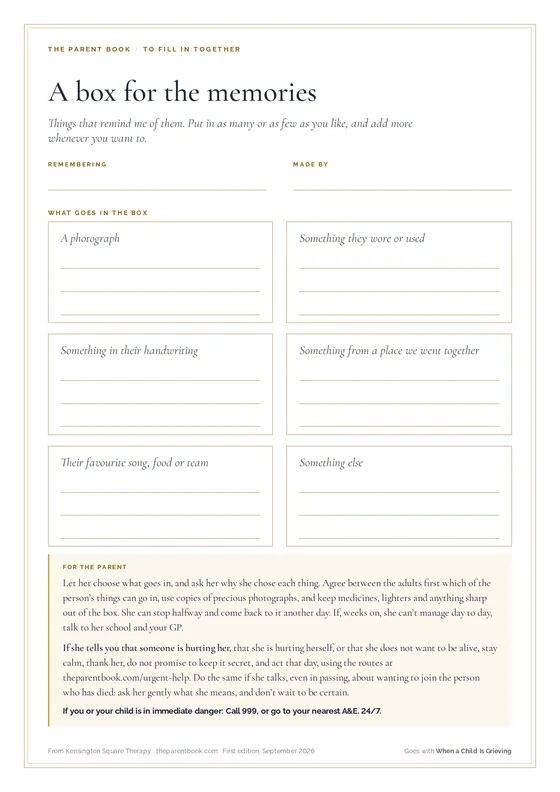
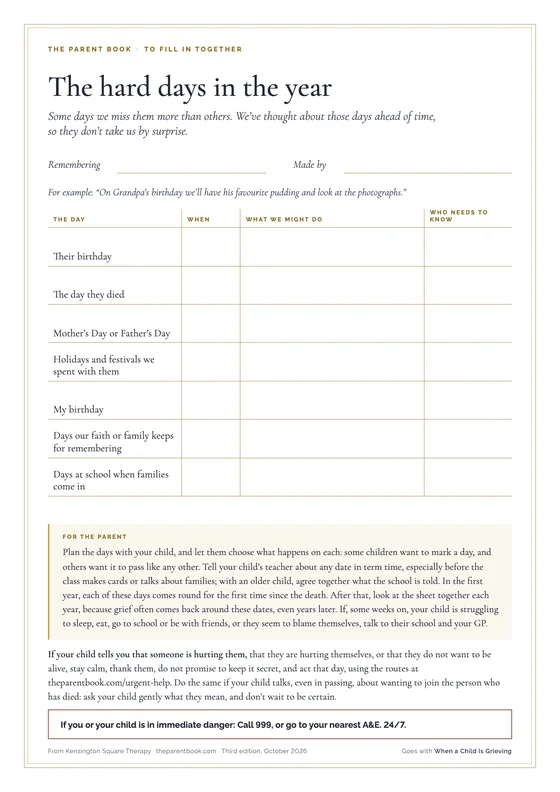
The quick tips and activities are for subscribers; the sheets that go with this chapter are yours to print. What a subscription includes.
Who else can help
Child Bereavement UK (incorporating Winston’s Wish)
The UK’s children’s bereavement charity, now including Winston’s Wish.
0800 02 888 40 · Mon-Fri 8am-8pm, except bank holidays
Outside those hours the line is closed. Samaritans answer at any hour on 116 123, and Shout answer if you text the word SHOUT to 85258.
childbereavementuk.org/Pages/Category/child-bereavement-uk-support-services
Coram Family Lives
A free, confidential helpline for any parenting or family worry, by phone, live chat, WhatsApp or email, staffed by trained family support workers.
0808 800 2222 · Mon-Fri 9am-9pm; weekends 10am-3pm; closed bank holidays
Outside those hours the line is closed. Samaritans answer at any hour on 116 123, and Shout answer if you text the word SHOUT to 85258.
coramfamilylives.org.uk/how-we-can-help/confidential-helpline