Quick tip · 2 min
The Child Who Looks Fine
Her grades are good. Her teachers say she is fine. She is not.
A minute to read, 3 things to try · in the library
ResourcesFor right now
Everything the library holds, by kind: chapters to read properly, one-minute pieces for tonight, things to do together, tools for you rather than your child, and the books, podcasts and films we would put in your hands.
A selection from the shelf, chosen to show the range rather than the whole index: what a week in a family actually throws up. Search reaches every piece the library holds. The pieces themselves, and the films, podcasts and curated bookshelf alongside them, open with a subscription.
The library holdsToday
22 chapters · 168 quick tips · 48 activities · 6 self-care tools · 103 books · 14 podcasts · 34 videos · 8 further reading
Across 38 subjects, from sleep and screens to friendships, anxiety, exams and grief. A selection of each is below; search reaches everything.
Free, and already openNothing to join
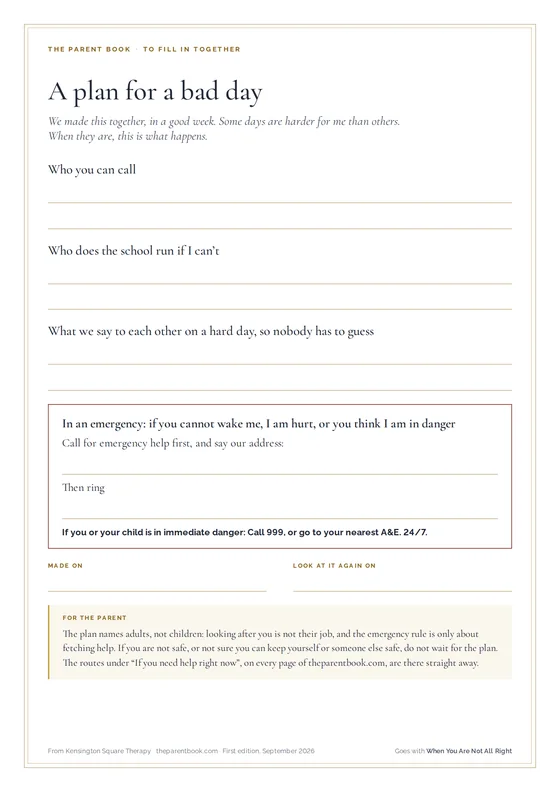
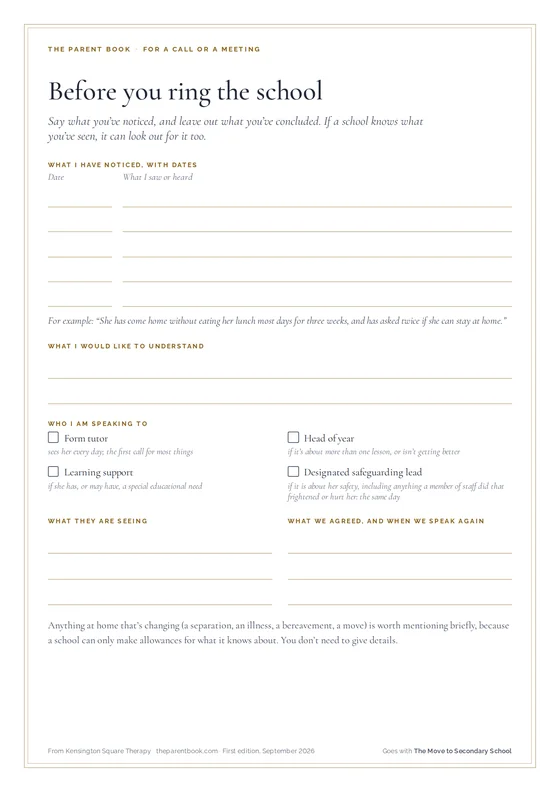
Two pages for every subject we cover, written to be printed and kept. One says what to do first, what helps, and three things to try this week. The other names the organisations beyond this library, what each one does, when it is the right call, and the number to ring. Neither asks you for anything.
Anxiety Sleep Friendships Behaviour Screens Separation
Every subject, and every organisation we would send a parent to · Finding a therapist
Read for your child’s ageAdjust any time
Every piece here
Quick TipsOne-minute reads
Quick tips168 in the library
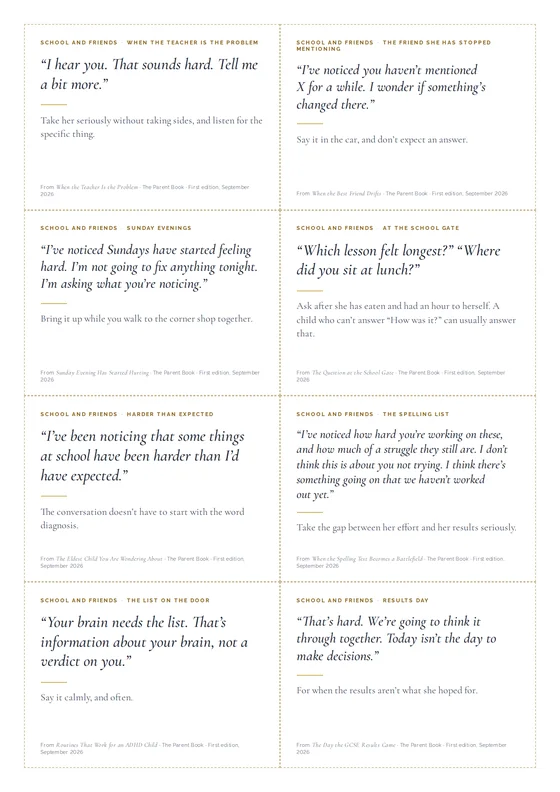
One idea, one minute, for the evening you are actually in. Twelve of them here, across the range of what families bring us.
Quick tip · 2 min
The Child Who Looks Fine
Her grades are good. Her teachers say she is fine. She is not.
A minute to read, 3 things to try · in the library
Quick tip · 2 min
The Body Too Awake for Bedtime
The parent’s pace matters more than the routine.
A minute to read, 3 things to try · in the library
Quick tip · 2 min
The Party She Needs to Leave
Her need to leave mid-party is not rudeness. It is recovery.
A minute to read, 3 things to try · in the library
Quick tip · 2 min
Homesick at Two in the Morning
The text says she cannot do this. By breakfast she usually can.
A minute to read, 3 things to try · in the library
Quick tip · 2 min
The Party She Cannot Walk Into
The stomach ache is real. Repeated pushing-through makes the next invitation harder, not easier.
A minute to read, 3 things to try · in the library
Quick tip · 2 min
The School’s First Conversation About the Condition
The school needs specifics. The child needs the school not to define her.
A minute to read, 3 things to try · in the library
Quick tip · 2 min
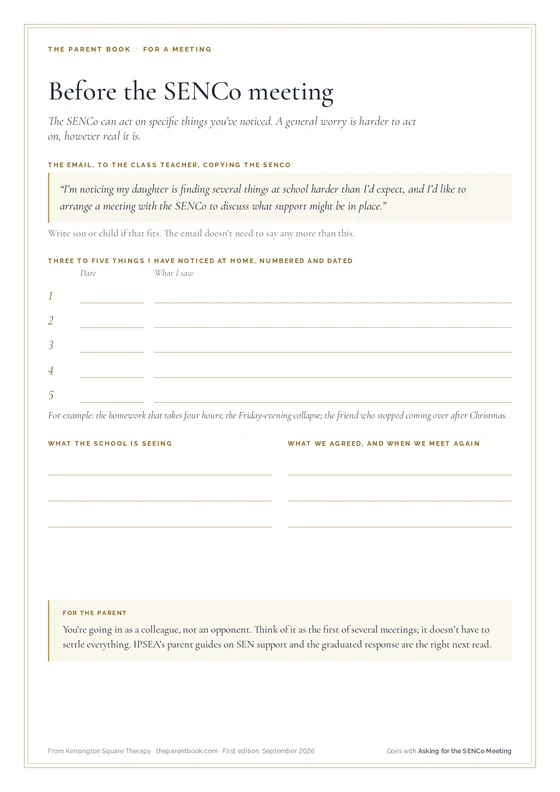
What a SENCo Actually Does
Every UK school has one. Most newly arrived parents have not met her.
A minute to read, 3 things to try · in the library
Quick tip · 2 min
The Night Before the Assessment
She does not need to be prepped. She needs the evening to be ordinary.
A minute to read, 3 things to try · in the library
Quick tip · 2 min
The Room She Will Not Leave
The headset is the room her social life happens in.
A minute to read, 3 things to try · in the library
Quick tip · 2 min
When You Are the One Not Sleeping
Parental insomnia is the body telling you something the day has not.
A minute to read, 3 things to try · in the library
Quick tip · 2 min
Sunday Evening Has Started Hurting
School refusal is a stack of causes. Slow down before deciding which.
A minute to read, 3 things to try · in the library
Quick tip · 2 min
The Day She Gets a Mental Health Diagnosis
She has been given a name for what she has been carrying.
A minute to read, 3 things to try · in the library
Activities48 in the library
Something to do together, not only to read. Each is short, structured, and drawn from a chapter in the library. Eight of them are below.
Activity · 20 min
A Lego challenge with a theme
Set a small theme, “the smallest dragon you can build”, and a 30-minute timer. The constraint makes it interesting; the time-bound makes it manageable; no screen required.
7 steps · in the library
From the chapter, What Screen Time Actually Is →Activity · 20 min
A body sensations chart
A simple drawing of a body. Together, locate where in the body different feelings live. Anger in the chest. Worry in the tummy. Helps children notice the physical signs of an emotion before it tips into overwhelm.
7 steps · in the library
From the chapter, When the Best Friend Moves On →Activity · 20 min
A breathing card by the bed
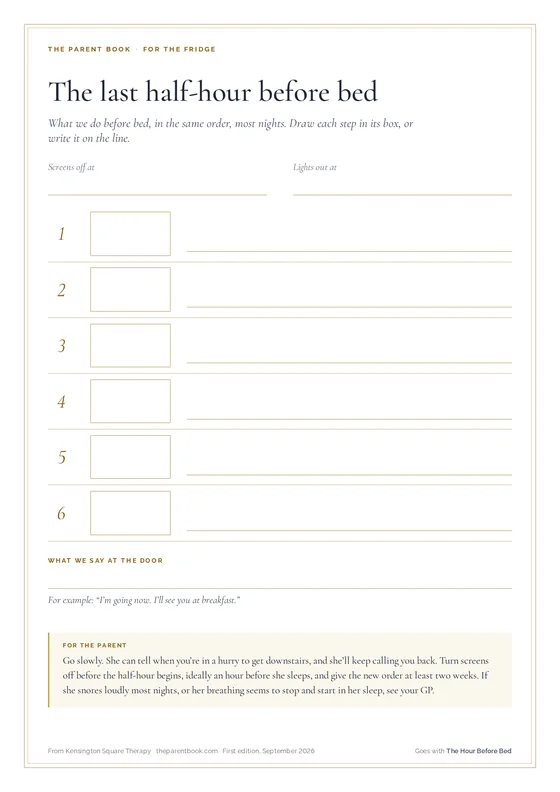
A laminated card with the lazy-8 breath drawn on it. When your child wakes in the night, they trace the figure 8 with their finger and breathe in time.
5 steps · in the library
From the chapter, The Hour Before Bed →Activity · 20 min
A calm-down corner with sensory items
A small designated space. Soft cushions, a weighted toy, a stress ball, a glitter jar, a colouring book. Children visit it independently when they need to settle. Not a punishment; a tool.
7 steps · in the library
From the chapter, When the Best Friend Moves On →Activity · 20 min
A cosy reading corner
A small designated space in or near the bedroom with cushions, a soft lamp, and books. Used in the last 20 minutes before bed.
5 steps · in the library
From the chapter, The Hour Before Bed →Activity · 20 min
A countdown calendar to the new
Mark the days. Each day, a small thing to look forward to about the new place (an art room, a swimming pool, a particular teacher). Turns the abstract change into a series of small concrete steps.
6 steps · in the library
From the chapter, When the Best Friend Moves On →Activity · 20 min
A family “new skill” challenge
Each member learns something new for a month, juggling, a song on the recorder, a card trick. Practise where everyone can see you being bad at first. The experience of public beginner-hood is the antidote.
7 steps · in the library
From the chapter, Perfectionism →Activity · 20 min
A goodbye letter to a teacher who mattered
For Year 6 children especially. A handwritten thank-you to a teacher who shaped their primary years. The act of writing it does as much for the child as receiving it does for the teacher.
7 steps · in the library
From the chapter, When the Best Friend Moves On →Chapters22 in the library
The long reads. Fifteen to twenty minutes on one situation, with the option to listen instead. Six of them here, and one is free to read in full.
Chapter · 13 min
When the Best Friend Moves On
A chapter for parents whose child has been quietly dropped.
Chapter · 13 min
The Hour Before Bed
A chapter for parents whose evenings have stopped working.
Chapter · 13 min
When They Stop Talking to You
A chapter for parents whose teenager has gone quiet.
Chapter · 13 min
What to Do When School Is the Problem
A chapter for parents whose child has started dreading school.
Chapter · 13 min
What Screen Time Actually Is
A chapter for parents who feel they have lost the screen-time argument.
Chapter · 13 min
When Parents Separate
A chapter for parents in the middle of a separation, watching their child.
Self-care tools for parents6 in the library
Short, practical, and for you rather than for your child. The half-hour that makes the rest of it possible.
For you
Breathing Space
A two-minute breath, for the kitchen counter or the car.
For you
The 60-Second Reset
For the moment between rooms.
For you
The Kitchen at Six PM
For the parenting witching hour.
For you
The Self-Compassion Break
For the moment after you have shouted again.
For you
Three Things to Put Down Today
A reflective prompt for the parental load.
For you
When You Cannot Sleep Because You Cannot Stop Worrying
For the 3am parent.
Books for parents57 in the library
The books we actually put into parents’ hands, each with a line on why. Six of them here.
Book for parents
Untangled: Guiding Teenage Girls Through the Seven Transitions into Adulthood
Lisa Damour
The book we put into the hands of parents of adolescent girls more than any other.
Book for parents
Under Pressure: Confronting the Epidemic of Stress and Anxiety in Girls
Lisa Damour
The cleanest evidence-anchored book on the kind of pressure school admission and exam years produce.
Book for parents
The Emotional Lives of Teenagers
Lisa Damour
Calm, evidence-based on adolescent emotion; the right read for parents avoiding contested cultural debates.
Book for parents
The Whole-Brain Child
Daniel J. Siegel and Tina Payne Bryson
The cleanest single primer on how a child’s brain organises a big feeling.
Book for parents
Brainstorm: The Power and Purpose of the Teenage Brain
Daniel J. Siegel
The neuroscience of adolescence, written for a general audience.
Book for parents
A Therapeutic Treasure Box for Working with Children and Adolescents with Developmental Trauma
Dr Karen Treisman
Workbook-shaped guide to felt-safety with traumatised children; accessible to parents.
Books to read together46 in the library
Books to read with a child, not about her. Chosen for the conversation they open rather than the lesson they teach.
Read together
A Book of Sleep
Il Sung Na, ages 2–5
A gentle bedtime read for the youngest · ages 2–5
Read together
A Little Spot of Anxiety
Diane Alber, ages 4–8
For naming anxious feelings · ages 4–8
Read together
A Little Spot of Feelings
Diane Alber, ages 4–8
On naming and managing feelings · ages 4–8
Read together
After the Fall
Dan Santat, ages 5–9
On trying again after failure · ages 5–9
Podcasts14 in the library
For the drive, or the washing up. Episodes worth the time, with the reason we chose them.
Podcast
Children’s sleep and the modern world
The Therapy Edit, 40 min
Podcast
How to raise resilient children
Greater Good · Berkeley, 32 min
Podcast
On childhood anxiety with Dr Sarah Mundy
The Therapy Edit, 38 min
Podcast
On childhood friendships
The Therapy Edit, 40 min
Videos34 in the library
Short, and often worth watching together. Nothing here is longer than an evening will allow.
Video
The Power of Vulnerability
Brené Brown, TED, 20 min
Brené Brown’s most-watched TED talk, from TEDxHouston 2010, and the cleanest single account we know of why vulnerability, including in parenting, is p
Video
Listening to Shame
Brené Brown, TED, 21 min
The companion talk to The Power of Vulnerability, given at TED 2012, on the distinction between guilt and shame and on why shame is the wound most oft
Video
The Power of Believing That You Can Improve
Carol Dweck, TED, 10 min
The clearest short summary we know of the growth-mindset frame referenced across the perfectionism chapter and the school-pressure tips, calibrated fo
Video
The Single Most Important Parenting Strategy
Dr Becky Kennedy, TED, 12 min
A clinical psychologist on the central role of repair after rupture in parent-child relationships, calmly delivered and consistent with the framework
Further reading8 in the library
Written by other people, and worth your time. We would rather point you somewhere good than pretend we wrote everything.
Elsewhere
Anxiety in children: a parent guide
YoungMinds
YoungMinds’ comprehensive parent guide to recognising and supporting childhood anxiety.
Elsewhere
Healthier living for children
NHS
NHS guidance on movement, sleep and wellbeing habits that support primary-aged children.
Elsewhere
Helping with friendship difficulties
Anna Freud Centre
Anna Freud Centre guidance on common social challenges and what parents can do.
Elsewhere
Helping your child cope with exam pressure
Place2Be
Place2Be’s parent guide on practical strategies, what to say, and what to avoid in the assessment season.