With a subscription
Getting it wrong
The sheet
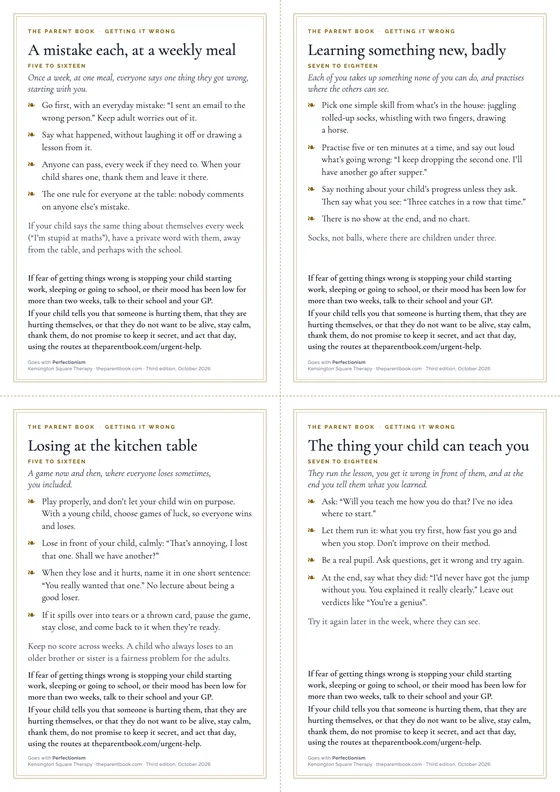
Four cards for the child who finds getting things wrong unbearable: a mistake each at a weekly meal, learning something new badly, losing at games, and the thing they can teach you.
Cards to cut out · A4, four cards to cut · One page · PDF, 60 KB
How it helps
A child who is frightened of getting things wrong often stops trying new things. Watching the adults make mistakes calmly, lose at games and learn something badly, in front of the child, shows them that getting it wrong is part of learning, and doesn’t change how you see them.
How to use it
- Cut out the four cards, and start with one. A mistake each at a weekly meal is a good first one.
- Go first each time, and let your child see you get things wrong without laughing it off or drawing a lesson from it.
- Say what you see, and leave out verdicts. Nobody comments on anyone else’s mistake.
- If fear of getting things wrong is stopping your child starting work, sleeping or going to school, or their mood has been low for more than two weeks, talk to their school and your GP.
How to get this sheet
This sheet comes with a subscription. It is also yours with its chapter, if that is the chapter you read free, or if a teacher or therapist sends it to you. School staff and therapists signed in to their shelf can print it too.
The first chapter you open here is free to read in full, with its sheets. This one goes with Perfectionism and The 11+ Year.
Free to print
These are free to anyone, with nothing to sign up for.
- A plan for a bad dayTo fill in together · A4
- Before you ring the schoolFor a call or a meeting · A4
- What to say: school and friendsCards to cut out · A4, eight cards to cut
- Before the SENCo meetingFor a meeting · A4
- Three reports, side by sideFor a meeting · A4 landscape
- The return-to-school meetingFor a meeting · A4
- The move to secondary school, for a parents’ eveningFor a parents’ evening · A4, five pages
- The last half-hour before bedFor the fridge · A4
- The worry ladderTo fill in together · A4
- Before you see the GP about your childFor an appointment · A4, two sides
- A record of what happenedFor a call or a meeting · A4, two pages
- The people I can tellTo make together · A4, two pages
Every sheet, marked free or with a subscription, is at theparentbook.com/printables.
Published by Kensington Square Therapy. Company No. 16707111. Written by therapists registered with the British Association for Counselling and Psychotherapy (BACP) and the National Counselling and Psychotherapy Society (NCPS). This page is not therapy, and not a substitute for professional support. The full library is at theparentbook.com.