The Parent Book·From the library
Screen Time
For parents who have lost the argument about screen hours, and suspect it was never quite the right argument to have.
An eight-minute read · Published 9 June 2026

It’s Sunday, and the negotiation has happened again. Twenty more minutes became forty. When the timer went off, your child was furious, the way children are when something they’re absorbed in is taken away halfway through. You’d meant to stay calm, and you didn’t. By the time the screen is off, everyone in the house feels a bit worse, and nothing has been decided except that the same thing will happen on Wednesday.
This chapter is not about what your child is encountering online, the messages and the images and the people who are not who they say they are. That is a different and sometimes frightening conversation, and it has its own chapter; if that is the worry that brought you here, turn to Your Child’s Online World. This chapter is about the smaller, everyday problem: how much, when, and what it’s costing. That means the hours, the arguments about the hours, and the feeling that everything else in family life is being pulled towards the screen.
The clock is measuring the wrong thing
The instinct is to look for a number: how many hours is too many. Parents come to this expecting there to be a line somewhere, and that a good parent draws it.
Beyond the earliest years there isn’t an agreed line, and the better clinical guidance has stopped pretending there is one. In its 2020 report on technology use and the mental health of children and young people, the Royal College of Psychiatrists supports the World Health Organization’s limits for the very youngest: no screen time before the age of one, and no more than an hour a day from two to four. For older children it declines to set a single safe amount. It looks instead at what the screen use is doing: whether it’s pushing out the things a developing child needs. The American Academy of Pediatrics has moved the same way, away from counting minutes and towards balance. It asks parents to protect sleep, physical activity and time with family.
This chapter rests on that idea. A clock can tell you how long your child spent on a screen. It can’t tell you what that time replaced. Two hours of something they love, on a day that still has time for sleep, moving about and a meal at a table with other people, is a different thing from forty minutes that cost them the only hour they had to be bored, or to talk to you, or to fall asleep.
A better place to start is with four questions, drawn from the same guidance:
- Is the screen eating into sleep?
- Is it crowding out physical activity and time outdoors?
- Is it replacing face-to-face time, with friends and with the family?
- And can your child stop, more or less, when it’s time to stop, or does stopping cost the whole house an argument every time?
If the answer to any one of these is yes, that’s worth attending to. If it’s yes to all four, that is what clinicians worry about, and it’s worth attending to whatever the number on the timer says.
What helps on a Wednesday
The first thing that helps is to stop negotiating it every day. A routine your child can predict is easier to keep than a limit you argue over every evening, because once the routine is the rule, there’s nothing new to decide each night; you just keep to it. The Anna Freud Centre’s guidance for young people is built around the same idea: a set time to put devices down, kept to without being rigid about it.
Start with sleep, because that’s where the evidence is clearest and the cost is highest. The NHS guidance is to turn screens off about an hour before bed and to keep devices out of the bedroom overnight, because the light suppresses the melatonin that makes a child drowsy, and because the content itself is built to keep the mind switched on. Charging everyone’s devices in the kitchen, the adults’ included, settles more bedtime battles than any lecture. It also puts a stop to the scrolling at three in the morning that your child would never tell you about.
The second thing that helps is to share some of the time. Watch what they’re watching, play the game badly while they laugh at you, and ask what they like about it because you want to know. It turns something your child does on their own into something you do together, and it tells you more about what they’re doing than any monitoring app. The American Academy of Pediatrics calls this co-viewing and rates it among the more protective things a parent can do.
The third thing is to look at your own phone. Children copy what they see. If you ask for your child’s phone at dinner while you’re answering work email under the table, you’ve lost the argument before it starts. You don’t have to be perfect. The aim is to be honest that the family is doing this together, and that the rule applies to the adults too.
The but everyone has it argument
At some point, usually around the move to secondary school, the argument moves on from minutes to belonging. Everyone has it. Everyone’s on it. You’re making me the only one.
It’s worth taking seriously, because it’s often partly true, and because being left out of the places where friendships now happen is a real cost. But it isn’t a reason to remove every boundary. What helps here is the tone this book keeps coming back to: warm, unhurried, and clear that the limit comes from caring about your child. You can keep the limit and acknowledge what they’re missing in the same breath. “I can see this is hard, and I can see you’re not making it up, and the answer for now is still not yet.” Your child can usually live with the limit if they don’t also have to feel that you don’t understand it.
At different ages
In the primary years, this is mostly your job. You set the routine, you watch with your child, you keep their bedroom free of screens, and you accept that the negotiating stays with you, because they haven’t developed the self-control to do it themselves yet.
In the early secondary years, start handing over a little of the control while the routine stays in place. This is the age to talk about how apps are designed to be hard to leave, so that stopping becomes a skill you’re teaching your child. The Anna Freud material on stepping back from social media is well pitched for this age, and you can read it together.
In the later teenage years, your influence comes through conversation and your own example. A sixteen-year-old won’t accept a timer. They will often admit, though, when their guard is down, that scrolling late at night leaves them feeling worse, and that gives you a way in. The job then becomes helping your teenager notice the cost for themselves. That’s the only kind of control that will still work after they leave home.
When the worry is bigger than the clock
Sometimes the real concern is what lies behind the hours. If your child has stopped seeing friends in person, if their sleep has collapsed, if their mood drops hard when they don’t have the device, or if the screen has clearly become the place they go to manage feelings they can’t otherwise manage, they are telling you something that a screen-time limit will not fix. Here, the screen use is often a symptom of something else. If that sounds like your child, the chapters on When Reassurance Stops Working and on low mood will be closer to the conversation you need to have, and a word with your GP or the school’s pastoral lead is the right next step.
NOTES
- Royal College of Psychiatrists (2020). Technology use and the mental health of children and young people (College Report CR225). The report supports the World Health Organization’s limits for children under five (none under one; at most an hour a day from two to four) and, beyond that, declines to set a single safe quantity, framing the question instead as one of function and displacement.
- American Academy of Pediatrics. Beyond Screen Time: A Parent’s Guide to Media Use and How to Make a Family Media Plan (HealthyChildren.org). The source of the balance-not-minutes framing, and of co-viewing as a protective practice.
- Anna Freud Centre. Managing social media and Time away from technology. Guidance written for young people on managing social media and taking time away from screens; worth reading alongside your child.
- NHS. Healthy sleep tips for children. Screens off about an hour before bed; devices kept out of the bedroom overnight.
Wider reading
The notes above come from clinical and public-health bodies: the Royal College of Psychiatrists, the American Academy of Pediatrics, the NHS and the Anna Freud Centre. The two books below are a different kind of source. Each is by an individual author who has shaped how parents talk about this subject. They are perspectives and arguments, not clinical guidance, and we suggest them as wider reading without adopting either position in full.
- Jonathan Haidt, The Anxious Generation (2024). The most widely discussed case that a phone-based childhood has reshaped adolescence, and an argument for delaying smartphones and social media. It’s influential and vigorously debated among researchers, so it’s best read with that debate in mind.
- Lisa Damour, The Emotional Lives of Teenagers (2023). A clinical psychologist’s calmer account of how teenagers develop, and of where technology fits in. It’s a useful counterweight, less alarmed and more concerned with what is normal.
Read either one as an argument to weigh up. The four questions earlier in this chapter, about sleep, movement, time with other people and whether your child can stop, will be more use to you on a school night than any single book’s verdict.
What helps a family with screens
After years of working with families on screen use, these are the practical things we have seen make a difference. None of them means declaring war on devices. They work by changing the routine around screens.
- Keep devices out of bedrooms at night. Charge devices in the kitchen overnight, including yours. What you do counts as much as the rule you set.
- Turn screens off 45 to 60 minutes before bed. The brain needs to wind down before it can sleep. Use the time for reading, a bath or talking together.
- Watch with your child where you can. Watching together turns passive viewing into something you share. It gives you a way into what they’ve seen, and it makes talking about what they watch a habit.
- Plan what happens after screens. Don’t go straight from a game to homework, or from a video to bed. Put a snack, a walk or a few minutes of talking in between. How they come off a screen matters as much as the screen time itself.
- Judge the content, not just the minutes. A slow nature programme is fine in the evening; a fast-paced game isn’t. How worked up it gets them matters as much as how long it lasts.
- Have one screen-free meal a day. Keep devices, yours and theirs, away from family meals, even if it’s only one a day. Being together without distractions doesn’t look like much, but it’s important.
- Keep talking about what they see online. Bring it up casually and often. A child who knows you won’t panic will tell you when they see something difficult, and that’s worth more than any filter.
What helps at 5 to 7
- Set the screen routine yourself. Decide the routine, watch with them, and accept that the negotiating falls to you, because their self-control isn’t built yet.
- Keep the bedroom screen-free. Charge screens outside the bedroom overnight, so the bedroom stays a place for sleep.
What helps at 7 to 9
- Set the screen routine yourself. Decide the routine, watch with them, and accept that the negotiating falls to you, because their self-control isn’t built yet.
- Keep the bedroom screen-free. Charge screens outside the bedroom overnight, so the bedroom stays a place for sleep.
What helps at 9 to 11
- Keep the routine, and start explaining the apps. You still set the routine. This is the age to start saying out loud that the apps are built to be hard to leave, so your child already has the idea before the negotiating starts.
What helps at 11 to 13
- Hand over a little control. Keep the routine, and start sharing the reasons for it. The aim now is to teach your child how to stop on their own.
- Talk about how apps are designed. Explain that the apps are made to be hard to leave. The Anna Freud material on stepping back from social media is pitched well for this age, and you can read it together.
What helps at 13 to 16
- Swap control for conversation and example. A sixteen-year-old won’t accept a timer, but they will sometimes admit that scrolling late at night leaves them feeling worse. When they do, that’s your chance to talk about it.
- Help them notice the cost themselves. Once your teenager leaves home, the only limits that will last are the ones they set because they have seen the cost for themselves.
What helps at 16 to 18
- Swap control for conversation and example. A sixteen-year-old won’t accept a timer, but they will sometimes admit that scrolling late at night leaves them feeling worse. When they do, that’s your chance to talk about it.
- Help them notice the cost themselves. Once your teenager leaves home, the only limits that will last are the ones they set because they have seen the cost for themselves.
Put it into practice
What this chapter looks like in practice: one-minute ideas for tonight, things to do together and sheets to print and keep.
Quick tipsOne minute each
- When Your Teenager Cannot Fall Asleep Before MidnightYour teenager’s body clock has moved later; a fixed time to get up, morning light and phones out of the bedroom can help them fall asleep sooner.
- The Game Rated Above Your Child’s AgeTwo games with the same age rating can be very different, so check why it got its number and watch it being played before you decide.
- Before the First Loot BoxHave the money conversation, and set the controls, before your child plays a game with a shop in it.
Six quick tips on this in the library
To do togetherActivities
- One meal without phones, yours firstOne regular meal where every phone in the house, starting with yours, stays in another room.About 30 minutes
- Show me three thingsOnce a week your child shows you three things: the funniest they have seen, the weirdest, and one they think you should see. You watch without comment.About 10 minutes · with a sheet to print
- The last half-hour before bedChoose the last half-hour before bed with your child, write it down in order and put it on the fridge. Then do it in that order most nights, slowly.About 30 minutes · with a sheet to print
Six activities on this in the library
To printWith this chapter
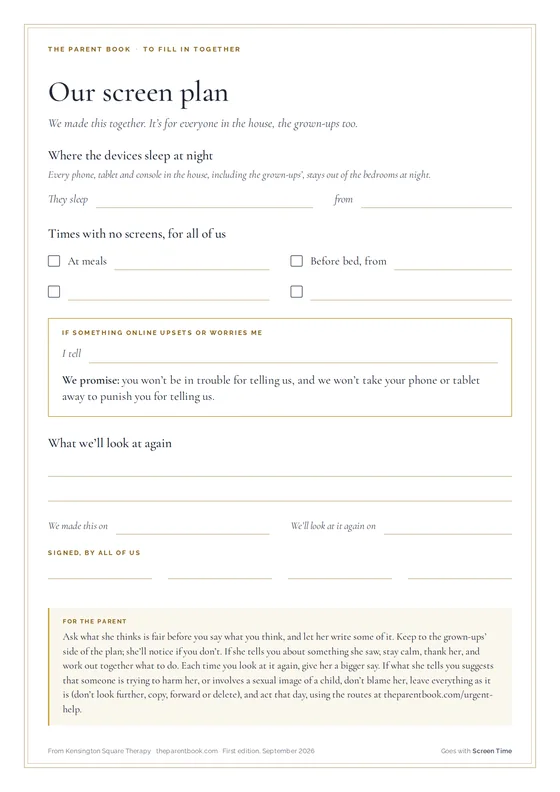
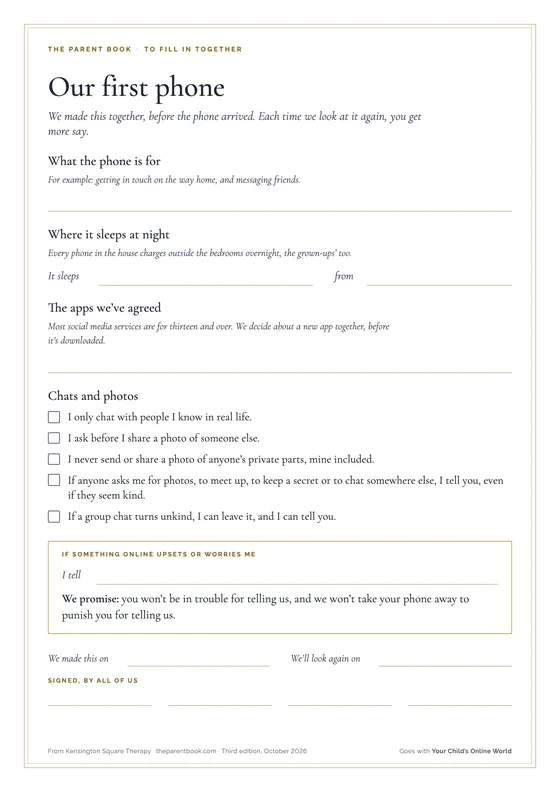

The quick tips and activities are for subscribers; the sheets that go with this chapter are yours to print. What a subscription includes.
Who else can help
Anna Freud
The Anna Freud Centre’s family wellbeing resources: careful, research-led reading on children’s emotional development, separation, self-care for parents, and supporting a child through treatment.
YoungMinds
The UK’s young people’s mental health charity, with a free Parents Helpline, webchat and email, and a plain A to Z of the things parents worry about.
0808 802 5544 · Mon, Thu, Fri 9.30am-4pm; Tue, Wed 9.30am-6pm
Outside those hours the parents line is closed. The urgent routes on this page are open when it is not.
Coram Family Lives
A free, confidential helpline for any parenting or family worry, by phone, live chat, WhatsApp or email, staffed by trained family support workers.
0808 800 2222 · Mon-Fri 9am-9pm; weekends 10am-3pm; closed bank holidays
Outside those hours the line is closed. Samaritans answer at any hour on 116 123, and Shout answer if you text the word SHOUT to 85258.
coramfamilylives.org.uk/how-we-can-help/confidential-helpline