The Parent Book·From the library
Body Image
A chapter for parents who want to raise a child at peace in their own body.
A fourteen-minute read · Published 25 May 2026
The mother is in the changing room of a high-street shop on a Saturday afternoon with her nine-year-old daughter, who is trying on a pair of jeans. The daughter has, in the last six months, begun looking at herself in a way that is different. The mother, half-watching, says without thinking “they look nice, they make your legs look longer”. The daughter looks at her in the mirror for a moment that is longer than it should be, and then turns and asks, in a voice without much expression, whether her legs are short.
The mother says no. She also notices, with a small drop in her stomach, that the sentence she has just used is the sentence her own mother used to use in changing rooms in 1991, and that she has, without meaning to, passed something on.
In the work at the practice, some version of this Saturday comes up often. The conversation about a child’s body is, almost always, a conversation a parent realises she is having only after she has already had it. The remark in the changing room. The comment about clothes that do not suit her. The diet talk at the dinner table that the child has overheard for years and is now, at nine, beginning to use as her own private vocabulary.
What is actually happening
A child’s body image is, for the first decade of life, almost entirely made out of what she has heard the adults around her say about bodies. Hers, theirs, other people’s. She does not arrive at six with views about her own thighs. She arrives at six with the views she has overheard, and by ten, with views she has begun to call her own. The cultural picture suggests body unease starts with social media in adolescence. The clinical picture is that it starts long before that, in kitchens and changing rooms and bathrooms where the child has been listening to the adult mirror talk since she could understand language.
The Mental Health Foundation’s research on body image in the UK has been clear for years that body image forms early and travels with the child. A significant minority of primary-aged children, more girls than boys but boys too, report being unhappy with their bodies before they are eleven. By the early teens, the figure rises sharply. The NHS Every Mind Matters body-image pages set the same picture out in language a parent can use, and their guidance on raising body confidence in children is one of the cleanest single primers we know in the UK.
This matters because the cultural framing puts the effort in the wrong place. Parents are told the problem is social media and the answer is to limit it. The screen is part of the picture, and there is a chapter about it elsewhere in this book. But the deeper foundation of how a child feels in her own body is poured long before she has a phone. It is poured in the language of the house. The screen amplifies what is already there; in most cases it does not create it from nothing.
The mirror talk you did not know you were doing
The conversations parents do not realise they are having are the ones that shape a child most. The running commentary at the bathroom mirror about looking tired, or older, or having put on weight after Christmas. The sigh at the new dress that does not work any more. The remark about a relative who has let himself go, about a celebrity who looks well (the polite English code for has lost weight), about the neighbour who has not aged a day. The diet talk: the new diet, the “I will start on Monday”, the calorie-counting at the supermarket, the discussion of carbohydrates as though they were a moral question. The child has heard all of it. She has heard the texture of how the adults in her house talk about bodies in private with the door open, and she is learning, at four, the script she will be running in her own bathroom at fourteen.
None of this is to blame the parent. The parents we sit with did not invent this script. It was running in their own mothers’ and fathers’ kitchens, and it has been running in the culture for as long as anyone reading this has been alive. The question is not who started it. The question is who, in this house, this year, decides to stop passing it on.
The no-diet-talk rule, and what to do instead
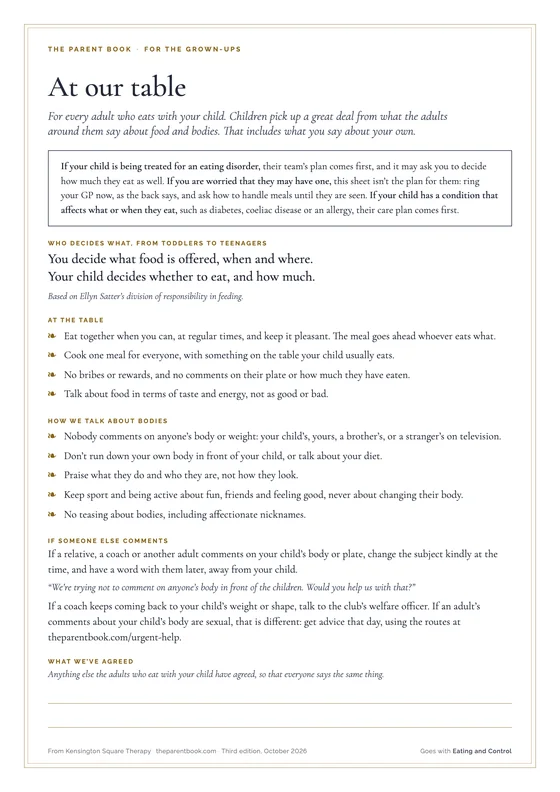
The single most useful piece of furniture a household can install here is the absence of diet talk at the table. Not the absence of healthy eating; that is a different and easier conversation. The absence of the moral vocabulary about food and bodies that turns the dinner table into a low-grade ongoing trial. Clean. Bad. Naughty. “I shouldn’t”. “I’m being good today”. “I’ll have to make up for this tomorrow”. None of this is necessary, and all of it is corrosive to the child watching.
The replacement is a slower, quieter form of speech about bodies and food. Food is food. The body is the body. Neither is being scored. The parent who can hold the table at this lower register for a year finds, by the end of it, that the children at the table have a calmer relationship with food and with their own bodies than they had at the start. The change is glacial; the direction is unmistakable.
A few specifics.
The mirror moment. When the urge rises to say something disparaging about your own body in front of the child, swallow the sentence. Do not substitute a forced positive sentence; you do not have to perform body love you do not feel. Silence in front of the mirror is the new house rule. The child registers the absence.
The changing room. The instinct is to comment on whether things suit, flatter, slim, lengthen. Stop using flattening language altogether. “Do you like them. Are they comfortable. Do they feel like you.” The vocabulary of comfort and identity rather than the vocabulary of figure correction.
The supermarket. The aisle conversation about what is in things, what is better, what is bad. Talk about food in terms of taste, energy, what we feel like, what we are going to do this afternoon. I want something filling because we are walking the dog. “I want something light because it is hot”. Function rather than moral status.
The first time she asks. Most children, somewhere between six and ten, ask the question. “Am I fat. Am I too tall. Am I the wrong shape.” The instinct is to answer with a vehement no. A calmer answer does more. “No, your body is the body of a nine-year-old, and it is doing its job. Why are you asking.” The second sentence is the one that matters. It opens the door to whatever has prompted the question, which is almost never about her body in isolation; it is about something said, by another child, or by an adult, or by an algorithm, that she is trying to make sense of.
The repair when you have already said the thing
The parent reading this has, in most cases, already said the thing. The diet remark, the changing room comment, the sigh at the mirror. The script has been running for years before she ever thought about whether it was running.
The repair is small and unceremonious. The child does not need a sit-down conversation in which the parent apologises for thirty years of inherited body talk; that would put her in the role of confessor, which is not hers. What she needs is the new pattern, starting now, without comment. The diet talk stops. The mirror remarks stop. Six months later, if she remarks on the change, the parent can name it lightly. “I have been trying not to talk about bodies so much. I think I picked it up from my mother and I do not want to pass it on.” Brief, honest, and located in the right place. Not a confession; a piece of information about a household value the parent is, deliberately, changing.
Philippa Perry’s The Book You Wish Your Parents Had Read is the book we keep putting in parents’ hands at this point. The chapter on what we pass on without meaning to is the cleanest piece of writing we know on why this matters, and on why it is not a moral failing to discover, at forty, that one has been carrying a script one did not write.
When the picture is more than body unease
Body unease and a clinical eating disorder are not the same thing. Most children pass through phases of body discomfort that do not tip into restrictive behaviour, compulsive exercise, or hidden food rules. Some do tip. If you are seeing the cluster set out in the eating chapter (creeping restriction, weight loss, food hidden or moved, a developing moralistic vocabulary about food, withdrawal from family meals, secret rule-bound exercise, mood flattening alongside changes in eating), the picture has tipped into a different conversation, and the right move is not to wait. BEAT, the UK’s eating disorders charity, is the right specialist line in that conversation; their helpline for England is on 0808 801 0677, Monday to Friday 3pm to 8pm, with separate lines for Scotland, Wales and Northern Ireland. The GP is the gateway to NHS routes including the local children’s eating disorder service. Early intervention changes the trajectory. The eating chapter in this book covers that ground in detail.
The body-image conversation in this chapter is the lower-acuity end of that spectrum: a child whose relationship with her body has become uncomfortable, who is making remarks about herself that the parent has not heard before, who is comparing herself to peers or to images online with a frequency that has begun to colour her mood. This is where a parent’s choices in the kitchen and at the mirror make the largest single difference. Where the cluster has crossed into what the eating chapter describes, the response has to broaden, fast.
At different ages
The body conversation is a different conversation at four, at nine, and at fifteen. The bands below are descriptions, not boxes; some children meet the body conversation earlier than the band suggests, others later.
If your child is between four and seven. The body in this band is, for the child, the body of an experiment in what she can do. She runs, climbs, dances, falls. Talk about her body in terms of what it lets her do. Strong legs. Good climbing arms. Fast. Not as a self-esteem programme; as a description of fact. Avoid commenting on her appearance as the first thing you say when she comes downstairs in the morning. You look so pretty in that dress installs the idea that being looked at is the test she is passing or failing. “Are you ready for breakfast” installs nothing of the sort. The compliment is not banned; it is moved from the centre of the conversation to the edge of it.
If your child is between seven and nine. Comparison begins. She is looking at the other children at school and registering who is taller, who is faster, who has the right shoes. Take the comparisons she names at face value and refuse to escalate them. “Yes, Eva is taller than you. She has been taller since reception.” Said calmly, without competitive reassurance, without making her body a project for the family. The school nurse is, in this band, an underused resource; if the child has questions about her growing body that you are not sure how to answer, the school nurse can take the question with calm professional ease, and is the right route for any concern about growth, weight, or puberty that has begun to worry you.
If your child is between nine and eleven. Pre-secondary self-consciousness arrives, often with a small surge of body criticism. She looks in the mirror differently. She asks the am I fat question, or its quieter sister, “I do not like my legs”. Take the question at face value, answer briefly, and stay curious about what lies behind it. “Why do you ask. Did someone say something.” If a particular peer is making remarks, that is a different conversation, and the school’s pastoral lead is the right route. Where a child this age is becoming entrenched in body criticism, your GP is the entry into NHS routes; the GP-to-CAMHS pathway is not only for eating disorders but for any mood concern that has begun to accompany the body talk.
If your child is in early secondary, eleven to thirteen. The peer-group conversation about bodies is now loud, and it is now also online. She is encountering images, comments, jokes about bodies in a daily volume the previous generation did not. Two things help. One: keep the house language about bodies quiet and unmoralised, with all the adults in the house sticking to it. Two: be curious about what she is seeing, sideways, not at her. “I read a thing about TikTok this week. What do you make of how people talk about their bodies on there.” Not interrogation; an invitation. If you have not seen the body content she is encountering, ask her to show you on a Sunday afternoon. The five minutes she spends showing you what she watches will tell you more about her body picture than an hour of asking.
If your child is in mid to late secondary, thirteen to sixteen. The autonomy is real and is not yours to override. What you can offer is a household in which her body is not, daily, being commented on by anyone. Not by you, not by the other parent, not by older siblings making the jokes that older siblings make. The school nurse remains a useful route for physical-health questions; the school’s pastoral lead and DSL are the right route if you have any reason to suspect that body image has tipped into restrictive eating, self-harm, or distress she has not been able to bring to you. Schools have safeguarding infrastructure for exactly this picture; you are not bypassing your child by raising a concern with the DSL, you are bringing another reliable adult into her support.
If your child is sixteen and beyond. Conversations are increasingly adult-to-adult. You can, in this band, talk more directly about your own work on this if she asks. “I have been trying not to talk about bodies the way my mother did. I do not always manage. I am working on it.” The honesty about your own inheritance, briefly named, is the modelling she needs to do the same in her own adult life. The BACP and NCPS therapist directories list counsellors working with young adults on body image and food; if she would benefit from someone outside the family, that is the route.
Boys, and the conversation that gets had less
Body-image work is often pitched at parents of daughters. The clinical picture is wider. Boys are increasingly affected by body comparison, with the muscle-and-leanness target arriving in their feeds with the same algorithmic weight as the thinness target in their sisters’. The Mental Health Foundation’s body-image work names this clearly. The same household rules apply: no commentary on his body or on anyone else’s, no diet talk, no muscle talk that sounds like a verdict. If a son is pursuing leanness and muscle in a way that has tipped into compulsive exercise, restricted eating, or supplement use that worries you, the eating-and-control chapter is where you are, and the BEAT line and the GP route apply equally.
The school, and when to bring it in
Where a body-image picture has tipped into something the parent cannot manage on her own, the school is a partner. The school nurse is the calm first stop for physical-health questions. The pastoral lead or form tutor knows the social weather of the year group and may have noticed things you have not. The Designated Safeguarding Lead (DSL), every UK school has one, is the right adult to bring into the conversation when body image has intersected with anything that has begun to worry you as a safeguarding question: restrictive eating, hidden self-harm, online content directed at the child that has begun to shape how she sees herself. Raising the concern with the DSL is not an escalation that takes the situation out of your hands; it is the partnership that means another professional adult, in the building she is in five days a week, knows what to watch for and how.
The longer arc
A child makes peace with her body slowly, over decades. The parent’s job is not to complete that peace by the time she leaves the house; it is to make sure the adults inside the house have not, at least, actively interfered with it. The mirror remarks not made. The diet talk not had. The commentary not delivered. These absences, year on year, become the texture of a different upbringing from the one the parent had herself.
The mother in the changing room on Saturday, who said the wrong sentence and noticed, has already done the most important thing this chapter can ask of her. She noticed. What matters now is the next sentence she does not say, and the mirror she stands in front of next week, in front of her daughter, without sighing. The pattern lives in the daily small absences. Across years, the absences add up to a different inheritance.
You are allowed to be the parent who decides not to pass this on. That is, in fact, the most useful piece of permission this chapter can give you.
NOTES
- Perry, Philippa. The Book You Wish Your Parents Had Read (and Your Children Will Be Glad That You Did). Penguin Life, 2019. Perry’s account of the rupture-and-repair cycle and the practice of catching ourselves in our own reactivity.
Where to go further
Philippa Perry, The Book You Wish Your Parents Had Read (and Your Children Will Be Glad That You Did) Named in the body of this chapter. The clearest writing we know on the patterns parents carry without meaning to, and on how a parent recognises and stops the inheritance she was not, herself, given the chance to refuse.
Susie Orbach, Bodies A UK psychotherapist on the relationship between bodies, culture, and the inner life across a lifetime. Heavier than a parenting primer; useful for the parent who wants to read seriously about why the changing-room sentence travels the way it does.
What helps around bodies and food talk
Most of this conversation happens without anyone deciding to have it. The work is in what the household stops saying.
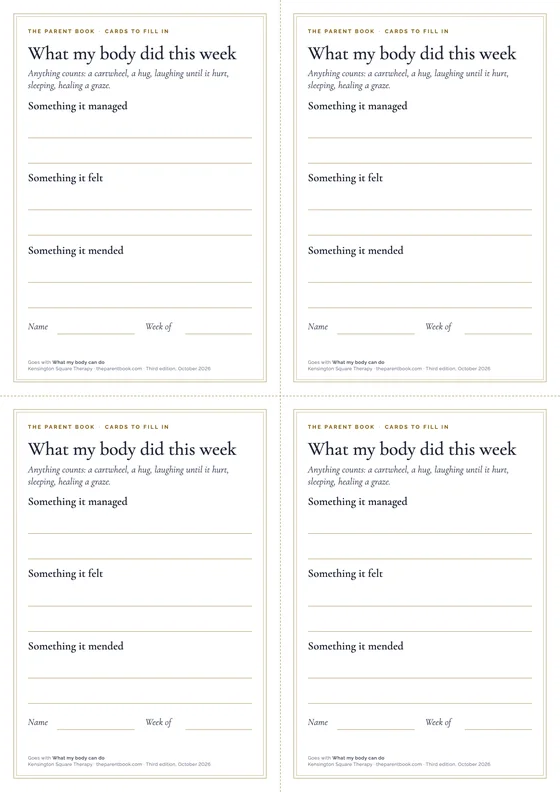
- Install the no-diet-talk rule. No clean, bad, naughty, no “I shouldn’t”. Food is food, the body is the body, and nothing at the table is being scored.
- Go silent at the mirror. You do not have to perform body-love you do not feel. Swallow the disparaging sentence; the child registers the absence.
- Swap figure-talk for comfort-talk. In the changing room: “Do you like them. Are they comfortable. Do they feel like you.” Comfort and identity, not figure correction.
- Repair without ceremony. The diet talk simply stops. Months later, name it lightly, once: a piece of information about a household value you are deliberately changing, not a confession.
More one-minute pieces, for when you need one
External support
Mental Health Foundation
A research and policy charity with strong family-focused resources.
Family Lives
A free confidential helpline for any parenting concern.
0808 800 2222 · Mon-Fri 9am-9pm; weekends 10am-3pm