The Parent Book.
Therapist-written support for parents
Urgent help

The Parent Book·From the library

The Hour Before Bed

A chapter for parents whose evenings have stopped working.

A thirteen-minute read · Published 25 May 2026

By seven in the evening, the parent has nothing left. The pasta has been made and rejected. The bath has happened. The teeth, mostly. And now the child, who was running around the kitchen with a sock on her head ten minutes ago, is sitting on the edge of the bed with very large eyes saying she does not feel well, that there is a knot in her tummy, that could you stay just a bit longer, what was that noise outside, why does the radiator make that sound, is the door closed properly, what if she has a bad dream.

The parent, who only wants to go downstairs and eat something standing up at the counter, is now sitting on the edge of the bed wondering how this is, somehow, the third time this week it has gone like this.

We see this hour, in some form, in almost every parent we work with who has a child between the ages of three and ten. It does not look the same in every house. In some it is the long unravelling described above; in others, the child who is fine, fine, fine, and then becomes incandescent with fury about a sock; in others, the older child who turns at the bedroom door and asks a question that turns out to take forty minutes to answer. What is consistent is that the hour before bed has stopped being an hour about sleep. It has become an hour about something else.

What is actually happening

A child who has held herself together at school all day is, by six in the evening, running on the last of her reserves. She has navigated playground politics, sat still when she did not want to, managed somehow not to cry when the friend she wanted to sit next to sat next to somebody else. She has held all of this, and she has held it well, because the social cost of not holding it is too high. By the time she gets home, she is depleted. By the time the bath is over, the holding is over too.

What happens next, in clinical language, is that the child off-loads. What happens next, in the language of the actual bedroom, is that every small worry she has been carrying since breakfast surfaces, more or less at once, and is presented to the only person safe enough to receive it. The fact that the parent is also the most depleted person in the house is irrelevant to the child’s nervous system. The child is not depositing her worries with you because you have capacity. She is depositing them with you because you are safe.

It helps to separate two sentences that often look the same on the surface. The first is “I cannot sleep”. The second is “I do not want you to leave”. They sound similar and ask for the same intervention, which is the parent’s presence. But they are different in what they say about the child’s inner life. “I cannot sleep” is usually a sensory or arousal problem: the body is too awake, the room is too hot, there has been screen time too close to bedtime, and the child is in a state of mild physiological activation she does not have the vocabulary for. “I do not want you to leave” is something else. It is the small child’s wholly reasonable observation that the world is large, that she is small in it, and that the adult who has held the day together is about to walk out of the room. The first wants a slower routine. The second wants you.

What to do, and what not to do

The bedtime industry will tell the exhausted parent to add structure: another step in the routine, a new wind-down protocol, a different light bulb. The parent reading the article at midnight usually has a perfectly good routine, and the problem is not the routine. The practical thing, in our experience, is about the parent’s pace, not the child’s environment.

A child who is off-loading needs a slower bedtime, not a faster one. The difference is the parent’s nervous system in the room. A parent sitting on the edge of the bed thinking about the washing-up is one the child can feel is not, in any settling sense, present, and she will keep talking until the parent actually arrives. The summoning stops when the summoning has worked.

The practical version, in most houses, is mechanical. Put the phone in a drawer in the hallway, not in your pocket. Sit on the edge of the bed rather than at the foot, where the child can feel you but cannot see your eyes flicking. Decide, before you go in, that the twenty minutes is the bedtime, not the prelude to it; you will be downstairs sooner if you stop pretending you are already there. The single most useful sentence parents describe saying is some version of “I am here, you do not need to keep asking”, placed quietly into the air at minute three rather than at minute fifteen, before the tactical questions start. You are not being asked to give more, only to stop the half-presence, which is the most expensive presence of all.

There is a particular pattern parents recognise, which is the small body that will not stay still: the child suddenly extremely interested in standing on the bed, fetching one more soft toy, going to the loo for the third time, finding the other water cup. This is sensory-seeking, not naughtiness: a small body at the end of an over-stimulated day, pushing the activation out through movement because it does not yet know how to push it out through sleep. Give the body what it is asking for before the moment of stillness, not after. Five minutes of jumping on the bed before the lights go down is regulating. The same five minutes after is the bedtime collapsing. Wear out the body, then turn the lights down, then sit on the edge of the bed.

The other recognisable pattern is the tactical question. The child who, having been told goodnight, asks about the radiator, then the dream, then what happens if the door blows open, then whether you love her more than the cat. The questions are real in the moment of asking, but their purpose is to keep you in the room. Answer the first briefly, the second briefly, and then name the pattern, kindly, before the third: “I think you are asking me questions because you want me to stay, and that is allowed. I am going to sit here for five more minutes and not answer any more, and then I am going to go.” You then sit, in silence, for five minutes. The child usually falls asleep before the five minutes are up. Sarah Ockwell-Smith’s writing on gentle bedtimes is, in this territory, the most useable parent-facing material we know in the UK; her framing of respecting a child’s sleep needs without sliding into either cry-it-out or never-leaving-the-room is the one most parents can actually follow on a Tuesday evening.

A second move, less popular but probably more important, is the conversation parents do not have with each other about whose bedtime it is. In two-parent households, the bedtime almost always falls to one parent, often by accident, and then by entrenchment. The parent doing it every night is also, predictably, the parent most depleted by it. Bedtime is a piece of domestic labour that should be shared, not from abstract fairness but because the parent who does it every night with no relief will eventually run out, and the running-out happens in the room with the child. Two nights on, two nights off is, in many households, the most useful change a couple can make to their evenings. The child adapts inside a week.

There is a related pattern, worth naming because it causes a great deal of low-grade Wednesday damage. It is the partner who arrives home at seven forty-five, in the middle of the bedtime that has been wound down for forty minutes, and who, with the best of intentions, opens the bedroom door for a hello and a tickle. The child, who was three minutes from sleep, is now fully awake. The fix, in many houses we know, is the small conversation between adults that says “if I am not downstairs by quarter to eight, do not come up”. The hello becomes a thing that happens at breakfast. The bedtime is allowed to finish.

For parents who want practical material calibrated to primary-age sleep without the marketing register, we send them to Place2Be’s Parenting Smart articles on bedtime and the wind-down hour, written by school-based counsellors and treating the parent as the expert on her own child. The NHS Every Mind Matters pages on children’s sleep are the right pointer for the parent who wants NHS-anchored material to show a sceptical relative or school nurse; for an older child, the NHS short course on sleep is the rare piece of self-help material we have seen a thirteen-year-old actually finish.

At different ages

Bedtime is the most age-dependent territory in the book. The five-year-old and the eleven-year-old need different things from the same hour, and the parent who treats them the same will find one of them shouting. The bands below are inclusive descriptions; some children are in an older band a year or two early, and some are still in the previous one.

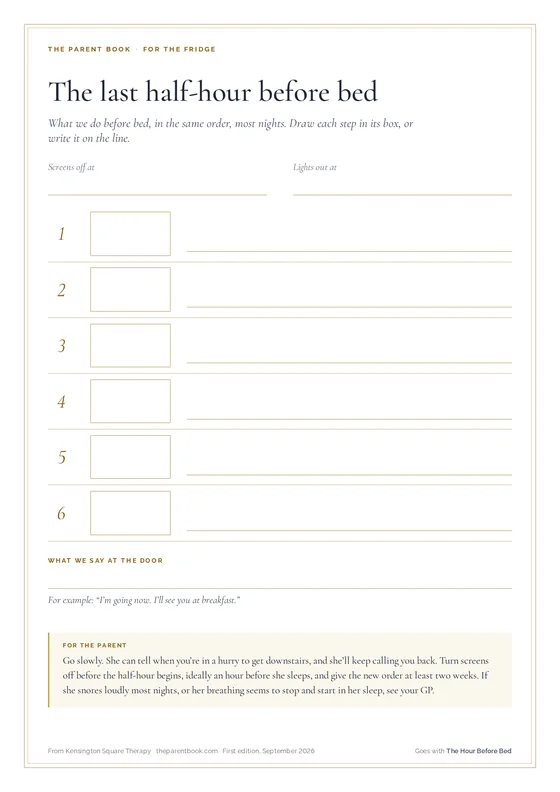
If your child is between four and seven. This is the band this chapter has mostly been describing. The off-loading is at its loudest, the tactical questions are at their most inventive, and the small body cannot yet do what the parent is asking it to do, which is to lie down and wait for sleep to arrive. The answer is presence and predictability. The same wind-down sequence, in the same order, on most nights. The same one or two books, not a new one. The same sentence at the door, said in the same voice. “I am going to go now, and I will see you at breakfast.” The repetition is the medicine. The bedtime story is a sensory routine for the nervous system, not a literary event; the four-year-old does not need a new author this week.

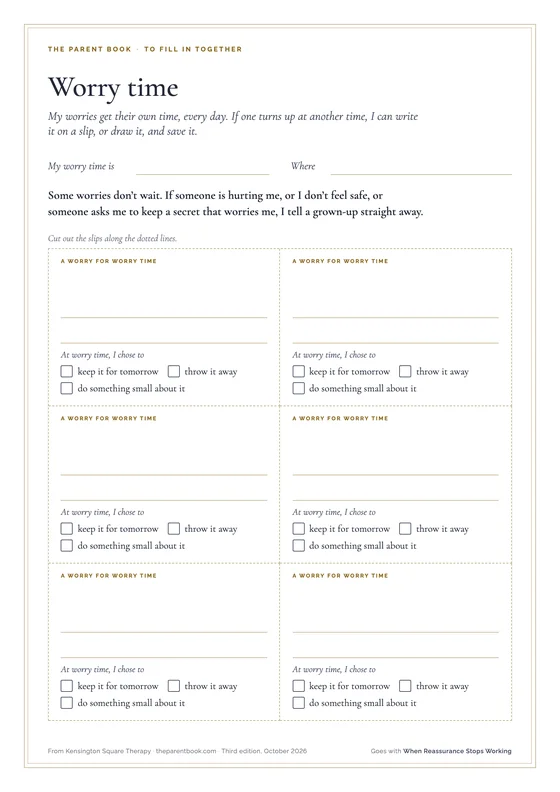
If your child is between seven and nine. The worries arriving at bedtime have started to have shapes. She is now able to tell you, dimly, that she is thinking about the maths test, or the swimming gala, or what Mrs G said in PE. Take the worry seriously without making the bedroom a problem-solving suite. “That sounds hard. We can think about it at breakfast.” Then a hand on the back, a slow exhale, the lamp off. The naming and the deferral are what settle her. The bedtime is the place to put the worry down for the night, not to solve it.

If your child is between nine and eleven. She is now reading in bed. The off-loading still happens, but it has migrated: from the edge of the bed to the doorframe, from the lights-out moment to the moment you have already said goodnight and are halfway down the stairs. Stay near the top of the stairs for a few extra minutes when she has had the kind of day that calls for it, and know that the conversation you most need to have with her this term is happening in the gap between her teeth being brushed and the bedroom light going off. Sit on the floor of the corridor for five minutes if she opens the bedroom door. The kitchen is no longer the right room. The landing is.

If your child is in early secondary, eleven to thirteen. The hour before bed is now the hour she is in her room with the door closed and a phone in her hand. The parent’s job has changed: she is no longer running a bedtime; she is making sure the conditions for sleep are in the room. Do the boring infrastructure the previous bands did not require. All phones, including the parents’, charging on the kitchen counter overnight rather than the bedside table. A properly dark room, blackout if you can. A consistent enough wake-time at weekends that the body clock has a chance. The bedtime conversation, if there is one, happens when she wanders down for a glass of water at half past ten. Be the parent making a cup of tea, not the parent waiting for her.

If your child is mid to late secondary, thirteen and beyond. At this age the parent is, in the practical sense, no longer part of bedtime. She is in bed before her teenager and is woken by the bathroom light at twelve. The chapter is now, mostly, not about her. What remains is the infrastructure: the phone-off-the-bedside-table rule that applies to the whole house, the morning routine that is not so brutal that the week’s sleep debt becomes a separate problem, the conversation at supper rather than at midnight. If a teenager’s sleep has come apart over weeks, sustained insomnia and a flat mood together, that is no longer a bedtime problem; that is a conversation with the GP.

When you have already lost your temper

You will, at some point in this hour, lose your patience. You will say the sharp thing. You will shut the door harder than you meant to. You will stand on the landing afterwards feeling like the worst version of yourself.

Two things about this, plainly. The first is that the hour before bed is the hardest hour of the parental day. It arrives at the moment your reserves are lowest, with a child whose reserves are also lowest, and asks you to be the regulated adult anyway. It is the hour designed to defeat you. The fact that it sometimes does defeat you is evidence only that you are a person doing a hard thing at the end of a long day.

The second is that the repair after the rupture, in attachment terms, gives back more than the rupture took. A parent who comes back into the room ten minutes later, sits on the edge of the bed, and says some version of “I was sharp with you and I am sorry, I was very tired and that is not your fault”, is teaching the child something no calm bedtime ever could. You are aiming not for a bedtime that never breaks but for one in which the breaks are noticed and made good.

The longer arc

The hour before bed will, like every developmental phase, change. The clingy four-year-old becomes the seven-year-old who reads in bed and the eleven-year-old who would prefer you not come in. The off-loading does not stop; it moves. It will surface, in a few years, in the back of the car on the way home from football, or in the kitchen at half past ten when a teenager wanders in for a glass of water and stays for forty minutes. The structure is the same. The child’s worries are looking for a safe place to be put down. The parent’s job is to be the place.

For now, on this Wednesday, the job is to sit on the edge of the bed and not go anywhere for a few more minutes. The washing-up will keep. The child in front of you, with her small face and her enormous evening of feeling, is doing the day’s last piece of work. She is putting it down. You are the place where she puts it.

It is hard, and it matters.

NOTES

  1. Siegel, Daniel J. & Bryson, Tina Payne. The Whole-Brain Child. Bantam, 2011. The “name it to tame it” move and the upstairs/downstairs brain model both originate here.
  2. Ockwell-Smith, Sarah. The Gentle Sleep Book. Piatkus, 2015. Ockwell-Smith’s developmental sleep framework: biologically-normal sleep, not sleep-training problems.

Where to go further

Sarah Ockwell-Smith, The Gentle Sleep Book Named in the body of this chapter. The most useable parent-facing material we know in the UK on respecting a child’s sleep needs without sliding into either cry-it-out or never-leaving-the-room.

Daniel J. Siegel and Tina Payne Bryson, The Whole-Brain Child The cleanest single primer on what is happening in a child’s brain at the end of an over-stimulated day, and on why the parent’s regulated presence does what no instruction can.

Written for each age

What helps a child sleep well

Sleep is more responsive to small, consistent changes than almost any other area of childhood wellbeing. The work is rarely dramatic. Done patiently, the following make a meaningful difference for almost every primary-aged child.

  • Devices out of the bedroom at night. The single biggest sleep intervention any family can make. The dark-bedroom-bright-screen combination is the most disruptive of all. Charge devices in the kitchen overnight.
  • A wind-down routine starting 30 to 45 minutes before bed. Bath, teeth, pyjamas, reading, lights low. The brain reads the sequence as “sleep is coming” and starts releasing melatonin. Predictability is the active ingredient.
  • Cool, dark, quiet bedroom. 16 to 18 degrees. Black-out blinds. No standby lights or digital clocks. A surprising number of sleep difficulties resolve once the room is properly dark and properly cool.
  • Same bedtime, same wake time (even weekends). Children’s sleep architecture is shaped by rhythm. The Saturday lie-in costs more than it gives. Hold the rhythm and the body will hold the sleep.
  • Reading together is the foundational settling moment. Even after children can read alone, being read to a few nights a week into Year 6 is one of the quietest, most settling things a parent can do.
  • Avoid food, drink, or exciting content close to bed. A small snack two hours before bed is fine; the late biscuit is not. Action films at 7pm sit in the body for hours afterwards. The hour before bed is for slow content, or none.
  • Manage night wakings gently, not dramatically. Go to them, brief and quiet. “It’s still night-time. I’m here. Close your eyes.” Bringing them into your bed feels kind at four in the morning and prolongs the problem by months. The going-to-them is the better way.

More one-minute pieces, for when you need one

External support

Place2Be

School-based counselling charity.

place2be.org.uk

NHS Every Mind Matters

The NHS self-help hub.

nhs.uk

Family Lives

A free confidential helpline for any parenting concern.

0808 800 2222 · Mon-Fri 9am-9pm; weekends 10am-3pm

familylives.org.uk

Kensington Square Therapy is a specialist therapy service for the independent school sector and the editorial home of The Parent Book. The Parent Book is written by qualified therapists registered with the BACP and NCPS, drawing on over a decade of clinical work with children, young people, parents, and schools across the prep and senior school years.

If you need help right now Tap for helplines
If you need help right now
If you or your child is in immediate danger999 · Call 999 · Go to your nearest A&E · 24/7
If you, or your child, is in mental health crisisNHS 111 · England, Scotland and Wales: call 111 and choose the mental-health option. Northern Ireland: call Lifeline on 0808 808 8000 · 24/7
If your child or young person is having thoughts of suicidePapyrus HopeLine 24/7 · 0300 102 2470 · text HOPE to 88247 · 24/7, every day · pat@papyrus-uk.org · Text and email replies may take up to 24 hours.
If your child needs to talk to someone themselvesChildline · 0800 1111 · 24/7
If you are worried that a child is being harmed or is at riskNSPCC Helpline · 0808 800 5000 · Mon-Fri 10am-4pm by phone; email 11am-4pm, seven days a week. An email sent when the service is closed is not received. · help@nspcc.org.uk · If the NSPCC service is closed and the concern cannot wait, call the police on 101. You can also contact the child’s local out-of-hours children’s social care, social work or social services team. If a child is in immediate danger, call 999.
If you would prefer to text rather than speakShout · Text SHOUT to 85258 · 24/7
If you are struggling yourself and need to talkSamaritans · 116 123 · 24/7

The rest of the library

This is one chapter of a library written by therapists.

The Parent Book is a library of chapters, quick reads and audio, written by therapists who work with children and parents every week. If this one helped, the rest is here.