The Parent Book·From the library
When You Are Not All Right
For parents whose own mental health is part of what’s going on at home.
An eighteen-minute read · Published 23 September 2026
Most of the chapters in this library are about your child. This one is about you, which means it’s about her too.
If you’ve come to it because you’re having a hard time, that’s where we’ll start.
Low mood, anxiety and depression are among the commonest things parents struggle with, and among the least talked about with other parents. In the most recent national survey, one adult in five in England had a common mental health condition. Among children in UK GP records, around one in four had a mother who was being treated for, or had been diagnosed with, a mental health condition at any one time. You’re far from the only parent reading a chapter like this one.
If you’re struggling, that doesn’t mean you’re failing your child. Most parents who live with a mental health condition go on providing a safe and loving home. Whether a parent is unwell makes a difference to children, but so does what happens around it: whether they’re told something true, whether there’s another adult they can rely on, whether the parent gets help, and whether everyday life at home keeps going. You can influence every one of those, even in a bad week.
What she sees, and what she makes of it
Children notice more than we think, and usually sooner. They notice when a door stays closed in the afternoon, when your voice goes flat, when you start having early nights, when you snap at bath time in a way that isn’t like you, and when you take a phone call out in the garden. They may not have the words for any of it. Even so, the guidance written for families like yours, from YoungMinds to the charity Our Time, agrees that children are more aware than their parents imagine.
A child who can see that something is wrong, and is told nothing, doesn’t stop thinking about it. She fills the gap with an explanation of her own, and children tend to come up with the same few.
The first is that it’s her fault: that she was too loud, too much, not good enough, and that this is why you’re sad. The second is that it’s her job to make it better, which is how some children become very quiet, very good and very helpful, all at once. The third, often left unsaid, is a fear about herself: that it might be catching, or that it will happen to her too.
None of these explanations is true, and every one of them is worse for her than the truth. A 2017 leaflet for parents from the Royal College of Psychiatrists calls secrecy, however lovingly meant, a mistake that makes it harder for children to cope. When nobody tells her anything, the story she tells herself often makes her the one to blame.
What to tell her, and how
There’s no research-tested script for this, and no right age for it. But the charities and clinicians who work with these families broadly agree on how to go about it.
Decide before you start what you’ll say and what you won’t. YoungMinds suggests writing it down, or saying it once to a friend first, and in our experience parents who do this find the conversation shorter and kinder than they feared. Choose a time when neither of you is upset and, if it helps, somewhere you can be side by side: on a walk, on a drive, or doing the washing-up.
You don’t need to say everything at once. If you say something small and true, calmly, you can add to it later. Something big said in distress is harder to take back. The Conversations Parents Avoid is about telling a child something hard in the course of everyday life, and much of it applies here.
What most children need to hear comes down to a few things, in words that fit their age. Tell them you’re not well at the moment, and that it has a name, or at least that it’s a kind of illness that affects how you feel. Tell them it isn’t their fault, and that nothing they did or didn’t do caused it; that it isn’t their job to make you better; and that it isn’t catching, and doesn’t have to happen to them. Tell them grown-ups are helping: a doctor, a counsellor, the other parent, a grandparent. And tell them you love them. Of all of these, that’s the one parents most often assume goes without saying, and the one children most often need to hear.
Then tell them two more things: that they can ask you questions, now or later, and that there’s another adult they can talk to as well. Name that person. When a parent is struggling, it helps a child a great deal to have someone else she trusts.
Some things aren’t hers to deal with. The detail of your darkest thoughts, the fears you bring to your own therapy, the state of your relationship: these belong with adults. Telling her the truth doesn’t mean telling her everything.
Keep the conversation going; it’s a subject you can both return to. You don’t have to be a parent who never snaps, but after a bad moment, come back and explain it: I was short with you this morning. That was because of how I was feeling, not because of anything you did. I’m sorry.
The week you are not all right
Some weeks are harder than others, and it helps to decide in a better week what a hard one will look like.
Make the day smaller. Supper can be toast and a film, and the bath can be skipped. If you can, protect the few things that tell a child the world is still in order: getting to school, bedtime at roughly the usual time, and ten minutes of your attention at the end of the day. With those in place, a child can manage a great deal of plainness in the rest of the day. What unsettles her is losing those as well.
Bring in the other adults, and do it early. A study in Wales followed the children of parents with recurring depression over four years and found five things that went with a child staying well: the other parent’s support for the child, the warm way the ill parent spoke about her, the child’s own friendships, her sense that she could manage things, and regular exercise. The more of those a child had, the better she tended to do. Most of the five don’t depend on your being well all the time, and the first depends on letting someone else in.
Coram Family Lives suggests agreeing a plan with your children for the bad times, and we’d add only that it’s best made in a good week. Agree who they can call, who will do the school run if you can’t, and what you’ll say to each other on a hard day, so that nobody has to guess. What they should do if they are ever frightened for you: call for emergency help first if they cannot wake you, you are hurt, or they think you are in danger, and then ring the adult named on the plan. A plan made calmly is a comfort in itself, and it means that when a bad day comes, the family has already thought about it.
Rest when you can. Anna Freud’s guidance for parents on looking after themselves puts it simply: taking time for yourself isn’t selfish, and asking for help is nothing to be ashamed of.
Medication in the house
If you take medication, the question of where it lives deserves a few minutes of attention, once, so that it can stop needing any.
Keep medicines out of children’s sight and out of their reach, ideally in a locked cupboard, and in a room where an adult is usually around. The places that catch families out are tablets left out on a bedside table, or loose in a handbag on the floor. Child-resistant caps slow a child down, but they will not always stop one, so they are not a substitute for putting things away. Your own prescription belongs there too, whatever it is. Take anything out of date, or no longer needed, back to a pharmacist. And never describe medicine to a small child as a sweet or a treat.
There’s also your child’s role to think about. An older child may know what you take and why, and a teenager may reasonably know how to reach your doctor or your care team. That is different from her being responsible for your medication, or for watching over you. Giving a parent their medication is among the tasks guidance in England names as ones that may be inappropriate for a child.
When helping becomes caring
When a parent is unwell, children usually help more. They make the tea, keep an eye on a younger sibling, notice when you’re tired and turn the television down. Much of this is just part of family life, and some of it is good for them: children who contribute feel useful and trusted.
What to watch for is the point where helping turns into being responsible for you. In England, a child who provides care to someone, including emotional support, is in law a young carer, and that in itself isn’t a problem. The government’s own guidance is concerned about care that is excessive or unsuitable for her age. Its examples include personal care, running the household budget, giving medication and giving emotional support to the adult. In our experience, the line on emotional support is crossed when a child has become the person her parent leans on.
The signs that it has become too much usually show up in her own life: she’s missing school, she has stopped seeing friends, she’s tired in a way that isn’t explained by her own late nights, or she won’t go on a sleepover because she doesn’t want to leave you.
A child who sometimes comforts a parent who is sad is not being harmed by that alone. If you recognise those signs, you haven’t done anything shameful. They mean the adults around you need to take on more, and that she might need some support of her own. In England, your local authority must assess a young carer’s needs if she or you ask, and her school may have someone who leads on young carers and is worth telling either way. When Parents Separate has more on the child who is drawn into being a parent’s confidant.
When your own history is in the room
For some parents, part of the difficulty goes back to the parent they had.
If you grew up with a mother or father who was unwell, you may find that the hardest moments with your own child are the ones that sound like your childhood: the silence at the table, the child tiptoeing, your own voice coming out in your mother’s tone. This is one of the most common things parents bring to us, and one of the most painful, because it comes with a particular fear: that you’re passing on what was passed to you.
That isn’t the whole story, though. Clinicians have long written about the ghosts in the nursery, the old fears that can pass from one generation to the next. More recently, clinicians have proposed a counterpart they call the angels in the nursery: memories of having been understood and cared for as a child, which they argue can help a parent break the pattern. Most of us have both. A counsellor can help you notice which one is in the room, and choose between them.
If you read one thing on this, make it Philippa Perry’s The Book You Wish Your Parents Had Read, which is clear about how the patterns we inherit show up, and kind to the parent who finds them in herself.
Getting help for yourself
The most reassuring finding is that when a parent’s depression is treated and lifts, children tend to do better too. In one American study, when mothers’ depression went into remission with treatment, their children’s own difficulties eased. A recent review of trials found that talking therapy for depressed mothers probably brings small benefits for their children, as well as larger ones for the mothers themselves. If your own treatment is taking longer to work, that’s common, and everything else in this chapter goes on helping her while it does. Looking after your own mental health is one of the most direct ways of looking after hers.
If you’re already under a mental health team, they’re your first call. For most other people, the first step is the GP, who can talk through what’s happening and refer you on. In England you can also refer yourself to NHS Talking Therapies, without a GP appointment, for anxiety and depression, including postnatal depression, and other common difficulties; the NHS website will find your local service. In Scotland, NHS 24’s Living Life service takes self-referrals by phone; in Wales, the NHS offers online therapy you can refer yourself to; in Northern Ireland the route is through your GP.
If the difficulty began in pregnancy or since the birth, your midwife or health visitor is another way in, and the PANDAS Foundation supports parents, including fathers and partners, through the perinatal years. If something changes suddenly and severely in the weeks after a birth, do not wait for an appointment: use the urgent routes on this page. If you’d rather see someone privately, our page on finding a therapist explains how to check that a counsellor is properly registered and trained.
Many parents hold back from asking for help because of a fear they rarely say out loud: that if they admit how bad things are, someone will decide they can’t look after their children. Writing about postnatal depression, the NHS calls that fear understandable and the outcome very rare. Mind is clear that children are taken into care only in extreme circumstances, and that contact with social services is not the same as having children removed. The Mental Health Foundation puts it most simply: asking for help is a sign of being a good parent.
At different ages
What you tell a child, and how, changes with her age. The guidance here comes from the charities and clinicians who work with these families; it isn’t based on trials. Go by what she understands, more than by how old she is.
If your child is under five. Routine matters more than words at this age. A simple, calm explanation in the language of feelings is enough: I’m feeling very tired and sad at the moment, and I need some rest. It’s not because of anything you did. Granny is going to do bath time tonight. What protects a small child most is care she can rely on, from you on your better days and from another adult she knows well on your harder ones.
If your child is between five and eleven. She can take a little more, and she needs it, because by now she’ll hear things at school. You might name the illness and explain simply how it affects you: that it makes you tired, or worried, or short-tempered, and that this is the illness, not how you feel about her. Say clearly that it isn’t her fault and isn’t her job to fix, and give her enough plain facts to set against anything a friend says in the playground. Ask her what she has noticed; you may be surprised by how much.
If your child is between eleven and fourteen. She can hear more about the condition and how you’re managing it, and she’ll want to know what it means for the family: who will do what, and whether things will change. Many children this age start taking on responsibility without drawing attention to it. Watch for this, and keep telling her it isn’t her job. If you think it would help to tell her school, talk to her first about what you’ll say.
If your child is fourteen or older. Teenagers can be given real information, and they’ll look it up whatever you do, so it’s better that they hear it from you first. You might talk about what the illness is, how treatment works, and what a bad day looks like. You can be honest that it’s hard. What you should still keep to yourself is detail that would frighten her or make her feel responsible, including any thoughts you have had of harming yourself, which belong with your GP, your counsellor or another adult, and the part of your own story that belongs in your own therapy. Older teenagers sometimes worry, without saying so, about whether they’ll become unwell too. If she has read that it can run in families, that’s true, but it isn’t a prediction: having a parent who is ill doesn’t mean she will be, and much of what protects her is in her own life.
The longer arc
Children who grow up with a parent who is sometimes unwell don’t all turn out the same, and many come through it well. Difficulties are more common in these families, but they aren’t inevitable, even when a parent’s illness is severe and recurring, and the research keeps finding that the illness is rarely the whole story.
Nobody is well all the time, and a child doesn’t need you to be. She needs the truth in amounts she can cope with, other adults brought in, and a parent who gets help and comes back after the hard moments. In the weeks when you can’t manage all of that, manage one part of it and let someone else do the rest.
NOTES
- NHS England Digital. Adult Psychiatric Morbidity Survey: Survey of Mental Health and Wellbeing, England, 2023/4, chapter 1, Common mental health conditions. 2025. 20.2 per cent of adults aged 16 and over had a common mental health condition.
- Abel, Kathryn M., et al. “Prevalence of maternal mental illness among children and adolescents in the UK between 2005 and 2017: a national retrospective cohort analysis.” Lancet Public Health30059-3), 2019, 4(6), e291–e300. 23.2 per cent of children aged 0 to 16 had a mother with a diagnosed, recorded or treated mental illness at any one time. Mothers only, and only illness recorded in primary care.
- Anna Freud. Parents and carers with mental health difficulties (for practitioners working with under-fives). Most parents who struggle with their mental health can cope and continue to provide a safe and loving home; the effect on children varies with severity, type, the child’s age and temperament, and protective factors.
- YoungMinds. Parenting with a mental health condition, parents’ A to Z guide, reviewed December 2025. Children notice when something is different at home, and without clear, honest information they fill the gaps or blame themselves. The most detailed parent-facing guidance on telling children: deciding in advance what to say, age-appropriate language, explaining behaviour afterwards, and what to reassure.
- Royal College of Psychiatrists. Parental mental illness: the impact on children and adolescents: for parents, carers and anyone who works with young people. 2017, past its review date. What children worry about (blame, catching it, becoming ill themselves), and why secrecy makes coping harder.
- Our Time. Parenting with a mental illness, brochure for parents, 2024. Children’s common beliefs (guilt, taking responsibility, fear of catching it) and ways to begin the conversation.
- Collishaw, Stephan, et al. “Mental health resilience in the adolescent offspring of parents with depression: a prospective longitudinal study.” Lancet Psychiatry00358-2), 2016, 3(1), 49–57. 262 adolescents in Wales, followed over four years. Five factors predicted sustained good mental health: the depressed parent’s positive expressed emotion about the child, the co-parent’s support for the child, good-quality friendships, self-efficacy and frequent exercise; their effect was cumulative. The study’s strict measure of sustained good mental health should not be read as the proportion of children who have difficulties.
- Coram Family Lives. Parenting when you have a mental health condition, updated February 2026. Agreeing a plan with children for bad times; telling the school.
- Anna Freud. Self-care for parents and carers. Taking time is not selfish; asking for help is nothing to be ashamed of.
- NHS. Medicines for babies and children, reviewed February 2024; Child Accident Prevention Trust, Poisoning prevention; RoSPA, Poisoning. Storage out of sight and reach, child-resistant caps, and disposal through a pharmacist.
- Department of Health and Social Care. Care and support statutory guidance, paragraphs 6.69 to 6.73, updated July 2025; Children Act 1989, section 17ZA, inserted by the Children and Families Act 2014, section 96. The definition of a young carer in England, and the tasks the guidance gives as examples of care that may be inappropriate for a child.
- Lieberman, Alicia F., Padrón, Elena, Van Horn, Patricia & Harris, William W. “Angels in the nursery: the intergenerational transmission of benevolent parental influences.” Infant Mental Health Journal, 2005, 26(6), 504–520. A clinical proposal, the counterpart to Selma Fraiberg’s “ghosts in the nursery”.
- Weissman, Myrna M., et al. “Remissions in maternal depression and child psychopathology: a STAR∗D-child report.” JAMA, 2006, 295(12), 1389–1398. When mothers’ depression remitted with treatment, their children’s diagnoses fell.
- Cuijpers, Pim, et al. “The effects of psychological treatment of maternal depression on children and parental functioning: a meta-analysis.” Journal of the American Academy of Child and Adolescent Psychiatry, 2026. Forty-seven trials in all; small but significant effects on mother and child interaction and, in the ten trials that measured it, on children’s mental health; heterogeneity was high.
- NHS. Talking therapies, reviewed November 2025, and Find NHS talking therapies for anxiety and depression. Self-referral in England. NHS 24, Living Life (Scotland); NHS Wales, SilverCloud online therapy; nidirect (Northern Ireland).
- NHS. Postnatal depression, reviewed March 2026; Mind, Parenting and mental health, June 2023; Mental Health Foundation, Parenting and mental health, February 2022. On the fear of children being taken into care.
Where to go further
YoungMinds, Parenting with a mental health condition The clearest guidance we know of for a parent deciding what to tell a child, and how. It covers what to say at different ages, how to explain a hard moment afterwards, and how to make sure a child isn’t taking on too much. It’s written for parents.
Our Time, information for parents A charity that works only with children and families affected by a parent’s mental illness. Its short page on talking to very young children and its brochure for parents on the fears children commonly have are both clear and kind.
What helps when a parent is struggling
Children in families like yours do best when a few things are in place around them. Most of them don’t depend on your being well all the time, and some depend on letting someone else in.
- Tell her something small and true. Say that you’re not well at the moment, that it isn’t her fault, that it isn’t her job to fix, that it isn’t catching, that grown-ups are helping, and that you love her.
- Name another adult. Make sure she knows who else she can talk to, and that it’s all right to.
- Come back after a hard moment. “I was short with you this morning. That was because of how I was feeling, not because of anything you did. I’m sorry.” Children don’t need a parent who never snaps; they need one who comes back.
- Make a plan in a good week. Who she can call, who does the school run, what you will say to each other on a hard day, and what to do if she is ever frightened for you and cannot reach anyone.
- Keep the basics going. In a bad week, make the day smaller but keep school, a bedtime near the usual time, and ten minutes of your attention.
- Give your medication a proper home. Out of sight and reach, ideally locked, never left out on a bedside table or loose in a handbag. An older child knowing what you take is fine; being responsible for it is not hers to do.
- Get help for yourself. When a parent’s depression is treated and lifts, children tend to do better too. If you are under a mental health team, start there; otherwise the GP is the first step, and in England you can also refer yourself to NHS Talking Therapies.
Put it into practice
What this chapter looks like in practice: one-minute ideas for tonight, things to do together and sheets to print and keep.
Quick tipsOne minute each
- What to Tell Her When You Are UnwellA child who is told nothing makes up her own explanation, and in it she is often to blame.
- When She Is Too Small for the WordsA child under five needs a short, calm explanation and care she can rely on.
- A Plan Made in a Good WeekAgree a plan with your children in a good week, so nobody has to guess on a bad day.
Nine quick tips on this in the library
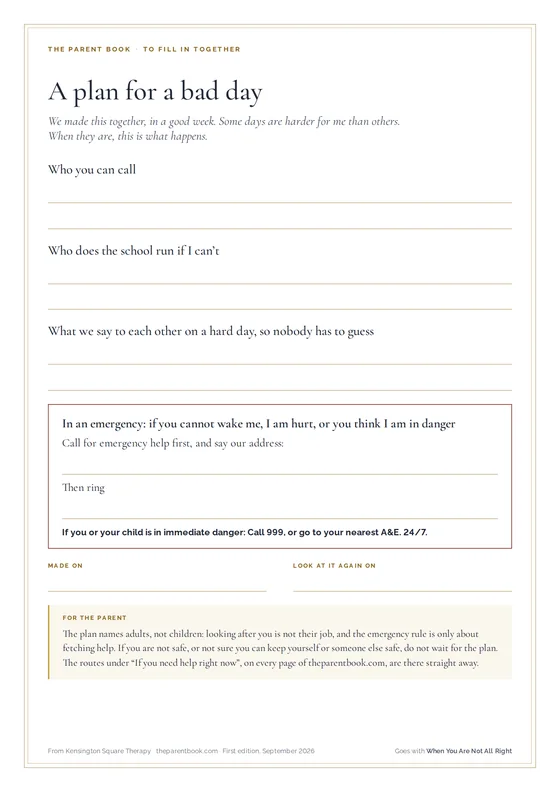
The quick tips and activities are for subscribers; the sheets that go with this chapter are yours to print. What a subscription includes.
Who else can help
YoungMinds
The UK’s young people’s mental health charity, with a free Parents Helpline, webchat and email, and a plain A to Z of the things parents worry about.
0808 802 5544 · Mon, Thu, Fri 9.30am-4pm; Tue, Wed 9.30am-6pm
Outside those hours the parents line is closed. The urgent routes on this page are open when it is not.
Mind
The UK’s mental health charity.
0300 123 3393 · Mon-Fri 9am-6pm (except bank holidays)
Outside those hours the line is closed. Samaritans answer at any hour on 116 123, and Shout answer if you text the word SHOUT to 85258.
PANDAS Foundation
Support for parents, mothers and fathers both, whose mental health has suffered in pregnancy or since the birth: WhatsApp every day, booked calls with trained volunteers, and peer groups.
WhatsApp 8am-10pm every day; free call-backs booked through the website