62 sheets, 12 free
Sheets to print, and to pass on.
Sheets to fill in together, keep on the fridge, or take to a meeting with school or an appointment with the GP. Each goes with a chapter, a quick tip or an activity in the library.
How to use these sheets
Each sheet goes with a chapter, a quick tip or an activity in the library, and is the part you use at home: the plan you make together, the words your child chooses, the notes you take to a meeting. Start with one, the sheet that fits what is happening at home now, and read what it goes with first.
A plan made together on a calm day is easier to follow on a hard one, for both of you. Writing things down gives your child words for what is hard, gives you something to look back on and change, and gives a teacher or a GP the detail they need to help.
Under each sheet are two notes, how it helps and how to use it, and its own page has both in full. None of the sheets is a test or a treatment. Many say when to talk to the school or your GP, and what to do the same day if something your child tells you worries you. Whichever sheet you use, the routes at theparentbook.com/urgent-help are there straight away.
How to print them
Each sheet is a PDF, made to print at home on A4. Choose actual size (100%) in the print settings, so that the cards cut out cleanly. Everything reads as well in black and white as in colour.
A sheet marked two sides is printed on both sides of the paper, flipped on the long edge, so each card’s back sits behind its front. A sheet marked two pages is printed on one side of each page.
Every sheet is dated, and none carries a telephone number except the emergency line, so nothing on the fridge can go out of date without you noticing.
Twelve of the 62 are free to anyone, and each is marked. The others come with a subscription. A sheet is also yours with its chapter, if that is the chapter you read free, and when a teacher or therapist sends you the sheet, or the chapter, tip or activity it goes with. School staff and therapists signed in to their shelf can print every one.
To make and fill in together
Sheets a parent and child make together, on a calm day, and keep.
-
To make together
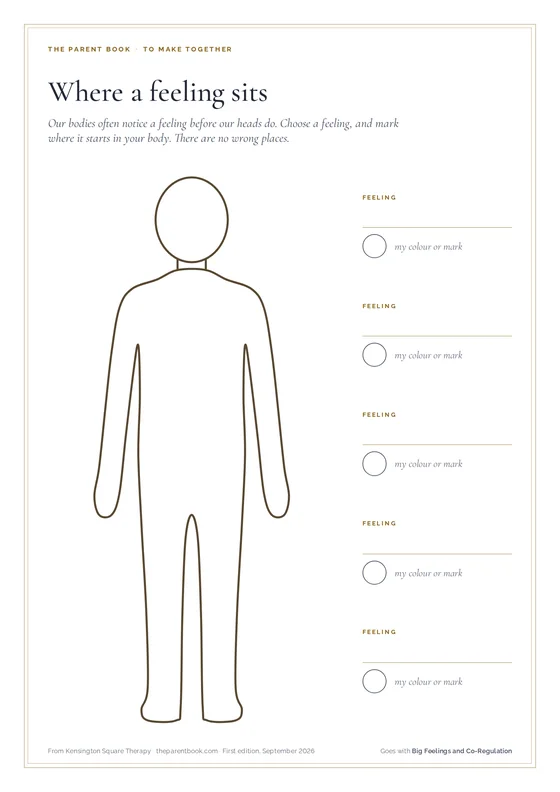
Where a feeling sits
A plain body outline to mark where a feeling starts, with a short list of feeling words on the back.
Goes with Big Feelings and Co-Regulation and Anxiety, by Age
With a subscription
How it helps
Children often notice a feeling in their body before they can name it: a tight chest, a hot face, a churning stomach. Marking where it starts gives them words for it, and an early signal they can learn to notice before the feeling gets too big.
How to use it
- Choose a calm day, not the middle of an upset, and sit down together with some coloured pens.
- Pick one feeling from the words on the back, and ask your child where they notice it first. They choose a colour and mark it, and there are no wrong places.
- If they’re stuck, tell them where yours starts, and make it clear that theirs might be somewhere else. Two or three feelings are plenty for one sitting.
- Keep the sheet, and come back to it after a hard moment: “Where did that one start?” If a stomach ache or headache keeps coming back, see your GP before you put it down to feelings.
- If your child has been through something frightening, take it slowly, and stop if they dislike it. If what they mark or say suggests that someone has hurt them, don’t ask them to show or tell you more: the back says what to do that day.
-
To fill in together
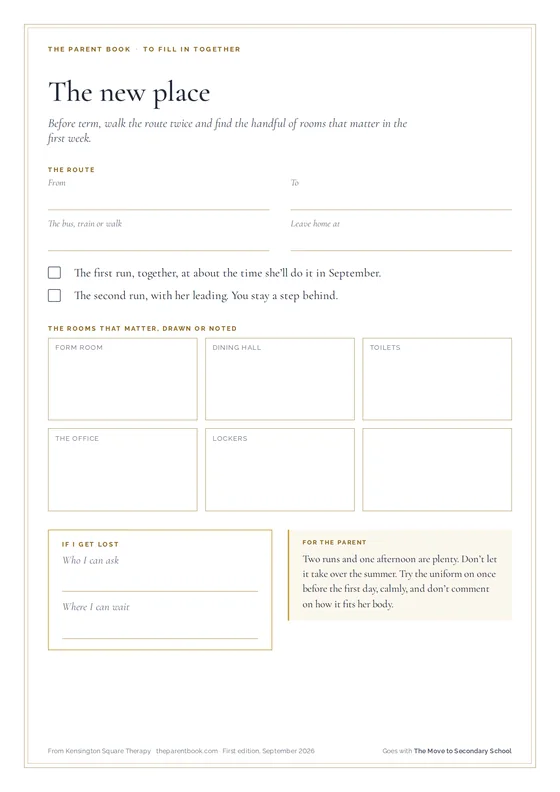
The new place
Before term, walk the route twice, find the handful of rooms that matter in the first week, and plan what your child will do if they get lost.
Goes with The Move to Secondary School
With a subscription
How it helps
Much of a child’s worry before a new school is about not knowing: the way there, where things are, and what to do if they get lost. Doing the route twice and planning for getting lost turns those unknowns into things they have already done and decided.
How to use it
- In the summer before term, do the route with your child twice: once together, at about the time they’ll travel in September, and once with them leading while you stay a step behind.
- From the school’s map or a visit, find the handful of rooms that matter in the first week, and let your child draw or note them on the sheet.
- Fill in the box for getting lost together: who your child can ask, and where they can wait.
- Two runs and one afternoon are plenty, so don’t let it take over the summer. Your child can keep the sheet in their bag for the first week if they like.
-
To fill in together
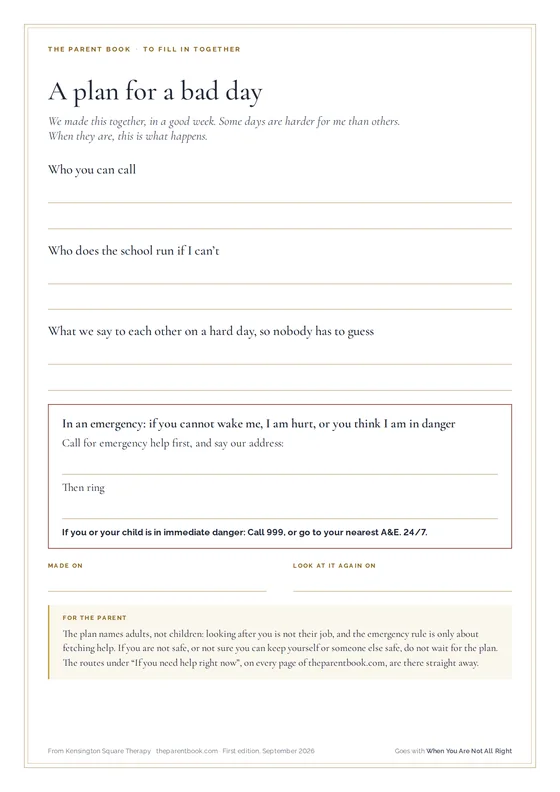
A plan for a bad day
Made together in a good week: who to call, who does the school run, what we say on a hard day, and one rule for an emergency.
Goes with When You Are Not All Right
Free to print
How it helps
When a parent is unwell or struggling, children notice, and they worry most about what will happen. A plan made in a good week tells them, so nobody has to guess on a hard day, and it names the adults who will help, so looking after you never becomes their job.
How to use it
- Fill it in during a good week, with the children and any other adult who is part of the plan.
- Write in the adults they can call and who does the school run, and agree the words you’ll use on a hard day, so nobody has to guess what they mean.
- Go through the emergency rule together. It is only about fetching help, and it is the one part of the plan that asks anything of them.
- Keep it where everyone can find it, and look at it again on the date you wrote. If you are not safe, or not sure you can keep yourself or someone else safe, don’t wait for the plan: use the routes at theparentbook.com/urgent-help straight away.
-
To keep
What I will miss
Two blank pages for the last weeks at a school, for what your child will miss and what they’re looking forward to. The pages are theirs to keep.
Goes with The Move to Secondary School and When a Child Is Grieving
With a subscription
How it helps
Leaving a school is a loss as well as a step forward, even when your child is looking forward to what comes next. Writing or drawing what they’ll miss, beside what they’re looking forward to, lets them feel both, and gives the ending its due.
How to use it
- In the last few weeks at the school, print both pages and leave them with your child, with some pens.
- Your child writes or draws as much or as little as they like. None of it has to be finished, and a page can stay blank.
- Read it only if they offer it to you. The pages are theirs to keep.
- Keep them with your child’s things from that school, somewhere they can find them later.
-
For the kitchen
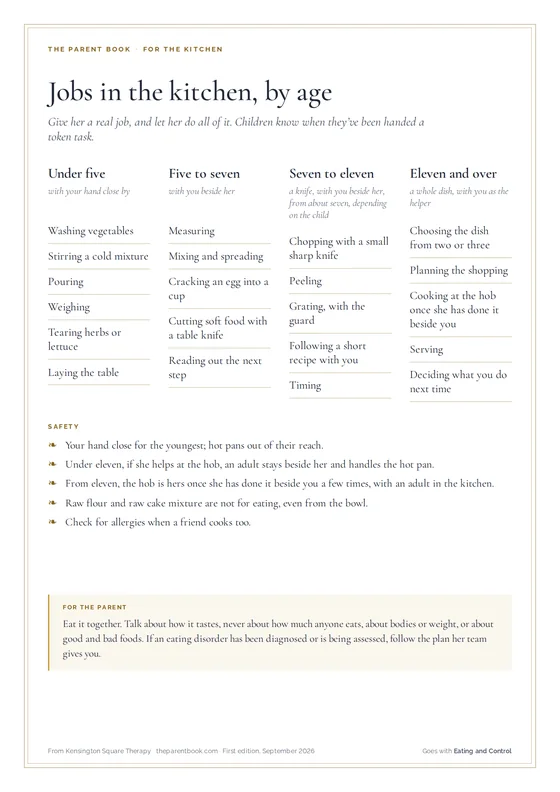
Jobs in the kitchen, by age
Real jobs for a child at each age, with the safety lines that go with them, for cooking one thing together each week.
Goes with When They Stop Talking to You and Eating and Control
With a subscription
How it helps
Cooking one thing together each week gives you time side by side with something to do, which is often when children talk. A real job, done from start to finish, shows your child you trust them, and the list by age says how close to stay.
How to use it
- Put the sheet up where you cook, and find your child’s age on it.
- Choose one thing to cook together each week, and give them a real job from their column, all of it, with you as close by as the sheet says.
- Read the safety lines together first, and check for allergies when a friend cooks too.
- Eat it together afterwards, and talk about how it tastes. Leave out talk of how much anyone eats, of bodies, and of good and bad foods. If an eating disorder has been diagnosed or is being assessed, follow the plan your child’s team gives you.
-
For the fridge
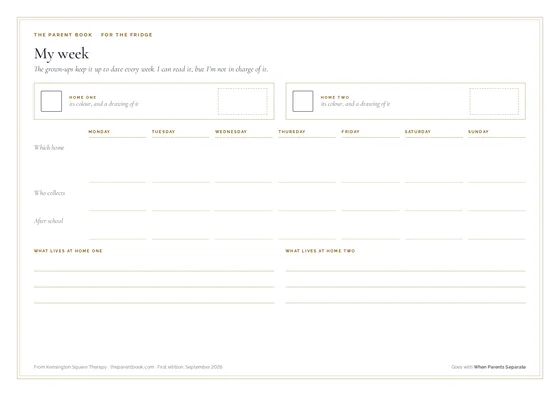
A week across two homes
Your child’s week in colour, made with them and put up at their eye level, with a second page for a holiday. No names or addresses are printed on it.
Goes with When Parents Separate
With a subscription
How it helps
After a separation, children often cope better when they can see where they’ll be each day and who will collect them. A week they can read for themselves, at their eye level, answers their questions before they have to ask them, and makes the move between homes easier to predict.
How to use it
- Agree the dates between the adults first, where you can, and not in front of your child.
- Make the week with your child: a colour and a drawing for each home, then which home each day, who collects, and what lives where.
- Put it up at their eye level, and update it yourself on the same day each week. When something changes, change it with them.
- Use the second page for a holiday, filled in before it begins. Where there are safety concerns about contact, keep addresses and details off the sheet, and don’t post photographs of it.
-
To make together
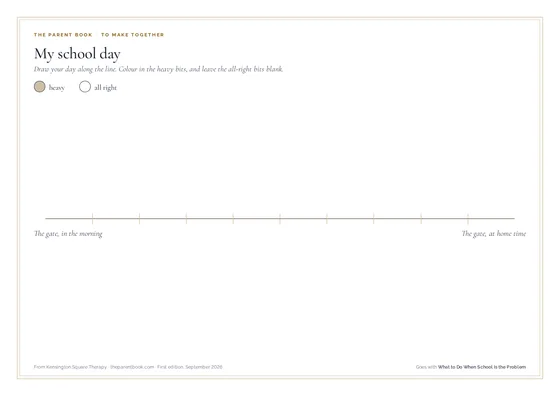
The school day, drawn as a line
Your child draws their day from gate to gate and marks the heavy parts. Your page is for taking one of those moments to the school, and leaving your conclusions out.
Goes with What to Do When School Is the Problem and The Move to Secondary School
With a subscription
How it helps
A child who is struggling at school often can’t say what’s wrong when they are asked. Drawing the day as a line lets them show you which parts are hard, and gives you one specific moment to take to the school, which a teacher can act on.
How to use it
- On a calm afternoon, ask your child to draw their day along the line, from the gate in the morning to the gate at home time.
- They colour in the heavy bits and leave the all-right bits blank. Ask about what they have marked, and take their answer as it comes.
- If your child marks a moment they are frightened of, or one when an adult frightened or hurt them, don’t question your child further, and don’t take it to their class teacher as a question. Thank your child, tell them what you’ll do, and speak to the school’s designated safeguarding lead that day.
- On your page, write down the one moment your child marked, in their words, and what you’ve noticed yourself.
- Tell them what you’ll say before you say it. Then take that one moment to the school, and leave your conclusions out.
-
To fill in together
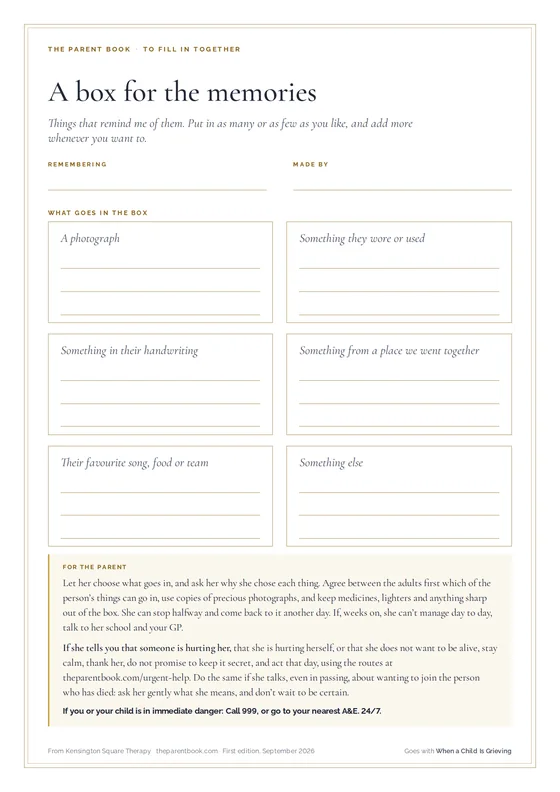
A box for the memories
Two pages to fill in together after a death: what your child would like to put in the box, and what they remember. The second page can go in the box too.
Goes with When a Child Is Grieving
With a subscription
How it helps
After a death, children often worry that they’ll forget the person, or that it isn’t all right to talk about them. A box of things that remind your child, and a page of what they remember, keeps their memories somewhere they can go back to, and gives you a way to talk about the person together.
How to use it
- Find a box together, or let your child choose one, and agree between the adults first which of the person’s things can go in.
- Use the first page to choose what goes in, and ask your child why they chose each thing. Use copies of precious photographs, and keep medicines, lighters and anything sharp out of the box.
- On the second page they write or draw what they remember, or tell you and you write it down. That page can go in the box too.
- Your child can stop halfway and come back another day, and add to the box whenever they want to.
- The sheet says when to talk to your child’s school or your GP, and what to do that day if something they say worries you, including any talk, even in passing, of wanting to join the person who has died.
-
To fill in together
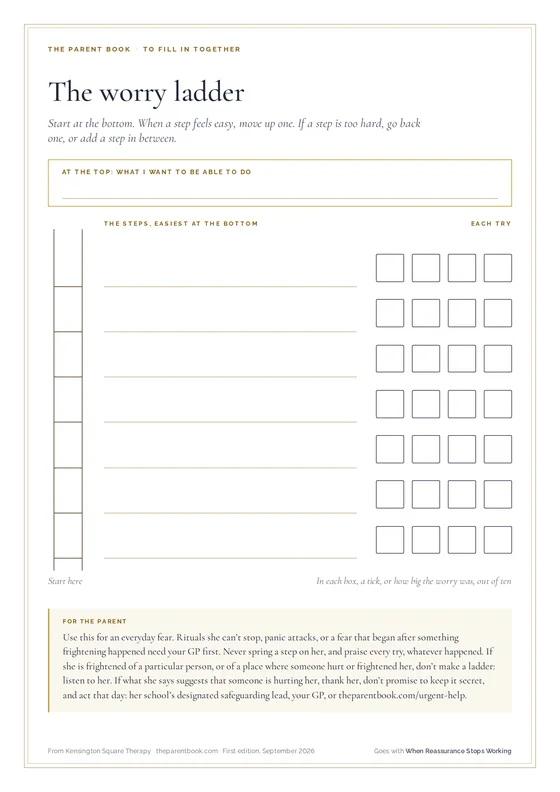
The worry ladder
For an everyday fear: the steps from easiest to hardest, written together, with a box to mark each try.
Goes with When Reassurance Stops Working
Free to print
How it helps
Avoiding an everyday fear tends to make it bigger. Facing it a step at a time, starting with one your child can already manage, lets them find out that the worry usually comes down if they stay with it, and each try tends to make the next step easier.
How to use it
- Use it for an everyday fear, such as dogs, the dark or asking for something in a shop.
- Rituals your child can’t stop, panic attacks, or a fear that began after something frightening happened need your GP first. If your child is frightened of a particular person, or of a place where someone hurt or frightened them, don’t make a ladder: listen to your child, and see the foot of the sheet for what to do that day.
- At the top, write what they’d like to be able to do. Then write the steps together, from easiest at the bottom to hardest at the top.
- Start at the bottom. When a step feels easy, move up one, and if a step is too hard, go back one or add a step in between.
- Mark each try in its box, and praise every try, whatever happened. Never spring a step on your child.
-
To fill in together
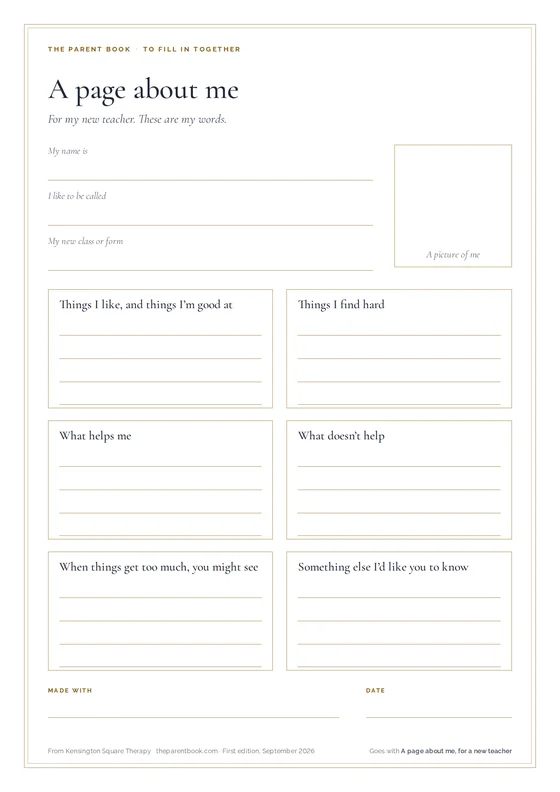
A page about me
A page in your child’s own words for a new teacher: what they enjoy, what they find hard, what helps and what doesn’t. The second page is for you, before you start.
Goes with Neurodiversity, and the Conversation with the School and The Move to Secondary School
With a subscription
How it helps
A new teacher learns about a child from records and first impressions. A page in your child’s own words says what they enjoy, what they find hard and what helps, so the teacher can get it right sooner, and your child knows they have had a say.
How to use it
- Read your page first. It stays at home, and says what to leave off.
- Before term, fill in your child’s page together. They can write, draw, or tell you and let you write, and their words go down as they say them. Start with what they enjoy and are good at.
- Read it back to them before it goes, because nothing goes on it without their agreement.
- Give it to their teacher before term or in the first week, with a line from you, and send a copy to the SENCo if your child has SEN support. Make a new page next year.
-
To fill in together
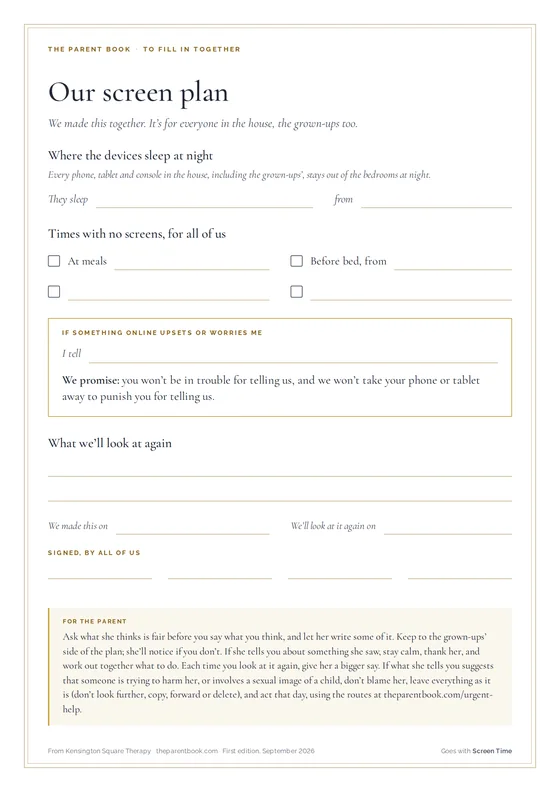
Our screen plan
A family agreement made with your child: where the devices go at night, the times with no screens (the adults keep them too), what your child does if something online upsets them, and when you will look at it again.
Goes with Screen Time and Your Child’s Online World
With a subscription
How it helps
A plan your child has helped to make is one they are more likely to keep, and it feels fair to them if the adults keep it too. It also tells your child, in writing, that they won’t be in trouble for telling you when something online upsets them, which makes it more likely that they’ll keep telling you.
How to use it
- Sit down together at a calm time, and ask what your child thinks is fair before you say what you think.
- Fill in where the devices sleep at night, the times with no screens for everyone, and who your child tells if something online upsets or worries them. Let them write some of it.
- Sign it, all of you, and put it up. Keep to the grown-ups’ side of the plan.
- Look at it again on the date you chose, and give your child a bigger say each time.
- If your child tells you about something they saw, stay calm, thank them, and work out together what to do. The foot of the sheet says what to do that day if it suggests that someone is trying to harm your child, has asked them for pictures or personal details, or has asked to meet them, or if it involves a sexual image of a child.
-
To make together
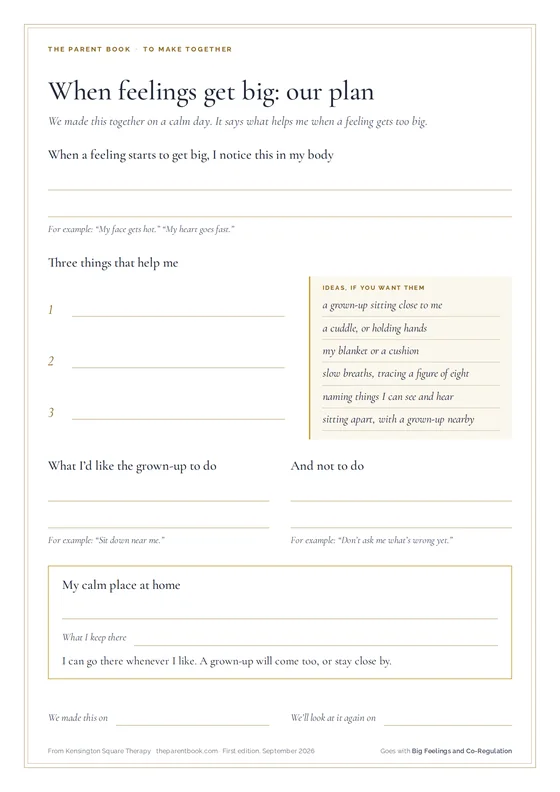
When feelings get big: our plan
Made on a calm day with a child between five and eleven: what they notice in their body, three things that help, what they would like the grown-up to do and not do, and where their calm place is.
Goes with Big Feelings and Co-Regulation
With a subscription
How it helps
In the middle of a big feeling, a child can’t think clearly, and it’s hard for the adult too. A plan made together on a calm day means you both already know what helps your child, and they have had a say in what you do, which often helps them settle sooner.
How to use it
- Make it with your child on a day when nothing much is wrong, and let them do the choosing. With a younger child, write down exactly what they say.
- Fill in what they notice in their body, three things that help, what they’d like you to do and not do, and their calm place at home.
- Put it up where they can see it. When a feeling gets big, start with your own body, say very little, and go to the calm place with them. Never send them there.
- Afterwards, when they’re calm, go back to it briefly, and change anything that has stopped helping. The back of the sheet has the rest.
-
To fill in together
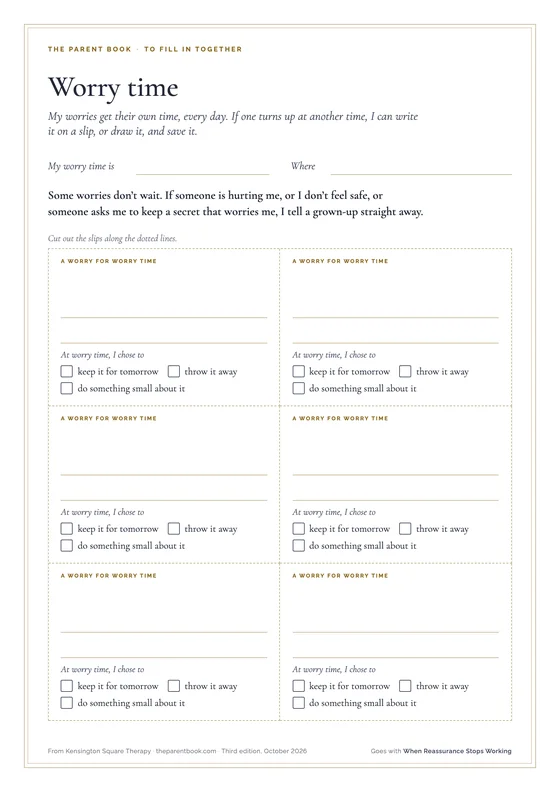
Worry time
Slips for the worries that come up during the day, saved for worry time: ten minutes at the same time each afternoon. The second page is for you: how the ten minutes go, and the worries that never wait.
Goes with When Reassurance Stops Working and Anxiety, by Age
With a subscription
How it helps
A worry that can turn up at any time tends to turn up at the worst one, often bedtime. Ten minutes of worry time each afternoon gives the worries a set place to go, and gives your child some say over them, which can make the evenings easier for you both.
How to use it
- Read the second page first: it is for you, and says how the ten minutes go and which worries never wait.
- Print both pages on one side each, because the slips are cut out, and choose a time with your child that you can keep most days, in the afternoon and well away from bedtime.
- When a worry comes up during the day, listen briefly and kindly, then help them write it or draw it on a slip and save it for worry time. Never save it if your child tells you that someone is hurting them, that they are hurting themselves, or that they do not want to be alive: hear it straight away and act that day, as the second page says.
- At worry time, sit beside your child while they decide what to do with each slip. When the ten minutes are up, stop, and go straight on to something normal together.
-
To fill in together
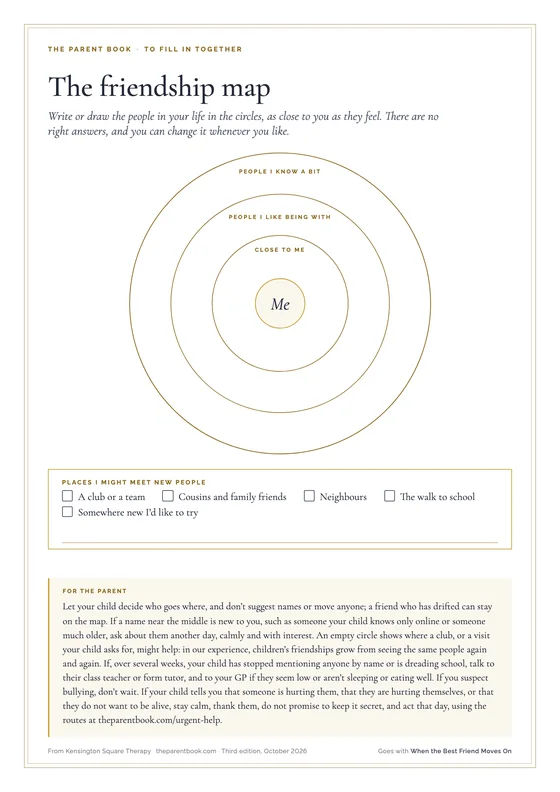
The friendship map
Three circles for the people in your child’s life, from the closest out, and a box for the places they might meet new people. For the weeks after a friendship changes.
Goes with When the Best Friend Moves On and The Move to Secondary School
With a subscription
How it helps
When a friendship changes, a child can feel they have no one left. Putting the people in their life on paper, from the closest out, can show the child more than they expected, and an empty circle shows you both where a club or a visit might help.
How to use it
- Choose a calm day in the weeks after a friendship changes, and sit down with your child and the sheet.
- Let them write or draw the people in their life in the circles, as close to them as each person feels. Don’t suggest names or move anyone; a friend who has drifted can stay on the map.
- Look at the box of places together, and let them tick any they’d like to try.
- If a name near the middle is new to you, such as someone your child knows only online or someone much older, ask about them another day, calmly and with interest. Your child can change the map whenever they like.
-
To fill in together
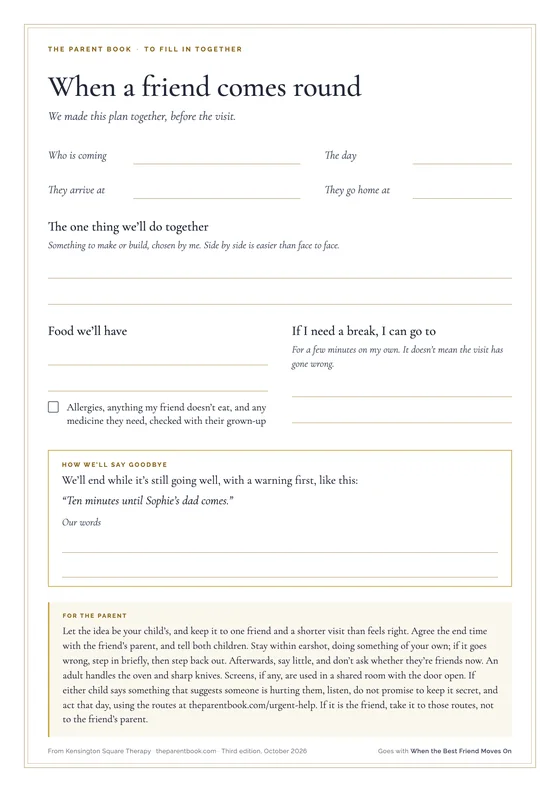
When a friend comes round
A plan made together before a visit your child has asked for: who is coming and when it ends, the one thing they’ll do, and how you’ll say goodbye.
Goes with When the Best Friend Moves On and Neurodiversity, and the Conversation with the School
With a subscription
How it helps
For a child who finds friendships hard, a long visit with no plan can go wrong just as it seemed to be going well. A short visit they have planned, with one thing to do side by side and a goodbye they know is coming, gives it the best chance of going well, and of them wanting another.
How to use it
- Let the idea be your child’s, and keep it to one friend and a shorter visit than feels right. Before the visit, sit down together and fill in who is coming, the day, and when they arrive and go home.
- Agree the end time with the friend’s parent, and check allergies, anything the friend doesn’t eat and any medicine they need.
- Help your child choose the one thing to do together, where they can go if they need a break, and the words for the warning before goodbye.
- During the visit, stay within earshot, doing something of your own. Afterwards, say little, and don’t ask whether they’re friends now.
- An adult handles the oven and sharp knives, and any screens are used in a shared room with the door open. If either child says something that suggests someone is hurting them, the sheet says what to do that day; if it is the friend, it goes to the routes at theparentbook.com/urgent-help, not to the friend’s parent.
-
Cards to fill in
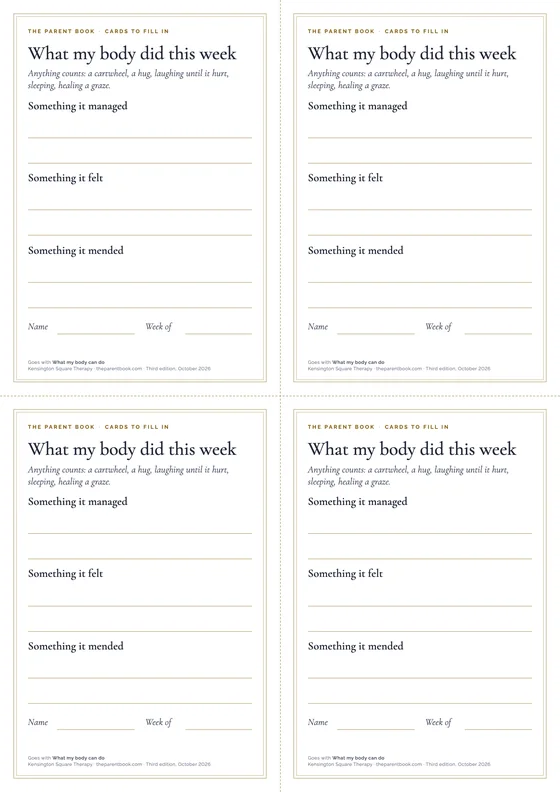
What my body can do
Four cards, one for each week of a month: something your body managed, something it felt, something it mended. Print a set each. The second page is for you.
Goes with Body Image
With a subscription
How it helps
What a child hears about bodies at home, including what adults say about their own, affects how the child sees theirs. Noticing each week what their body did gives them a way of thinking about it that has nothing to do with how it looks.
How to use it
- Read the second page first. It is for you, and says what to leave off the cards, and when to see your GP. If your child is being treated for an eating disorder, ask their team before you try this.
- Print a set of cards for each of you. Once a week for a month, you each fill in a card: something your body managed, something it felt, something it mended.
- Go first, with plain facts about your own body, then let your child write or draw theirs. Leave out anything counted or measured, and don’t compare cards.
- Your child keeps their cards where they choose. After a month, stop the cards, and go on mentioning what bodies do.
-
To fill in together
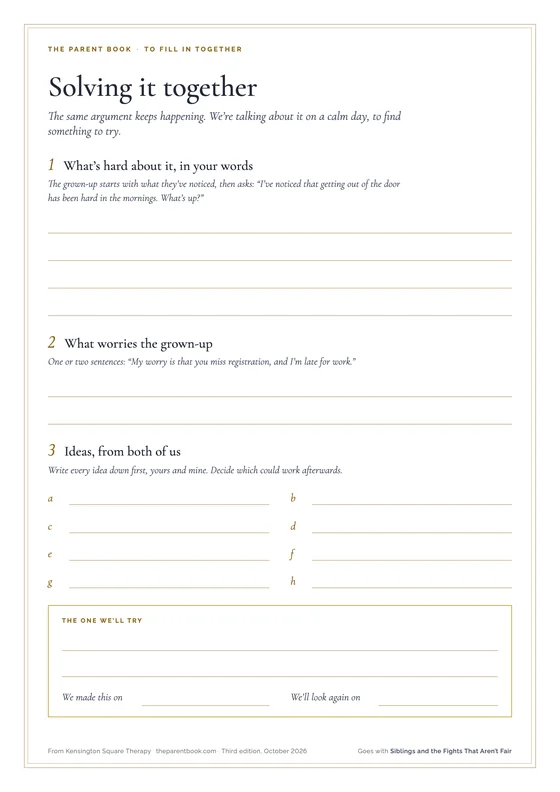
Solving it together
For the argument that keeps happening: a conversation on a calm day that starts with your child’s side, then yours, then ideas from both of you, with one to try and a date to look again.
Goes with Siblings and the Fights That Aren’t Fair and Big Feelings and Co-Regulation
With a subscription
How it helps
When the same argument keeps happening, something is often getting in your child’s way that nobody has spotted yet. Hearing their side first, then looking for a solution together, helps you find out what it is, and a plan they have helped to make is one they are more likely to keep.
How to use it
- Use it for an everyday argument, such as mornings, homework, screens or bedtime, on a calm day and one problem at a time. Read the back first: it is for you. If an argument ever turns physical, or anyone at home is frightened, don’t wait for a calm day: get help that day, using the routes at theparentbook.com/urgent-help.
- Start with your child’s side. Say what you’ve noticed, ask what’s up, and keep asking until you understand. Then say what worries you, in one or two sentences. If your child tells you that someone is hurting them, that they are hurting themselves, or that they do not want to be alive, stop the problem solving and don’t ask more questions: the back says what to do that day.
- Write down every idea from both of you before you decide, then choose one you can both really do, and that answers their worry as well as yours.
- Try it for a week, and look at it again together on the date you wrote. If it didn’t work, go back to your child’s side.
-
To fill in together
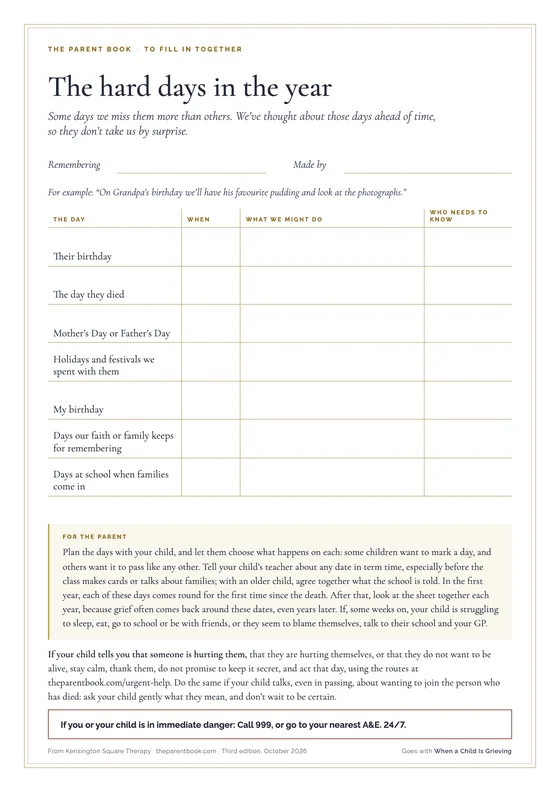
The hard days in the year
After a death: the days in the year that may be hard, planned ahead together, with what you’ll do on each and who else needs to know.
Goes with When a Child Is Grieving and The Conversations Parents Avoid
With a subscription
How it helps
After a death, some days in the year bring the loss back: a birthday, the anniversary, a festival, a day when families come into school. Planning ahead means the days don’t take your child by surprise, lets them choose how each one goes, and gives the people around them, including their teacher, time to be ready.
How to use it
- Sit down together at a calm time and go through the days on the sheet, adding any of your own.
- For each day, let your child choose what happens. Some children want to mark a day, and others want it to pass like any other.
- Write in who needs to know, and tell your child’s teacher about any date in term time. With an older child, agree together what the school is told.
- Keep the sheet, and look at it together each year, because grief often comes back around these dates, even years later.
- The sheet says when to talk to your child’s school or your GP, and what to do that day if something they say worries you, including any talk, even in passing, of wanting to join the person who has died.
-
To fill in together
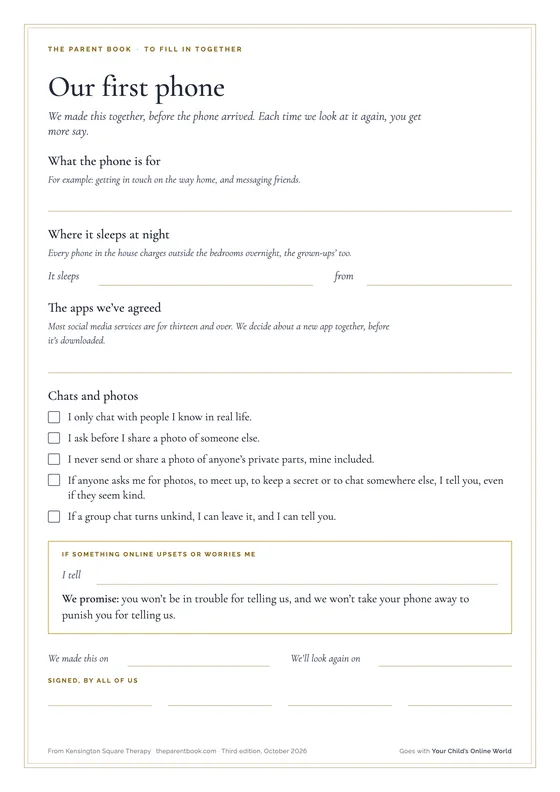
Our first phone
An agreement made with your child before their first phone arrives: what it’s for, where it sleeps, the apps, chats and photos, and what they tell you about. On the back, how to set it up together.
Goes with Your Child’s Online World and Screen Time
With a subscription
How it helps
The easiest time to agree how a phone is used is before it arrives. A child is more likely to keep an agreement they have helped to write, which the adults keep too, and the promise on it, that your child won’t be in trouble for telling you, makes it more likely that they’ll keep telling you when something online goes wrong.
How to use it
- Before the phone arrives, fill in the front together. Ask what your child thinks is fair before you say what you think, and let them write some of it.
- Set the phone up with them, using the back, so they know what each setting does and why: the controls, purchases, location sharing and the school’s rules.
- Sign it, all of you, and keep your side: your phone out of the bedroom at night, and away at meals.
- Look at it again on the date you wrote, and give your child more say each time. The back says what to do if they tell you about something that worries you.
-
To fill in together
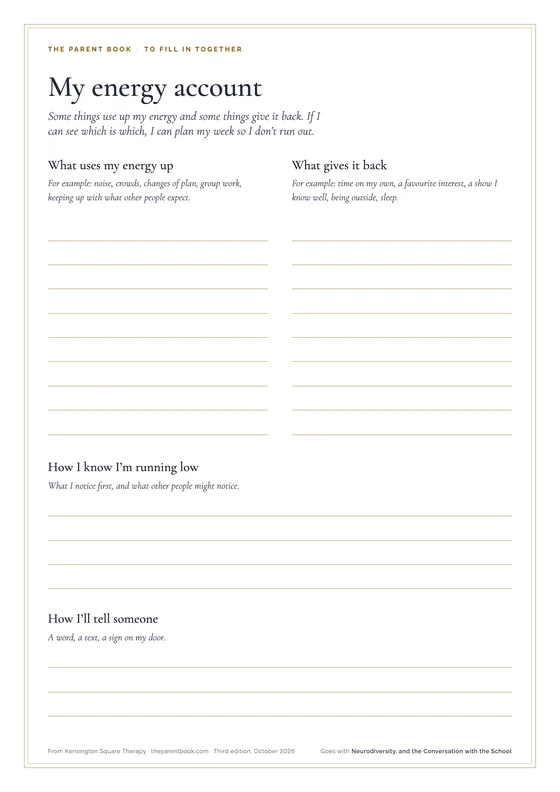
My energy account
For autistic young people: what uses up their energy and what gives it back, in their own words, and a week planned with time to recover.
Goes with Neurodiversity, and the Conversation with the School and When Reassurance Stops Working
With a subscription
How it helps
Many autistic young people use a lot of energy getting through a school day, and it often doesn’t show until they get home or reach the weekend. Writing down what drains their energy and what gives it back makes the pattern visible, so that they can plan time to recover, on their terms.
How to use it
- At the weekend, somewhere your child chooses, explain the idea in a sentence and fill in the two lists together. At eleven to thirteen you may do more of the writing.
- Look at the week ahead, mark the heavy days, and ask them where they would like time to recover, and how much.
- At the end of the week, look at it together for a few minutes: what went well, what didn’t, and what they would change.
- Let it be theirs, and protect the time they ask for. If your child’s low mood doesn’t lift, they withdraw from everyone or stop going to school, talk to your GP and the school’s SENCo.
-
To make together
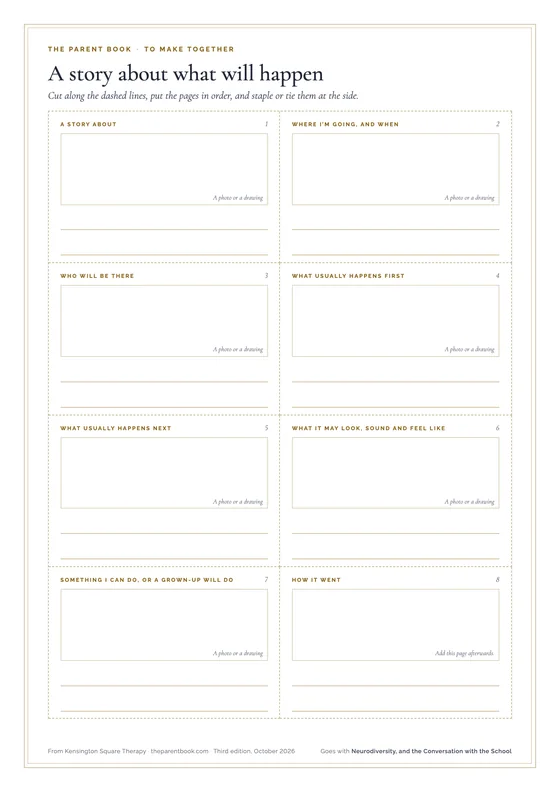
A story about what will happen
A small book to make with your child before something new: where they are going, who will be there and what usually happens. On the second page, how to write it, with an example.
Goes with Neurodiversity, and the Conversation with the School and When Reassurance Stops Working
With a subscription
How it helps
Many autistic children find not knowing what will happen harder than the thing itself. A short, accurate story about what usually happens tells them what to expect, in words and pictures they can go back to as often as they like.
How to use it
- A few days before something new, find out what usually happens there, in order. Photos of the real place and people help most.
- Write it with your child on the pages, a sentence and a picture on each, as “I” or with their name. Use “usually” and “sometimes”, and leave out “should”, “must” and anything about past meltdowns.
- Cut the pages out, put them in order and staple them. Read it together a few times in the days before, when your child is calm, and let them keep it.
- Afterwards, add the last page about how it went. Never read it after a meltdown as a lesson about behaving.
-
To make together
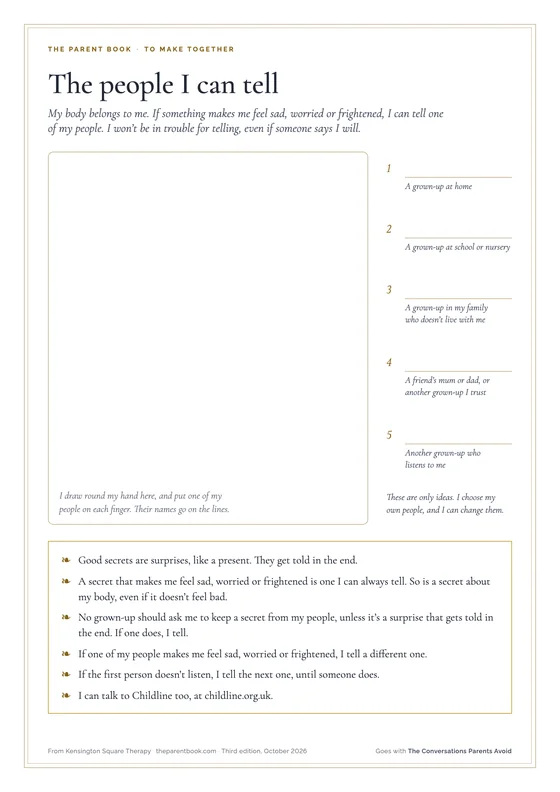
The people I can tell
Your child draws round their hand and puts a grown-up they could tell on each finger. On the second page, how to choose them together, and what to do if your child tells you something.
Goes with The Conversations Parents Avoid
Free to print
How it helps
Child protection charities advise helping children work out, in advance, which grown-ups they could go to. Naming five, in different places and not all in the family, gives your child people to go to, and their page reminds them that a secret that makes them feel sad, worried or frightened, or a secret about their body, is one they can always tell.
How to use it
- Print the two pages on one side each: the first is your child’s to keep, and the second is yours. On a calm day, let them draw round their hand, put one person on each finger, and write the names on the lines.
- Let your child choose. Help them think of people in different places, with at least one outside the family, and don’t fill in names for them.
- Read the box on their page together: good secrets are surprises and get told in the end; a secret that makes them feel sad, worried or frightened, or a secret about their body, is one they can always tell; no grown-up should ask them to keep a secret from their people, unless it’s a surprise; and if the first person doesn’t listen, your child tells the next.
- Let them keep it somewhere that is theirs, not the fridge, and look at it again each term. If your child tells you something that worries you, stay calm, thank them, don’t promise to keep it secret, and act that day, as your page says.

For the fridge and the pocket
Short cards for the routines the library suggests, to print and cut out.
-
For the fridge
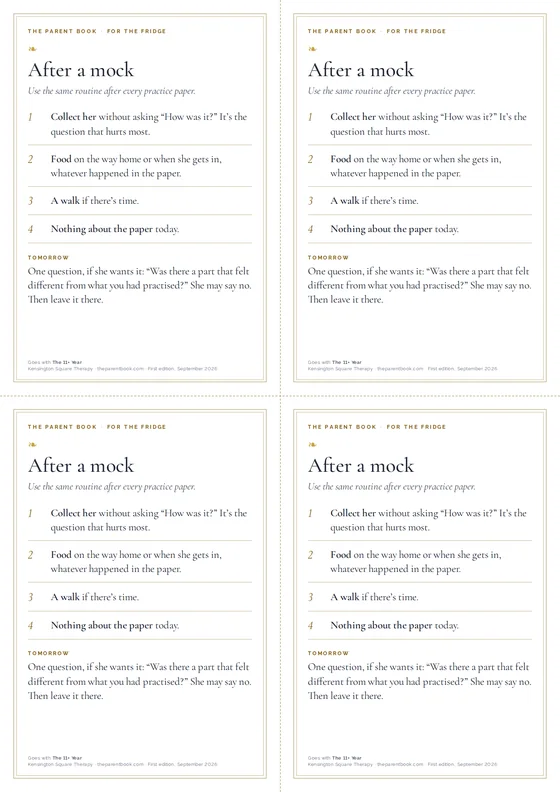
After a mock
The same routine after every practice paper, on a card for the fridge.
Goes with The 11+ Year and Perfectionism
With a subscription
How it helps
After a practice paper, “How was it?” is the question that hurts most. The same short routine every time, with food, a walk if there’s time and nothing about the paper that day, tells your child they matter more to you than the result, and helps the paper stay the size it is.
How to use it
- Cut out the cards, put one on the fridge, and keep one with you for the day of the mock.
- Collect your child without asking how it went, and have food ready on the way home or when they get in, whatever happened in the paper.
- Go for a walk if there’s time, and say nothing about the paper that day.
- The next day, ask the one question on the card if they want it, and leave it there if they say no.
-
Pocket card
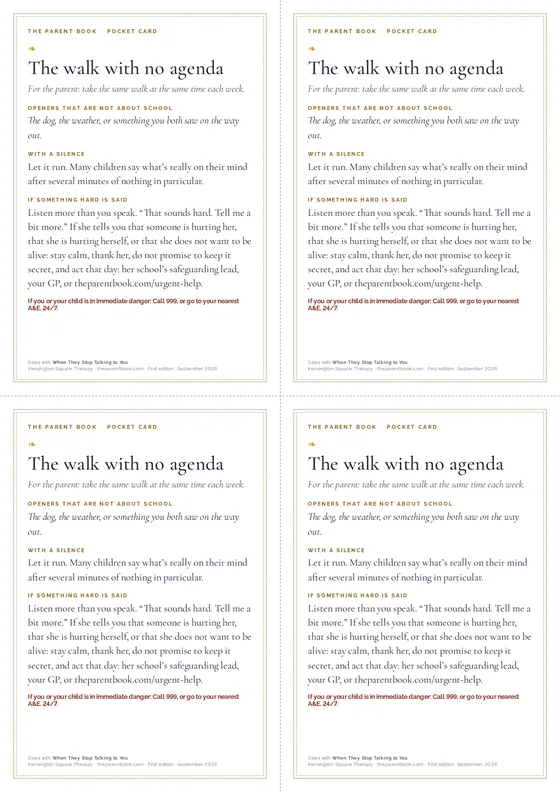
The walk with no agenda
For the parent: openers that are not about school, what to do with a silence, and what to do if something hard is said.
Goes with When They Stop Talking to You
With a subscription
How it helps
Many children find it easier to talk while walking beside you than face to face, with no questions waiting. The same walk at the same time each week gives your child a regular chance to say what’s on their mind, without being asked.
How to use it
- Cut out the cards and keep one in your pocket. Choose a walk you can take at the same time each week, just the two of you.
- Start with something that isn’t school: the dog, the weather, something you both saw on the way out.
- When there’s a silence, let it run. Many children say what’s really on their mind after several minutes of nothing in particular.
- If something hard is said, listen more than you speak. The card says what to do if your child tells you something that worries you.
-
For the fridge
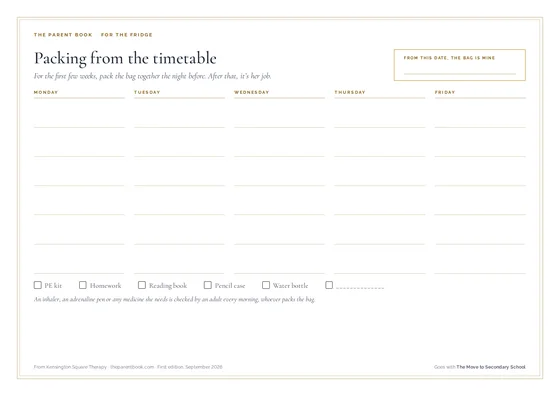
Packing from the timetable
For the first weeks at a new school, pack the bag together the night before, then choose a date when it becomes your child’s job.
Goes with The Move to Secondary School
With a subscription
How it helps
A new timetable is a lot for your child to hold in their head in the first weeks. Packing the bag together the night before takes that worry away while everything is new, and handing it over on a date you’ve agreed gives them a job they can manage on their own.
How to use it
- Put it on the fridge beside your child’s timetable, and fill in what goes in the bag on each day of the week.
- For the first few weeks, pack the bag together the night before, using the sheet.
- Agree a date when the bag becomes their job, and write it on the sheet.
- An inhaler, an adrenaline pen or any medicine your child needs is checked by an adult every morning, whoever packs the bag.
-
For the fridge
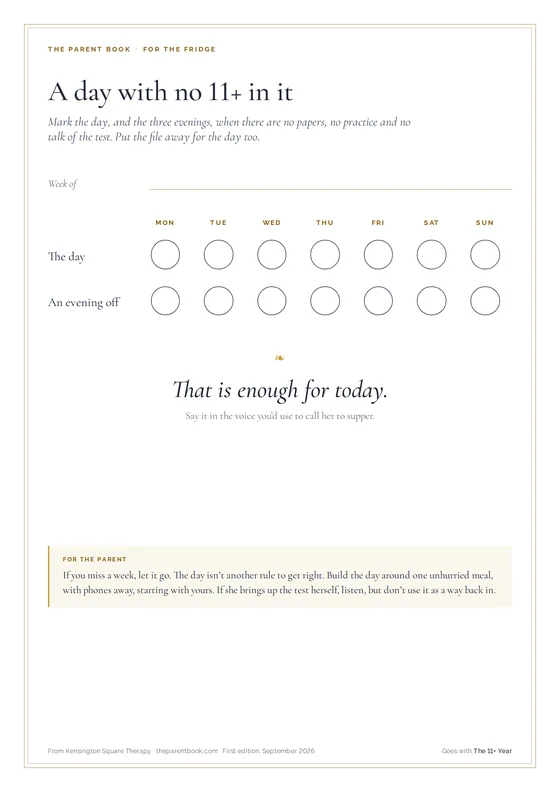
A day with no 11+ in it
The week on one page: the day, and the three evenings, with no papers, no practice and no talk of the test.
Goes with The 11+ Year
With a subscription
How it helps
In an exam year, the test can take over every day of the week. A day and three evenings with no papers, no practice and no talk of it give your child time to be a child, and remind you both that the rest of life is still there.
How to use it
- At the start of each week, sit down together and mark the day and the three evenings on the sheet.
- On those days, put the file away and don’t bring up the test. If your child brings it up themselves, listen, but don’t use it as a way back in.
- Build the day around one unhurried meal, with phones away, starting with yours.
- If you miss a week, let it go. The day isn’t another rule to get right.
-
Pocket card
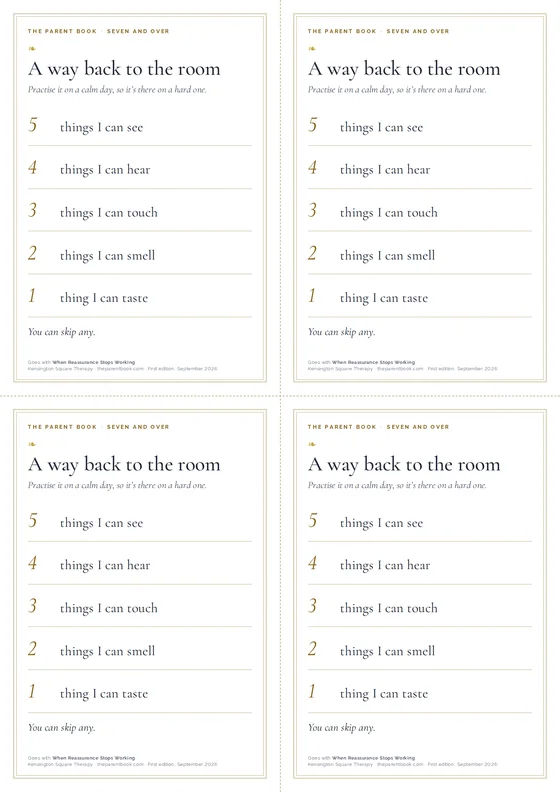
A way back to the room
A short noticing game on one side and a figure of eight to trace on the other, practised together on calm days.
Goes with When Reassurance Stops Working and Anxiety, by Age
With a subscription
How it helps
When a child is caught up in panic or a big worry, noticing what they can see, hear and touch, and slowing their breathing, can bring them back to the room they are in. Practised on calm days, it’s there for them on a hard one.
How to use it
- Print on both sides, flipping on the long edge, and cut out the cards. One side, the senses, is for children aged seven and over; the other, the figure of eight, is for children aged five to nine.
- On a calm day, practise it together a few times: go through the senses, or trace the figure of eight slowly, breathing in along one loop and out along the other, each breath slower, not deeper.
- Keep a card where your child can reach it: in their pocket, their bag, or by their bed.
- When a hard moment comes, do it with them and keep your words few. They can skip any part.
-
Pocket card
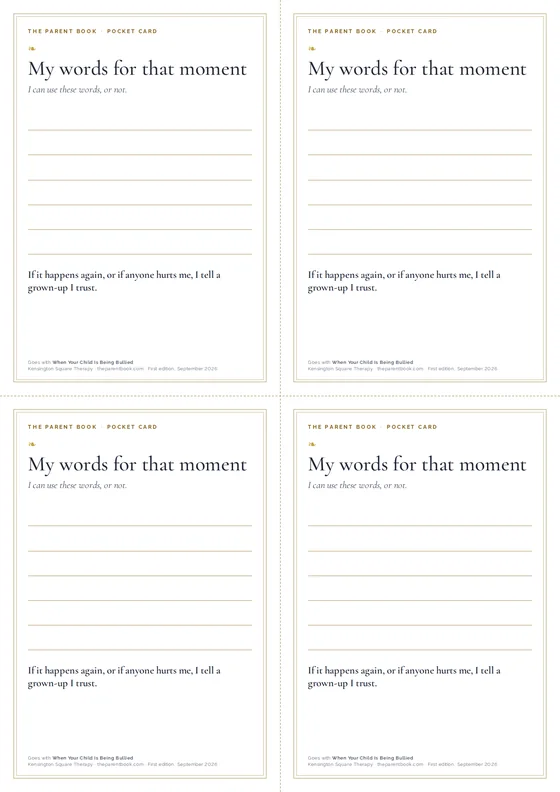
My words for that moment
A small blank card for the two or three sentences your child has chosen for a moment they dread, in their own handwriting.
Goes with When the Best Friend Moves On and When Your Child Is Being Bullied
With a subscription
How it helps
A moment your child dreads, such as a comment in the playground, is easier to face when they already know what they’ll say. Words they have chosen and practised, in their own handwriting, are there when their mind goes blank.
How to use it
- First, run through the moment together at home, as the activity it goes with describes, and let your child find two or three sentences that feel like theirs.
- Your child writes them on a card in their own handwriting. Keep the other cards for another time.
- They keep the card somewhere only they will see it, such as a pocket or a pencil case.
- The card reminds your child that they can use the words or not, and that if it happens again, or anyone hurts them, they tell a grown-up they trust.
-
For the fridge
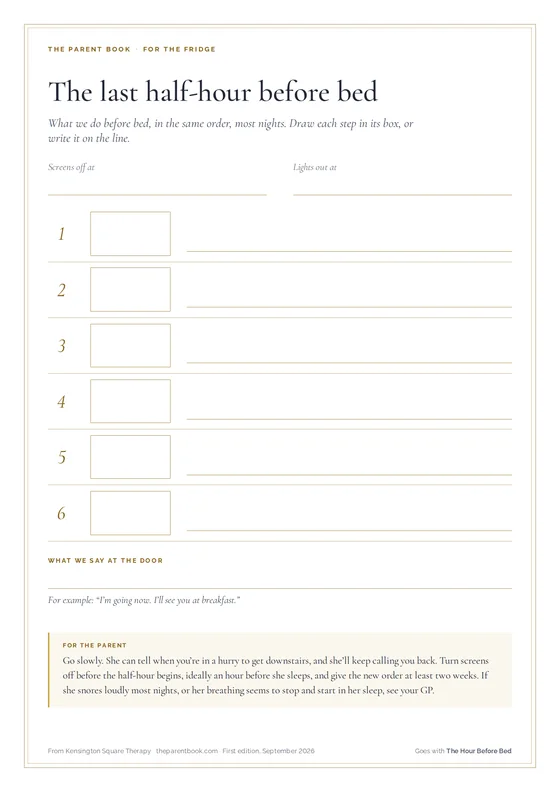
The last half-hour before bed
Your family’s last half-hour before bed, in the order you chose together, with a box for each step to draw in and a line to write it.
Goes with The Hour Before Bed
Free to print
How it helps
Children usually settle more easily when bedtime goes the same way each night. Steps they have helped to choose, in the same order and up on the fridge, mean fewer reminders and fewer arguments, and a calmer last half-hour for all of you.
How to use it
- Choose the steps together, in the order you’ll do them most nights, and let your child draw each one in its box or write it on the line.
- Fill in when screens go off and when the lights go out. Turn screens off before the half-hour begins, ideally an hour before they sleep.
- Agree what you’ll say at the door, and say the same words each night.
- Go slowly, and give the new order at least two weeks.
-
Cards to cut out
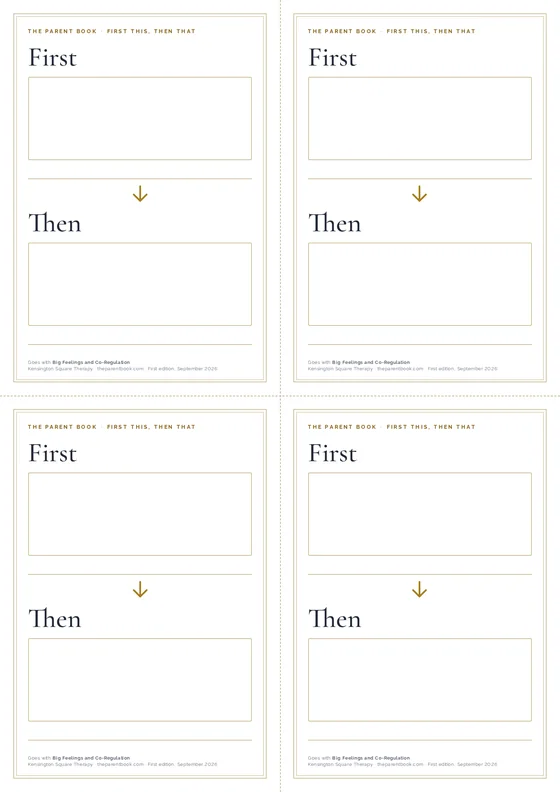
First this, then that
Four cards to cut out, each with a box for the thing your child does first and a box for what comes next, to draw in or stick a photograph on. The back of each card says how to use it.
Goes with Big Feelings and Co-Regulation and Neurodiversity, and the Conversation with the School
With a subscription
How it helps
For a young child, or a child who finds changes hard, a picture of what happens first and what comes next makes a hard moment easier to predict, and cuts down the words you need. Fewer words, calmly said, usually mean less of a battle.
How to use it
- Print on both sides, flipping on the long edge, and cut out the four cards. The back of each card says how to use it.
- Choose one hard moment in the day, such as leaving the park, the bath or the tablet going off, and draw the first thing and the next, or stick on photographs.
- Give your child a warning first, then point at the card when it’s time: “First bath, then story.” Say little, and wait.
- Keep “then” to something that was happening anyway, and don’t take it away if “first” goes badly.
-
For the door
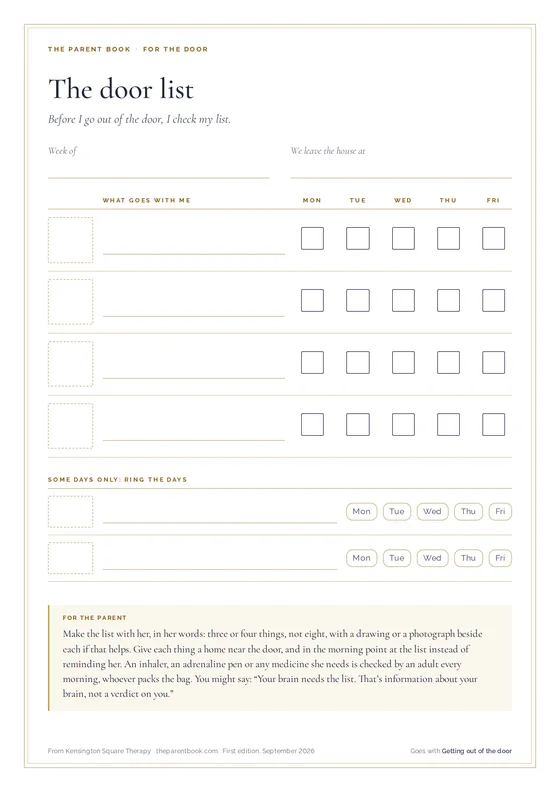
The door list
The family’s own list of the three or four things that go out of the door each morning, with a tick box for each school day and a box for the things that go on some days only.
Goes with Neurodiversity, and the Conversation with the School and The Move to Secondary School
With a subscription
How it helps
Mornings go wrong when a child has to remember everything and a parent has to remind them of it. A short list by the door, in your child’s words, does the remembering for both of you, and pointing at it replaces reminders that turn into arguments.
How to use it
- Make the list with your child, in their words: three or four things, not eight, with a drawing or a photograph beside each if that helps.
- Give each thing a home near the door, and put the sheet up by the door at their eye level.
- In the morning, point at the list instead of reminding them, and let them tick each day.
- An inhaler, an adrenaline pen or any medicine your child needs is checked by an adult every morning, whoever packs the bag.
-
For the fridge
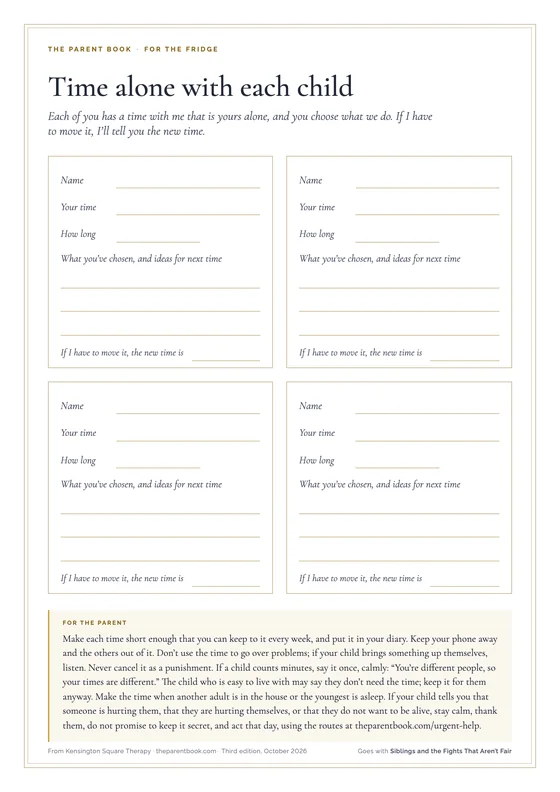
Time alone with each child
A box for each of your children: when their time is, how long it lasts, what they have chosen, and the new time if you have to move it.
Goes with Siblings and the Fights That Aren’t Fair and When They Stop Talking to You
With a subscription
How it helps
In a busy house, each child can feel that the others get more of you. A regular time that is each child’s alone, which they choose how to spend and which is never cancelled as a punishment, tells them they matter to you as themselves, and often eases the rivalry between brothers and sisters.
How to use it
- With each child, choose a time you can keep every week, short enough to manage, and put it in your diary.
- Write each child’s time in their box on the sheet, and let them write what they have chosen and their ideas for next time.
- Keep your phone away and the others out of it. If you have to move a time, write the new one in the child’s box and tell them.
- Don’t use the time to go over problems; if your child brings something up themselves, listen. Never cancel it as a punishment.
-
Pocket card
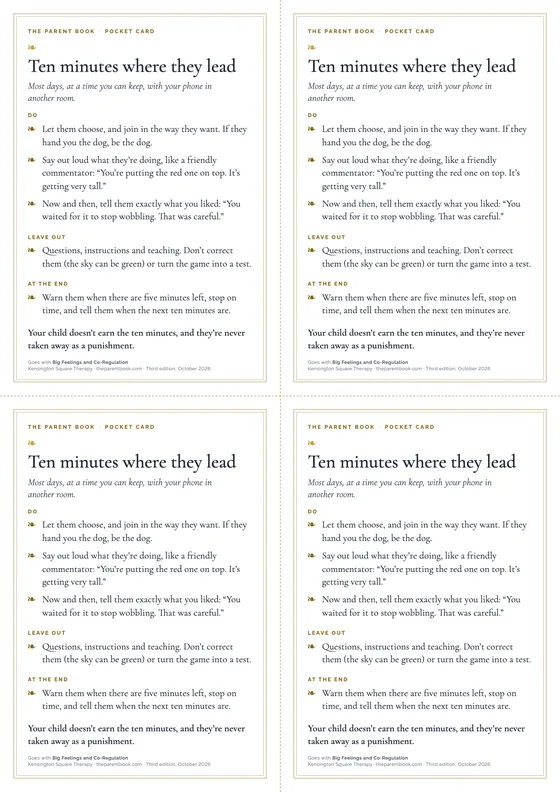
Ten minutes where they lead
For the parent: ten minutes most days when your child chooses the game and you follow. What to do, what to leave out, and what to do if it goes off course.
Goes with Big Feelings and Co-Regulation and Siblings and the Fights That Aren’t Fair
With a subscription
How it helps
Ten minutes of play where your young child leads and you follow, with your full attention, tells them that they matter to you just as they are. Children who have this most days often need to fight less for attention at other times.
How to use it
- Print on both sides, flipping on the long edge, and cut out the cards. Keep one where you’ll see it.
- Most days, at a time you can keep, put your phone in another room and let your child choose the game. Join in the way they want.
- Say out loud what they’re doing, and now and then tell them exactly what you liked. Leave out questions, instructions and teaching.
- Warn them when there are five minutes left, stop on time, and tell them when the next ten minutes are. Your child doesn’t have to earn them, and they’re never taken away.
- The back of each card says what to do if the play goes off course. If, in play or in words, your child tells you that someone is hurting them, that they are hurting themselves, or that they do not want to be alive, don’t question them or interpret it: the back says what to do that day.
-
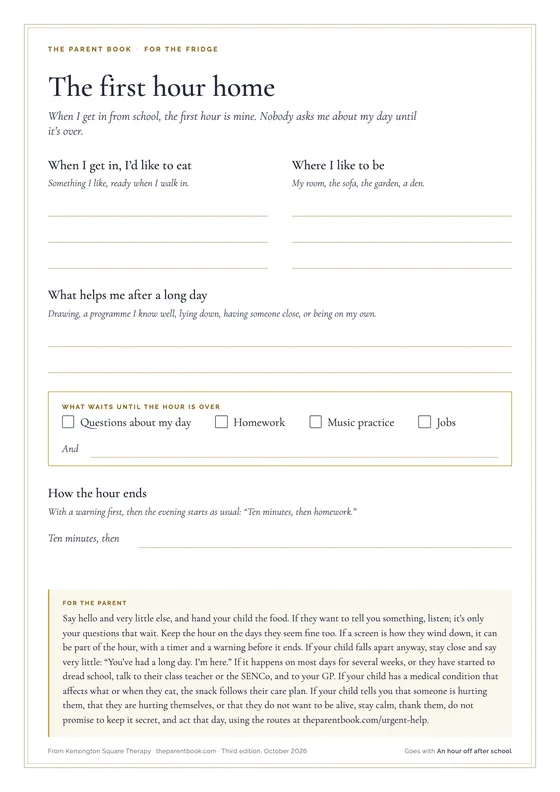
For the fridge
The first hour home
Planned with your child at the weekend: what they’d like to eat when they get in, where they go, what helps after a long day, and what waits until the hour is over.
Goes with Neurodiversity, and the Conversation with the School and What to Do When School Is the Problem
With a subscription
How it helps
Many children hold themselves together all day at school and fall apart when they get home. An hour that is theirs, with food, somewhere to be and no questions about their day, gives them time to recover, and makes the rest of the evening easier for everyone.
How to use it
- At the weekend, sit down together and fill it in: what your child would like to eat when they get in, where they like to be, and what helps after a long day. If they have a medical condition that affects what or when they eat, the snack follows their care plan.
- Tick what waits until the hour is over, such as questions about their day and homework, and agree how the hour ends.
- When your child gets in, say hello and very little else, and hand them the food. If they want to tell you something, listen.
- Keep the hour on the days they seem fine too, and give them a warning before it ends.
-
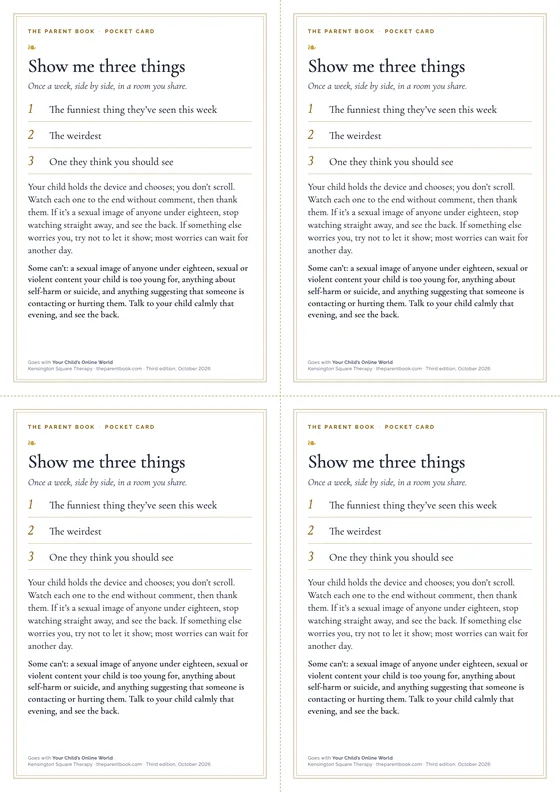
Pocket card
Their online world
Two ways to find out what your child does online, on their terms: once a week they show you three things, and now and then they teach you their game. On the back, what cannot wait.
Goes with Your Child’s Online World and What Screen Time Actually Is
With a subscription
How it helps
You can’t protect your child in a world you never see. Being shown it on their terms, once a week and without comment, keeps you in touch with what they do online, and makes you someone they can come to when something there goes wrong.
How to use it
- Print on both sides, flipping on the long edge, and cut out the cards. Read both sides before you start: the front says which things can’t wait, and the back says what to do.
- Once a week, side by side in a room you share, ask your child to show you three things: the funniest, the weirdest, and one they think you should see. They hold the device and choose.
- Watch each one to the end without comment, and thank them. If one is a sexual image of anyone under eighteen, stop watching straight away, and see the back.
- Now and then, ask your child to teach you their game, and be the beginner.
-
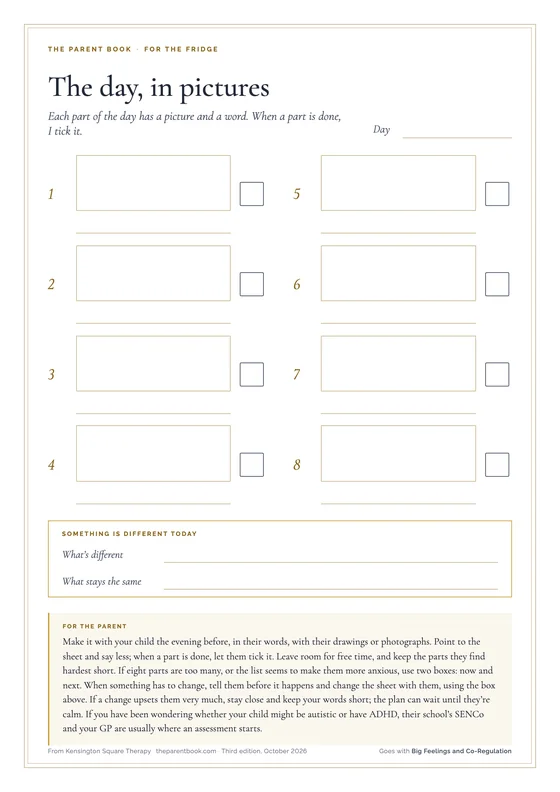
For the fridge
The day, in pictures
For a weekend or a holiday: the day in order, with a picture and a word for each part and a box to tick when it’s done, made with your child the evening before.
Goes with Neurodiversity, and the Conversation with the School and Big Feelings and Co-Regulation
With a subscription
How it helps
Weekends and holidays have less structure than school days, which can make them the hardest days for a child who needs to know what comes next. Seeing the day in order, in pictures your child has helped to make, lets them predict it, and a tick for each part done shows them how the day is going.
How to use it
- The evening before, make the day with your child: a picture and a word for each part, in their words, with their drawings or photographs.
- Leave room for free time, and keep the parts they find hardest short. If eight parts are too many, use two boxes: now and next.
- Put it on the fridge. During the day, point to the sheet and say less, and let them tick each part when it’s done.
- When something has to change, tell them before it happens, and change the sheet with them, using the box at the bottom.
-
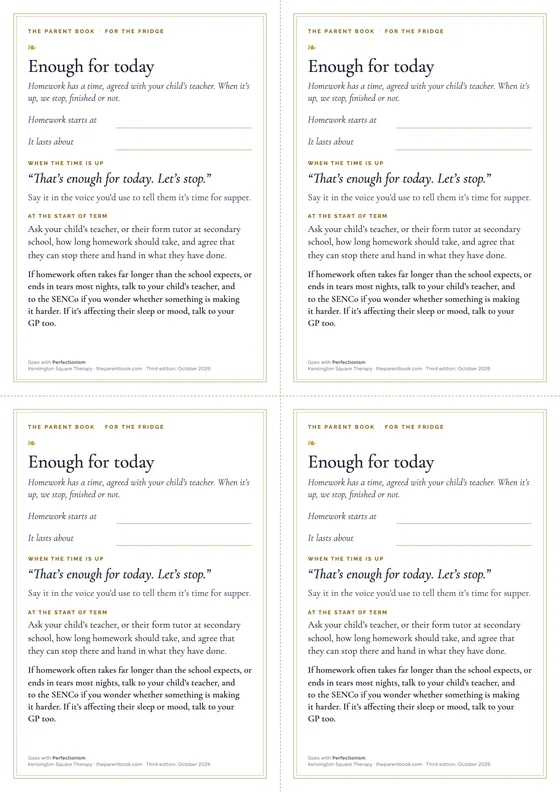
For the fridge
Enough for today
A card for homework: the time agreed with your child’s teacher, the words to use when it’s up, and what to do if homework keeps taking far longer.
Goes with Perfectionism and Neurodiversity, and the Conversation with the School
With a subscription
How it helps
For a child who can’t stop until homework is perfect, a time agreed with their teacher settles the question before the evening begins. Stopping when the time is up, finished or not, shows them that what they have done is enough, and protects their evenings and their sleep.
How to use it
- At the start of term, ask your child’s teacher, or their form tutor at secondary school, how long homework should take, and agree that your child can stop there and hand in what they have done.
- Fill in when homework starts and how long it lasts, and put a card on the fridge.
- When the time is up, say the words on the card, in the voice you’d use to tell them it’s time for supper, and stop.
- If homework often takes far longer than the school expects, or ends in tears most nights, talk to your child’s teacher, and to the SENCo if you wonder whether something is making it harder. If it’s affecting their sleep or mood, talk to your GP too.
-
Cards to cut out
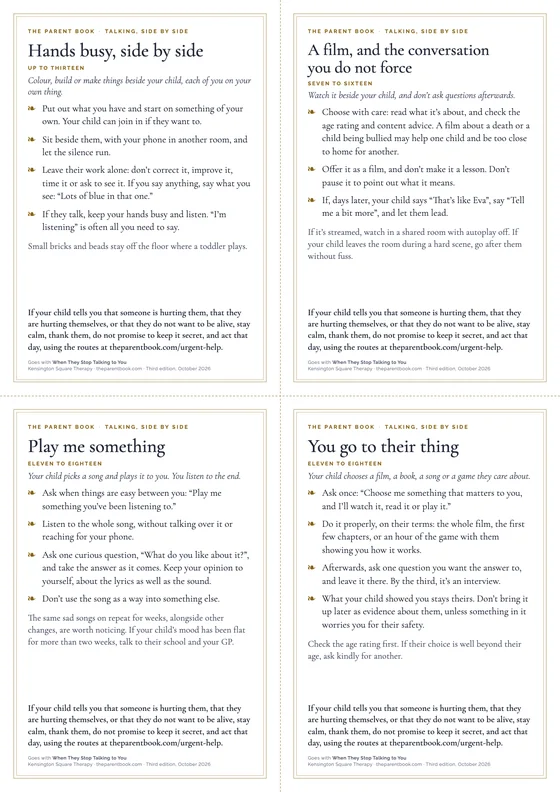
Talking, side by side
Four cards for the child who says more when nobody is looking straight at them: hands busy beside you, a film, a song they play you, and the thing they care about.
Goes with When They Stop Talking to You and Big Feelings and Co-Regulation
With a subscription
How it helps
Some children, and many teenagers, say more when nobody is looking straight at them and there are no questions waiting. Each card is a way of being together side by side, and each leaves room for them to talk if they want to, without being asked.
How to use it
- Cut out the four cards, and choose the one that suits your child’s age and what they enjoy. The age on each card is a guide.
- Try one at a time, when things are easy between you, and follow the steps on the card.
- If they talk, listen, and ask no more than the card suggests. If they don’t, the time together still counts.
- The foot of each card says what to do if your child tells you something that worries you.
-
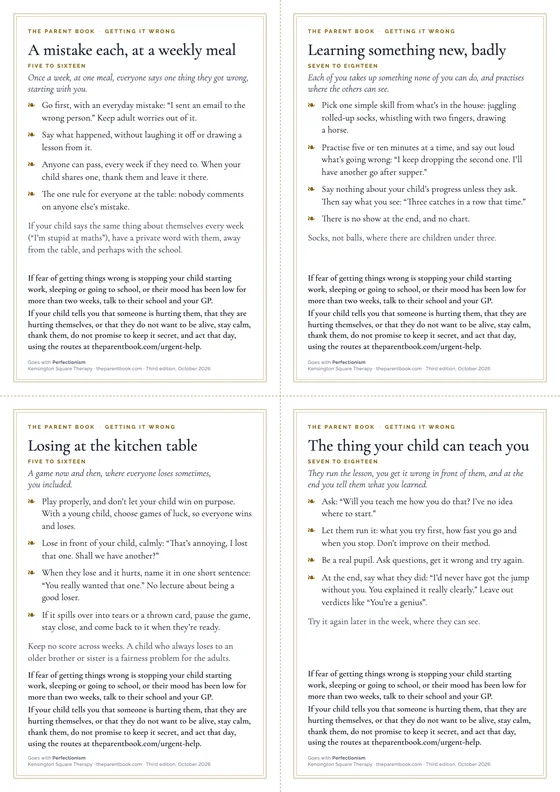
Cards to cut out
Getting it wrong
Four cards for the child who finds getting things wrong unbearable: a mistake each at a weekly meal, learning something new badly, losing at games, and the thing they can teach you.
Goes with Perfectionism and The 11+ Year
With a subscription
How it helps
A child who is frightened of getting things wrong often stops trying new things. Watching the adults make mistakes calmly, lose at games and learn something badly, in front of the child, shows them that getting it wrong is part of learning, and doesn’t change how you see them.
How to use it
- Cut out the four cards, and start with one. A mistake each at a weekly meal is a good first one.
- Go first each time, and let your child see you get things wrong without laughing it off or drawing a lesson from it.
- Say what you see, and leave out verdicts. Nobody comments on anyone else’s mistake.
- If fear of getting things wrong is stopping your child starting work, sleeping or going to school, or their mood has been low for more than two weeks, talk to their school and your GP.
-
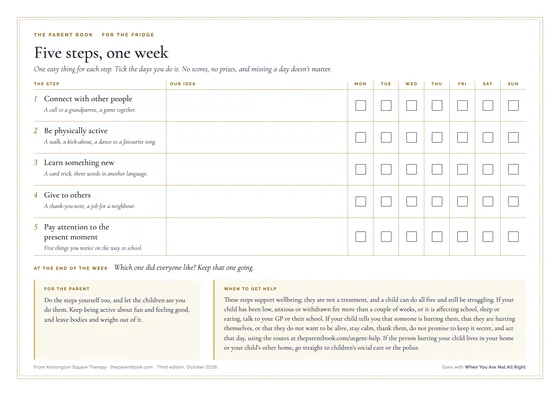
For the fridge
Five steps, one week
The NHS’s five steps to mental wellbeing as a week on the fridge: one easy thing for each step, with no scores and no prizes.
Goes with When You Are Not All Right and When Reassurance Stops Working
With a subscription
How it helps
The NHS’s five steps to mental wellbeing are simple things that help anyone, children and parents alike. Doing them together for a week turns them into something the family does, so nobody is being told to look after themselves.
How to use it
- At a weekend meal, choose one easy thing for each step together, and write it in. With younger children you choose; with teenagers, ask whether they want to join in.
- Put it on the fridge and tick them off as the week goes, with no scores and no prizes. Do the steps yourself too, and let the children see you do them.
- At the end of the week, ask everyone which one they liked, and keep that one going.
- If your child seems low whatever you try, or has been low, anxious or withdrawn for more than a couple of weeks, talk to your GP or their school.
-
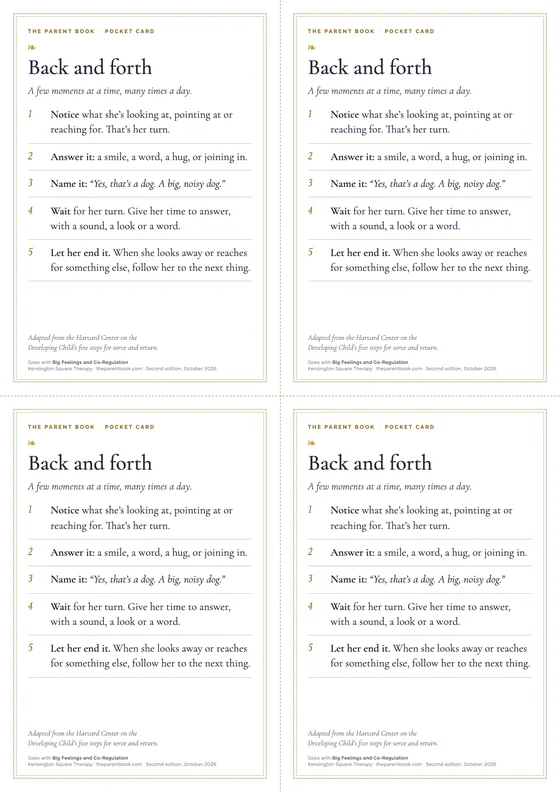
Pocket card
Back and forth
Four cards to cut out, for the back and forth that helps babies and toddlers learn to talk: notice, answer, name it, wait, and let them end it.
Goes with Big Feelings and Co-Regulation
With a subscription
How it helps
Babies and toddlers learn to talk through back and forth with the people who look after them: your child does something, you answer, they answer you. The card holds the five steps for moments already in your day, such as the bath, the shops and the stairs.
How to use it
- Print it on both sides, flipping on the long edge, cut out the four cards, and keep one where you spend time with your child: on the fridge, in the buggy, by the bath.
- When your child looks, points, babbles or reaches, answer it, name it, and wait for their turn.
- Let them lead, and let them end it. A few moments here and there all count.
- If you’re worried about your child’s talking or hearing, speak to your health visitor or GP. Talk to them too if you find it hard to enjoy or to feel close to your child, or you feel low most days, and if you have thoughts of harming yourself or your child, act that day: ask the surgery for an urgent appointment, and if it is closed, use the routes at theparentbook.com/urgent-help.
What to say
First sentences, each word for word from a quick tip, on cards to cut out and keep.
-
Cards to cut out
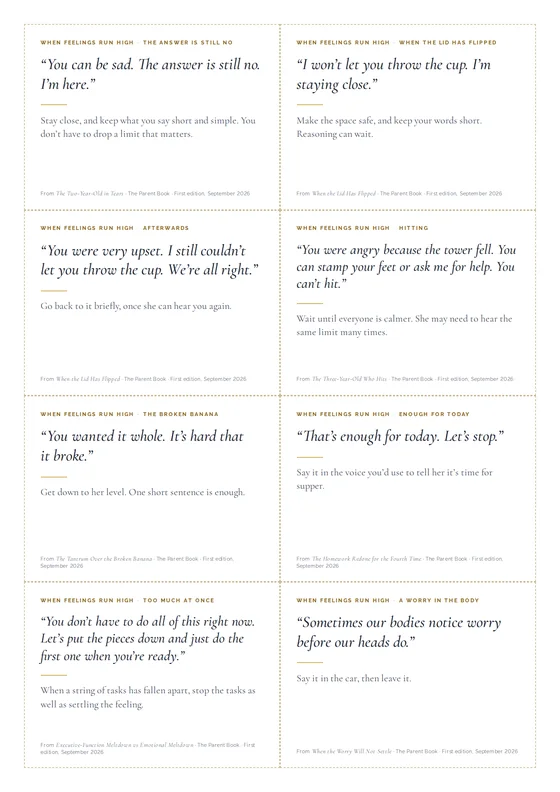
What to say: when feelings run high
Eight first sentences, each from a quick tip in the library, with a line on when to say it.
With a subscription
How it helps
In the middle of a meltdown, the right words are hard to find, and too many make things worse. Each card has one short first sentence, from a quick tip in the library, so it’s ready when you need it.
How to use it
- Cut out the eight cards. Each names the quick tip it comes from, which has the rest.
- Choose the one or two that fit what’s happening at home now, and keep them where you’ll see them: on the fridge, by the kettle, in your pocket.
- Say the sentence in your own voice, and follow the line beneath it.
- Keep what you say short. One sentence, calmly said, is often enough.
-
Cards to cut out
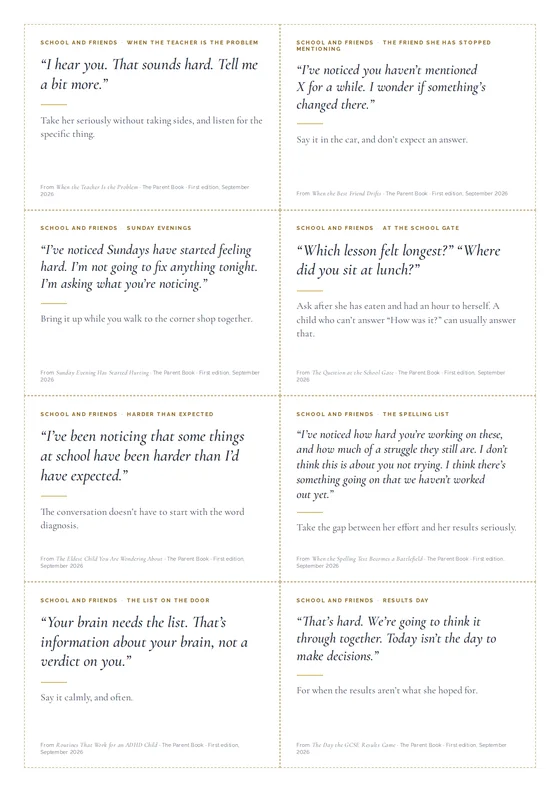
What to say: school and friends
Eight first sentences, each from a quick tip in the library, with a line on when to say it.
Free to print
How it helps
When your child comes home upset about a friend, a test or a teacher, the first thing you say often decides whether they tell you more. Each card has a first sentence, from a quick tip in the library, that keeps the conversation open.
How to use it
- Cut out the eight cards. Each names the quick tip it comes from, which has the rest.
- Choose the one or two that fit this term, such as Sunday evenings or results day, and keep them where you’ll see them.
- Say the sentence in your own voice, and follow the line beneath it.
- After that, listen more than you speak.
-
Cards to cut out
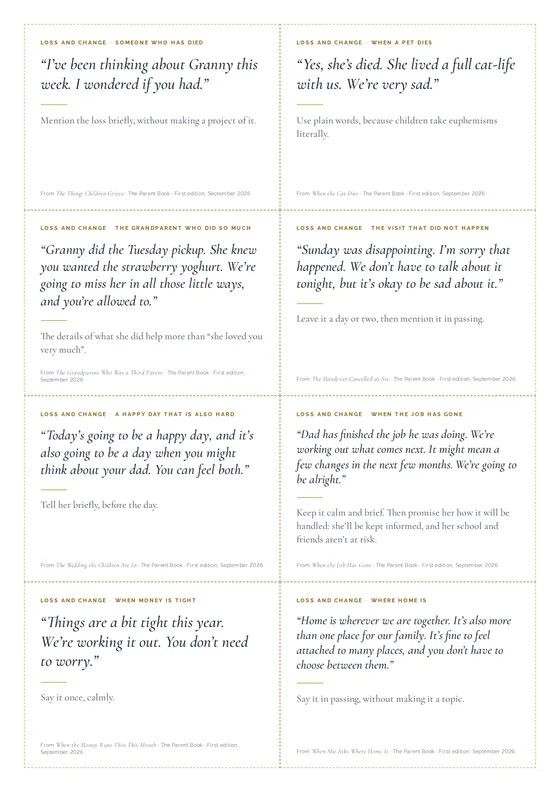
What to say: loss and change
Eight first sentences, each from a quick tip in the library, with a line on when to say it.
With a subscription
How it helps
When something is lost or changing, such as a pet, a grandparent, a job or a home, it’s hard to know where to start. Each card has a first sentence, from a quick tip in the library, to start with, and a line on when to say it.
How to use it
- Cut out the eight cards. Each names the quick tip it comes from, which has the rest.
- Choose the one that fits what’s happening now, and read its tip before you say it.
- Say the sentence in your own voice, at the time the line beneath it suggests.
- Expect the questions to come back, sometimes weeks later, and answer them again.
-
Cards to cut out
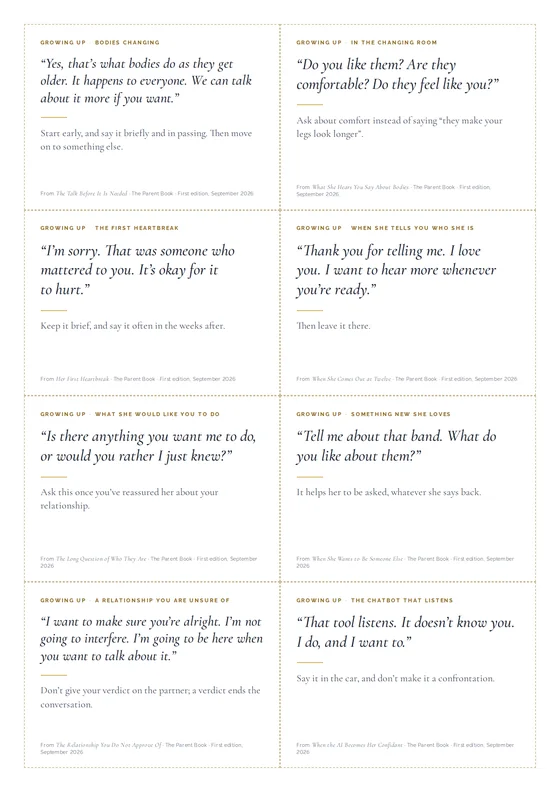
What to say: growing up
Eight first sentences, each from a quick tip in the library, with a line on when to say it.
With a subscription
How it helps
Growing up brings conversations many parents put off: bodies, a first heartbreak, who your child is, a relationship you’re unsure of. Each card has a first sentence, from a quick tip in the library, so the conversation can begin before you feel ready.
How to use it
- Cut out the eight cards. Each names the quick tip it comes from, which has the rest.
- Choose the one or two that fit your child’s age and what’s happening now, and keep them somewhere private.
- Say the sentence in your own voice, and follow the line beneath it.
- Let your child lead from there, and listen more than you speak.
-
Cards to cut out
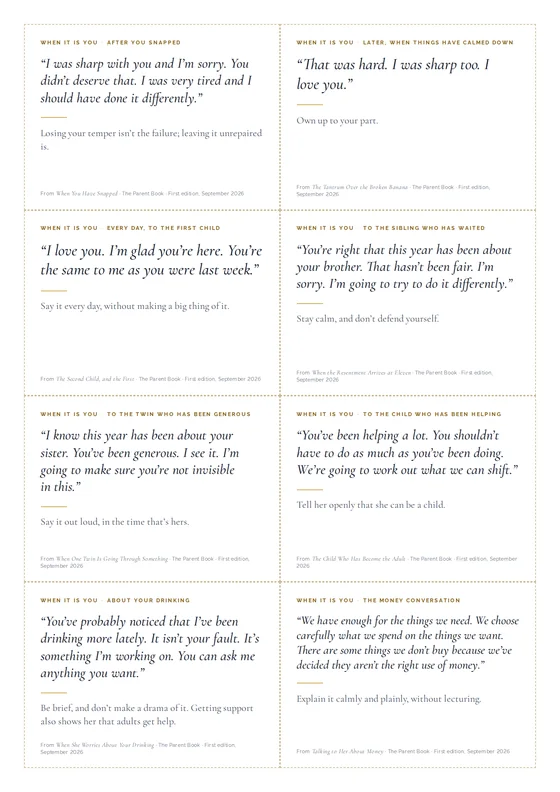
What to say: when it is you
Eight first sentences, each from a quick tip in the library, with a line on when to say it.
With a subscription
How it helps
Some of the hardest conversations are about you: after you have snapped, when one child has had more of you, when you are drinking more or money is tight. Each card has a first sentence, from a quick tip in the library, that owns your part and reassures your child.
How to use it
- Cut out the eight cards. Each names the quick tip it comes from, which has the rest.
- Choose the one that fits, and read its tip before you say it.
- Say the sentence in your own voice, and follow the line beneath it. Keep it brief, and don’t make a drama of it.
- Keep the cards for yourself, as a reminder.
For the school and the GP
For the phone call, the SENCo meeting, the GP appointment and the return after a long absence.
-
For a call or a meeting
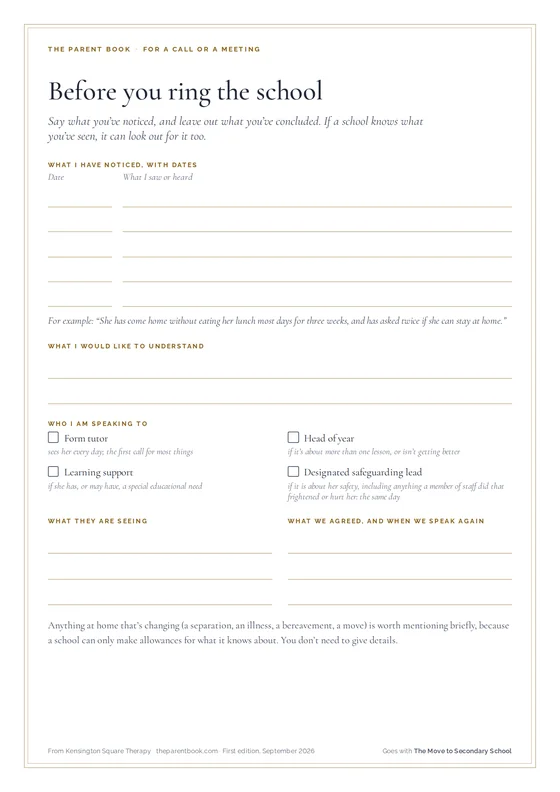
Before you ring the school
What you’ve noticed, with dates, who to speak to and what you agreed. A school can look for a pattern if it’s told about it.
Goes with The Move to Secondary School and What to Do When School Is the Problem
Free to print
How it helps
A school can only act on what it knows about. Writing down what you’ve noticed, with dates, before you ring helps you say it clearly and calmly, and gives the school a pattern to look out for too.
How to use it
- Before you call, write down what you’ve noticed, with dates, and what you’d like to understand. Leave out what you’ve concluded.
- Use the list on the sheet to choose who to speak to. For anything about your child’s safety, it is the designated safeguarding lead, the same day.
- During the call, note what the school is seeing, what you agreed, and when you’ll speak again.
- Keep the sheet, and add to it if nothing changes.
-
For a meeting
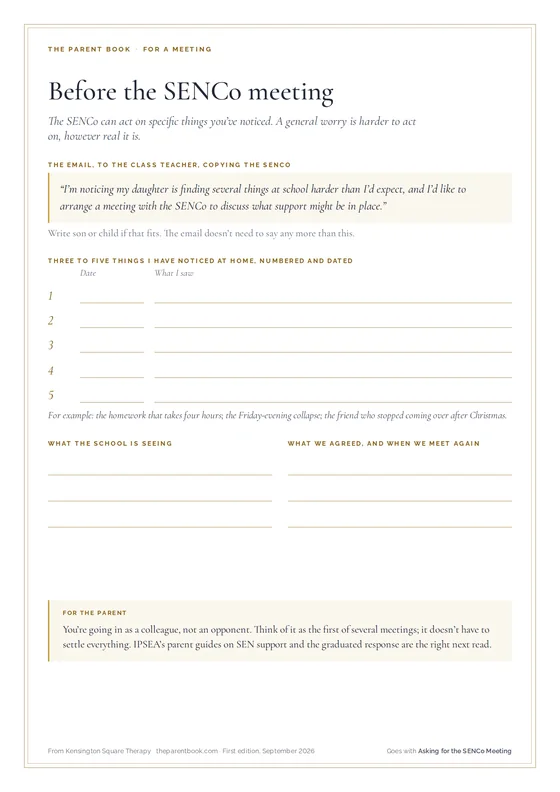
Before the SENCo meeting
The email that asks for the meeting, three to five specific things you have noticed, and what was agreed.
Goes with Neurodiversity, and the Conversation with the School
Free to print
How it helps
A SENCo can act on specific things you have noticed, and a general worry is harder to act on, however real it is. The sheet helps you ask for the meeting in one short email, and go in with three to five dated examples.
How to use it
- Send the email on the sheet to your child’s class teacher, copying the SENCo. It doesn’t need to say any more than that.
- Before the meeting, write down three to five specific things you’ve noticed at home, numbered and dated.
- In the meeting, note what the school is seeing, what you agreed, and when you’ll meet again.
- Go in as a colleague. It’s the first of several meetings, and doesn’t have to settle everything.
-
For a meeting
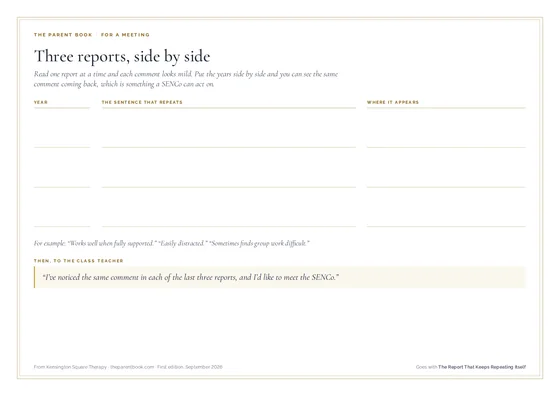
Three reports, side by side
A grid for the last three years of school reports, to find the sentence that keeps repeating, and the line to take to the class teacher.
Goes with Neurodiversity, and the Conversation with the School
Free to print
How it helps
Read one report at a time and each comment looks mild. Side by side, the same comment coming back year after year shows a pattern that a SENCo can act on.
How to use it
- Find your child’s last three school reports, and lay them out side by side.
- Write down any sentence that keeps coming back, in the teachers’ words, and where it appears.
- Take the sheet to your child’s class teacher with the sentence at the foot, and ask to meet the SENCo.
- Take it with you to the SENCo meeting too, with the sheet for that meeting.
-
For a meeting
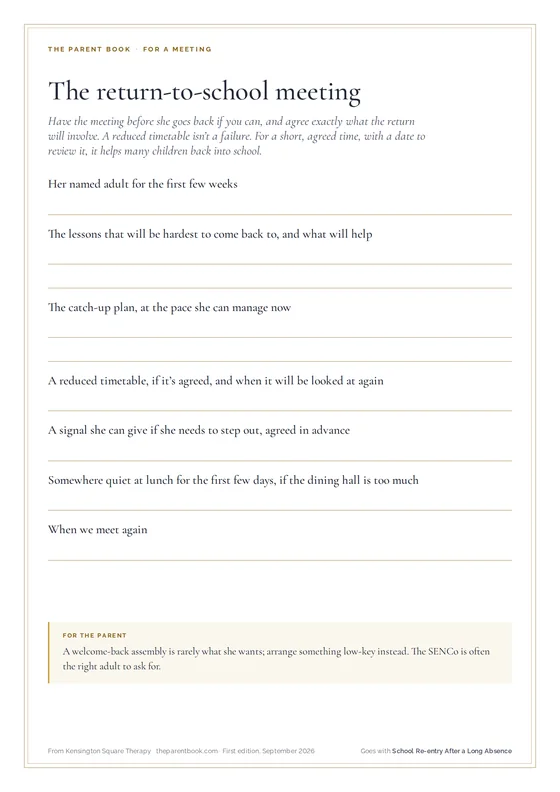
The return-to-school meeting
For a child going back after a long absence: the named adult, the hardest lessons, a catch-up plan at their pace, and the practical arrangements that make the first day possible.
Goes with What to Do When School Is the Problem
Free to print
How it helps
After a long absence, a return that is planned in detail is more likely to last. The sheet makes sure the meeting covers what makes the first days possible: a named adult, the hardest lessons, a catch-up plan at your child’s pace and a way to step out.
How to use it
- Ask for the meeting before your child goes back, if you can, and take the sheet with you.
- Go through each box with the school, and agree exactly what the return will involve.
- If a reduced timetable is agreed, write down when it will be looked at again.
- Before the first day, tell your child what has been agreed, including who their named adult is and the signal they can give.
-
For an appointment
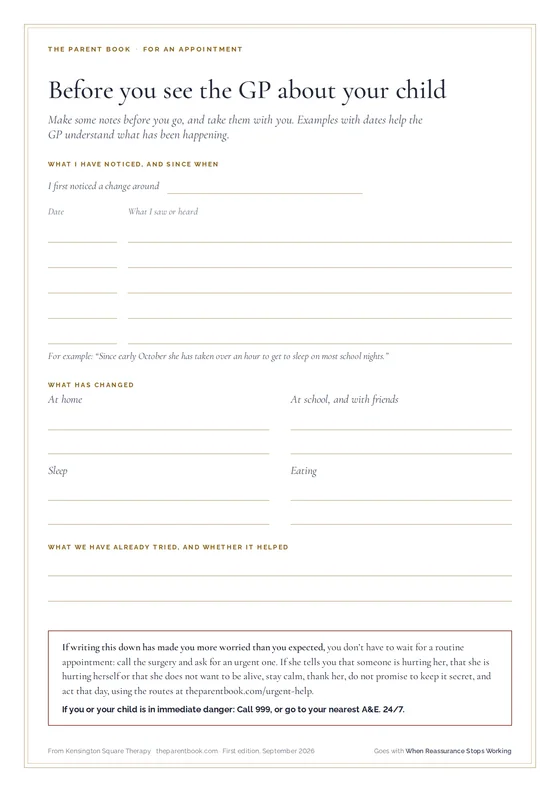
Before you see the GP about your child
What you’ve noticed and since when, what has changed and what you’ve tried; on the back, your questions, what the GP says and what happens next.
Goes with When Reassurance Stops Working and Anxiety, by Age
Free to print
How it helps
Appointments are short, and it’s easy to forget what you meant to say. Notes with dates help the GP understand what has been happening, and the back makes sure you leave knowing what happens next.
How to use it
- Before the appointment, fill in the front: what you’ve noticed and since when, what has changed, and what you’ve tried. If writing it down makes you more worried than you expected, don’t wait for a routine appointment: call the surgery and ask for an urgent one.
- When you book, ask whether the surgery offers double appointments, and ask your child beforehand how they’d like it to go.
- At the appointment, ask your questions in order, most important first, and write down what the GP says.
- Before you leave, check what happens next and when, and who to contact if things get worse.
-
For a call or a meeting
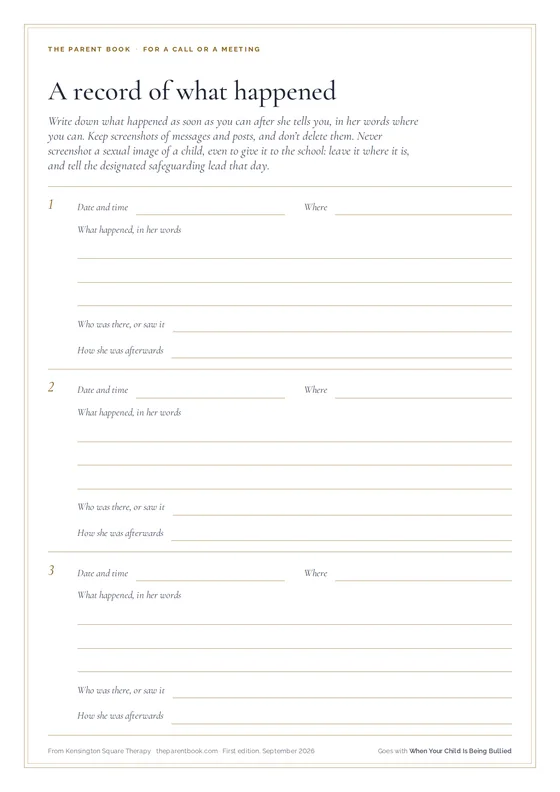
A record of what happened
A dated log of what happened, in your child’s words, with who saw it; and a page for what you told the school, what they said they would do and when you will speak again.
Goes with When Your Child Is Being Bullied
Free to print
How it helps
If your child is being bullied, a dated record in their words, with who saw it, gives the school what it needs to act. The second page keeps track of what the school said it would do, so nothing is lost between calls.
How to use it
- Write down what happened as soon as you can after your child tells you, in their words where you can. If they have been hurt or threatened, or you’re worried about their safety, don’t question them further: ask for the designated safeguarding lead that day.
- Keep screenshots of messages and posts, and don’t delete them. Never screenshot a sexual image of a child, even to give it to the school: leave it where it is, and tell the designated safeguarding lead that day.
- Use the second page for every call or meeting with the school: who you spoke to, what they said they would do, and when you’ll speak again.
- After each call, send a short email saying what you agreed. If nothing has changed by that date, write to the headteacher.
-
For an appointment
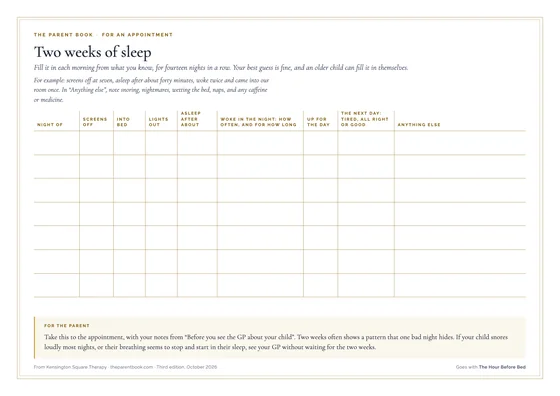
Two weeks of sleep
A sleep diary for fourteen nights, to take to the GP: when your child went to bed and fell asleep, when they woke in the night and for how long, and how the next day went.
Goes with The Hour Before Bed and When Reassurance Stops Working
With a subscription
How it helps
One bad night says little, and a fortnight of nights often shows a pattern: when your child falls asleep, how often they wake, and how the next day goes. It gives the GP something to work with, and sometimes shows you something you hadn’t seen.
How to use it
- Start on any night, and fill it in each morning for fourteen nights in a row. Your best guess is fine.
- An older child can fill in their own. If they sleep some nights at their other home, ask their other parent to fill those in, or mark them.
- Keep going on the nights that are fine too, because they’re part of the pattern.
- Take it to the appointment. If your child snores loudly most nights, or their breathing seems to stop and start in their sleep, see your GP without waiting for the two weeks.
-
For a meeting
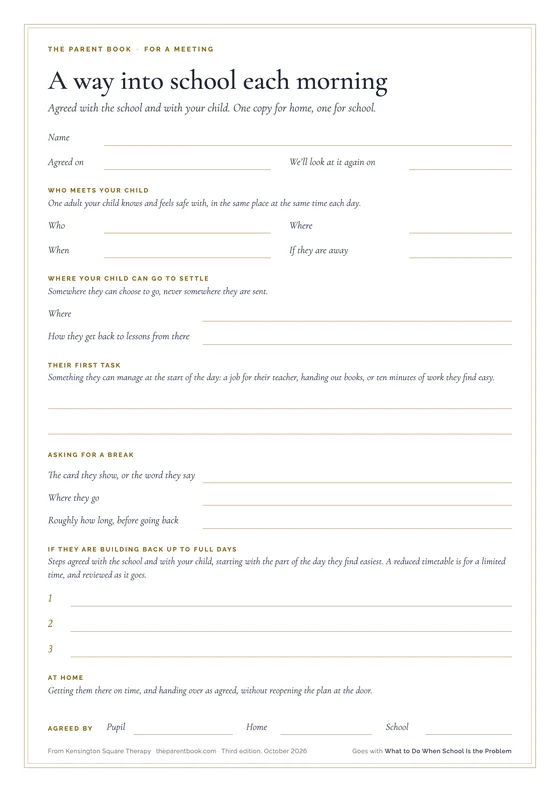
A way into school each morning
A plan agreed with the school and with your child: who meets them, where they can settle, their first task and how they ask for a break. On the second page, four break cards to cut out.
Goes with What to Do When School Is the Problem
With a subscription
How it helps
When getting into school has become hard, a plan agreed in advance means your child knows who will meet them, where they can go to settle, what they’ll do first and how to ask for a break, so each morning starts the same way.
How to use it
- Ask the school for a meeting about how your child gets in each morning, and ask for them to be there for at least part of it. Take the sheet.
- Fill in the plan together: who meets your child, where they can go to settle, their first task and how they ask for a break. Make one copy for home and one for school.
- Cut out the break cards, one for them, one for the adult who meets them and two spare, and agree a date to look at the plan again.
- Each morning, get your child there on time and hand over as agreed, without reopening the plan at the door. If a morning goes badly, start again the next day.
-
For an appointment
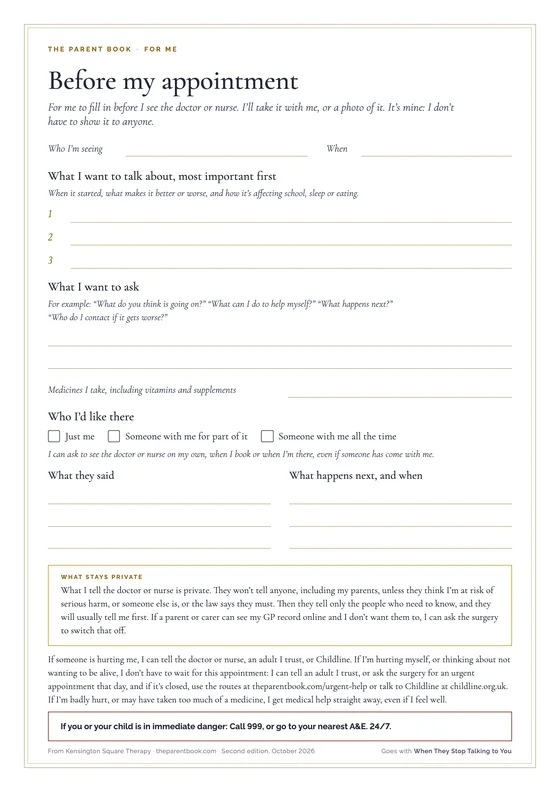
Before my appointment
For your teenager to fill in before they see the doctor or nurse: what to say, what to ask, and who they want with them. A second page for you: how to step back, and what stays private.
Goes with When They Stop Talking to You
With a subscription
How it helps
Seeing a doctor or nurse alone is a skill, and it’s easier for your child to learn with you nearby than all at once when they leave home. The first page helps them get ready: what they want to say, what they want to ask and who they’d like there. The second is for you: how to step back in stages, and what stays private.
How to use it
- A few days before, give your child the first page to fill in, on their own or with you if they’d like. It’s theirs: don’t read it unless they show you.
- Ask whether they want you there for all of it, part of it or none, and go with what they say.
- Let them book it if they can, and take their page, or a photo of it, to the appointment.
- Afterwards, ask how it went and let them tell you as much as they want. If your child tells you that someone is hurting them, that they are hurting themselves, or that they don’t want to be alive, stay calm, thank them, don’t promise to keep it secret, and act that day, using the routes at theparentbook.com/urgent-help.
For the grown-ups
To plan with before a hard conversation, and to keep for yourself.
-
Pocket card
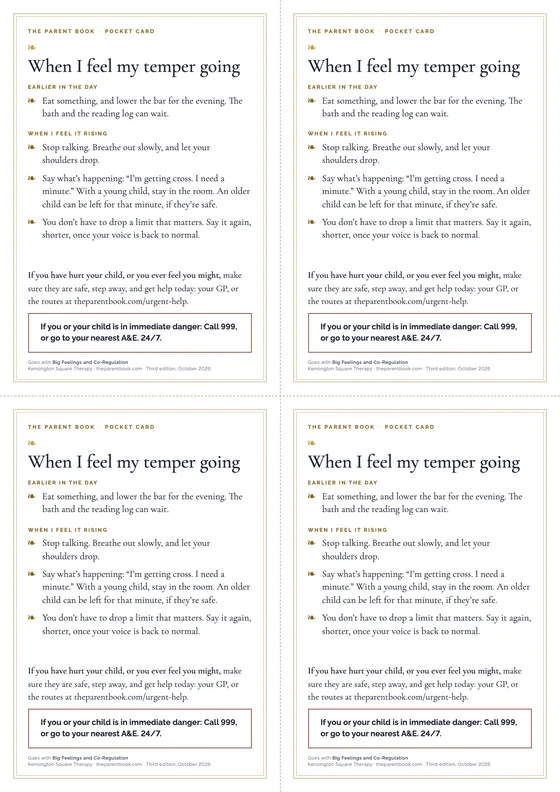
Putting it right
For the parent: what to do when you feel your temper going, and on the back, how to put it right with your child when it has gone.
Goes with Big Feelings and Co-Regulation and When You Are Not All Right
With a subscription
How it helps
You’ll lose your temper sometimes, as every parent does. Stopping early helps, and going back afterwards to put it right, owning your part without a “but”, shows your child that things between you can be mended, and that it wasn’t their fault.
How to use it
- Print on both sides, flipping on the long edge, and cut out the cards. Keep one where you’ll see it at the hardest time of day.
- Earlier in the day, eat something, and lower the bar for the evening.
- When you feel your temper rising, stop talking, breathe out slowly, and say what’s happening: “I’m getting cross. I need a minute.” With a young child, stay in the room. An older child can be left for that minute, if they’re safe.
- Afterwards, once you’re both calm, go to your child and follow the back of the card. If you have hurt them, or ever feel you might, the front says what to do today.
-
For the grown-ups
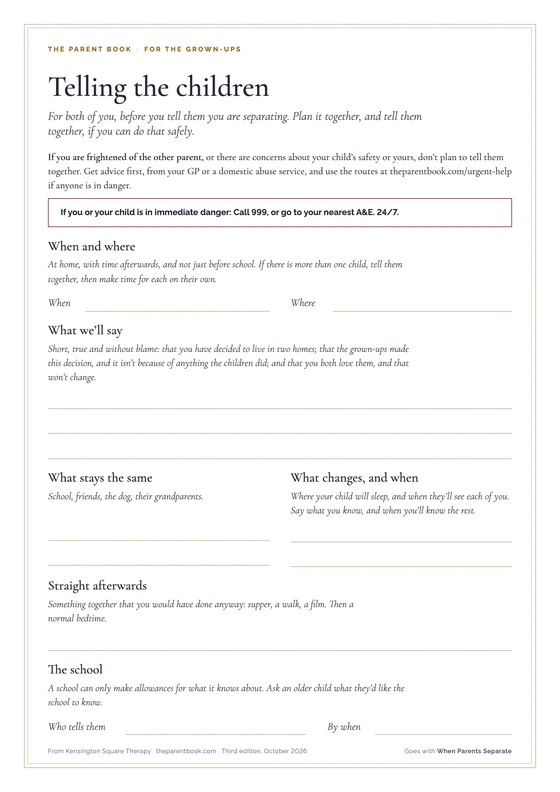
Telling the children
For both parents, before you tell the children you are separating: when and where, the words you’ll use, what stays the same and what changes. On the back, what they might ask, and the weeks after.
Goes with When Parents Separate and The Conversations Parents Avoid
With a subscription
How it helps
Children often remember how they were told. Planning it together first, with short, true words and no blame, means your child hears one story, knows what stays the same, and hears that the separation isn’t because of anything they did.
How to use it
- Read the box at the top first. If you’re frightened of your child’s other parent, or there are concerns about your child’s safety or yours, don’t plan to tell them together. Get advice first, from your GP or a domestic abuse service, and use the routes at theparentbook.com/urgent-help if anyone is in danger.
- Fill in the front together, before you tell the children: when and where, what you’ll say, what stays the same and what changes.
- Agree between you how you’ll answer the questions on the back, and who tells the school.
- Straight afterwards, do something together you would have done anyway. Expect the questions to come back, and answer them again.
- The back says what to do that day if your child tells you something that worries you. If it is about their other home, it goes to the routes at theparentbook.com/urgent-help, not to their other parent.
-
For you
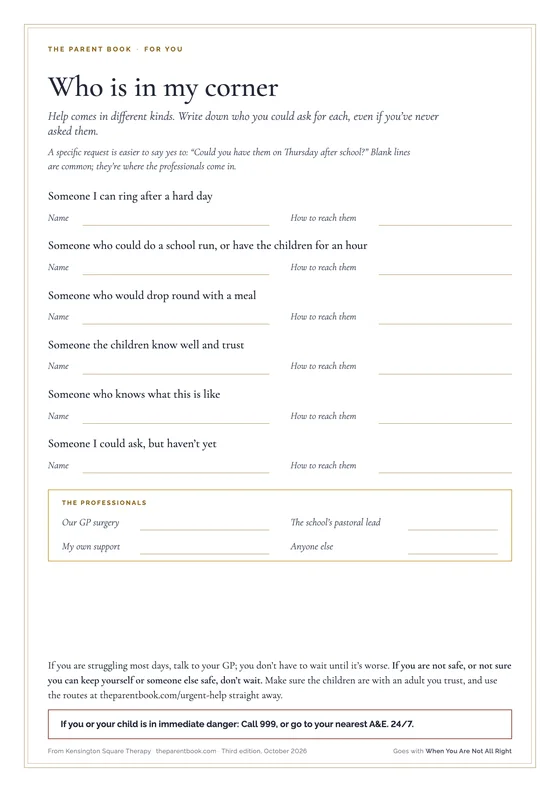
Who is in my corner
For you: who you could ask for each kind of help, including the people you haven’t asked yet. Fill it in on a good day, and keep it where you’ll find it on a bad one.
Goes with When You Are Not All Right
With a subscription
How it helps
When you’re struggling, it’s hard to think who to ask, and easy to decide there’s no one. A list made on a good day, with a name for each kind of help, makes asking easier on a bad one, and shows you where the professionals fit.
How to use it
- Fill it in on a good day, on your own or with someone you trust.
- For each kind of help, write a name and how to reach them, including people you haven’t asked yet. Blank lines are common, and they’re where the professionals come in.
- Add your GP surgery, the school’s pastoral lead and your own support.
- Keep it where you’ll find it on a bad day. If you are not safe, or not sure you can keep yourself or someone else safe, don’t wait: make sure the children are with an adult you trust, and use the routes at theparentbook.com/urgent-help straight away.
-
For the grown-ups
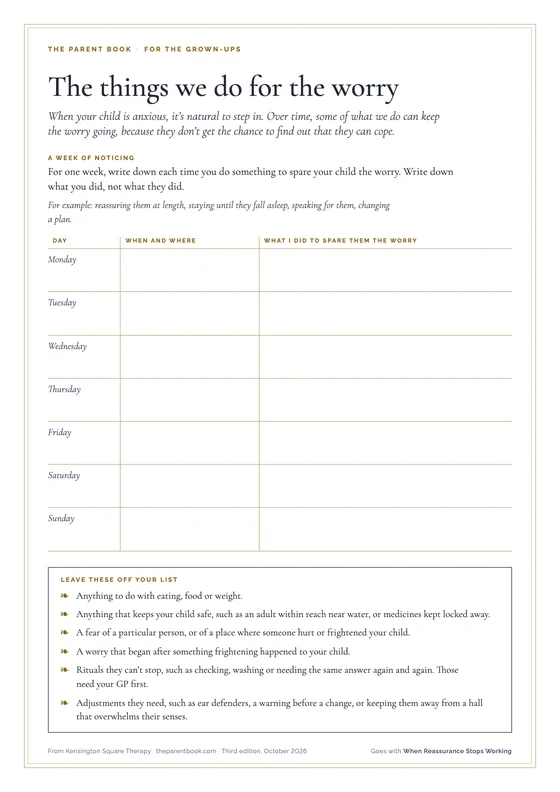
The things we do for the worry
A week of noticing what you do to spare your child the worry, and on the back, the one thing you’ll change, the sentence you’ll use, and how it is going.
Goes with When Reassurance Stops Working
With a subscription
How it helps
When a child is anxious, the adults around them step in, and over time that can keep the worry going, because the child doesn’t get the chance to find out that they can cope. A week of noticing shows you what you do; one planned change, made kindly and with the same sentence every time, gives the child that chance.
How to use it
- For one week, write down each time you do something to spare your child the worry: what you did, not what they did.
- Choose one thing that happens often and that you can keep to every time, and plan to cut it back one step at a time. Never choose anything in the box on the front.
- Write your sentence, and tell your child about the change in advance, at a settled moment.
- Keep to it every time, kindly. If your child hurts themselves, talks about hurting themselves or not wanting to be alive, or tells you someone is hurting them, stop the plan and act that day, as the back says.
-
For the grown-ups
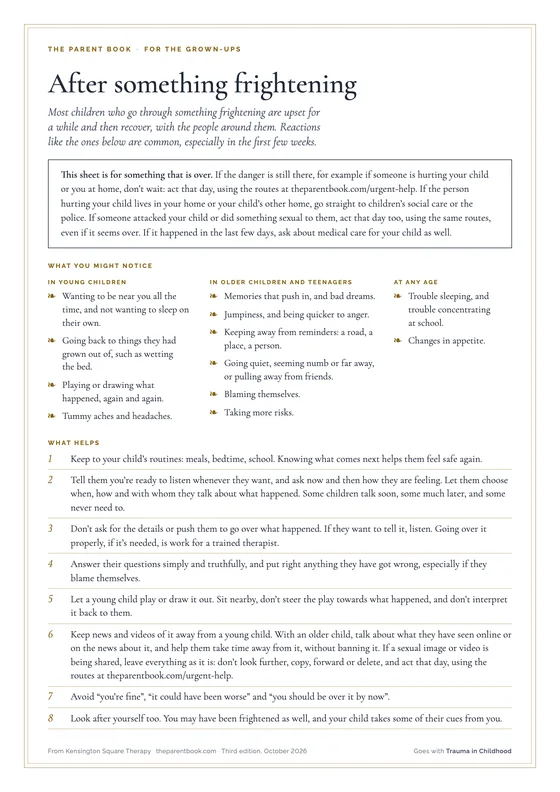
After something frightening
For the first weeks after your child has been through something frightening, such as an accident, a fire or something violent they saw: what is common, what helps, and when to talk to your GP.
Goes with Trauma in Childhood
With a subscription
How it helps
After something frightening, most children are upset for a while and then recover, with the people around them. The sheet sets out what is common in the first weeks, what helps and what to avoid, and when to talk to your GP, with a table on the back for what you notice.
How to use it
- Read it in the first days, on your own or with your child’s other parent. If the danger is still there, don’t wait: use the routes at theparentbook.com/urgent-help that day. Do the same if someone attacked your child or did something sexual to them, even if it seems over.
- Keep to your child’s routines, check in now and then, and let them choose when to talk. Don’t ask for the details, and don’t tell them they should be over it.
- Write down what you notice on the back, with dates, and tell their school or nursery what has happened.
- Talk to your GP if, about a month on, your child is still very upset and finding everyday life hard, or sooner if things are getting worse or you’re worried. If they are under five, you can talk to your health visitor instead.
-
For the grown-ups
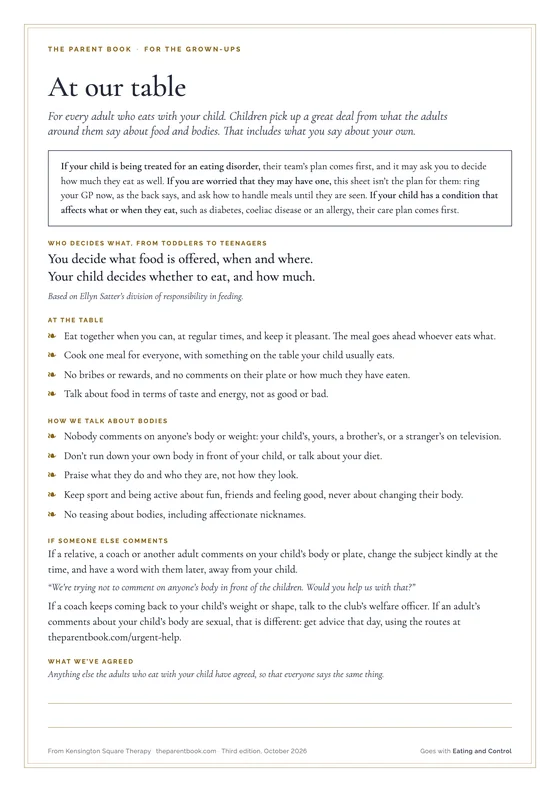
At our table
For every adult who eats with your child: who decides what at meals, how the family talks about food and bodies, and when a worry about eating needs the GP.
Goes with Eating and Control and Body Image
With a subscription
How it helps
Children pick up a great deal from what the adults around them say about food and bodies. A few rules that every adult in the house keeps can make mealtimes calmer and keep weight and appearance out of family talk. The back says when a worry about eating needs the GP.
How to use it
- Read it with the other adults who eat with your child, and agree the rules you’ll all keep. If your child is being treated for an eating disorder, or has a condition that affects what they eat, their team’s plan comes first; if you’re worried they may have an eating disorder, ring your GP first.
- At meals, you decide what is offered, when and where; your child decides whether to eat, and how much. No bribes, and no comments on their plate.
- Leave bodies and weight out of family talk, your own included. If your child says something about their body, ask what made them think that, and listen.
- If your child starts eating much less, hides food, seems frightened of putting on weight or gets upset after eating, ring your GP for the earliest appointment.
For schools
For a pastoral lead to print, show or send to parents.
-
For a parents’ evening
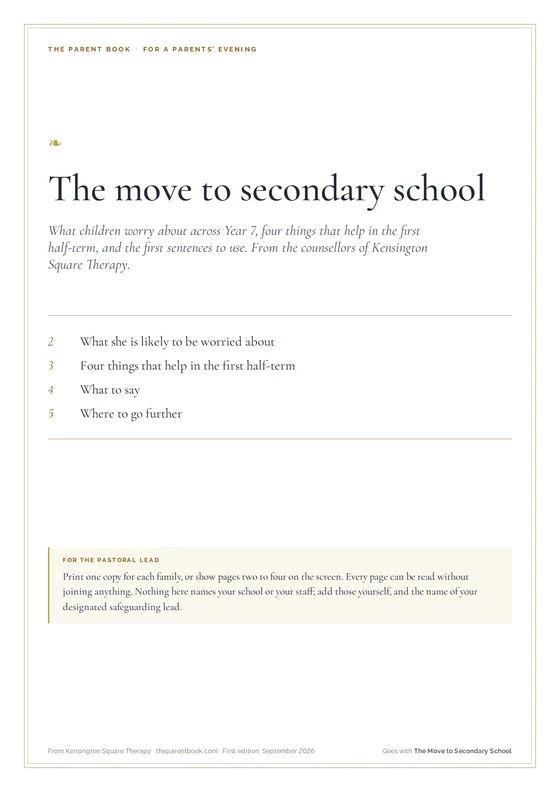
The move to secondary school, for a parents’ evening
For a pastoral lead to print, show or send: what children worry about across Year 7, four things that help in the first half-term, and the first sentences to use.
Goes with The Move to Secondary School
Free to print
How it helps
What children worry about across Year 7 is often different from what their parents expect. The pack puts that in front of parents before the move, with four things that help in the first half-term and the first sentences to use, written by the counsellors of Kensington Square Therapy.
How to use it
- Print one copy for each family, or show pages two to four on the screen at a parents’ evening.
- Add your own details before you share it: the names of your staff, and of your designated safeguarding lead.
- Send it home before the move, or hand it out on the evening. Every page can be read without joining anything.
The rest of the library, the chapters, the quick tips and the things to do together, is at theparentbook.com. For a page on each subject, and everyone else who can help with it, see what helps, and where else to go.
Published by Kensington Square Therapy. Company No. 16707111. Written by therapists registered with the British Association for Counselling and Psychotherapy (BACP) and the National Counselling and Psychotherapy Society (NCPS). This page is not therapy, and not a substitute for professional support. The full library is at theparentbook.com.