The Parent Book·From the library
Neurodiversity, and the Conversation with the School
A chapter for parents whose child has been working harder than other children, for longer, to do the things that come more easily to others.
A twelve-minute read · Published 26 May 2026

It is a Sunday evening. The bag is by the door, the uniform is on the chair, and the parent has been sitting at the kitchen table for an hour with the school report from the end of last term, which has used a particular phrase (does well when fully supported) for the third year running. The maths homework, which the other children seem to finish in twenty minutes, took two and a half hours and ended, as has happened on most Sundays this year, in tears.
The parent has, by now, read every parenting article on focus and on motivation and on screens and on sleep, tried what each suggested, and watched the same pattern come back the following week. Something else, she has begun to suspect, is going on. She has been holding the word for it at arm’s length for a while.
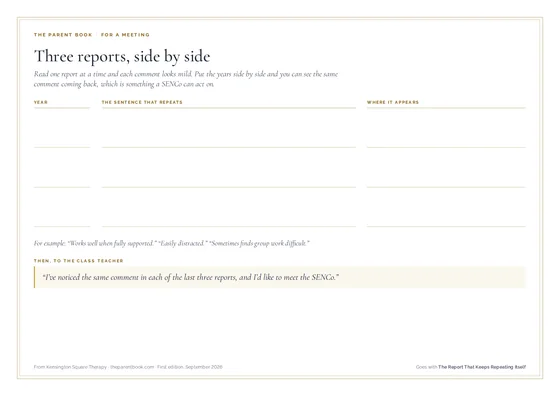
In our counselling work with parents, this Sunday evening comes up often. The friction has been there for some time. The reports have been hinting at it. And the parent is now beginning to wonder whether the conversation she has been avoiding is the conversation she ought to be having.
What is actually happening
The word neurodiversity names a simple idea that has, in recent years, sometimes been overloaded with culture-war freight. The plain version is this. Human brains develop differently. Some of those differences cluster, in the language of clinical assessment, into recognisable patterns: autism, ADHD, dyslexia, dyspraxia, Tourette’s, dyscalculia, and others. Each is a real description of a real way of being in the world. None of them is, on its own, a disorder in the way the older medical vocabulary suggested. They are also not, in plain household terms, no big deal. A child whose nervous system is calibrated differently from the median can find both real strength and real difficulty in the same morning.
The most useful framing, in our view, is the one most of the careful UK organisations have arrived at independently: neurodiversity is a difference, and difference does not preclude difficulty. To insist a child’s autism is only a difference is to refuse to see the homework taking four hours. To insist it is only a difficulty is to refuse to see the child. The parent’s first job is to look at both.
The friction that brings parents to wonder
Parents in our practice rarely arrive here by reading a diagnostic checklist. They arrive through the kinds of friction that have built up over months and years. The picture varies. The pattern recognition is similar.
The homework that takes four times as long as it should. The bedroom that has, over a year, become unmanageable in a way that is neither laziness nor defiance; it is a room a child cannot, in any literal sense, get on top of. The playground that has begun to feel too loud, too bright, too full of unwritten rules she cannot make out. The friendship that has not quite worked, and then the next one, and then the third. The timetable at the new secondary that has, despite her best efforts, defeated her by half-term. The way she is, by Friday evening, so exhausted from holding herself together at school that the kitchen on Friday is the unsafest place in the week.
In a different child the picture is different again: the boy who is the brightest in the year and has not, this term, finished a single piece of written work; the girl whose passionate, encyclopedic interests have begun to mark her out; the child whose tics have, since the autumn, become harder to hide.
The parents we sit with often describe a low-grade exhaustion that has set in over years. The household has been working harder than other households appear to be working, on things that look, from outside, ordinary. That exhaustion is information.
When concerns become specific enough to act on
There is no single threshold at which a parent’s wondering becomes a parent’s acting. There is a useful test. If the pattern has held for at least two terms, across more than one setting (home, school, an after-school club), and the strategies the family has tried have not, in any sustained way, changed the picture, the wondering has earned a name and is worth taking somewhere. The instinct to wait another year, to see whether she grows out of it, is, in most cases, the instinct that ends with the child further behind than she needed to be. Where the picture is in fact neurodevelopmental, early specialist input shortens the years of misattribution (laziness, anxiety, behaviour) a child otherwise carries.
The right move is rarely a referral on its own: first a conversation with the GP, and, in parallel, a conversation with the SENCo at school. Both, not either.
The UK assessment landscape
Parents arrive at our consultations with very different ideas of what UK assessment looks like. A brief, honest account.
The NHS route begins with the GP, who refers, in most areas, into community paediatrics or CAMHS depending on presentation and local commissioning. The assessment, when it happens, is thorough, multidisciplinary, and free at the point of use. The honest difficulty is the waiting list. In most areas of England in 2026, the wait for a children’s ADHD or autism assessment via the standard pathway is between twelve and thirty-six months, with regional variation; in some areas it is worse.
The NHS Right to Choose framework, less widely known than it should be, allows a GP in England to refer to any approved provider with an NHS contract, anywhere in the country, for a first assessment funded by the NHS. The waits are often substantially shorter than local CAMHS. The framework is, at points, under commissioning pressure, but for many families it is the route that turns a thirty-month wait into a four-month one. We send parents to ADHD UK’s Right to Choose guidance, which is the clearest UK-anchored explainer we know, and to the GP, who will in most cases support the route when asked.
The private route is the third option. Private child assessments in the UK typically cost between £1,200 and £1,700 for a single condition, with combined ADHD-and-autism pathways costing more. The Giaroli Centre in Harley Street, founded by Dr Giovanni Giaroli, is the private centre we most often hear named by London parents who have made this choice; their multidisciplinary children’s pathway, conducted by psychiatrists, psychologists and paediatricians together, is the structure we would look for in any private provider. The questions to ask any clinic before paying are: who is conducting the assessment, what is their professional registration (HCPC, GMC, BPS), is the assessment multidisciplinary, will the report be accepted by the NHS for prescribing if medication is later indicated, and is post-assessment support included or charged separately. A private assessment with a single clinician and no follow-on is not, in our experience, a good use of family money.
The conversation with the school
The school is not the route to assessment, but it is the route to support, and the two are not the same. In England, schools operate a graduated response under the SEND Code of Practice: the school identifies a need; the SENCo, the Special Educational Needs Co-ordinator who sits on every school’s staff, coordinates the assess-plan-do-review cycle; support is put in place at the level the school can resource. The graduated response begins long before any formal diagnosis. A child does not need an assessment outcome to receive SEN support at school. She needs the SENCo to know.
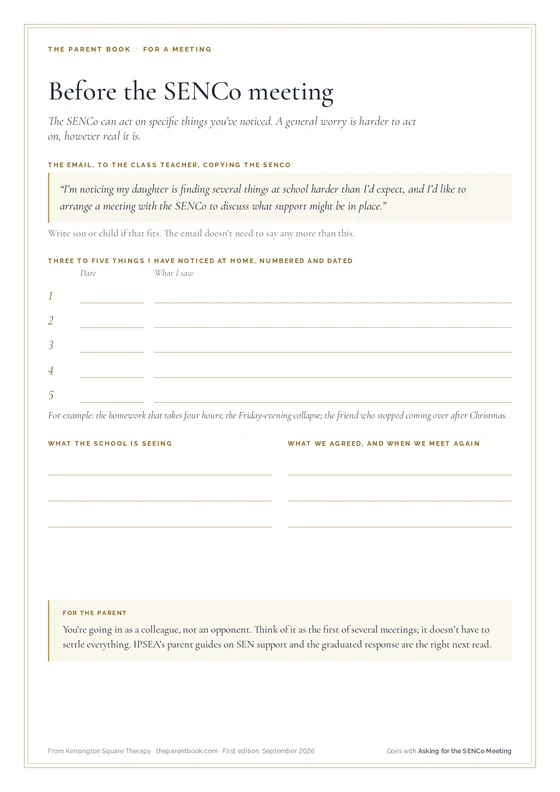
So this term, ask for a SENCo meeting. Email the class teacher and request one. The form matters less than parents fear; “I am noticing my daughter is finding several things at school harder than I would expect, and I would like to meet with the SENCo to discuss what support might be in place” is enough. Bring to the meeting, in writing, a short list of the specific things you have observed at home: the homework that takes four hours, the Friday-evening collapse, the friend who stopped coming over after Christmas. Specifics are what the SENCo can act on. General worry is what they politely note.
Where the school’s support is insufficient, the next step is an Education, Health and Care Plan, the EHCP, a legally enforceable document held by the local authority that sets out the support a child must receive. EHCPs are obtained, in the great majority of cases, only by parents willing to advocate through a process that is, in plain language, harder than it should be. IPSEA, the Independent Provider of Special Education Advice, is the UK’s specialist legal charity in this territory; we send every parent beginning an EHCP application or appeal to their advice line.
What we support parents away from is the adversarial posture. Schools, in the great majority of cases, want what is best for the child and are working inside a resource constraint that is not theirs to fix. The parent who arrives with the SENCo as a colleague rather than an opponent is, by the second meeting, in a different conversation. The relationship is the variable; the child is the same child either way.
The child in all of this
Across the months of the assessment process and the SENCo meetings, there is a child, and what she makes of what is happening to her deserves attention of its own.
How much to say, and when, depends on age. Younger children, under nine or so, generally do not need the language of diagnosis so much as the language of what they are noticing. “Some children’s brains find loud rooms harder than other children’s. Yours is one of those. That is why the dining hall has been hard. We are going to talk to your teacher about it.” The specificity, named without weight, gives the child a vocabulary for what she has been carrying. Older children, from around eleven, often arrive at the diagnosis ahead of the family, having read about it themselves; the conversation is then more about validation than introduction. Adolescents tend, in our experience, to want the name. The name is the relief; the years of misattribution finally have an explanation.
What we support parents against is the diagnosis-as-whole-story move. A child who is told she is autistic and then has every difficulty for the next three years routed through her autism has, in effect, been replaced by her diagnosis. The diagnosis is a piece of information, not a personality. The National Autistic Society’s pages on talking with autistic children about their diagnosis are the right primer for parents at the threshold of that conversation.
The longer arc
A diagnosis, when it arrives, mainly gives the family sharper information to act on. The task from here is helping her live a life that fits the way her brain actually works, with the strengths and the difficulties named and the supports in place. She does not have to become more like the other children for any of that.
Most parents we sit with describe, six months after a diagnosis, a sense not of new burden but of new clarity. The pattern has a name. The school knows. The strategies have direction. The child knows what she is contending with and, often, why the homework has been so hard. The household has stopped, on Sunday evenings, asking a question it was not, at the time, able to answer.
She is still the same child. You are still the same parents. The years ahead are now slightly more navigable than they were last week.
Where to go further
ADHD Foundation Neurodiversity Charity. The UK’s leading neurodiversity charity, based in Manchester and operating across the lifespan. Their parent-facing resources on what neurodiversity is, and how to think about it as a family, are the calmest UK starting point we know. adhdfoundation.org.uk.
National Autistic Society. The first signpost for any family at the autism threshold. Their Parent to Parent Emotional Support Helpline is staffed by parents of autistic children and is the call we send parents to make on the evening they have started to wonder. Arranged through autism.org.uk; the service is a one-off call back from a parent of an autistic child. The charity no longer publishes a general helpline number.
IPSEA. The Independent Provider of Special Education Advice. The right line when the school has stopped engaging, or the EHCP process needs legal scaffolding, or the formal SEND tribunal is in view. Free, independent, and the cleanest legal resource we know. ipsea.org.uk.
Luke Beardon, Avoiding Anxiety in Autistic Children: A Guide for Autistic Wellbeing A UK academic at Sheffield Hallam’s Autism Centre, writing for parents in plain English. The right read for any family at the autism threshold, with practical material on school, on sensory differences, and on the everyday small adjustments that change the texture of a day.
Steve Silberman, NeuroTribes: The Legacy of Autism and How to Think Smarter About People Who Think Differently The cultural history of autism and the neurodiversity movement, written for a general audience. Heavier reading; the right book for the parent who wants to understand the wider field her family has just walked into.
If you need help right now
If you or your child is in immediate danger, call 999 or go to your nearest A&E.
If you, or your child, is in mental health crisis, NHS 111 is the route to your local mental health crisis line, twenty-four hours a day: in England, Scotland and Wales, call 111 and choose the mental-health option. In Northern Ireland, Lifeline is free and confidential on 0808 808 8000, twenty-four hours a day.
If your child or young person is having thoughts of suicide, Papyrus HopeLine 24/7 offers confidential support to anyone under 35 and to those worried about them. Call 0300 102 2470, open 24 hours, every day. Text HOPE to 88247 or email pat@papyrus-uk.org; text and email replies may take up to 24 hours.
If your child needs to talk to someone themselves, Childline is free, confidential, and available 24 hours a day on 0800 1111, with online chat at childline.org.uk.
If you are worried that a child is being harmed or is at risk, the NSPCC Helpline for adults is on 0808 800 5000, Monday to Friday 10am to 4pm, with email at help@nspcc.org.uk read between 11am and 4pm, seven days a week. An email sent outside those hours is not received. If the NSPCC service is closed and the concern cannot wait, call the police on 101. You can also contact the child’s local out-of-hours children’s social care, social work or social services team. If a child is in immediate danger, call 999.
If you would prefer to text rather than speak, Shout is a free, confidential 24-hour mental health text service. Text SHOUT to 85258.
If you are struggling yourself and need to talk, Samaritans is free to call at any time of day or night on 116 123.
What helps with the school, this term
Support at school does not wait for a diagnosis. It starts when the SENCo knows what you are seeing.
- Ask for the SENCo meeting this term. “I am noticing my daughter is finding several things at school harder than I would expect, and I would like to discuss what support might be in place” is enough to begin the graduated response.
- Bring specifics, in writing. The homework that takes four hours, the Friday-evening collapse, the friend who stopped coming over. Specifics are what a SENCo can act on; general worry is what they politely note.
- Stay out of the adversarial posture. Most schools want what is best for the child inside a resource constraint that is not theirs to fix. Where the support is not enough, IPSEA’s advice line is the specialist route to an EHCP.
- Pace the conversation with the child. Under nine or so, the language of what she notices rather than diagnosis. Adolescents tend to want the name; the name is the relief.
More one-minute pieces, for when you need one
External support
ADHD Foundation Neurodiversity Charity
The UK’s leading neurodiversity charity, based in Liverpool.
National Autistic Society
The UK’s leading autism charity.
· By arrangement, requested through the website
IPSEA (Independent Provider of Special Education Advice)
The UK’s specialist legal charity for SEND.
0300 222 5899 · Triage Tue 9.30am-12.30pm; Call-in Helpline Wed 9.30am-2.30pm