The Parent Book·From the library
When They Stop Talking to You
For parents whose teenager hardly talks to them any more.
A thirteen-minute read · Published 25 May 2026

The change is rarely dramatic. There’s no fight, no slammed door, no moment you can point to and say that is when it changed. Instead, one day in October, you realise that the after-school conversation, which used to be the one part of the day you could count on, has been single syllables for about three weeks. How was it? Fine. Their phone is out before their coat is off, and they’re upstairs before you’ve put the shopping down.
As you stand in the hall with the bags, it dawns on you that the child who, eighteen months ago, wouldn’t stop talking about their day has become a teenager who tells you nothing.
This is one of the most disorienting changes in parenting, and parents going through it tend to assume they’re the only ones. In fact it happens to more or less every parent of a thirteen-year-old. It’s disorienting because you have been the most important person in someone’s life, and now you’re watching yourself being demoted, in real time.
What is actually happening
In the great majority of cases, a teenager who stops talking to their parents is doing exactly what this stage of development asks of them. Among other things, adolescence is about building a self that isn’t a smaller version of their parents. To do that, a teenager needs an inner life that they don’t report, at every turn, to the adults who raised them. Keeping things to themselves is how they build it.
There are good developmental reasons for this. The teenage brain is reorganising, and friends’ reactions are becoming the main way a fourteen-year-old judges themselves. The opinions that count most now belong to the four other fourteen-year-olds in the WhatsApp group, not to the parent who still asks whether the homework is done. Your teenager hasn’t stopped loving you. They are holding their thoughts back because they are testing what it’s like to have thoughts that are their own.
The conversations that do still happen are the ones they have chosen: the things they have decided, on some level, to share with you. That’s more intimate than an eight-year-old’s chatter, even though it looks like less.
There’s also an indignity in this that parents rarely say out loud. The person you have given fourteen years of your attention to now finds your questions tedious and your presence mildly embarrassing. You aren’t imagining the eye-roll: it’s real, it’s aimed at you, and you got it for asking how their day was. Parents who pretend it doesn’t sting are often the ones who end up snapping three days later. It’s better to admit that it hurts. The indignity is part of having a teenager.
When the silence is something else
Most of the time, the silence is part of normal development. Sometimes it’s more than that, and you’re right to ask: is this normal, or is something happening? There’s no clean test, and we would distrust anyone who offered one. But there are signs we look for in clinical practice, and you can look for them too.
A teenager who is withdrawing as part of normal development is usually withdrawing from their parents in particular, and is still talking to their friends, still on the phone in their room and still going out on Saturdays. Their friendship group is intact, or changing in the way friendship groups change at fourteen. They are still, broadly, getting on with school. Their sleep is wrong, as teenage sleep is, but it’s wrong in the recognisable way: late to bed, hard to wake, sleeping the weekend off.
A teenager whose silence is part of something bigger is often withdrawing from their friends as well. Their phone is less busy, not more. The Saturday plans have stopped. There used to be music behind their bedroom door, and now there’s nothing. Their appetite has changed. Their mood is flat in a way that doesn’t lift when something good happens. Low mood can also look like being irritable or grumpy most of the time, in girls and boys alike.
The second pattern is the one to take seriously, without panicking. No single sign separates a teenager going through adolescence from one who is struggling. What separates them is how the signs build up, how long they last, and your own sense, which is usually accurate, that something is off.
If this second pattern sounds like your child, don’t corner them. Make any kind of conversation as easy to start as you can, and at the same time begin thinking about what professional support might look like. Your GP is the gateway to NHS routes; CAMHS waiting lists are real, which is why the parent who notices early is best placed to help. On average, teenage boys are less likely than girls to talk about how they feel or to ask for help themselves, so with a son, don’t wait for him to bring it up.
What not to do
When a teenager goes silent, the instinct is to ask more questions, to organise a sit-down, or to say, with the best of intentions, “We used to be so close. What’s changed?” We’d ask you not to do any of these things.
For a teenager, a sit-down conversation is almost unbearable. It puts them in the spotlight just when they are trying to step out of it, and it tells them you’ve decided their silence is a problem to be solved, which makes them the problem.
Saying we used to be so close is worse. However lovingly you mean it, you are asking your teenager to repair your grief. They can’t, because they are the cause of it, in the sense that they are the one growing up. Asking them to manage your sadness about that is asking for something they can’t give, and they will withdraw further.
Finally, interrogating your teenager never gets you what you’re after. “Are you all right? Are you sure? You’d tell me if something was wrong, wouldn’t you?” They’ll say yes and mean nothing by it. The information you want won’t come from asking them straight out, so you need to keep a less direct way open.
There’s one moment worth describing, because almost every parent gets it wrong: the minute your teenager walks in after school. You’ve been thinking about them all afternoon, so you open with “How was it? Did you see Maya? What did you have for lunch?” They have spent seven hours managing how they come across to everyone at school, and they have nothing left for questions at the front door. They give you one syllable and go upstairs, and the rejection makes your question the next afternoon a little sharper. What works, almost embarrassingly, is to say nothing beyond hello. Smile, and go back to whatever you were doing. Slowly, the room you’re in becomes somewhere they come back into, and stops being somewhere they escape from.
What does work
The way in is through something you do together that isn’t about the conversation: a drive, a dog walk, a trip to the supermarket, or the late-night visit to the kitchen when your teenager has come down for a snack. These are the conversations teenagers actually have with their parents. Doing something together gives a teenager the dignity of not being looked at while they talk, and gives you something to do with your face while you listen, which is harder than it sounds.
One thing that works is a question that doesn’t sound like one: “I was wondering whether Maya has been around much this term.” Say it when you’re side by side, with neither of you looking at the other, and then don’t fill the silence. They’ll answer or they won’t. If they don’t, you’ve lost nothing, and you’ve raised the subject. The mistake is to ask the same thing with a question mark and an expectant face, which turns it into an interview.
Parents take a silent supper harder than they need to. A teenager with nothing to say at supper is using the meal to refuel; they aren’t punishing the family. Leave the silence alone. Talk to whoever else is at the table about the rest of the day, let the radio do some of the talking, and keep your eyes on your own plate. After three or four suppers like this, your teenager will say something. It won’t be at this one. It will be at the fourth. More gets said in passing, while a teenager stands at the counter eating, than in any planned conversation, so sometimes just be the parent making a cup of tea when they walk in, and ask whether they want one.
Parents tend to overdo it when their teenager has a friend round. Treat the friend as a guest: say hello and help yourselves to anything in the fridge, then leave them to it. Your teenager wants to be seen having a friend; they don’t want the friend interrogated.
The phrase we find ourselves using is presence without demand: being in the room, on the sofa or just nearby, without needing your teenager to do anything with you. It can feel like doing nothing, but being available without intruding is more or less the whole of a parent’s job in the teenage years.
For parents of girls at this stage, the book we keep recommending is Lisa Damour’s Untangled, which sets out the seven strands of adolescent development without reducing them to slogans. For sons and daughters alike, we recommend her later book, The Emotional Lives of Teenagers. For the neuroscience behind all this, Daniel Siegel’s Brainstorm is the clearest writing for a general reader we’ve come across. The chapter on how the brain reorganises in adolescence is the part that helps most, because once you’ve read it, you can see the eye-roll as something other than a personal insult.
When a teenager is going through something, the answer is not yet formal therapy, and the parent is the person they will not talk to, we point parents to Kooth: a free, anonymous online support service for young people, commissioned by the NHS in many parts of the UK, giving them the option of typing rather than talking to a counsellor they will not face in school the next day. Check availability via the postcode lookup. Childline is also there, free and twenty-four hours, and the YoungMinds parents helpline is the right line for the parent who needs to be listened to rather than read at.
At different ages
This kind of withdrawal happens almost entirely in the pre-teen and teenage years, and your part in it changes noticeably over that time. The bands below are a rough guide: some children begin to pull back at ten, and others not until fourteen. The pattern tells you more than your child’s age does.
If your child is between nine and eleven. In most families, this is where the first withdrawal happens. The self-consciousness that comes just before secondary school is arriving: your child has realised that they don’t have to report everything they think to you, and conversation at supper has started to thin. This is the smaller step back that comes before the silence of adolescence proper. At this age, resist the urge to treat the thinning as a problem to fix. Keep up the after-school routine, ask less, not more, and notice the conversations that do still happen, which are often at bedtime or on the way somewhere, and let them run as long as they want to.
If your child is in early secondary, eleven to thirteen. This chapter is mostly written for this age group. Your child’s friendships have reorganised, WhatsApp is now where their social life happens, and they no longer want to go over their day with you when they get home. The approach is the one set out above: presence without demand, talking while you do something else, and a home they can come back into without being interviewed. The single most useful thing at this age is to say very little when they come in. When they walk through the door after school, say hello, smile and go back to whatever you were doing. Save the questions for later, and most of them for never.
If your child is mid-teen, thirteen to sixteen. By now silence is the norm, and the conversations that do still happen are more and more the ones they choose. Your part is to make those easier to have. Some might come on the way back from a friend’s house late in the evening, or when your teenager comes down for a snack and stays for forty minutes because you’ve stopped asking and started listening. If what you’re seeing warrants it, talk to them as one adult to another. Ask them once whether they’d like to see a counsellor of their own, tell them you’d help them find one, and then leave the offer open without pressing. The BACP and NCPS directories are searchable for counsellors working with adolescents; in many areas Kooth is available without going through the GP at all.
If your child is in late secondary, sixteen to eighteen. At this age the silence is often a sign of something different from the withdrawal of fourteen: in some sense, they have already gone. More and more of their life is outside the house, the friendships they have now are the ones they will take with them, and their inner life is being put together in places you aren’t invited into. While your teenager is still living with you, work out with them the new, adult terms of your relationship. When they do talk to you, treat it as part of their adult life. Ask their opinion on things and listen to the answer. At this age you’re moving, slowly, from being their parent to being one of the adults in their life.
If your child is eighteen and beyond. The silence has a different cause now. Your child calls less because they’re busy living the life you have spent eighteen years preparing them for. Your job now is restraint. Answer when they call, and leave the calling to them. Send messages that don’t need a reply. When they’re home for a weekend, resist the urge to make up for three months of conversation in two days. The long conversations they’ll have with you at twenty-five will come because the visits at nineteen were easy.
The longer arc
No one tells you, in the middle of this, how much you miss the relationship as it was: the eight-year-old who told you dinosaur facts, or the eleven-year-old who came and sat on the end of your bed the night before they started secondary school because they couldn’t sleep. Those children are still there in the teenager you have now, but for now you can’t reach them, and the grief is real.
The relationship that comes back in their early twenties is a new one, between two adults, and it often has more in it than the old one did. There’s no good way through the teenage years that doesn’t involve sitting out the silence and keeping the door open, day after day, without making an issue of it.
Your teenager won’t thank you for it, this year or next. But in eight years’ time, on a visit home, they may sit down with you and tell you, without any preamble, something you had no idea they’d been going through. If they do, it will be because the door was open.
NOTES
- Damour, Lisa. Untangled. Atlantic, 2017. The developmental tasks of adolescence framework: Damour’s reading of the seven landings girls move through.
- Siegel, Daniel J.. Brainstorm. Tarcher, 2014. Siegel’s account of the adolescent brain remodel and the integration model that runs through it.
- NHS. “Depression in children and young people”. Reviewed 2023. Royal College of Psychiatrists. “Depression in children and young people”. 2025. Low mood in children and teenagers showing as irritability or grumpiness.
- Royal College of Psychiatrists. “Depression in children and young people”. 2025. NHS England. “Mental Health of Children and Young People in England, 2023: wave 4 follow up, Part 3: Education, services and support”. 2023. Boys and young men being less likely, on average, to talk about how they feel or to seek help themselves.
Where to go further
Lisa Damour, Untangled: Guiding Teenage Girls Through the Seven Transitions into Adulthood We mention this book earlier in the chapter. It’s the book we give parents of teenage girls more than any other, and its seven-strand framework is the clearest writing we know on what your daughter is actually doing when she goes silent.
Lisa Damour, The Emotional Lives of Teenagers: Raising Connected, Capable and Compassionate Adolescents We mention this book earlier in the chapter. Damour wrote it about sons and daughters alike: a clear account of the emotional life of adolescence, and of how to tell everyday distress from the kind that needs help.
Daniel J. Siegel, Brainstorm: The Power and Purpose of the Teenage Brain We mention this book earlier in the chapter. Its chapter on how the brain reorganises in adolescence is the part that most often changes how parents read the eye-roll, from a personal insult to a normal part of development.
What helps when a teenager stops talking
The silence is, first of all, a normal part of growing up. These are the things that keep you connected to your teenager while they grow up.
- Talk while doing something together. Use time in the car, dog walks and the supermarket run. Teenagers talk when nobody is looking at them, and doing something together spares them being watched while they speak.
- Keep it to hello at the front door. After seven hours of school your teenager has nothing left for “how was it”. Say hello, smile and go back to what you were doing, and over time they’ll start coming back into the room where you are.
- Wonder out loud. Say something like “I was wondering whether Maya has been around much this term” with your eyes on the road, and don’t fill the silence afterwards. Wondering out loud doesn’t demand an answer the way a direct question does.
- Don’t push for talk at supper. Your teenager is refuelling after the day, not punishing the family. Keep your eyes on your own plate and give it time; they’ll say something at the fourth supper.
- Be around without asking for anything. Sit on the sofa in the same room without needing your teenager to do anything with you. It will feel like doing nothing, and it’s the main job of parenting a teenager.
Put it into practice
What this chapter looks like in practice: one-minute ideas for tonight, things to do together and sheets to print and keep.
Quick tipsOne minute each
- When Nothing Makes Your Child Laugh Any MoreA child with low mood often keeps going to school and doing their homework, but stops enjoying things.
- The Week Before Your Child LeavesThe week before your child leaves for university is one of the hardest; do less than you think it needs.
- The First Phone Call BackA short, slightly distracted first call from university is a good sign that your child is settling in.
Twenty quick tips on this in the library
To do togetherActivities
- The walk with no agendaWalk with your child at the same time each week, side by side. Some weeks they will talk, and you still go on the weeks they do not.About 20 minutes · with a sheet to print
- Cooking one thing togetherCook one dish together each week, side by side, and give your child a real job. If they want to talk, they can do it while they chop.About 45 minutes · with a sheet to print
- Play me somethingYour child picks a song and plays it to you. You listen to the end, and ask one question about it.About 10 minutes · with a sheet to print
Thirteen activities on this in the library
To printWith this chapter

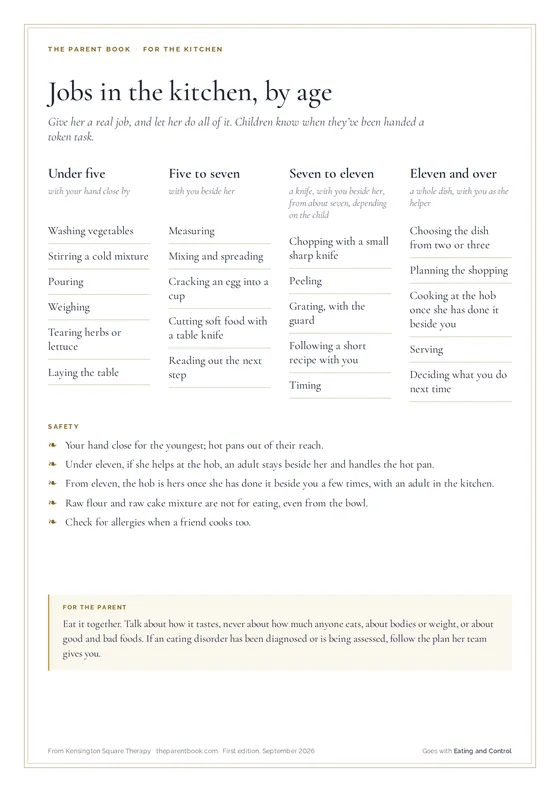
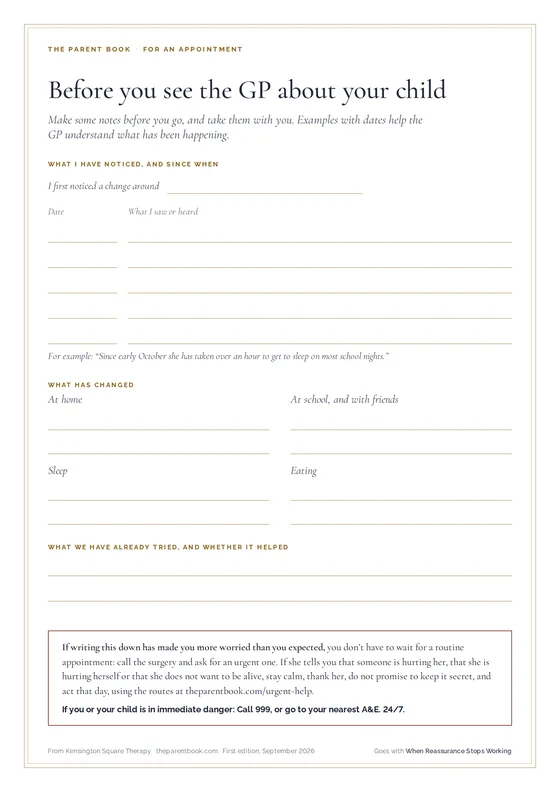
The quick tips and activities are for subscribers; the sheets that go with this chapter are yours to print. What a subscription includes.
Who else can help
Soluna by Kooth
Confidential online support for young people, free in the areas where the NHS or the council funds it: articles, moderated forums and drop-in text chat with a qualified practitioner.
Coram Family Lives
A free, confidential helpline for any parenting or family worry, by phone, live chat, WhatsApp or email, staffed by trained family support workers.
0808 800 2222 · Mon-Fri 9am-9pm; weekends 10am-3pm; closed bank holidays
Outside those hours the line is closed. Samaritans answer at any hour on 116 123, and Shout answer if you text the word SHOUT to 85258.
coramfamilylives.org.uk/how-we-can-help/confidential-helpline
YoungMinds
The UK’s young people’s mental health charity, with a free Parents Helpline, webchat and email, and a plain A to Z of the things parents worry about.
0808 802 5544 · Mon, Thu, Fri 9.30am-4pm; Tue, Wed 9.30am-6pm
Outside those hours the parents line is closed. The urgent routes on this page are open when it is not.