
The chapter to start with
Your Child’s Online World
For parents who have seen something on their child’s phone that they can’t unsee.
14 min read · Ages 8 to 18
Read the chapter Your first chapter is free to read in full.
↑ ↓ to moveEnter to openEsc to close
A subject in the library

This is the most difficult subject in the library and the one we have handled most carefully: the clinical pathways and reporting routes are clearly marked. The pages do not replace formal safeguarding. They sit alongside it, for the parent who has begun to wonder.
What to do first and who else can help are free to read and to print. So is the first chapter you open.
What the library holds on safeguarding
From the therapists
You do not have to be certain, and it is not your job to investigate. It is your job to tell someone whose job it is to know what to do next, and to keep believing your child while you do.
If you are worried about a child’s safety
Urgent help2 on safeguarding
The long reads, each on one situation, written by a therapist.
The chapter to start with
For parents who have seen something on their child’s phone that they can’t unsee.
14 min read · Ages 8 to 18
Read the chapter Your first chapter is free to read in full.
Nothing on this shelf is written for that age yet.
6 on safeguarding
Short pieces for the moment in front of you, each with things to try.
Family dynamics
Teach your child that surprises get told in the end, and that a secret that worries them is one they can always tell you.
Try this
From the tip
Young children love secrets, and most of theirs are harmless: what is in the box for Granny’s birthday, the den behind the shed. The NSPCC’s Underwear Rule teaches children that there are good and bad secrets. A good secret is a surprise, like a present or a party, and it gets told in the end. A bad secret makes your child feel sad, worried or frightened, and they can always tell you about it.
If your child tells you that someone has touched them, hurt them or asked them to keep a secret about their body, stay calm, thank them for telling you, tell them it isn’t their fault, and don’t promise to keep it secret: tell them you will need to tell someone whose job is to keep children safe. Don’t question your child further or confront the person, and act that day. If the person lives in your home or your child’s other home, go straight to children’s social care or the police. Act that day too if what your child tells you suggests that another child is being hurt. A national child protection helpline will talk it through with you. NSPCC, 0808 800 5000. Email help@nspcc.org.uk. Mon-Fri 10am-4pm by phone; email 11am-4pm, seven days a week. An email sent when the service is closed is not received. If the NSPCC service is closed and the concern cannot wait, call the police on 101. You can also contact the child’s local out-of-hours children’s social care, social work or social services team. If a child is in immediate danger, call 999. Help is free.
If your child is in danger right now, don’t wait. Call 999. Help is free and available at any hour.
Home And Belonging
Your school’s focus on safeguarding is required by law, and every school in the UK shares it.
Try this
From the tip
Families newly arrived at UK independent schools are often surprised by how seriously the school takes safeguarding: the training the staff have, the Designated Safeguarding Lead whose name appears in every policy, and how often safeguarding is mentioned in school communications. If you’re used to a different system, the way it’s presented can make it seem more alarming than it is.
UK safeguarding is statutory. In England, every school, independent schools included, works to Keeping Children Safe in Education, known across the sector as KCSIE, which sets out what schools must do to protect children. Wales, Scotland and Northern Ireland each have their own guidance, under a different name and with a differently titled lead, on the same architecture. The DSL in your child’s school is the senior member of staff who takes lead responsibility for safeguarding; the governing body or proprietor is answerable for it. All the training, the policies and the seriousness come from this framework. None of it is a sign of a particular concern about your child or your school.
In practice, this makes your school’s safeguarding something you can rely on. The DSL is the right adult to bring in if you have any concern about your child’s safety, online or in person. The DSL is also the right adult to ask if you are not sure whether something rises to the level of a safeguarding concern.
Family dynamics
Being hurt by your own child is not a secret to keep, and there is help for both of you.
Try this
From the tip
In the moment, get yourself and the other children out of the room, or the house. Don’t hit back, and don’t try to restrain an older or stronger child: you could both be hurt. If violence is being used or threatened, call the police. Call 999. Help is free and available at any hour. If anyone is hurt, get medical help. If your child hurts a brother or sister badly or often, or in a way you cannot stop, in either home, ask children’s social care for help that day: both children need it.
In England and Wales, parents can call a free helpline. Coram Family Lives, 0808 800 2222. Mon-Fri 9am-9pm; weekends 10am-3pm; closed bank holidays. Outside those hours the line is closed. Samaritans answer at any hour on 116 123, and Shout answer if you text the word SHOUT to 85258. Help is free. Scotland has its own. Children First, 08000 28 22 33. Email supportline@childrenfirst.org.uk. Mon-Fri 9am-9pm, Sat-Sun 9am-noon. Outside those hours the line is closed. If a child is in immediate danger, Children First says to call the police. Samaritans answer at any hour on 116 123, and Shout answer if you text the word SHOUT to 85258. Help is free. So does Northern Ireland. Parentline NI, 0808 8020 400. Email parentline@ci-ni.org.uk. Mon-Thu 9am-9pm, Fri 9am-5pm, Sat 9am-1pm. Outside those hours the line is closed. Samaritans answer at any hour on 116 123, and Shout answer if you text the word SHOUT to 85258. Help is free.
Your GP can start an assessment.
If you think someone may be hurting your child, or your child tells you so, stay calm, thank them if they have told you, don’t promise to keep it secret, and act that day. If the person hurting your child lives in your home or your child’s other home, go straight to children’s social care or the police. A national child protection helpline will talk it through with you. NSPCC, 0808 800 5000. Email help@nspcc.org.uk. Mon-Fri 10am-4pm by phone; email 11am-4pm, seven days a week. An email sent when the service is closed is not received. If the NSPCC service is closed and the concern cannot wait, call the police on 101. You can also contact the child’s local out-of-hours children’s social care, social work or social services team. If a child is in immediate danger, call 999. Help is free. Your child can also talk to someone themselves, without you in the room. Childline, 0800 1111. For anyone under 19 in the UK. There is a one-to-one chat online at https://www.childline.org.uk/get-support/1-2-1-counsellor-chat/. Help is free and available at any hour.
More quick tips on safeguarding
Online life
If your child has been watching pornography, start with a calm conversation, unless it involves a child, an adult contacting your child, or pressure.
2 min read · Ages 11 to 16
Bodies & growing up
A child who suddenly wants privacy is growing up, and knocking first tells them that their body is theirs.
2 min read · Ages 9 to 16
Bodies & growing up
In a girl, puberty at eight is within the normal range, and girls who feel prepared and accepted at home tend to fare better.
2 min read · Ages 7 to 11
The rest of each tip, with more to try and why it works, is in the library.
Nothing on this shelf is written for that age yet.
2 on safeguarding
Small, repeatable things to do with your child, with what to watch for and when to get help.
To do together · About 15 min
Agree a code word with your teenager that means “come and get me”, with no telling-off that night, so that they can always leave somewhere they don’t want to be.
What it is for. A teenager who wants to leave a party, a car or a friend’s house often stays, because leaving means losing face or owning up to where they are. A word agreed in advance lets them get out without explaining, and tells them that their safety matters more to you than any rule they may have broken.
Safety. Spiking can look like being very drunk, and some drugs leave the body within hours. If you suspect it, get medical help early and report it to the police. The person who was spiked is never to blame. If your teenager is very drunk, stay with them and don’t leave them to sleep it off alone: they could be sick while drowsy and choke. If you think they have alcohol poisoning, call for emergency help, using the routes under “If you need help right now”. Keep the word between the two of you and any adult you name to collect your teenager.
When to get help. If your teenager or anyone with them is hurt, very drowsy or confused, unconscious, has been assaulted, may have been spiked or is being held or threatened, use the routes under “If you need help right now”, at the foot of every page, straight away. Do the same if your teenager hasn’t come home, you can’t reach them or anyone with them, and you are worried for your teenager’s safety. If your teenager tells you, that night or later, that someone hurt them or did something sexual to them, that someone is pressuring or threatening them, or that they are hurting themselves or don’t want to be alive, stay calm, thank them for telling you, don’t promise to keep it secret, and act that day, using the same routes. If the person hurting your teenager lives in your home, go straight to children’s social care or the police. If you think your teenager is being exploited or groomed, act that day: contact the police or your local children’s social care, or get advice from the NSPCC. If something that happened is still troubling them weeks later, talk to your GP.
The other two steps, and your part in it, are in the library.
More to do together
To do together
Teach your child the NSPCC’s Underwear Rule a few minutes at a time, at bath time or getting dressed: their body belongs to them, and they can tell you any secret that worries them.
About 5 min · Under 11 · With a sheet to print
Nothing on this shelf is written for that age yet.
7 on safeguarding
Made to be printed, kept, and handed on.
To print and keep
What to do first, a few things to try and who else can help, together in one guide. Free to print and keep, or to hand to the other parent, a grandparent or the school.
Who else can help with safeguarding, on a sheet of its own.
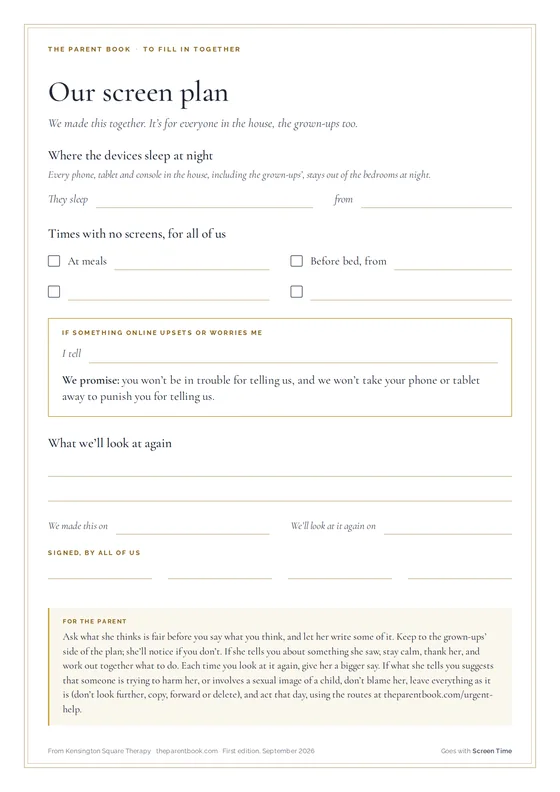 Our screen plan
To fill in together · A4 · With a subscription
Our screen plan
To fill in together · A4 · With a subscription
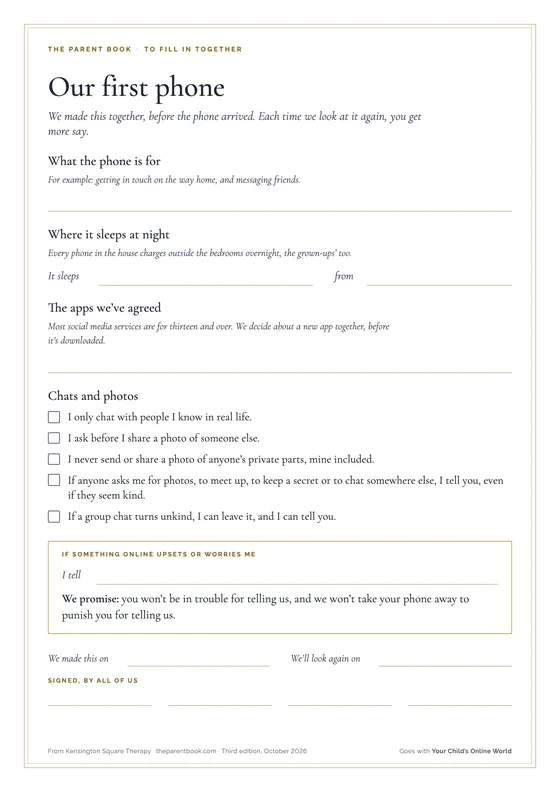 Our first phone
To fill in together · A4, two sides · With a subscription
Our first phone
To fill in together · A4, two sides · With a subscription
 Their online world
Pocket card · A4, four cards to cut, two sides · With a subscription
Their online world
Pocket card · A4, four cards to cut, two sides · With a subscription
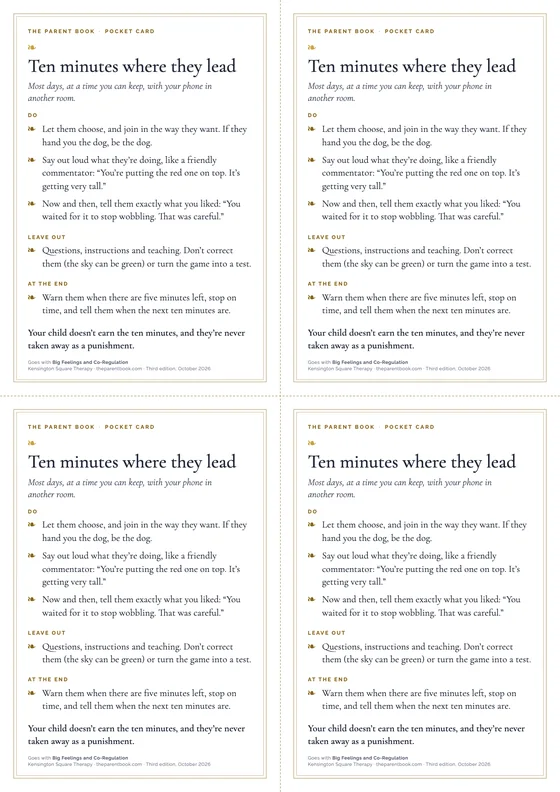 Ten minutes where they lead
Pocket card · A4, four cards to cut, two sides · With a subscription
Ten minutes where they lead
Pocket card · A4, four cards to cut, two sides · With a subscription
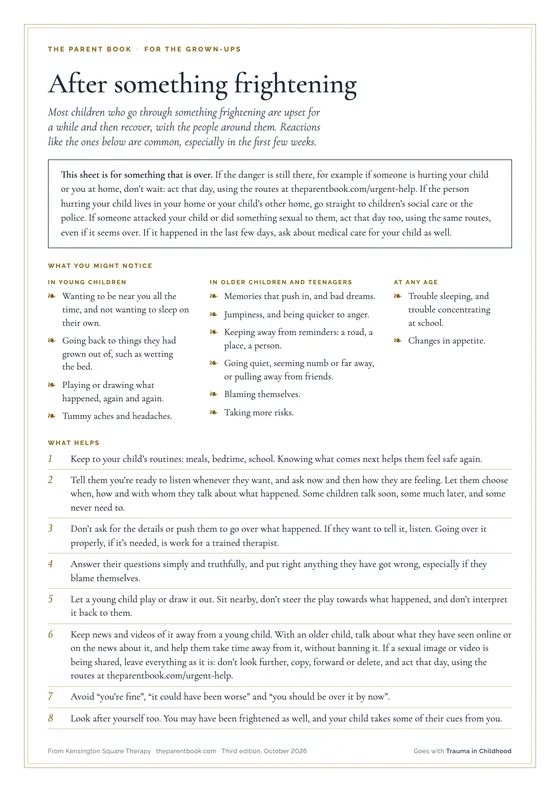 After something frightening
For the grown-ups · A4, two sides · With a subscription
After something frightening
For the grown-ups · A4, two sides · With a subscription
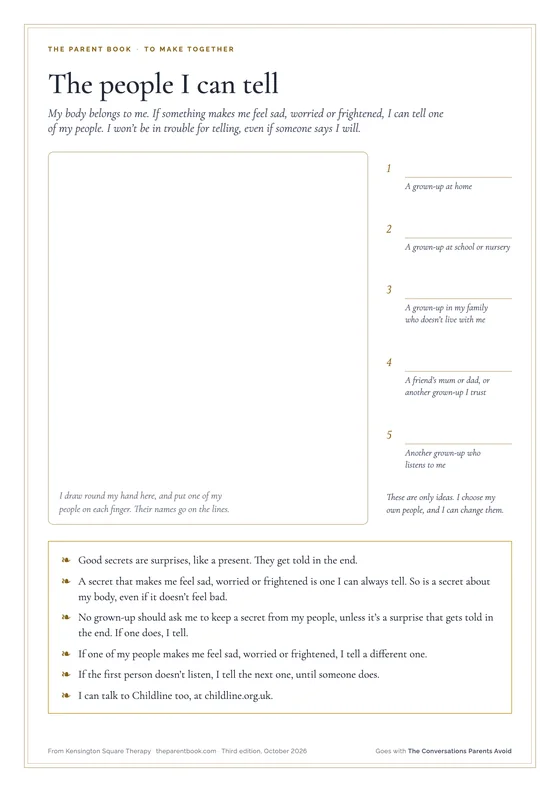 The people I can tell
To make together · A4, two pages · Free
The people I can tell
To make together · A4, two pages · Free
9 on safeguarding
Chosen by the therapists who write the library: books for you and to read with your child, and pages from organisations we trust.
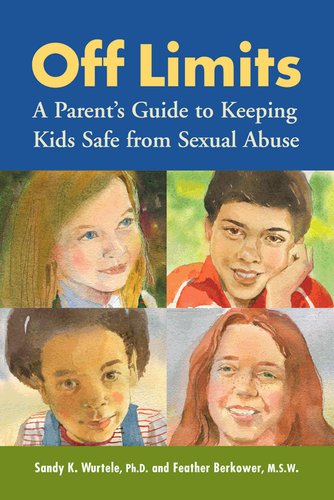
Also on this shelf
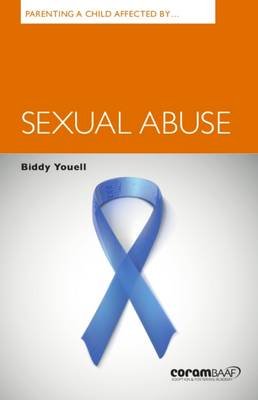
Every book on the shelf, with a therapist’s note on what it is good for, is in the library.
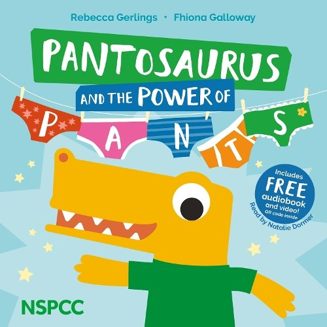
Also on this shelf
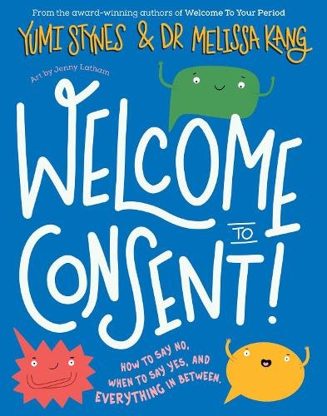
Every book on the shelf, with a therapist’s note on what it is good for, is in the library.
NSPCC
How to respond if a child tells you they are being harmed: listen, stay calm, reassure them it is not their fault, do not confront the person, and report it.
NSPCC
The NSPCC’s simple framework for teaching young children that their body belongs to them, that some secrets should not be kept, and whom to tell if something feels wrong.
NSPCC
How grooming works online and in person, the signs a child may be being groomed, and what to do if you are worried.
NSPCC
Helps parents tell the difference between the ordinary, healthy sexual behaviour of growing up and behaviour that may signal a problem, and what to do about it.
Childnet
Explains how financially motivated sextortion targets teenagers, especially boys, the signs a child is affected, and exactly what to do if it happens.
Nothing on this shelf is written for that age yet.
14 on safeguarding
Podcast episodes, talks and films, each chosen for a reason.
NSPCC Learning Podcast
NSPCC Helpline and Childline staff explain how living with domestic abuse affects children even when they are not directly involved, and how it can show in behaviour, development and school.
Also on this shelf
NSPCC Learning
NSPCC Learning Podcast
Thriving Kids
Every episode on the shelf, with a therapist’s note on what it is good for, is in the library.
YouTube · 4 min
NSPCC, YouTube
Real parents try having the PANTS conversation with their young children, showing how short and ordinary it can be. Takes the awkwardness out.
Also on this shelf
YouTube · 2 min
NSPCC, YouTube
YouTube · 3 min
NSPCC, YouTube
YouTube · 3 min
Blue Seat Studios, YouTube
YouTube · 3 min
Childline, YouTube
And five more. Every film on the shelf, with a therapist’s note on what it is good for, is in the library.
Nothing on this shelf is written for that age yet.
You do not have to be sure. Tell someone whose job it is to know what to do next.
Where to start
Every school has one, by law. They are trained for exactly this conversation and they have the routes a parent does not.
As soon as you have a concern about a child’s safety. Ask for them by role; you do not have to explain yourself to the office first.
A line for the adult who is not sure whether what they have noticed is serious. You do not need to be certain, and you can call anonymously.
When something has been said or seen and you do not know what to do with it. They will tell you whether it needs to go further, and help you take that step.
Helpline 0808 800 5000, Monday to Friday 10am to 4pm
Email help@nspcc.org.uk, read 11am to 4pm, seven days a week; a message sent while the service is closed is not received. If it is closed and the concern cannot wait, call the police on 101, or contact the child’s local children’s social care, social work or social services team. If a child is in immediate danger, call 999.
The council team whose job is to keep children safe. You can contact them directly about any child you are worried about, your own or someone else’s. In Wales it is social services, and in Scotland the council’s social work department. In Northern Ireland it is the Gateway team at the local Health and Social Care Trust; nidirect.gov.uk gives each team’s details. The link below finds the team in England.
When you think a child is being harmed, or is at risk of harm. Contact the team for the area where the child lives; if you do not know where that is, contact your own local team, the NSPCC or the police for advice. You will be asked for your details, and you can choose not to give them. Outside office hours, the council’s or Trust’s website gives the number to call. If a child is in immediate danger, call 999.
For safeguarding
The National Crime Agency’s child protection command. Their parents’ pages explain grooming, image sharing and gaming risks calmly, and the CEOP Safety Centre is where you report grooming or sexual abuse of your child online.
When what has happened online may be a crime: someone asking for images or personal details, or pressure on your child to share pictures. Report at ceop.police.uk/safety-centre.
A free, confidential tool for under-18s to get a nude or sexual image of themselves removed from the internet, with Childline counsellors there if they want to talk.
When an image of your child has been shared. Your child makes the report; you can sit with them while they do.
www.childline.org.uk/info-advice/bullying-abuse-safety/online-mobile-safety/report-remove
The UK hotline that gets sexual images of children removed from the internet. The report is online, anonymous and free.
When you have found an illegal image of a child, including one of your own child, and need it taken down. The IWF removes the image; reporting the person goes to CEOP or the police.
The two usually need to run together.
Every organisation for safeguarding, and when each is the right call Finding a therapist