The Parent Book·From the library
Trauma in Childhood
A chapter for parents whose child has been through something, or whose family has.
A sixteen-minute read · Published 25 May 2026
The four-year-old, six weeks after the accident in which no one in the family was seriously hurt, has begun waking at three in the morning and walking, fully awake, into her parents’ room without speaking. She does not cry. She climbs in and lies between them. By morning, she does not remember having done this. The school has rung twice to say she has been crying in assembly and is not sure why. The paediatrician at the follow-up has said the physical recovery is on track.
The parent, at the kitchen table on a Wednesday evening, has begun to understand that the accident has not left the family. It has taken up residence in the four-year-old’s body, in the school day, in the small hours of the night. The parent’s own sleep has gone strange. Neither adult in the house has yet said the word out loud.
In our work, families arrive in some version of this Wednesday often. The accident. The illness in the family. The witnessed violence. The death. The repeated unpredictability of an adult whose moods have been the household’s weather for years. The chapter that follows is about what trauma actually is in a child’s developmental life, what the parent can do, and what the parent cannot do alone.
What is actually happening
Trauma in a child is not the event. The event is what happened. The trauma is what is left in the child’s nervous system, and the family’s, when the event is over and the child does not have, by her age, the developmental equipment to make sense of it on her own. Two children can witness the same accident and emerge differently. The difference is not bravery and not character. It is, in nearly every case, what the child had around her in the days and weeks after.
Clinicians sometimes distinguish between big-T trauma and little-t trauma, and the distinction is useful as a starting point. Big-T trauma is the discrete event: the accident, the death, the assault, the disclosure, the witnessed violence. Little-t trauma is the pattern: chronic unpredictability in the home, persistent insecurity, repeated emotional unavailability of an attachment figure, sustained low-grade fear. The cultural script tends to take big-T seriously and little-t less so, when in fact the developmental impact of little-t over years is often the larger picture. A child can be more affected by ten years of an unpredictable household than by a single dramatic event held by warm and responsive adults.
The Anna Freud Centre’s work on developmental trauma is the single best UK-anchored resource we know in this territory, and their family-wellbeing pages are calm, clinically authoritative, and parent-readable. Dr Karen Treisman, a UK clinical psychologist whose Safe Hands Thinking Minds consultancy has shaped how a generation of NHS-aligned practitioners think about relational trauma, is the clinician we most often point parents to when they want to read a writer who holds the developmental picture without flattening it. Her wider writing on felt safety is the cleanest practical material for parents we have found.
The work in this chapter is the parent’s, with the school as partner, the GP as the route to specialist help, and trauma-trained counsellors as the longer-arc support when one is needed. None of those can do this alone.
What trauma does to a child’s body and behaviour
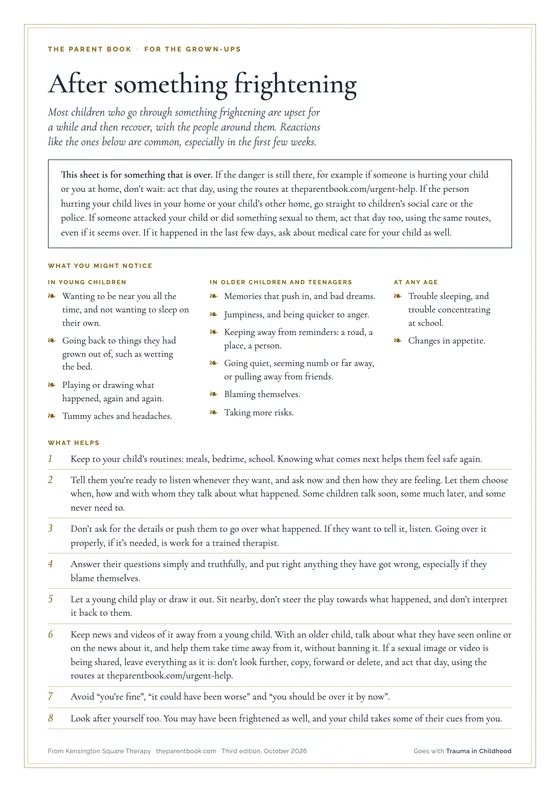
Trauma lives in the body and the behaviour before it lives in any sentence. The cultural picture imagines a traumatised child as one who talks about what happened, perhaps in nightmares, perhaps in flashbacks. The clinical picture is wider. Most traumatised children do not, in the days and weeks after, talk about the event in any direct way. The trauma shows up sideways.
In younger children, the most common picture is regression: a five-year-old who returns to thumb-sucking, who wets the bed again, who refuses to sleep alone, who clings, who replays the event in unstructured play. None of this is weakness. The nervous system is reaching back to a state from which it knew how to be safe.
In school-age children, the picture is often somatic and social: stomach aches and headaches that do not respond to medical assessment, sleep disruption, new irritability or new flatness, concentration falling apart, friendships becoming difficult, refusal of an activity she had done happily. Teachers may notice before parents do, because the child is, often, holding the performance at home and letting it down at school.
In teenagers, trauma can present as withdrawal, irritability, risk-taking, self-harm, entrenched school refusal, the friendship cluster that has dissolved, the mood that has flattened or sharpened beyond the normal teenage range. It can present as substance use, as the new bad-tempered relationship with food, as the device kept face down on the bedside table at night. The teenage manifestation is often the one most easily misread as ordinary adolescent storm, and the misreading delays help.
The thread across all ages: the trauma has changed the texture of the child’s days, and the change has stayed changed for longer than the family expected. Distress that does not lift over weeks and months, or distress that lifts and then returns at six months, twelve months, two years, is the picture that warrants specialist attention.
The they do not remember assumption, and why it is wrong
The most common parental belief we hear in this territory is some version of they were too small to remember. The two-year-old at the time of the accident. The three-year-old when the grandparent died. The cultural script is that small children, lacking autobiographical memory, are protected by their age from the impact of what they encountered.
This is, in the clinical literature, not how it works. Children below the age at which they can narrate an event still carry it, in their bodies, in their attachment patterns, in their nervous system’s calibration of what to expect from the world. Pre-verbal trauma is real and is, in some respects, harder to repair, because the child has no narrative handle on it; the felt sense of unsafety is not attached to any story she can tell. By the time she is seven, she may not remember the accident. The system that learned to brace for it is, however, still bracing.
This is not a counsel of despair. The same nervous system is plastic, particularly in childhood, and what shapes it next is what shapes it. A child who experienced early trauma and has, in the years since, been held by warm, predictable, attuned adults is a child whose nervous system has been substantially rewritten by the holding. The work of repair is not undoing the past; it is the steady, present, repeated experience of being safe in a family that knows what happened and is, in the present, calmly responsive.
What the parent can do
The parent’s work in the aftermath is more important than the parent gives herself credit for, and harder than she gives herself credit for, because the family system is part of the trauma context. The parent who witnessed the accident is, in her own body, holding what she witnessed. The parent who lost the same person the child lost is grieving in parallel. The work is not done from a position of having recovered first.
The clinical frame parents respond to is what Treisman and others call felt safety. A child does not need a world without risk; she needs to feel safe, in her body, with the adults around her, even when the world has shown her that it is not always safe. Felt safety is built not in a conversation but in the repeated, predictable, calm presence of an adult who is, in the daily small textures of life, the same adult today as yesterday and as tomorrow. The bedtime in the same shape every night. The hand on the back at the front door. The arrival home at the predicted time. The voice that does not rise when the child does not eat the supper. These are not, in this period, the small details of family life. They are the entire repair.
The practical steps fan out from there.
Keep the rhythm. Trauma disrupts the child’s sense that the world is predictable. The parent’s job is to be the most predictable thing in her week. Wake-up the same time. Breakfast the same. School run the same route. The parent who finds this exhausting, because it is, is doing it exactly right.
Name what is feelable. Younger children rarely have the language for what they are carrying. The parent can offer pieces of vocabulary. “Sometimes after something big happens, our bodies remember it before our heads do. You might notice your tummy feels strange even when you are not thinking about anything. That is normal.” Said in the car, repeated in different forms across weeks.
Allow the regression without making it the topic. The four-year-old climbing into the bed at three in the morning is doing repair, and the most useful parental response is the slow, calm welcome that does not turn the climbing-in into a household project. Lift the duvet. Make room. Do not, the next morning, sit her down to discuss it.
Be sad in front of her without asking her to manage it. The parent who is briefly sad in front of the child, and is also competent enough at the daily textures to keep the house running, is the parent who teaches that hard feelings can live in a family without breaking it.
Talk to the school, early, calmly, and in detail. The school cannot help with what it does not know. The Designated Safeguarding Lead is the right adult to bring in when the event has a safeguarding dimension; the head of year or class teacher is the right adult for the daily watch. Both need a clear account of what has happened and what to expect. Schools take this seriously and adjust the day for a child carrying something heavy. Place2Be, where the school has an in-house counsellor or partners with them, is often the right route for school-anchored support; ask the pastoral lead.
When to bring in professional help, and which kind
Not every traumatised child needs specialist therapy. Many children, with attuned family response, the right school environment, and time, recover well from significant events. The question parents ask, often after weeks of keeping everything steady at home, is when the family work needs to be joined by a clinician.
The honest answer is that the question is the wrong way round. The right question is not “is my child sick enough to need help”, it is would specialist input now reduce the risk of a longer-arc impact. In trauma work, early specialist help, even when the picture is not yet at crisis, often shortens the recovery. Waiting until the picture is bad enough to be obviously clinical is, in many cases, waiting too long.
The route, in the UK, is the GP, the gateway to CAMHS and to local specialist trauma services where they exist. The waiting lists are honest about being long. Where the family can pay for private support, the BACP and NCPS therapist directories list counsellors working specifically with children and with trauma; filter by age range and by trauma. The school, particularly in schools with in-house counselling, may also be a route; ask the pastoral lead.
A brief, non-prescriptive note on the approaches that have evidence behind them, because parents often ask. Trauma-focused cognitive behavioural therapy, EMDR for older children and adolescents, and play therapy for younger children are the approaches most commonly named by NHS-aligned services. Each is a different fit for a different child; the GP or the local CAMHS team are the right people to advise on which, not the parent reading at half past ten on a Wednesday. The parent’s job is to engage the gateway and to be present alongside whatever the clinical work then is.
Your own work in parallel
The parent reading this chapter, in many cases, is part of the trauma context. The accident happened to the family. The death was a death you are also grieving. The household whose unpredictable adult is part of the child’s little-t picture may be a household in which you are also living. The work of being the calm, attuned adult the child needs is being asked of you from inside your own depletion.
This is information, not failure. The parent doing trauma-repair from inside her own unrepaired material is doing the hardest work we see in our practice. The right move, where the resources exist, is parallel support: your own counsellor, your own GP, your own friend, your own twenty-minute walk without the phone. Family Lives’ confidential helpline at 0808 800 2222 is the right line for the parent who needs to be listened to by someone who hears this work daily. The Mental Health Foundation’s family-wellbeing pages cover the parental side of this clearly.
A truth worth naming in this territory: the parent who has been through her own childhood version of what her child is now living is, in some sense, twelve again, alongside being forty. The activation has a history. Recognising it is part of the repair. The parent who notices that some of what she is feeling belongs to her own past is best placed to keep her response calibrated to the present.
At different ages
Trauma presents and recovers differently across the developmental range. The bands below are descriptions, not prescriptions.
If your child is between four and seven. The picture is the body and the play. Regression, sleep disruption, magical thinking that has tipped into worry, repetitive play that replays the event. What she needs is presence, predictability, and the calm welcoming of the regression. Sit with her while she carries it; do not try to talk the feeling out of her. The school nurse and class teacher are the right early partners; the school’s DSL where there is a safeguarding dimension. Play therapy, through CAMHS or a registered counsellor, is the modality that most often helps children this young; the GP is the gateway.
If your child is between seven and nine. Somatic and increasingly verbal: stomach aches, headaches, sleep, friendship difficulty, new fearfulness, new irritability. She has more language, and the side-door conversation in the car becomes useful. Name what her body might be doing, briefly, and let the silence work. Talk to her class teacher and pastoral lead in detail. Place2Be, in schools that have it, is very good with children of this age.
If your child is between nine and eleven. Pre-secondary self-consciousness arrives on top of the trauma response. She is more aware of being different, and may begin to hide the difficulty to avoid standing out. Give her named permission to be visibly affected at home. “You do not have to be fine. Our house is the house where you do not have to perform.” The school’s pastoral lead becomes more important as the social environment becomes harder to navigate alone.
If your child is in early secondary, eleven to thirteen. The picture often broadens to school refusal, sustained low mood, irritability, somatic symptoms. The early secondary years are a vulnerable window where trauma can compound the ordinary disruptions of transition. The school’s DSL and head of year are the right early partners. The GP-to-CAMHS pathway is the clinical route. Trauma-focused CBT and, for some older children in this band, EMDR are the modalities most often named; the family does not need to choose, only to engage the gateway.
If your child is in mid to late secondary, thirteen to sixteen. Trauma in this band is often where the impact becomes visible in self-harm, risk-taking, withdrawal, or entrenched school refusal. The crisis dimension can become live, and the standing crisis block at the foot of every chapter applies. The GP is the gateway. Where the picture is acute, NHS 111 is the route into the mental health crisis line in England, Scotland and Wales, and Lifeline on 0808 808 8000 in Northern Ireland. The school’s DSL needs to know. A trauma-trained counsellor through BACP or NCPS is the right private route if the family can use it; many areas have Kooth available for the child who will not, at sixteen, talk to anyone she has met.
If your child is sixteen and beyond. Conversations are increasingly adult-to-adult. She may want to seek her own support, and the parent’s job is to make that possible without making it a project. The GP for clinical routes. The BACP and NCPS directories for trauma-trained counsellors taking young adults. The parent’s job is often to be the household she is still able to come back into, on her own terms.
The longer arc
Recovery from trauma in childhood is not, in most cases, a project that completes. It is a longer arc in which the event becomes one piece of a child’s life rather than the piece that organises everything else. A child who has been held, by family and school and where necessary by clinicians, through the months and years after a hard event grows into a young person who carries what happened, knows it happened, and is not, in any final sense, defined by it. The arc is slow. It is also, in nearly every family we have seen, real.
The four-year-old who has been climbing into the bed at three in the morning is, six months from now, climbing in less. A year from now, less still. The school has settled her into a year-group rhythm that holds. The family has named the accident enough times for it to be in the room without being the room. The parent has, in the meantime, talked to her own counsellor about her own night. None of this is the dramatic recovery the cultural script suggests. It is the slow, undramatic work of being a family that has had something hard happen and has decided to live, deliberately, in the aftermath.
That work is yours. It is also not yours alone: the school, the GP, and, where one is needed, the specialist are in it with you. You are the parent who, by being calm and predictable and willing to be sad when sadness is what the moment asks for, has done the largest single piece of the repair.
She will, in time, be alright. The repair is the rhythm. The rhythm is what you can give her. The rest, the parts you cannot do alone, are there to be reached for.
NOTES
- Treisman, Karen. A Therapeutic Treasure Box for Working with Children and Adolescents with Developmental Trauma. Jessica Kingsley, 2018. Treisman’s felt-safety frame and the practical work with developmentally-traumatised children.
- van der Kolk, Bessel. The Body Keeps the Score. Penguin, 2014. The somatic register of trauma and the limits of cognitive interventions alone.
Where to go further
Karen Treisman, A Therapeutic Treasure Box for Working with Children and Adolescents with Developmental Trauma A UK clinical psychologist’s workbook-shaped guide to felt-safety with traumatised children. Written for practitioners, accessible to a parent who is not a clinician; the illustrated worksheets and the writing on the body in trauma are the parts we point parents to most often.
Bessel van der Kolk, The Body Keeps the Score The seminal book on how trauma lives in the body across a lifetime. Heavy by the standards of a parenting primer; the right read for the parent who wants to understand what her own activation is, alongside the child’s.
What helps after something big
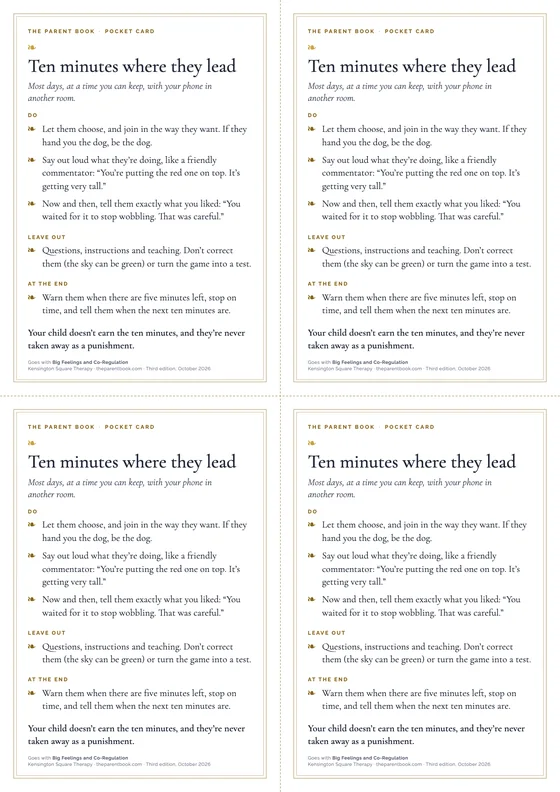
Felt safety is not built in a conversation. It is built in the repeated, predictable, calm presence of the same adult, day after day.
- Be the most predictable thing in her week. Wake-up at the same time, breakfast the same shape, the school run the same route. In this period these are not small details of family life; they are the repair.
- Offer vocabulary for the body. “Sometimes after something big happens, our bodies remember it before our heads do. That is normal.” Said in the car, in different forms, across weeks.
- Allow the regression without making it the topic. The four-year-old back at your bedside is asking an old question again. Answer it, warmly, without headlines.
- Do your own work in parallel. The parent who witnessed the same event, or lost the same person, is carrying it too. Support for you is support for the child.
More one-minute pieces, for when you need one
External support
NSPCC
The UK’s leading child-protection charity.
0808 800 5000 · Mon-Fri 10am-4pm by phone; email 11am-4pm, seven days a week. An email sent when the service is closed is not received.
If the NSPCC service is closed and the concern cannot wait, call the police on 101. You can also contact the child’s local out-of-hours children’s social care, social work or social services team. If a child is in immediate danger, call 999.