The Parent Book.
Therapist-written support for parents
Urgent help

The Parent Book·From the library

The 11+ Year

A chapter for parents whose child is preparing for a school admission process.

A fourteen-minute read · Published 25 May 2026

It is a Sunday evening in October. The vocabulary book is open on the kitchen table, with the same nine words she did not know on Wednesday and still does not know now. The child, who has just turned ten, is going through the list with the slightly fixed face of a person who has been doing this since teatime. The parent, who has not sat down since lunch, is at the other end of the table with a cup of tea she has reheated twice. She has the file open on her laptop, which she has begun to think of as the file, and which contains the timeline, the school list, the entrance dates, the practice paper log-in, and the email from the head of Year 5 saying she is doing fine. She had meant, this evening, to make a proper supper. There is a frozen pizza on the side.

This scene plays out in some version in many of the families we sit with at this point in the school year. In some houses the child is six and being prepared for 7+ entry to a competitive prep school. In others, eleven, working towards senior school admissions or a scholarship interview. In others, thirteen, doing the Common Entrance term that has become, for that family, the longest term of the year. The thing-ahead has a different name in each house. The weather it creates in the household is the same weather.

We are not the definitive book on school admissions. The literature parents reach for tends to lean either towards the technical (the papers, the tutoring strategies, the school-by-school admissions data) or towards the dismissive (the reassurance that none of it matters, which the parent watching the practice paper at half past nine on a Sunday cannot quite believe). What we can offer, drawn from over a decade of counselling work with parents and children in this position, is a slower description of what is actually happening, in the household, in the child, and in the parent, while the thing ahead approaches.

What is actually happening

A school admission process, viewed from outside the family, is a series of dates on a calendar. Viewed from inside, it is something larger. It is, in most houses, the first sustained moment in which the child is being evaluated by adults who do not know her, on terms she did not choose, with consequences the parent has decided are significant. What we see in our work tends to organise itself into three layers.

The first is the pressure on the child. She knows, even when the parents have been careful not to say it, that this matters. She reads the file open on the laptop, the reheated tea, the slight tightness in her mother’s voice when she asks about the practice paper. The pressure she feels is not, in most cases, about the test itself; it is about the worry she can see her parents are carrying on her behalf. She is doing the test for two people. This is heavier for a ten-year-old to carry than the test would be on its own.

The second is the parent’s own school history. The parent who herself sat an 11+ thirty years ago, and remembers the morning of it more vividly than she remembers most of the rest of that year, is in the room on this Sunday evening. The parent who did not, and whose own sense of school is the sense of being on the wrong side of a result, is also in the room. The parent who has been carrying, since adolescence, a quiet feeling about whether she was the bright one or not, is watching her own daughter go through a process that will, the parent privately fears, decide the same question for her. This is rarely conscious. It is almost always operative.

The third is the household’s bandwidth. The application is small in calendar hours and enormous in mental real estate. The weekend that used to have a slow Sunday morning in it has been reorganised around the practice paper. The other child in the family, who is not doing the admission this year, has noticed that the household’s attention has narrowed; in our work, it is often the sibling, not the candidate, who shows the first sign of strain. The thing ahead does not occupy the family in proportion to its objective size. It occupies the family in proportion to the worry attached to it.

These three layers are not the parent’s fault. They are the weather of a school admission process in any household where the parents care about the outcome. Naming them is the first practical move, because the parent who has named the weather is the parent in slightly less of it.

The pressure differential by stage

The admission process is not one thing. It changes with the age of the child and with what it is asking of her.

The 7+ and 8+, where they exist (most often in London, into competitive prep schools), are doing something to a six- or seven-year-old that is, in our view, slightly more than the developmental moment can comfortably absorb. The child is being asked to perform under timed conditions on tasks calibrated to identify the children already ahead of the year-group standard. The parent’s job in this band is mostly to insulate. Keep preparation in small daily increments, do not let it eat into the parts of the week that are her childhood, and remember that a six-year-old’s performance on a Saturday morning is not, by any clinical measure, a fixed report on who she is becoming.

The 11+ is the admission process most parents in our practice describe as the hardest. The child is now ten or eleven; she has language for what she is being asked to do; she has friends doing it too, which means the process has acquired a social dimension. She knows that some of the children sitting next to her in the lunch hall will, in the new year, go to a different school than she does. The pressure here is partly academic and largely social. Keep the admission off the kitchen table as much as possible, and keep the conversation with the child about the work and not about the result.

The 13+ Common Entrance and senior-school admissions are different again. The child is thirteen, has now spent several years inside a school openly preparing her for this, and the pressure has become, for many of these children, internalised. She is not going through a process she has been told about; she is going through a process she has been inside. The parent’s task is partly to slow the internalised pressure, which is harder to address than the external kind, and partly to make sure that the next stage, whatever it is, has been chosen because of what the school is, not because of what the result of the entrance has produced.

Scholarship processes run alongside these and have their own weight. The child has been told that she is the one capable of trying for this, and the workload has, without anyone quite saying so, increased. We would gently encourage parents to remember that a scholarship not won is not a scholarship failed. The existing place at the school is, in most cases, unaffected; the result is information, not a verdict. Saying so out loud, on the kitchen table the morning the result comes through, is the parent’s job.

What helps in the household

Most of what helps, in our experience, is not in the preparation but in what surrounds it.

The first move is to keep the rest of the child’s life going. The Saturday football, the Wednesday piano, the Friday playdate that has been a weekly fixture for two years. The parent’s instinct, three months out from an entrance, is to clear the diary so there is more time for the work. The clinical move is to do the opposite. The diary, full of the things she did before the admission was a thing, is the evidence to her own nervous system that she is still herself. The week cleared down to the work tells her the work is the only thing that matters this term. That is a heavier message than the parent meant to send.

The second is to keep at least one conversation at the kitchen table that is about something else. A daily ten-minute thing, after school, in which the parent asks about her day in the way she would have asked last year, before the file appeared. How was netball. “What did you have for lunch.” Is Sophie back in school yet. These are the sentences that tell the child the parent is still interested in her, not in her preparation. The child who has registered that her parent is interested only in the work has registered that her worth, this autumn, is conditional on it.

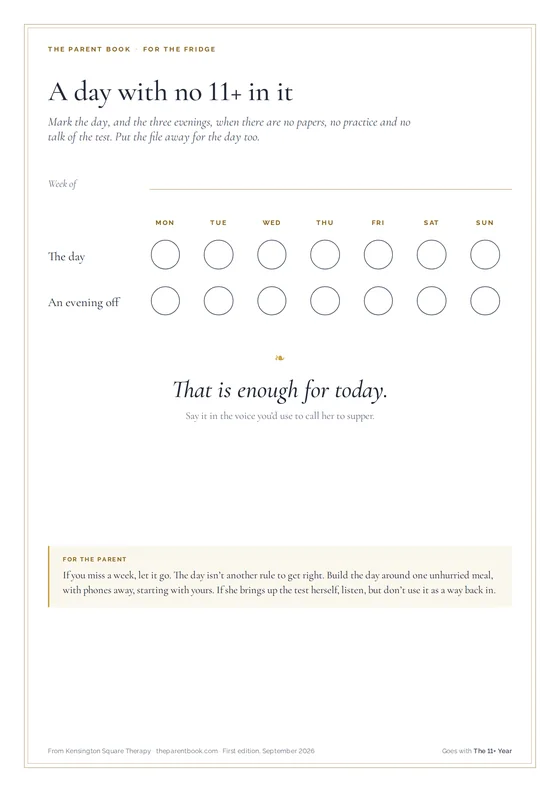
The third is to take the laptop off the kitchen table on at least two evenings a week. The file is, for the parent, a way of feeling in control of a process largely outside her control. The cost of the file open at supper is that the child is now sitting across from a parent whose attention is in the spreadsheet, not in the room. The parent who can do this on a Tuesday and a Thursday has, in our experience, lowered the household’s temperature more than any amount of additional practice could lower the child’s.

For the wider conversation about school stress in children and adolescents, the resource we point parents to most consistently is the YoungMinds parent-facing material on school anxiety and academic pressure. Their A-Z pages are the clearest single primer we know in the UK, calibrated for parents who want to understand what their child is carrying. Family Lives’ helpline, on 0808 800 2222, is the other line we send parents to: not because the child is in crisis but because the parent often needs to be listened to by an adult outside the household. Lisa Damour’s Under Pressure, written about the rising stress and anxiety in girls but applicable across the admission years for any child, is the book we put into the hands of parents who want to read calmly about what their kitchen is doing.

At different ages

The admission processes themselves are age-banded, and what the parent does changes with them. A Year 2 child doing a 7+ is not doing the same thing as a Year 8 child doing Common Entrance, and the practical advice does not transfer cleanly.

If your child is in Reception or Year 1 (four to six). You are at the early edge of the question, and most of what we would say in this band is to be cautious about how soon you let the question into the household. A four-year-old who has registered that her mother is anxious about the school she will get into in two years has registered something it is too early for her to carry. Read the schools, make the visits, hold the question between adults. Where the 7+ is a live process for the family, the practical work for the child is small, daily, and not framed as preparation: ten minutes of reading together at bedtime, the puzzle on a Saturday morning, the conversations at the kitchen table that build vocabulary because she is being talked to like an interesting person, not because vocabulary is a target.

If your child is in Year 2 or Year 3 (six to eight). The 7+ or 8+ is now imminent or recent. Keep the practice short. Keep it varied. Stop when she has stopped. The most useful sentence on a Saturday morning that has been preparation-heavy is “that is enough for today, we are going to do something else now”. The child who learns that the parent will stop when the appetite is gone is the child who comes back to the work more willingly the next morning.

If your child is in Year 4 or Year 5 (eight to ten). The 11+ is now on the horizon. This is the band in which the parent’s own anxiety tends to begin showing, and the household’s bandwidth tends to start narrowing. Visit the schools she will be considering, walk the route, eat in the cafe near the gate, let her form her own impressions. The child who has had the schools introduced as places, not as targets, has an easier relationship with the admission than the child for whom the school is first encountered as the thing she has to get into.

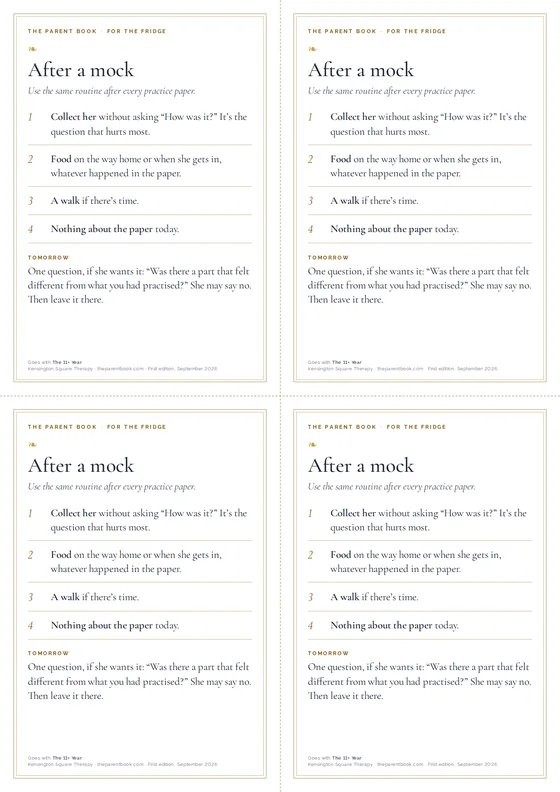
If your child is in Year 6 (ten to eleven). The exam term is now this term. The job is to lower the temperature, not raise it. A daily rhythm with the preparation that does not exceed the school day’s natural endpoint. A bedtime that has, if anything, more space in it for the conversation that is not about the test than it has had since Year 4. The exam morning, when it comes, is the morning the parent is in the kitchen at quarter past seven, the breakfast is the same as a normal Wednesday, and the sentence she hears as she goes is “I love you, do your best, see you at half past three”. Not good luck. Not “remember everything we practised”.

If your child is in Year 7 or Year 8 (eleven to thirteen). The senior-school admission, the 13+, or the scholarship process is now the picture, and the child is old enough to be carrying more of the weight herself than the parent can fully see. What helps in this band is the side-door conversation, in the car, on the dog walk, at the supermarket: “what are you thinking about the senior schools at the moment.” Not “have you done your practice today.” Listen to the answer. She is making, increasingly, an adult decision about her own next several years.

If your child is in early secondary, thirteen to fifteen. Scholarship pressure, sixth-form-application pressure, and the early visibility of GCSE pressure all arrive in this band. Keep some part of the conversation at home that is not about achievement at all. Music she likes, the funny thing the dog did, her view on something in the news. The supper that is allowed to be just a supper, not a debrief. The teenager who registers that the parent is still interested in her as a person, not only in her trajectory, is the teenager most protected from the harder forms of perfectionism described in the chapter alongside this one.

When the result is not the one you hoped for

In some proportion of the families we sit with, the result, when it comes, is not the one the parents had been imagining. The senior school of choice does not offer. The scholarship is awarded to another candidate. The 11+ produces a result that closes a door the family had been planning around for two years. The Sunday evening on which that letter arrives is one of the most painful in the year in question.

What we want to say to the parent in that Sunday evening is this. The result is information about a process. It is not a report on the child. The schools that did not offer have made a decision based on what they saw in one morning, against criteria that may or may not be the right set for understanding her. They have produced an outcome from a process, and the family will now choose how to read it.

We have, over the years, watched a remarkable number of children whose first-choice schools did not offer go on to flourish, often startlingly, at the schools they did go to. The post-result year is, in many of the families we see, the year in which the parent realises that the school the child has, in the end, gone to is the school in which the child has been able to become herself.

What is unhelpful in the post-result period is the disappointment the household does not say out loud. The remark, made over coffee with another parent, that the child has overheard. The look between the adults that the child has registered. The silence about the school that did not offer, which the child has read as evidence that the topic is shameful. The child is watching closely. The conversation she needs to hear is the one in which the parent has made peace with the result and is telling her, in words and posture, that the next school is now the school they are looking forward to.

The longer arc

The school admission is, in most families we work with, the largest single piece of weather the household has faced. Looked back at from the end of the first year at the next school, it is almost always smaller than it felt at the time. The child has made the new friends. The new uniform has stopped being new. The Sunday evenings have, at some point, become Sunday evenings again. The file on the laptop has been moved into an archive folder.

What stays, in the household, is the experience the parent and the child had of going through it together. The Sunday evenings in which the laptop was, against the parent’s grain, closed by half past seven. The breakfast on the exam morning that was the same as a normal Wednesday. The sentence at the door that was “I love you, do your best, see you at half past three”. These are the things she will remember long after the result has stopped mattering.

You are not, this Sunday evening, going to make the admission less important to the schools running it. What you can do is make it slightly less important in your own kitchen, which is the kitchen the child is actually living in. Reheat the tea. Close the laptop at half past seven. Ask her what she would like for supper. Tell her that you are glad she is in the room. The thing ahead will, in time, become the thing behind. The kitchen is the thing that stays.

NOTES

  1. Damour, Lisa. Under Pressure. Atlantic, 2019. Damour’s account of the anxiety epidemic among teenage girls and the place of healthy stress.

Where to go further

Lisa Damour, Under Pressure: Confronting the Epidemic of Stress and Anxiety in Girls The clearest evidence-anchored book we know on the kind of pressure the school admission years produce. Pitched at girls but read profitably by parents of any child.

Madeline Levine, The Price of Privilege A clinical psychologist on what happens to children when high-achieving families confuse high standards with high pressure. American in setting, recognisable in the UK independent-school landscape, useful as a mirror.

What helps a child through the 11+ year

After years of working with Year 5 and Year 6 families through the 11+ year, these are the practical things that most reliably help. They are simple, low-cost, and largely about the rhythm of home rather than the work of school.

  • Let home be the place she does not have to keep working. The school will hold the academic preparation, alongside the class teacher and the in-school enrichment that the year is built around. Your job at home is to provide somewhere that does not feel like that. The home is the place to recover, not the place to keep working.
  • Praise the effort, the behaviour, the trying. “You kept going when that question was hard.” “You were kind to your sister tonight.” Specific, observed, not evaluative. Praise that depends on outcomes is praise that adds pressure.
  • Limit school conversation to specific times. Not at pickup. Not at bedtime. Choose a window: after the early bath, or over Sunday lunch: and let the rest of the home be about other things. The constant low hum of school-talk shapes the household.
  • Protect sleep, food, exercise, and play above all. These are not the soft parts of the year. They are the foundation. A child who is tired, hungry, or has not had any unstructured time will not do their best work, however well-prepared they are on paper.
  • Build your support network around you, not your child. A friend, a partner, a therapist, a journal. Your anxiety needs a place to go that is not the kitchen. Find that place. The unspoken pressure your child picks up comes mostly from this.
  • Treat “good enough” as the explicit goal. A version of this said out loud, often: “Trying your best is what matters.” “Some questions will be hard. That’s fine.” “You are loved whichever school you go to.” Repetition matters.
  • Stay in conversation with the school. A short note to the form teacher early in the year, and another in the spring term. “We’d love to know if anything comes up.” Pastoral teams are part of the wider net.

More one-minute pieces, for when you need one

External support

YoungMinds

The leading UK youth mental health charity.

0808 802 5544 · Mon, Thu, Fri 9.30am-4pm; Tue, Wed 9.30am-6pm

youngminds.org.uk

Family Lives

A free confidential helpline for any parenting concern.

0808 800 2222 · Mon-Fri 9am-9pm; weekends 10am-3pm

familylives.org.uk

Place2Be

School-based counselling charity.

place2be.org.uk

Kensington Square Therapy is a specialist therapy service for the independent school sector and the editorial home of The Parent Book. The Parent Book is written by qualified therapists registered with the BACP and NCPS, drawing on over a decade of clinical work with children, young people, parents, and schools across the prep and senior school years.

If you need help right now Tap for helplines
If you need help right now
If you or your child is in immediate danger999 · Call 999 · Go to your nearest A&E · 24/7
If you, or your child, is in mental health crisisNHS 111 · England, Scotland and Wales: call 111 and choose the mental-health option. Northern Ireland: call Lifeline on 0808 808 8000 · 24/7
If your child or young person is having thoughts of suicidePapyrus HopeLine 24/7 · 0300 102 2470 · text HOPE to 88247 · 24/7, every day · pat@papyrus-uk.org · Text and email replies may take up to 24 hours.
If your child needs to talk to someone themselvesChildline · 0800 1111 · 24/7
If you are worried that a child is being harmed or is at riskNSPCC Helpline · 0808 800 5000 · Mon-Fri 10am-4pm by phone; email 11am-4pm, seven days a week. An email sent when the service is closed is not received. · help@nspcc.org.uk · If the NSPCC service is closed and the concern cannot wait, call the police on 101. You can also contact the child’s local out-of-hours children’s social care, social work or social services team. If a child is in immediate danger, call 999.
If you would prefer to text rather than speakShout · Text SHOUT to 85258 · 24/7
If you are struggling yourself and need to talkSamaritans · 116 123 · 24/7

The rest of the library

This is one chapter of a library written by therapists.

The Parent Book is a library of chapters, quick reads and audio, written by therapists who work with children and parents every week. If this one helped, the rest is here.