The Parent Book·From the library
Anxiety, by Age
For parents of a child whose worry has started to make decisions for them, with what helps at each age and when to ask for help.
A fifteen-minute read · Published 17 August 2026

In one sense, anxiety is the same thing all through childhood. It’s the body’s signal that it has decided something is dangerous, in a child who doesn’t yet have the experience or the words to switch that signal off again. What changes between four and eighteen is what the worry is about, and what the child has to get on with while it’s going on.
That’s why anxiety is so confusing for parents. The four-year-old who won’t be put down doesn’t look like the same problem as the fifteen-year-old who won’t get on the bus. They look entirely different, and the cause is entirely different. Strategies that helped at four can stop helping at ten, and the ones that help at fifteen would have terrified the four-year-old.
So this is a guide to all of it, age by age. Each section covers a band of years: the kinds of worry that come up at that age, what tends to help, and when to ask a counsellor for help. At the end of each one we name the chapters in this library that go deeper.
Most of what’s described here is normal worry, in the strict sense of the word. Normal doesn’t mean small. When the people around a child respond to it well, normal worry is how a young brain learns that the world is mostly safe, and that the child can cope with the parts that aren’t. The adults in a child’s life can’t take the worry away; their job is to stay calm while it passes. That’s true at four, eight, twelve and sixteen.
Ages four to seven · the small, whole-body worry
When a four-year-old decides that going to the loo at school is dangerous, he is telling you, with the full force of his body, that part of him felt unsafe in a place he couldn’t leave. It comes out as a stomach ache, a tantrum at drop-off, not being able to sleep alone, or refusing to be parted from a parent more fiercely than the situation seems to call for. Children this age don’t separate themselves from the worry. For as long as the wave lasts, it takes them over completely.
At this age, what helps is mostly to do with your body.
A child this age can’t reason their way out of the wave, because the part of the brain that does that is still developing. What they can do is ride it out next to an adult who isn’t afraid of it. This is co-regulation: lending them your calm until their own nervous system can manage by itself. It’s the single most reliable intervention for early-years anxiety. In practice it means sitting on the floor with them, at their level, with a slow voice and relaxed shoulders. It also means giving your child time, which children this age can feel, and which adults often find harder to give than they expect.
What doesn’t help at this age is interrogation. A four-year-old who is told to use their words and say what’s wrong often doesn’t have the words yet. “But why are you upset?” is usually a question they can’t answer. A better question is one you mostly ask yourself: “What do they need right now to calm down?” The answer is almost always less stimulation, someone familiar to lean against, and time to settle at their own pace.
When to ask a counsellor. If the worry has reorganised the household. If bedtime has stopped working for weeks rather than nights. If a child is regressing, in toileting or in speech, around an anxious moment that was not there before. If the worry has started to limit what the child will try, beyond the usual cautiousness of this age. A short conversation with someone who specialises in the early years is rarely wasted. It often costs less than parents fear, and it can save a year of muddling.
If you want to read more about this age, the chapter to go to is Big Feelings and Co-Regulation. It’s built around the broken-banana moment that is so typical of these years.
Ages eight to eleven · when the rumination begins
Somewhere around eight, worry starts to work differently. The whole-body wave is still there at bedtime and on the morning of a test, but something new comes with it: the child begins to think about the worry. They rehearse it and run the scene over in their head. They ask the same question four times in a row. Your child heard the answer; it just didn’t settle the worry for long. This going over and over is called rumination. At this age it’s what drives the worry, and it’s exhausting, for them and for the people around them.
School also asks more of children at this age. Friendship groups shift and the work gets longer. A Year 4 child notices, for the first time, that they find maths harder than their best friend does. By Year 5, for families facing the eleven-plus, the exam has begun to organise the household. Anxiety that lived in the body in the early years now starts to attach itself to particular things: tests, friendship pairings, the Sunday evening before a school week, the seven minutes before a piano lesson.
Two things help at this age, and they can feel slightly contradictory.
The first is the company of an adult who takes the worry seriously without getting caught up in it. A nine-year-old who tells you she’s worried about being last in line at lunch wants you to understand that the worry is real, and also to see that you aren’t going to react with the same intensity she feels. A reply like “But that’s silly, you’ve got nothing to worry about” dismisses the worry. A reply like “Yes, that does sound difficult. What would you like to do about it?” makes her slightly bigger than the worry.
The second is unhurried, low-key exposure to the thing your child is worried about, with no dramatic confrontation. A slow walk past it, with someone they feel safe with, lets their body learn that it’s survivable after all. Avoidance is what keeps anxiety going. Every time you let them leave the room instead of going in, the worry gets bigger. Every time you help them stay in the room a minute longer than they wanted to, the worry gets smaller. Don’t apply this rigidly, though. There are days when a child has no fight left, and the kind thing is to leave the room. But over a season, the direction of travel should be towards the worry, not away from it.
When to ask a counsellor. If the rumination is keeping the child awake on most nights for more than a few weeks. If the worry has started to insist that things which are not dangerous are dangerous, and will not be moved on it. If school avoidance has settled in. If your child has begun to police you, asking you to perform reassurance rituals that grow over time. If they have dropped an activity they once loved because the worry has attached itself to it. If your own anxiety, which is understandable, has started to organise the day along with theirs. Any one of these on its own is reason enough to pick up the phone.
For this age, the chapter in this library is When Reassurance Stops Working, written for the years when rumination starts. The 11+ Year goes with it, for families whose Year 5 has been taken over by the exam.
Ages eleven to fourteen · the social tier
Adolescence doesn’t arrive on a particular date. It creeps in, sometimes from late Year 6, more often through Year 7 and 8, and worry changes again with it. The test, the dog and the loo at school matter less now. The main thing your child worries about is themselves, as other people see them: the peer group, the group chat, the way they looked when they walked into maths that morning. That’s where their anxiety plays out now.
This is the age at which social anxiety, in its proper clinical sense, often begins to develop. It’s also when school stress, body image, comparing themselves with others on social media and being left out of group chats all start to tangle together. From the outside, you often can’t tell which of these is behind it on any given day, and often your child can’t either. What they can tell you, very fluently, is that the worry is real and that they don’t want to talk to you about it.
From the early teens, anxiety and low mood become more common in girls than in boys, and by seventeen to nineteen young women are affected about twice as often as young men. Take a teenage daughter’s worries seriously, and don’t take a son’s silence to mean he is fine.
In many cases, what helps now is the opposite of what helped at eight.
A direct question, face to face, will almost always be deflected. A conversation side by side, in the car with the radio on and no eye contact, will sometimes go somewhere. If you can put up with not being told things, while making it clear you’re there when your child wants to tell you, they will eventually come to you. If you pursue them, however lovingly, they’ll experience you as the threat their worry is already trying to manage. That’s what makes these years so hard for parents. What you most want to do, which is to know everything and fix it, is what will stop them talking to you. What keeps them talking is mostly waiting.
The other thing that helps is having one or two other adults your child trusts: an aunt, a counsellor, a tutor, a coach, a head of year who knows them by name. A thirteen-year-old who has even one trusted adult outside the household, someone they can take a difficult thing to, tends to do better through these years. In our work, it’s one of the most reliable protective signs we see. Odd as it sounds, your job is sometimes to help build the support that doesn’t run through you.
When to ask a counsellor. If a child has stopped speaking up in class for a whole term and the school has noticed. If sleep is being lost across several nights a week, every week, with worry as the named cause. If the worry has started to make your child turn down social events they once enjoyed. If the worry now brings physical symptoms that were not there before, such as a stomach pain that arrives every Sunday evening or a headache that always falls on a maths morning. If a child has begun to talk about themselves in language that surprises you, that is sharper or more disqualifying than what you know to be true. If self-harm or persistent low mood has entered the conversation in any form. Some of those need a counsellor; some of them need a GP first.
For this age band, read Perfectionism, What to Do When School Is the Problem and When They Stop Talking to You. Between them they cover most of what early-teenage worry is about.
Ages fourteen to eighteen · the worry that looks like other things
By the middle of senior school, anxiety often doesn’t look like anxiety any more. It can look like sleeping until noon, an unfinished essay, or a flat refusal to go to a school event your teenager has been to four years running. It can look like withdrawal or irritability. Or it can look like a teenager who has, in the last term, gone still in a way you recognise as new but can’t place.
In the late teenage years, worry and identity meet. To a Year 4 child, questions like “Who am I?”, “Who gets to know that?” and “What happens to me if the wrong people find out?” would have seemed abstract. Now your child is living them, on top of the practical pressure of GCSEs, A-levels, university applications, friendship groups that are starting to get smaller and closer, sexual feelings, first relationships, and the question of what comes next, which hangs over all of it.
Parents at this stage often feel they can no longer read their child the way they used to. That’s fair, and doing your best to read your teenager anyway is most of the job. If you can stay curious without interrogating them, be around without making it a demand, and keep the long view in conversations they treat as short ones, you’re doing most of what a parent can do at this stage.
What helps at this age is acknowledging plainly what is hard, without rushing to fix it. A sixteen-year-old who is told he’ll be fine, when he doesn’t feel he will be, hears that you don’t see him. A sixteen-year-old who is told in plain terms that this is a hard time, and that you’re going to be alongside him through it, has been seen. That’s what lets him work the problem out in the end, often without you having a hand in it.
The other thing that helps is professional support your child has had a say in choosing. A counsellor you pick and present as the solution is much less likely to work out than a list of three that you offer and they choose from. The worry is trying to take away their ability to make their own choices, and recovery has to be built out of those choices.
When to ask a counsellor, in this band. If the worry has begun to run the young person’s day, in the sense that what they do and where they go is being decided by what they are willing to face. If sleep has gone for weeks. If eating has changed in a way that has not changed back. If alcohol or other substances have entered the picture as a way to manage feeling. If a parent has heard, even once, language about being a burden, about not wanting to be here, about wishing they were not. If a young person is asking, even obliquely, for help. None of these need the parent to handle alone. All of them are reason enough to ask.
For this band, read Eating and Control, When Your Child Is Working Out Who They Are, When They Stop Talking to You and Body Image, which go deeper into the late-adolescent years.
What stays the same, across all the ages
Three things don’t change between four and eighteen.
The first is that the worry is real. In any clinically useful sense, it isn’t a problem of willpower or attitude. An anxious child’s body is telling them, with the full force of equipment that evolved over hundreds of thousands of years, that something is wrong. Their body is often wrong about the size of the thing, but they really are scared.
The second is that the company of a calm adult is the most reliable intervention at every stage. The four-year-old needs you close, the fifteen-year-old needs you in the next room, and the eighteen-year-old needs you on the phone. What doesn’t change is that they need you calm. You can be afraid for your child and still be calm with them. No app or technique replaces this, and the techniques work best when it’s in place.
The third is that worry can be worked with. Children come into therapy worried and leave less worried. Parents come in feeling defeated by it and leave better equipped. Looking back, the anxious years of childhood aren’t the ones that defined the child. They were the years the child learned what to do when their body told them something was bigger than it was.
When to ask, in plain terms
At every age, the sign that worry has tipped from normal into clinical is roughly the same: the worry has begun to make decisions for your child. It is choosing what they will try, where they will go, who they will speak to, what they will eat and when they will sleep. When that has been happening for weeks, not days, and when the everyday support around them has not been able to shift it, that is the time to put your hand up.
Putting your hand up doesn’t mean booking a course of therapy that day. Often it means a short call to the school’s pastoral lead, your GP, or a private counsellor who knows the age group. Most of those conversations end with some advice and a wait-and-see plan. Some end with a referral. Either way, you’ve done the right thing.
You don’t have to deal with your child’s worry on your own, and nor do they.
NOTES
- Lebowitz, Eli R. Breaking Free of Child Anxiety and OCD: A Scientifically Proven Program for Parents. Oxford University Press, 2021. The SPACE programme developed at Yale: how loving accommodation keeps an anxious avoidance in place, and how a parent can step back from it, gradually and supportively, one accommodation at a time.
- NHS England. “Mental Health of Children and Young People in England, 2023: wave 4 follow up to the 2017 survey, Part 1: Mental health”. 2023. NHS Digital. “Mental Health of Children and Young People in England, 2017: Emotional disorders”. 2018. How rates of mental health problems, and of anxiety and low mood, differ between boys and girls at different ages.
Where to go further
Eli R. Lebowitz, Breaking Free of Child Anxiety and OCD: A Scientifically Proven Program for Parents This is the SPACE programme, developed at Yale, written up for parents. It’s the clearest single account we know of how loving accommodation can keep an anxious avoidance in place, and of what a supportive response looks like instead. It’s the right next step if your child is younger or of primary-school age.
Daniel J. Siegel and Tina Payne Bryson, The Whole-Brain Child The clearest writing we know on co-regulation and on name it to tame it, the approach that underpins any conversation with an anxious child. It’s the book to reach for at the early-years and primary end of this chapter.
A chapter from The Parent Book, by the therapists at Kensington Square Therapy. Registered with the BACP and the NCPS.
What helps an anxious child
These are the practical, therapy-informed things that, in our work, most consistently make a real difference. You don’t need a professional for any of them. They work because they respond to what an anxious child’s nervous system is doing at the time.
- Stay calm first, talk later. Sit close and slow your own breathing. Being next to a calm adult helps a child’s body settle, and that does more than anything clever you could say. Save the words for when the worst has passed.
- Name the feeling out loud. Try “That sounds really hard” or “You look really worried.” Naming the feeling makes it seem less strange, and it shifts brain activity from the alarm centre towards the language centre.
- Don’t fix it or reason it away. “Don’t be silly, there’s nothing to worry about” tells the child their feeling is wrong. It rarely brings the anxiety down, and usually they just stop showing it. Stay with them and acknowledge the feeling instead.
- Protect sleep, meals and exercise. Sleep, regular meals, daily movement and time outside all count. Anxious children are far more vulnerable when they’re tired, hungry or short of exercise. A walk after dinner is an easy place to start.
- Have a daily worry time. Set aside ten minutes at the same time each day when worries are welcome. Try after school, sitting together with a snack, and not at bedtime. A predictable time for worries keeps them from spreading across the rest of the day.
- Get them moving when a worry is stuck. Anxiety is physical as well as mental. Walking, dancing, jumping on the trampoline and swimming all use up the chemicals the stress response releases, so movement helps in its own right.
- Keep in touch with the school. Send your child’s form teacher a short, specific note, so you’re both working from the same information. “We’ve noticed X has been finding evenings hard. Are you seeing anything in the day?” is far more useful to the teacher than a diagnostic label.
What helps at 5 to 7
- Stay calm beside them. Your child can’t think their way out of the fear yet, but they can get through it next to an adult who isn’t frightened by it. Sit on the floor at their level, keep your voice slow and your shoulders relaxed, and give it time.
- Notice how the worry shows up. At this age the worry comes out as a stomach ache, a tantrum at drop-off or a refusal to sleep alone. Take these as your child’s way of telling you that something felt unsafe.
- Don’t press them for reasons. “But why are you upset?” asks for words your child doesn’t have yet. Stay with them first; the words may come later, or they may not.
What helps at 7 to 9
- Take the worry seriously without joining it. Your child wants you to understand that it’s real, and to see that you won’t react with the intensity they feel.
- Expect the same question again and again. Your child asks the same question four times because your answer doesn’t settle the worry for long. Going over things again and again is what drives anxiety at this age, so patience with the repetition is part of the help.
- Look for the pattern in their worries. It might be tests, friendship pairings or the Sunday evening before school. Naming the pattern with your child is calmer than trying to solve each worry as it comes.
What helps at 9 to 11
- Stay with them without being pulled in. Keep your child company and take the worry seriously, but calmly and consistently refuse to be drawn into it. Doing both at once is what helps at this age.
- Keep the worries in proportion. School demands more, friendships shift and, in some families, the eleven-plus has started to organise family life. Anxiety now fixes on specific things, so help your child see the pattern, and don’t fight each worry as it comes.
What helps at 11 to 13
- Talk side by side. Ask your child a direct question face to face and they’ll deflect it. In the car, with the radio on and no eye contact, a conversation sometimes gets somewhere.
- Be available without chasing them. In the end your child comes to the parent who is clearly there but doesn’t go after them. Being pursued, however lovingly, feels to them like part of the threat.
- Expect the worries to overlap. School stress, body image, comparison and the group chat all feed into the same worry, and neither of you can always tell which one is behind it. You don’t need to sort it out to stay close.
What helps at 13 to 16
- Know what anxiety looks like now. Often it has stopped looking like worry. It can look like sleeping until noon, an unfinished essay, a flat refusal, irritability or being unusually still.
- Stay curious without interrogating. Be around without making demands of your teenager, and take the long view, even when they cut every conversation short.
- Acknowledge what’s hard. Exams, applications, and friendships fading or deepening are all hard. Say that you can see it, and don’t rush to reassure your teenager; the acknowledgement helps on its own.
What helps at 16 to 18
- Stay, even when they’re hard to read. Much of your teenager’s world may feel foreign to you now, and that’s a fair feeling. Staying close anyway is most of the job.
- Let them work out who they are. Questions such as who they are and who gets to know are real ones now, on top of the practical pressures. Be there for them, and don’t try to supply the answers.
Put it into practice
What this chapter looks like in practice: one-minute ideas for tonight, things to do together and sheets to print and keep.
Quick tipsOne minute each
- When the Worry Will Not SettleAn anxious child rarely tells you they’re worried; it comes out as stomach aches, refusals and repeated questions.
- The Party Your Child Cannot Walk IntoYour child’s stomach ache is real, and pushing them through party after party makes the next one harder.
- The Week Before the ExamsIn the week before exams, protect your teenager’s sleep, meals and some peace at home.
Nine quick tips on this in the library
To do togetherActivities
- Where a feeling sitsOn a plain outline of a body, your child marks where they first notice anger, worry and sadness.About 20 minutes · with a sheet to print
- A way back to the roomA short noticing game, and for younger children a slow breath traced with a finger. Practise them together on calm days, so your child already knows them on a hard one.About 5 minutes · with a sheet to print
- Worry time, not at bedtimeTen minutes at the same time each afternoon for your child’s worries. If one comes up at another time, you listen, write it down and save it for then.About 10 minutes · with a sheet to print
Five activities on this in the library
To printWith this chapter
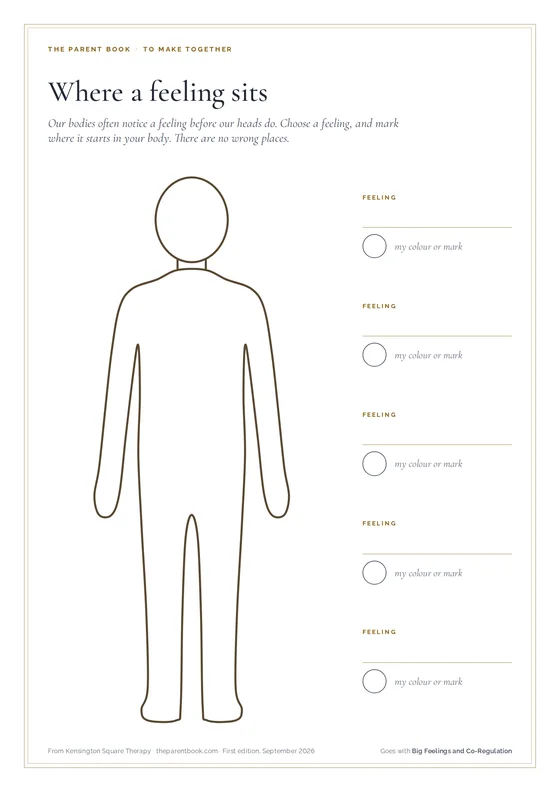
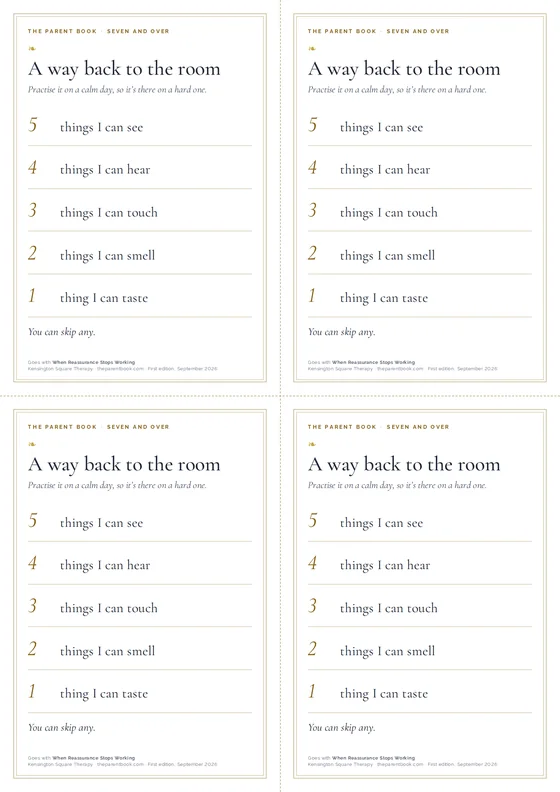
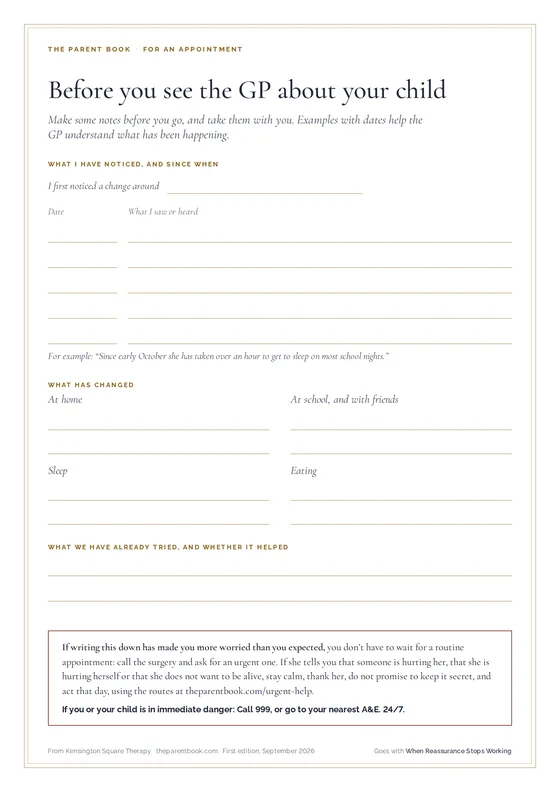
The quick tips and activities are for subscribers; the sheets that go with this chapter are yours to print. What a subscription includes.
Who else can help
Place2Be
Parenting Smart, written by the child mental health specialists who work in primary schools: short, practical articles and films on friendships, behaviour, worries and routines.
Anna Freud
The Anna Freud Centre’s family wellbeing resources: careful, research-led reading on children’s emotional development, separation, self-care for parents, and supporting a child through treatment.
Coram Family Lives
A free, confidential helpline for any parenting or family worry, by phone, live chat, WhatsApp or email, staffed by trained family support workers.
0808 800 2222 · Mon-Fri 9am-9pm; weekends 10am-3pm; closed bank holidays
Outside those hours the line is closed. Samaritans answer at any hour on 116 123, and Shout answer if you text the word SHOUT to 85258.
coramfamilylives.org.uk/how-we-can-help/confidential-helpline
YoungMinds
The UK’s young people’s mental health charity, with a free Parents Helpline, webchat and email, and a plain A to Z of the things parents worry about.
0808 802 5544 · Mon, Thu, Fri 9.30am-4pm; Tue, Wed 9.30am-6pm
Outside those hours the parents line is closed. The urgent routes on this page are open when it is not.