The Parent Book·From the library
When the Best Friend Moves On
A chapter for parents whose child has been quietly dropped.
A thirteen-minute read · Published 25 May 2026

There is a particular kind of parental grief that arrives without a name. The child comes home from school on a Wednesday, drops the bag in the hall, and is quieter than usual at supper. Asked if anything is wrong, she says nothing is wrong. By the second week, the name of the best friend, the one who has been mentioned across every meal for two and a half years, has stopped appearing in conversation. By the fourth week, the parent realises that the playdates have not been requested, the texts have gone unanswered, the friendship has, in the language children themselves so rarely use, ended.
In our work with parents at the practice, this conversation comes up often. It is one of the most painful, and one of the least dramatic, things that happens in a primary or early-secondary school year. There is no incident to point to. There is no falling-out the child can describe with any clarity. There is, often, no other child to be cross with. The friendship has not broken; it has dissolved, slowly, over a term, while the parent was thinking about other things.
What follows is what we tend to say, in some form, to those parents.
What is actually happening
Friendship change in childhood and early adolescence is not, in most cases, the failure it feels like. It is developmental. Between the ages of roughly seven and twelve, children’s social worlds reorganise in waves: they move from dyads (the inseparable pair, the one best friend) to clusters (the group of four or five), and then, around the start of secondary school, to fluid networks of overlapping smaller friendships that look much more like adult social life. Each of these transitions involves loss. The dyad that has held the child for two years stops being the structure the child needs; the cluster pulls one of the pair in, and the other is, often without ill intent, left behind.
The child who is left behind has usually done nothing to be rejected for. She is experiencing the unevenness of her own developmental timeline against her friend’s. Children move into the cluster stage at different rates, and the one who moves first does not, in any meaningful sense, choose to move. She finds herself absorbed by a new group, and the friend who has not yet moved is, on the playground on a Monday morning, suddenly the third one in a conversation of two. The slow drift begins there.
We find it helps parents to know this. The story the child is telling herself, often, is that there is something wrong with her, that she has been measured and found wanting. The story that is closer to true is that her friend is, for now, somewhere different in the developmental sequence, and that being somewhere different is not the same as being preferred against.
What the child is feeling, and what you might not be hearing
The child rarely uses the language an adult would use for this loss. She does not say she is grieving, because she does not have the word for what is happening as grief. She says she is bored, or that she does not feel like going to ballet, or that her stomach hurts on Sunday evenings. The grief is in the body before it is in the sentence. Parents who go looking for the conversation, the sit-down at the kitchen table where the child explains what is happening, will often find no such conversation is available. The child does not have the access.
What is often available, instead, is a different kind of conversation. A car journey. A walk to the corner shop. A bedtime where the lights are off and the child’s voice is suddenly closer to the surface. The conversations about lost friendships, in our experience, almost never happen face to face across a table. They happen sideways, with both parties looking at something else.
The other thing parents miss is the role the friend who has moved on continues to play in the inner life of the child who has been left. The lost friend is often, for months, the imagined audience for every small triumph and every small humiliation. The child is, in effect, talking to a ghost. She has not yet learned, because no one has yet taught her, that this is what loss does, and that the work of grief is the slow project of finding new internal audiences. A parent who notices this and names it, gently, is doing something no other adult is likely to do for her.
What to do, and what not to do
The instinct, when a parent realises this is happening, is to act. To call the other parent, to engineer a playdate, to take the child somewhere bright and distracting at the weekend, to make a list of new friends she might try to make. Some of these instincts are useful and most are not.
What is useful, in roughly descending order of usefulness:
The first useful thing is to name what is happening, without making a project of it. Something like “I have noticed you have not mentioned Eva for a while, and I wonder if something has changed there”, said in the car on a Tuesday, with both of you looking at the road, without expectation of an answer. The naming does work even if the child does not respond. She knows now that you have seen her, and that the loss is not invisible. The car matters; the fact that you are not looking at her matters. The same sentence at the kitchen table, with eye contact and a serious face, sounds like an interrogation. In the car it sounds like company.
The second useful thing is to make sure your home is, for the next few weeks, slightly more available than usual. Not louder, not more activity-filled, not full of suggested distractions. Available. A grown-up who is around, who does not require the child to perform recovery, who is happy to sit on the sofa and watch something undemanding for an hour after school. The child is doing developmental work and is exhausted by it. Available is the word. What Dan Hughes calls PACE, the stance of playfulness, acceptance, curiosity and empathy, is the closest framework we know to the posture this calls for; the parent is in the room without making the room about the loss. The practical version of this, in most houses, is letting the after-school hour be slower than it usually is for a few weeks: the snack on the sofa rather than the kitchen counter, the question about homework deferred until after supper, the small accommodation that says “I have noticed you are tired and I am not going to add to it tonight”.
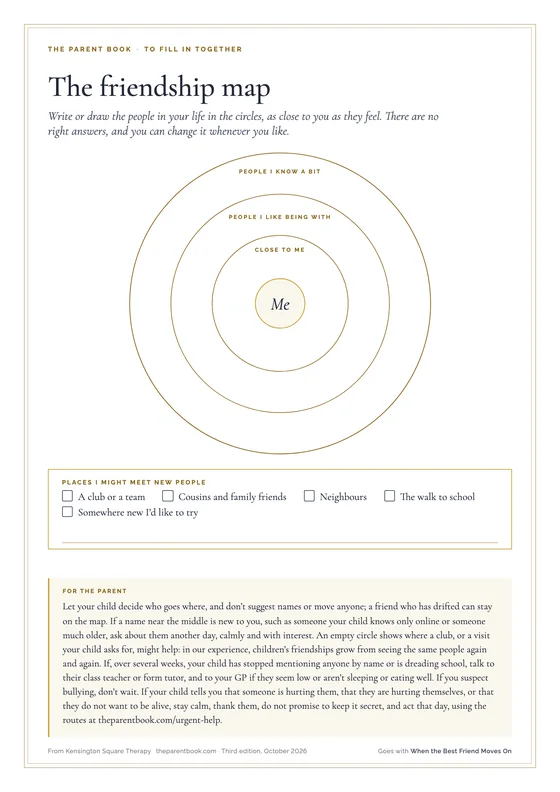
The third useful thing is to keep the territory of friendship open, but not to legislate it. Carry on with the activities the child already does. Say yes to the invitations that come. Do not, except in very particular circumstances, organise a new round of playdates with children the child has not chosen herself; the message of that intervention is “I, your parent, do not believe you can recover from this on your own”, and that message is rarely the one the child needs to hear. There is one exception, which is the older relative or family friend the child likes spending time with, the cousin or the godmother, who is not a new friendship she has to manage but an existing one she can lean on while school rearranges itself.
A fourth move, less obvious and worth naming, is the friendship from outside school. The Brownies, the football team, the weekend swimming squad. A child whose school-day friendships have come apart is much steadier if there is one other context in her week in which she has a place, and the place is not contingent on the playground politics of any given Monday. This is not the term to introduce three new activities; it is the term to keep going to the one she already attends, and to drive her there on the days she would rather not go.
What is rarely useful: ringing the other parent for an explanation. The explanation, if it exists, is developmental, not personal, and a phone call will produce only awkwardness on both sides. Asking the school to intervene at the level of please make them be friends again. Suggesting your child make a new best friend by Friday. Telling stories from your own childhood about a friendship that ended and how it all worked out fine; the child will hear this as a request to feel better faster, which is exactly what she cannot do.
For parents who want more practical, school-anchored guidance, we send them to Place2Be’s Parenting Smart articles on friendship change, which are written by school-based counsellors and have the unfussy, practical register we find parents can actually use in the kitchen on a Sunday evening. The piece on supporting a child through a friendship ending is particularly good. If the loss has tipped into something that is starting to look like low mood or anxiety, and is not lifting after a few weeks, the YoungMinds A-Z page on a child’s friendships is the clearest UK parent-facing primer we know on when normal friendship grief begins to need a different kind of attention, and is the piece we sometimes ask parents to read on the train before the next session.
At different ages
What a lost friendship looks like, and what helps, shifts as the child does. The bands below are descriptions, not boxes; a small ten-year-old can be socially closer to seven, and a tall eight-year-old already moving where the eleven-year-olds are.
If your child is between four and seven. The friendship at this age is the friendship with the child she sat next to in Reception. It is more about proximity than chosen affinity, and it dissolves and reforms in weeks. A four-year-old who has stopped mentioning Lily on Monday is often back to mentioning her on Friday. Try not to interpret the loss too heavily. Hear the report without weighting it. “I see, you played with Otto today instead.” What the small child needs is a parent who registers the change calmly, and who arranges, where she can, the things that build slow rhythms: the regular Wednesday playdate with a different family, the after-school routine that is the same on Mondays. The friendship will, in most cases, do its own rearranging without you doing anything except being unsurprised.
If your child is between seven and nine. The dyad is now real. The best friend is named in every report from school, and the loss of her, when it comes, hits harder than a parent expects. The seven-year-old does not yet have the language to call this grief; she has the stomach ache on Sunday evenings and the sudden flatness in the back of the car. What helps is the side-door conversation, the slower after-school hour, and keeping open the one outside-school activity she already has. Do not, this term, introduce three new ones. Drive her to the one she already attends, on the days she would rather not go.
If your child is between nine and eleven. The cluster reorganisation has begun in earnest, and is, in this band, often visibly painful. The pre-secondary social weather is already gathering, and friendships are being sorted for who will be where in September. The child who finds herself outside the cluster forming around her former best friend may go very quiet about it; silence is how children this age grieve. Name what you have noticed, without making a project of it. “I have noticed Eva has not been over for a while.” Said in the car, not at the table. Then keep the home slightly more available than usual, defer the homework battle, and let the after-school hour be slower for a few weeks while she comes to terms with a new configuration she did not vote for.
If your child is in early secondary, eleven to thirteen. The friendship economy has now become conditional in a way the primary years did not prepare her for. The group chat is the medium and the territory both; she is being included in some and not in others, on a rhythm that changes weekly. The friendship that has moved on, in this band, often did so visibly online before it did so in the corridor. Stay out of the group-chat literature and stay in the kitchen. Be the parent who is broadly available at half past four with a snack and no questions. The information will arrive on its own timetable, usually in fragments, usually when you are looking at something else.
If your child is mid to late secondary, thirteen and beyond. The friendship loss is now part of something larger. She is, around this time, choosing who she will be in the sixth-form year, and the friend who is no longer in her life is sometimes a friend she has simply outgrown. This does not make the grief smaller. The long car journey and the late-night kitchen visit still work here, as they do for the rest of adolescence. Resist the urge to comment on her new friends; the comment, however positive, is the comment she will not forgive.
If your child is eighteen and beyond. The specific loss at this age band is the friend who does not make the move to university, or who does make the move and changes once there. The school friendship that was the structure of every weekend for six years thins inside a term, and the child you have on the phone in October is sometimes a child mourning a person who is, in the technical sense, still on the other end of a WhatsApp. The best help here is restrained: be the parent who answers when called, sends the occasional message that does not require a reply, and trusts that the new friendships, currently mid-formation around her in the new city, will, by the end of the year, be doing what the old ones did.
The longer arc
A friendship that ends in childhood is almost never the friendship that defines the child’s social life by the time she is fifteen. The child who is, this autumn, eating her sandwich on her own in the corner of the dining hall will, in the great majority of cases, be in a group of four by next September. A parent cannot make that happen. What a parent can do is stay close through the months in which it does not, yet, feel like it will.
There is a thing parents often do not let themselves notice, which is that this whole experience is, for the parent, its own kind of loss. The other family was, for two years, part of the rhythm of your weekends. The school-gate exchange with the other mother had become its own small friendship. You have lost something too, and the cultural script for that loss is even thinner than the one for your child. If the experience is, for you, surprisingly heavy, that is because it is, in fact, surprisingly heavy. You are allowed to mind it. The parent who allows herself to mind it is, in practice, the parent better placed to see the child through it, because what she models is that loss is real and also survivable.
It almost always is survivable. It is, however, slow. The drift took weeks. The recovery takes months. Both timelines are normal.
NOTES
- Damour, Lisa. Untangled. Atlantic, 2017. The developmental tasks of adolescence framework: Damour’s reading of the seven transitions teenagers move through.
- Sunderland, Margot. What Every Parent Needs to Know. DK, 2016. Sunderland’s developmental neuroscience for parents: body before brain, and the regulated nervous system as the regulating tool.
Where to go further
Lisa Damour, Untangled: Guiding Teenage Girls Through the Seven Transitions into Adulthood The book we put into the hands of parents of girls in the cluster-and-network reorganisation years. Damour’s seven-strand frame is the cleanest writing we know on why friendships move and why your daughter is not at fault for the moving.
Margot Sunderland, What Every Parent Needs to Know A UK clinical psychologist’s calm, illustrated primer on what is happening underneath childhood emotion. The chapters on small losses and on the rhythms of repair are the right read for the parent who has registered that her primary-age child is grieving without using the word.
What helps a child with friendship difficulties
The friendship territory is one of the hardest to support from the outside, because most of the work has to happen between the children themselves. What parents can do is everything around the edges. Done consistently, this matters more than it appears.
- Listen first, advise second. Sit down. Don’t dispute the feeling. “That sounds really hard. Tell me what happened.” Let them finish before offering a single suggestion. The witnessing is more useful than the strategy.
- Build the home as a strong secure base. Children with a steady home are remarkably good at finding their people, in time. The investment in the home is the most reliable social investment a parent can make.
- Help them name the social dynamics, gently. “It sounds like Maya and Iris were close today. That can feel really hard when you wanted to play too.” Naming what is happening helps the child make sense of it without solving it for them.
- Resist the urge to fix the social structure. You cannot. Avoid emailing the other child’s parent. Avoid steering a clique solution from outside. The social architecture of a class is owned by the children, and most attempts from outside backfire.
- Build out-of-school connections. A cousin. A child from a club. A weekend playdate. One reliable friendship outside the school world gives your child somewhere their identity does not depend on the playground weather.
- Read books about friendship together. The Invisible Boy, Enemy Pie, Wonder. Children’s books on social difficulty are a quiet, indirect way to open conversations they would never have if you asked directly.
- Speak to the school for specific, ongoing concerns. A short, factual note to the form teacher. “We’ve noticed she’s been coming home upset about lunchtimes for a couple of weeks now. Anything you’ve noticed?” The pastoral team will often have observations that complete the picture.
More one-minute pieces, for when you need one
External support
Family Lives
A free confidential helpline for any parenting concern.
0808 800 2222 · Mon-Fri 9am-9pm; weekends 10am-3pm
YoungMinds
The leading UK youth mental health charity.
0808 802 5544 · Mon, Thu, Fri 9.30am-4pm; Tue, Wed 9.30am-6pm