The Parent Book·From the library
Big Feelings and Co-Regulation
A chapter for parents whose child has just come undone.
A thirteen-minute read · Published 25 May 2026

By five past five on a Wednesday, the three-year-old is lying face down on the kitchen floor, screaming about a banana. The banana, broken in half by his mother in the act of handing it to him, is on the floor in two pieces. He has been told he can have a new one. He does not want a new banana. He wants this banana, the broken one, to be, by some mechanism he feels in his bones his mother should be capable of, no longer broken. He is incandescent. His mother, who has had a long day at work, looks at the banana, then the child, then the clock, and feels the small piece of her that is still functional begin to argue with the larger piece that would like to go upstairs and shut the bathroom door for ten minutes.
The same scene, ten years later, has different furniture. The thirteen-year-old has slammed the bedroom door hard enough that the picture on the landing has tilted. The argument, about whether she could go to Maya’s house on Saturday, has escalated into the larger argument running under the surface for weeks, about the fact that her mother does not understand her, has never understood her, and is currently the worst person on the planet. The mother on the landing would also, if she is honest, like to shut a bathroom door for ten minutes.
In our work with parents, both of these kitchens come up often. The furniture varies. The mechanism does not. A child whose feelings have become bigger than her capacity to manage them needs a calmer person beside her to find her way back. The cultural script tends to mislabel this as discipline. It is, in fact, the unglamorous daily practice the literature calls co-regulation.
What is actually happening
A young brain, faced with a feeling larger than its capacity to process it, does something specific. The thinking part goes briefly offline; the emotional part, responsible for fight, flight, and overwhelm, takes the wheel. Daniel Siegel describes this in The Whole-Brain Child as flipping the lid: when the lid is on, the upstairs and downstairs of the brain are working together; when it has flipped, the downstairs is alone in the building and the upstairs is unreachable. The three-year-old on the floor has flipped his lid. So has the thirteen-year-old behind the bedroom door, although the literature is sometimes shyer about naming it that way for teenagers.
The lid does not flip because the child is being difficult. It flips because the load has, in that moment, exceeded the regulation she has so far developed. The prefrontal cortex does not finish developing until the mid-twenties. The four-year-old does not have the wiring. The thirteen-year-old has more of it, but is being asked to use it in a body that is, hormonally, going through one of the most disruptive periods of its life. Both children are running on a system not yet built for the load.
The mechanism changes what the parent does next. The parent who has understood that the upstairs brain is offline does not, in the kitchen at five past five, attempt to reason with it. She does the only thing that actually works in that moment: she lends the child her own regulated nervous system until the child’s own comes back online. That is co-regulation. It is the loaning of capacity until the child has grown her own.
Co-regulation is not staying calm
The slogan in the parenting internet is stay calm. It is, on the surface, the right instruction. It is, in practice, almost useless, because it tells the parent what state to be in without telling her how to be in it.
Co-regulation has three layers. The first is the body. The parent’s body is, in those moments, the most regulating object in the room. A slower breath, a softer face, a lower voice, hands open rather than tight, a body that has moved closer rather than further away. The child’s nervous system reads these signals long before her conscious brain processes the words. The two-year-old who has stopped crying when picked up has not been persuaded by an argument; she has been held by a body in a regulated state, and her own body has started to match it.
The second is presence. Co-regulation requires the parent to actually be there. Not on the phone. Not running a parallel monologue about whether this is happening because of the screen time or the sugar. Present, with her attention on this child, even if for only sixty seconds. Karen Treisman writes well on this in her work on felt-safety; a child who feels she has been received does not need to keep escalating to be received.
The third is the repair. Co-regulation does not end with the meltdown ending. It ends with the conversation that comes after, hours or sometimes a day later, in which the experience is named and the relationship is reaffirmed. This is the layer most parents skip, often because they are exhausted, and skipping it costs more than they realise. The child who has been through a meltdown without repair carries, internally, the memory of having gone off the rails alone. The child who has been through the same meltdown and then, an hour later, had her mother sit on the edge of the bed and say “that was really hard for both of us, was it not, I am sorry I was sharp with you, I love you very much” has the meltdown contextualised as a survivable event in a relationship that holds.
Why your child melting down activates you
A child’s meltdown is, physiologically, contagious. The screaming three-year-old is, by the second minute, doing in your body what is happening in his. The cortisol rises. The breath shortens. The flight instinct suggests you leave the room. The fight instinct suggests you shout. The freeze instinct suggests you stand on the rug and let go of your own face.
This is not a character flaw. What is being asked of you, in those minutes, is to remain regulated while another person’s nervous system is unregulated in your immediate vicinity, with your bond to that person amplifying the signal. The parent who has had three of these in a day, on top of the morning meeting and the laundry, is depleted.
The realistic frame is one in which the parent is having her own response and is, by small accumulated practices, able to manage it well enough to stay in the room. Some practices are personal (the long out-breath, cold water on the wrist, the conscious dropping of the shoulders). Some are environmental (the partner who can take over, the kitchen counter to put your hand on). Some are, in the longer arc, a matter of looking at why your child’s meltdown produces this particular activation in you, which sometimes benefits from your own counsellor. Parenting often surfaces material that has been waiting twenty years.
What about time-out
Time-out, the move most parents of my generation grew up with, is now widely held to be unhelpful in most situations. A child sent to her room mid-meltdown is a dysregulated child being asked to regulate alone. Her thinking brain is offline. Her emotional brain has been told that the parent is, in the moment of greatest need, leaving the room. The intervention asks her to regulate herself in the state in which that is hardest, with the most regulating object (the parent) removed from the building. The meltdown that resolves usually resolves because the child has run out of energy.
This is not to say no version of stepping back ever works. The limited case is the cooling-off moment for an older child who has herself decided she needs a few minutes alone. “I am going to step out of the room for a minute. I will be back. You can come and find me when you are ready.” That is not a time-out; it is regulated removal modelled, with the door explicitly unclosed. In a two-parent household, the silent handover in which one tags out and the other tags in is useful, and is a different thing entirely from sending the child away.
The general rule, in our work, is that co-regulation happens with the parent in the room and that the meltdown is not, in itself, a behaviour to be punished; it is a developmental moment. Siegel and Bryson’s No-Drama Discipline, the practical sister volume to The Whole-Brain Child, is the book we find ourselves most often putting into parents’ hands on what to do after the meltdown; it is unusually good on the distinction between discipline (teaching) and punishment (making the child feel worse for what has just happened).
What actually helps in the moment
The body before the brain. Before any sentence about the banana, lower the voice, slow the breath, and get closer to the floor than the child is. Sit down. Do not stand over. The two-year-old looking up at his mother sees a giant figure looming. The mother on the kitchen floor is the same mother in a much less escalating shape. Hands open. Face soft. “I see you. The banana broke. That was so hard.” Naming the feeling, before any attempt to fix the situation. Siegel calls this name it to tame it; the naming alone, said in a regulated voice, does forty percent of the work.
The presence before the lesson. The lesson, if there is one, comes later, and is smaller than the parent thinks it needs to be. The downstairs brain does not learn lessons; it learns whether the world is safe. What it is learning, on the kitchen floor, is whether the adult next to it stayed. The presence is the lesson. Everything else is for after.
The repair after the rupture. An hour later, sit on the edge of her bed and name what happened. “That was a really hard moment for both of us, was it not. I was sharp with you, and I am sorry. I love you.” Not a speech. A short, true sentence in a calm voice. The repair, in attachment terms, rebuilds more than the rupture undid. A child in a household where repair happens reliably learns that ruptures do not end relationships, which is one of the most important pieces of information a young adult can carry into her own friendships.
The thing you stop doing. The conversation about whether this was caused by the screen time, the sugar, the lack of sleep, the way Granny spoke to her on Sunday, is not a useful conversation in the kitchen at five past five. Suspend the analysis; the post-mortem can happen after the children are in bed.
Place2Be’s Parenting Smart articles on big feelings, written by school-based counsellors, are the unfussy, practical pointer we send parents to for primary-age material. Anna Freud’s resources on emotional regulation in younger children are the next step for the parent who wants something more clinically anchored, particularly where the meltdowns have started to feel more sustained than the developmental norm. Family Lives runs a confidential helpline that is the right call when the question is about the family system rather than a clinical concern in the child.
At different ages
Dysregulation, and the co-regulation it calls for, looks different at every age. The bands below are descriptions, not boxes.
If your child is between four and seven. The meltdowns are at their loudest and most frequent in this band. This is not a behavioural problem; it is a brain still under construction. Go body before brain. Get to the floor. Lower the voice. Name the feeling. Do not try to reason mid-melt. “You wanted the blue cup and I gave you the green. That is so disappointing.” The naming matters even when the child cannot yet respond. The Whole-Brain Child is, in this band, more useful than any other single book we know.
If your child is between seven and nine. Meltdowns are less frequent and often more verbal. The seven-year-old can articulate what is wrong, often inaccurately, in the middle of the meltdown. Receive the articulation without arguing with the accuracy. “That sounds really hard. I am sorry it has been like that.” Then a hand on the shoulder, and the kitchen continues. The meltdown is, in this band, often the first sign of a hard day at school she has not, until then, mentioned.
If your child is between nine and eleven. Pre-secondary self-consciousness is in play, and meltdowns are increasingly happening behind a closed bedroom door. What helps is the named knock and the patient sitting outside the door. “I am here when you are ready.” Said calmly, then sit on the landing for ten minutes. Do not force entry. Do not leave entirely. The middle ground is the available adult on the landing, not requiring conversation, doing nothing visibly except being there.
If your child is in early secondary, eleven to thirteen. The teenage rage has arrived. It is louder than the parent expected, comes faster than at nine, and is often directed at the parent specifically. The upstairs-downstairs frame applies to her too. The thirteen-year-old whose lid has flipped is not, in those minutes, in a state where reasoning works any better than it did at four. The body-before-brain move still applies. Lower the voice, leave space, do not match the volume. The conversation about what was actually being argued about is for the next morning, in the car, with the radio on low and the conversation oblique.
If your child is in mid to late secondary, thirteen and beyond. The dysregulation is sometimes less explosive but more sustained. A bad week is a bad week, not a bad afternoon. What helps is presence without demand: the offer of a walk, the cup of tea brought to the bedroom without comment, the lift to her friend’s house in which you say almost nothing. The repair, after a row, is the small acknowledgement on the Tuesday. “I have been thinking about what we said on Saturday. I am sorry I was sharp. I love you.” Said in passing, not at the table.
The longer arc
What you are building, in the kitchen on a Wednesday at five past five, is not a child who never melts down. You are building a child who has borrowed your calm often enough to learn regulation from the inside. The capacity is not innate; it is laid down through ten thousand small moments in which the adult next to her stayed put, slowed her own breath, and let the storm pass without joining it. The child grows up to be the adult who can do this for herself, and then, often, for her own children.
This is the slowest of the parenting projects. It does not produce visible results inside a week. It does, over years, produce a person whose internal weather she can stand, and everything else is built on that. It is not a flashy outcome, but we think it is the most important one.
The three-year-old on the kitchen floor, in the great majority of cases, eventually picks himself up, eats half of the new banana, and is, by half past five, asking for a story. The thirteen-year-old behind the closed door eventually opens it, and a few hours later sits at the kitchen table, subdued, picking at the dinner you have plated up for her. Both moments are the lid coming back on. Both are, in the long arc, evidence that what you are doing, although slow, is working. You are allowed to be tired. You are also, in those moments, doing more than you realise.
NOTES
- Siegel, Daniel J. & Bryson, Tina Payne. The Whole-Brain Child. Bantam, 2011. The “name it to tame it” move and the upstairs/downstairs brain model both originate here.
- Siegel, Daniel J. & Bryson, Tina Payne. No-Drama Discipline. Bantam, 2014. The discipline-as-teaching frame, and the distinction between connection and correction.
- Sunderland, Margot. What Every Parent Needs to Know. DK, 2016. Sunderland’s developmental neuroscience for parents: body before brain, and the regulated nervous system as the regulating tool.
Where to go further
Daniel J. Siegel and Tina Payne Bryson, The Whole-Brain Child The cleanest single primer we know on how a child’s brain organises a big feeling, why the upstairs goes offline when the downstairs is in charge, and what the parent can practically do about it. Named in the body of this chapter; the book itself is short enough to read in two evenings.
Margot Sunderland, What Every Parent Needs to Know A UK clinical psychologist’s illustrated primer on the science behind everyday emotion. The chapters on tantrums, on bedtime regulation, and on the parent’s nervous system as the child’s regulator are the ones we send parents to most often.
What helps a child learning to regulate
Emotional regulation is learned, not taught. Children build it through thousands of small co-regulated moments with the adults around them. These are the practical, evidence-informed moves that, in our work, most reliably help the learning along.
- Co-regulate: your calm is the teacher. Children cannot self-regulate at this age. They borrow regulation from a steadier nervous system nearby. Your state matters more than any words you choose. Notice it first.
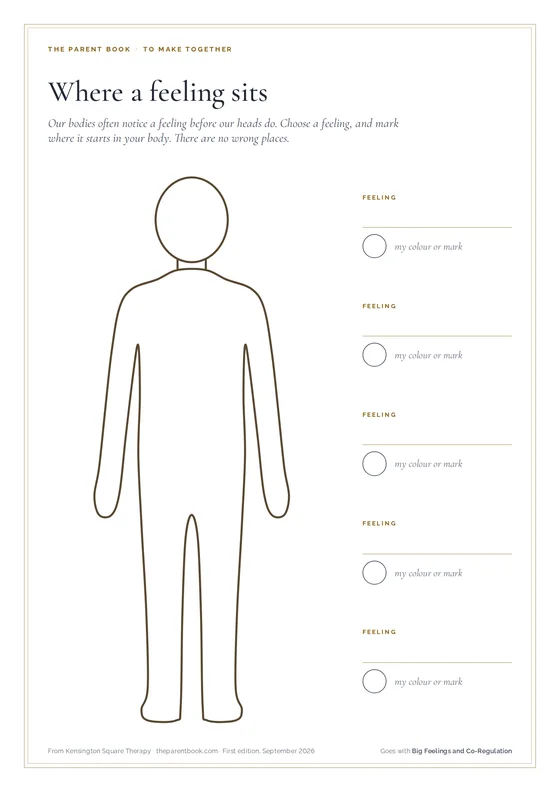
- Name the feeling, simply. “You’re really frustrated right now.” That is the whole intervention. Naming moves brain activity from the emotional centre toward the language centre, and the naming itself is regulating.
- Less language in the storm, more presence. Mid-meltdown, the thinking part of the brain is offline. Words don’t land. What lands is your steady body, sitting nearby, breathing slowly. Save the conversation for later.
- Repair after you lose it yourself. Every parent loses it sometimes. The repair afterwards is more important than the moment itself. “I’m sorry I shouted. That wasn’t fair. You didn’t deserve that.” Teaches your child that conflict does not break love.
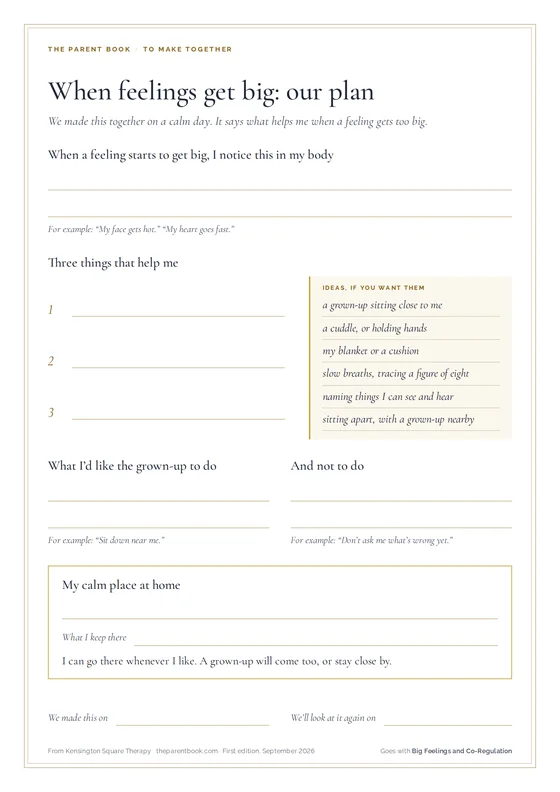
- Build a calm-down corner. A small space with cushions, soft toys, a book, a sensory item. Not a punishment corner. A place to go to settle. Children use it more than parents expect, especially older primary-age children who are too proud to ask.
- Use breathing tools they can do without you. Lazy 8 (trace a figure 8 in the air, in on the way up, out on the way down). Finger breathing (trace your hand, in on each finger up, out on the way down). Small physical tools they can use anywhere, including at school.
- Talk about feelings outside of the storm. The conversation about anger lands at 6pm in a calm moment, not at the height of the tantrum. The learning happens between the storms, not during them.
More one-minute pieces, for when you need one
External support
Family Lives
A free confidential helpline for any parenting concern.
0808 800 2222 · Mon-Fri 9am-9pm; weekends 10am-3pm