
The chapter to start with
After You Have Lost Your Temper
A chapter for parents who have shouted, and are lying awake about it.
16 min read · Under 19
Read the chapter Your first chapter is free to read in full.
↑ ↓ to moveEnter to openEsc to close
Family life and behaviour

This section is for any parent thinking about how the family is run: boundaries, routines, how you talk to each other at home, and the decisions you make about phones, friends, money and faith. It describes the habits our practice has seen make a difference to families over the years.
What to do first, what helps and who else can help are free to read and to print. So is the first chapter you open.
What the library holds on parenting strategy
From the therapists
There’s no manual, and the parents who look certain usually aren’t. Doing one thing consistently works better than doing five things well for a fortnight.
From the chapters
The school, the class teacher and the in-school enrichment that the year is built around will cover the academic preparation. Your job is to make home feel different from that, so your child has somewhere to recover.
“You kept going when that question was hard.” “You were kind to your sister tonight.” Say exactly what you saw, without judging how good it was. Praise that depends on outcomes adds pressure.
Sit close and slow your own breathing. Being next to a calm adult helps a child’s body settle, and that does more than anything clever you could say. Save the words for when the worst has passed.
Try “That sounds really hard” or “You look really worried.” Naming the feeling makes it seem less strange, and it shifts brain activity from the alarm centre towards the language centre.
9 on parenting strategy
The long reads, each on one situation, written by a therapist.
The chapter to start with
A chapter for parents who have shouted, and are lying awake about it.
16 min read · Under 19
Read the chapter Your first chapter is free to read in full.
Nothing on this shelf is written for that age yet.
67 on parenting strategy
Short pieces for the moment in front of you, each with things to try.
Neurodiversity
Ask five questions before you pay, and be wary of any clinic that can’t answer them.
Try this
Friendships & social life
Talk about drink before the first party, so your teenager knows your rules and that they can always ring you.
Try this
From the tip
If your teenager seems to be drinking to cope, drinks alone, or you are worried about how much they drink, talk to your GP.
Spiking can look like being very drunk. If you suspect it, get medical help early and report it to the police. The person who was spiked is never to blame. If your teenager tells you someone did something sexual to them while your teenager was drunk, or an older person is giving them alcohol, stay calm, thank them for telling you, don’t promise to keep it secret, and act that day. If that person lives in your home, go straight to children’s social care or the police. A national child protection helpline will talk it through with you. NSPCC, 0808 800 5000. Email help@nspcc.org.uk. Mon-Fri 10am-4pm by phone; email 11am-4pm, seven days a week. An email sent when the service is closed is not received. If the NSPCC service is closed and the concern cannot wait, call the police on 101. You can also contact the child’s local out-of-hours children’s social care, social work or social services team. If a child is in immediate danger, call 999. Help is free.
Alcohol poisoning can look like confusion, being sick, slow or irregular breathing, pale or blue-tinged skin, a fit, or passing out and being hard to wake. If your teenager is very drunk, stay with them and don’t leave them to sleep it off alone: they could be sick while drowsy and choke. If you think they have alcohol poisoning, call for emergency help. Call 999. Help is free and available at any hour.
Family dynamics
Describe what your child did and how they did it, which tells them far more than a verdict on how clever they are.
Try this
More quick tips on parenting strategy
Neurodiversity
Your child experiences the world differently from you, and it helps to find out how.
2 min read
Bodies & growing up
Some early waking can be changed and some can’t, and a two-week sleep diary will show you which you have.
2 min read · Under 7
Bodies & growing up
Go back to your toddler before they get up, and when they do get up, take them back to bed without a conversation.
2 min read · Under 5
Bodies & growing up
Toilet training works when your child’s body and brain are ready, whatever the timetable says.
2 min read · Under 7
Health and difference
Build the medication into something the family already does, and give your child ownership of the routine in stages.
2 min read · Ages 5 to 13
Family dynamics
At fifteen, most of what you know about your teenager’s life is what they choose to tell you, so keep a few rules and let the rest go.
2 min read · Ages 13 to 18
Parent wellbeing
A calm “We can’t afford that” gives your child a way to talk about money that they’ll keep.
2 min read · Ages 5 to 13
Family dynamics
You agreed to look after them for a weekend, and the weekend has become a year.
2 min read
Parent wellbeing
If your shouting tends to come at the same hour, changing that hour may help more than resolving to be patient.
2 min read · Under 16
Parent wellbeing
Money is something you can talk about with your child, though most families don’t.
2 min read · Ages 7 to 13
Family dynamics
Answer truthfully and briefly when your child asks why their friend is going skiing and they aren’t.
1 min read · Ages 9 to 16
Home And Belonging
Register with a GP as soon as you arrive; in the UK, almost all NHS care starts there.
2 min read
Parent wellbeing
Agree a plan with your children in a good week, so nobody has to guess on a bad day.
2 min read · Ages 7 to 16
Online life
Asking what your child watches online is harder than timing it, and more useful.
2 min read · Ages 7 to 13
Parent wellbeing
A specific request for help gets a yes or a no; a general one gets sympathy.
2 min read
Online life
Have the money conversation, and set the controls, before your child plays a game with a shop in it.
2 min read · Ages 7 to 13
Online life
Keep pictures of your child to people you know, and once they’re old enough to have a view, ask them first.
2 min read · Under 9
Family dynamics
A child growing up between two cultures learns two ways of doing things, and both are theirs.
2 min read · Ages 5 to 13
Big feelings
The diagnosis is part of family life now, but most of life isn’t about it.
2 min read · Ages 11 to 18
School & pressure
When you ring the school, describe what you’ve seen, with dates, so staff know what to look for.
2 min read · Ages 9 to 16
School & pressure
An apprenticeship deserves the same care you’d give to choosing a university.
2 min read · Ages 13 to 18
Online life
A four-year-old doesn’t choose their own apps, so choose them with care and review them as your child grows.
2 min read · Under 9
Family dynamics
Set a boundary with your own parent calmly and briefly, before resentment builds up.
2 min read
Family dynamics
An extroverted parent often mistakes an introverted child’s temperament for shyness or low confidence.
2 min read · Ages 5 to 13
Online life
Two games with the same age rating can be very different, so check why it got its number and watch it being played before you decide.
2 min read · Ages 7 to 13
Family dynamics
A grandparent’s advice is given with love, but you still need to set it aside calmly.
2 min read
Family dynamics
You can be clear about how your own house runs without proving a grandparent wrong.
2 min read
School & pressure
Pack the bag together for a few weeks, then hand the job to your child on a date you’ve set.
2 min read · Ages 9 to 13
Neurodiversity
When the same comment turns up in three years of school reports, take it seriously.
1 min read · Ages 7 to 13
Family transitions
If the bedtime is different at the other parent’s, your child will be alright.
2 min read · Ages 5 to 13
Bodies & growing up
Aim for eighteen short conversations about puberty over two or three years, starting early.
2 min read · Ages 7 to 11
Bodies & growing up
In their first decade, a child’s body image is built almost entirely from what they hear adults say.
2 min read · Ages 7 to 11
Bodies & growing up
A child’s relationship with food is almost always about control.
2 min read · Under 11
Big feelings
A change in your child’s dose is information, and in most cases it doesn’t mean anything is going wrong.
2 min read · Ages 11 to 18
School & pressure
Take your child seriously without taking sides, and listen for specific incidents you can act on.
2 min read · Ages 5 to 11
Bodies & growing up
Most teenagers don’t vape, and most who have tried were given their first one, usually by a friend.
2 min read · Ages 11 to 18
Parent wellbeing
After you’ve snapped at your child, go back, apologise and put it right.
2 min read
Big feelings
If your child needs the same answer again and again before they can settle, it may be OCD, so talk to your GP.
2 min read · Ages 7 to 18
Home And Belonging
If your child has started refusing the family’s food, keep cooking it and take the pressure off.
1 min read · Ages 7 to 16
Bodies & growing up
When a young child says their tummy is too big, ask them where the idea came from.
2 min read · Ages 5 to 9
Family transitions
Seeing a doctor on their own is part of growing up; know what stays private, what doesn’t, and how you can still help.
2 min read · Ages 13 to 18
Online life
At four, treat the tablet as yours, lent to your child for short stretches with you nearby.
2 min read · Under 7
Neurodiversity
Ask for the meeting in a short email, and bring three to five specific examples in writing.
1 min read · Ages 5 to 11
Neurodiversity
Your child’s brain needs structure from outside, and you’re the one who has to provide it.
2 min read
Neurodiversity
An ADHD child needs a routine that’s more visual and more forgiving, with the prompts outside their head.
2 min read · Ages 5 to 11
Online life
If your child has let an AI tool do their homework, go through what it wrote with them.
1 min read · Ages 7 to 13
Family dynamics
Twins are compared from the start, so describe each one in their own terms, without mentioning their twin.
2 min read · Ages 5 to 13
Health and difference
During a parent’s long treatment, accept practical help, keep one family ritual and lower the bar on everything else.
1 min read · Ages 5 to 16
Family dynamics
When money gets tight, get help with the numbers and decide what the children will be told.
1 min read · Ages 5 to 16
Family transitions
If it grates when your new partner disciplines your child, sort it out between the adults.
2 min read · Ages 5 to 16
Parent wellbeing
Your teenager doesn’t have to accept your apology tonight for it to count; say it once, and leave them free to come round.
2 min read · Ages 11 to 18
Neurodiversity
For a child with ADHD, homework goes better in short timed blocks, one instruction at a time, with you nearby.
2 min read · Ages 7 to 13
Big feelings
Children often hide OCD at school, and a short conversation can help stop staff feeding it without meaning to.
2 min read · Ages 7 to 18
Neurodiversity
The decision about medication is yours, made with the prescribing team.
2 min read · Ages 7 to 16
Neurodiversity
When a younger child is assessed, parents often start to see the same patterns in the eldest.
2 min read · Ages 7 to 13
Neurodiversity
If an hour of maths ends with two questions done, an ADHD child has usually been working very hard.
2 min read · Ages 7 to 13
Home And Belonging
Keep speaking your heritage language at home; the research supports it.
2 min read
Home And Belonging
Primary care, secondary care, CAMHS, A&E, the urgent advice lines. The map is worth holding.
2 min read
Health and difference
Most teachers don’t know which pupils are young carers, so tell the school.
1 min read · Ages 7 to 16
Family dynamics
Early-years twins are more exhausting than most people realise, so cut back on everything else.
2 min read · Under 7
Big feelings
Ordinary bedtime routines comfort a child; an OCD ritual runs on fear, and it changes best one step at a time.
2 min read · Ages 5 to 11
Big feelings
Boredom can be a sign of low mood when it takes in almost everything, friends included, and lasts a fortnight or more.
2 min read · Ages 7 to 11
Big feelings
A child who is cross with everything may be low, and the clue is what they have stopped enjoying.
2 min read · Ages 9 to 16
Big feelings
A teenager who refuses the GP may agree to a different way of going, and if they won’t, you can still go.
2 min read · Ages 11 to 16
The rest of each tip, with more to try and why it works, is in the library.
Nothing on this shelf is written for that age yet.
17 on parenting strategy
Small, repeatable things to do with your child, with what to watch for and when to get help.
To do together · About 15 min
Agree a plan with your teenager before each party, including how they get home and what they do if things go wrong.
What it is for. Most of what parents know about a teenager’s life comes from what the teenager chooses to tell them. A plan made together before a party gives your teenager an easy way to tell you where they will be and how they are getting home, and settles what happens if something goes wrong before anyone is frightened or cross.
Safety. Spiking can look like being very drunk, and some drugs leave the body within hours. If you suspect it, get medical help early and report it to the police. The person who was spiked is never to blame. If your teenager is very drunk, stay with them and don’t leave them to sleep it off alone: they could be sick while drowsy and choke. If you think they have alcohol poisoning, call for emergency help, using the routes under “If you need help right now”.
When to get help. If your teenager or anyone with them is hurt, very drowsy or confused, unconscious, has been assaulted, may have been spiked or is being held or threatened, act straight away, using the routes under “If you need help right now”, at the foot of every page. Do the same if your teenager hasn’t come home, you can’t reach them or anyone with them, and you are worried for your teenager’s safety. If your teenager tells you, that night or later, that someone hurt them or did something sexual to them, that someone is pressuring or threatening them, or that they are hurting themselves or don’t want to be alive, stay calm, thank them for telling you, don’t promise to keep it secret, and act that day, using the same routes. If the person hurting your teenager lives in your home, go straight to children’s social care or the police. If you think your teenager is being exploited or groomed, act that day: contact the police or your local children’s social care, or get advice from the NSPCC. If something that happened is still troubling your teenager weeks later, talk to your GP.
The other three steps, and your part in it, are in the library.
More to do together
To do together
Cook one dish together each week, side by side, and give your child a real job. If they want to talk, they can do it while they chop.
About 45 min · Under 18 · With a sheet to print
To do together
When nobody is upset, pick one problem that keeps causing rows, hear your child’s side of it first, then say yours, and work out a plan you can both keep.
About 20 min · Ages 9 to 18
To do together
Notice what you do to spare your child a worry, then change one thing, telling them first and staying kind.
About 15 min · Ages 7 to 16 · With a sheet to print
To do together
Walk with your child at the same time each week, side by side. Some weeks they will talk, and you still go on the weeks they do not.
About 20 min · Under 18 · With a sheet to print
To do together
Your child chooses a film, a book, a song or a game they care about. You watch it, read it or play it, and ask one curious question.
An evening, or an afternoon · Ages 11 to 18 · With a sheet to print
To do together
Agree a code word with your teenager that means “come and get me”, with no telling-off that night, so that they can always leave somewhere they don’t want to be.
About 15 min · Ages 11 to 18
To do together
A short list by the door, made with your child, of the things that go with them each morning. Your child ticks each one off as it goes in the bag, and you point at the list instead of reminding them.
About 20 min · Ages 5 to 16 · With a sheet to print
To do together
Each of you takes up something none of you can do, and practises it where the others can see. There is no show at the end.
About 10 min · Ages 7 to 18 · With a sheet to print
To do together
For an everyday fear, such as dogs, the dark or a new club: together you write the steps from easiest to hardest, and your child practises each one until it feels easy before they move up.
About 15 min · Ages 5 to 16 · With a sheet to print
To do together
Ten minutes most days when your child chooses what you play and you follow their lead. You don’t teach, correct or ask questions, and they never have to earn it.
About 10 min · Under 11 · With a sheet to print
To do together
Choose the last half-hour before bed with your child, write it down in order and put it on the fridge. Then do it in that order most nights, slowly.
About 30 min · Under 13 · With a sheet to print
To do together
Ask your child to teach you something they can do and you can’t. They run the lesson, you get it wrong in front of them, and at the end you tell them what you learned.
About 20 min · Ages 7 to 18 · With a sheet to print
To do together
Help your teenager get ready for a GP appointment and book it, then step back in stages until they can manage it alone.
About 30 min · Ages 13 to 18 · With a sheet to print
To do together
A regular time with each of your children on their own, doing something they choose. Keep it short enough to protect every week.
About 15 min · Ages 5 to 16 · With a sheet to print
To do together
Now and then, each of you writes a few things your body did this week: something it managed, something it felt, something it mended. Nobody mentions how anyone looks.
About 10 min · Ages 7 to 16 · With a sheet to print
To do together
For a visit your child has asked for: one friend, one thing to do together, you within earshot, and a warm, clear ending.
An afternoon · Ages 5 to 13 · With a sheet to print
Nothing on this shelf is written for that age yet.
49 on parenting strategy
Made to be printed, kept, and handed on.
To print and keep
What to do first, what helps, a few things to try and who else can help, together in one guide. Free to print and keep, or to hand to the other parent, a grandparent or the school.
Who else can help with parenting strategy, on a sheet of its own.
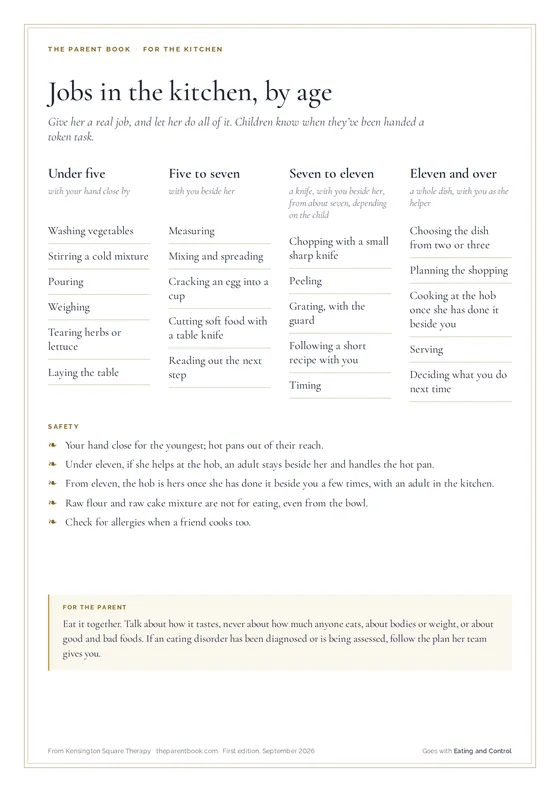 Jobs in the kitchen, by age
For the kitchen · A4 · With a subscription
Jobs in the kitchen, by age
For the kitchen · A4 · With a subscription
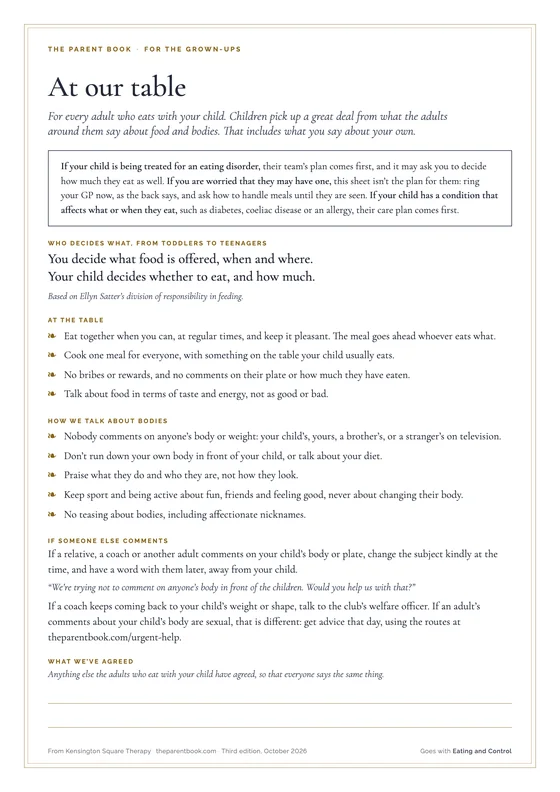 At our table
For the grown-ups · A4, two sides · With a subscription
At our table
For the grown-ups · A4, two sides · With a subscription
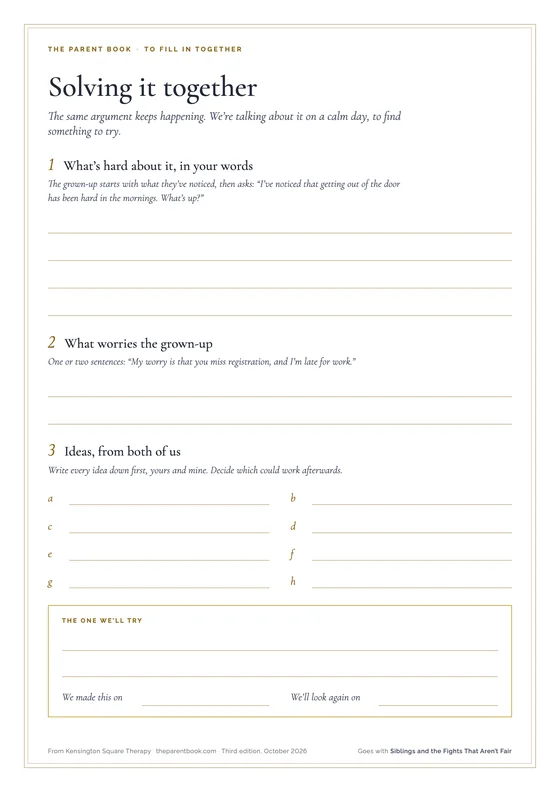 Solving it together
To fill in together · A4, two sides · With a subscription
Solving it together
To fill in together · A4, two sides · With a subscription
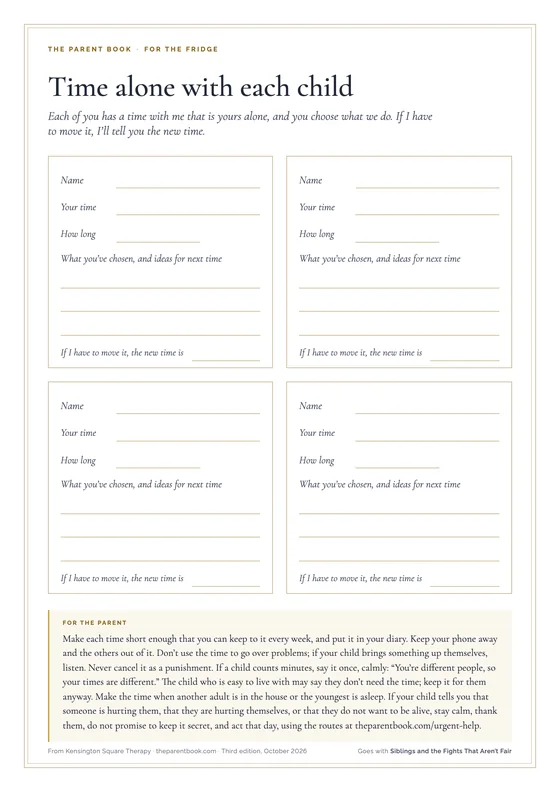 Time alone with each child
For the fridge · A4 · With a subscription
Time alone with each child
For the fridge · A4 · With a subscription
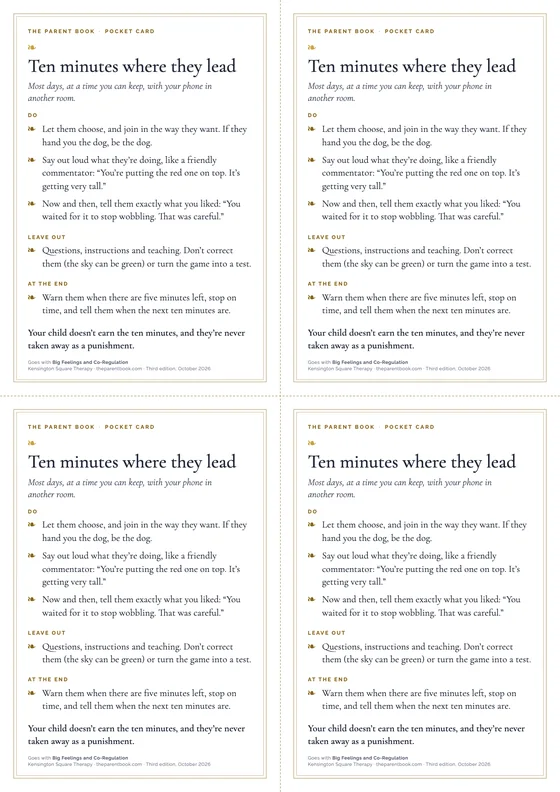 Ten minutes where they lead
Pocket card · A4, four cards to cut, two sides · With a subscription
Ten minutes where they lead
Pocket card · A4, four cards to cut, two sides · With a subscription
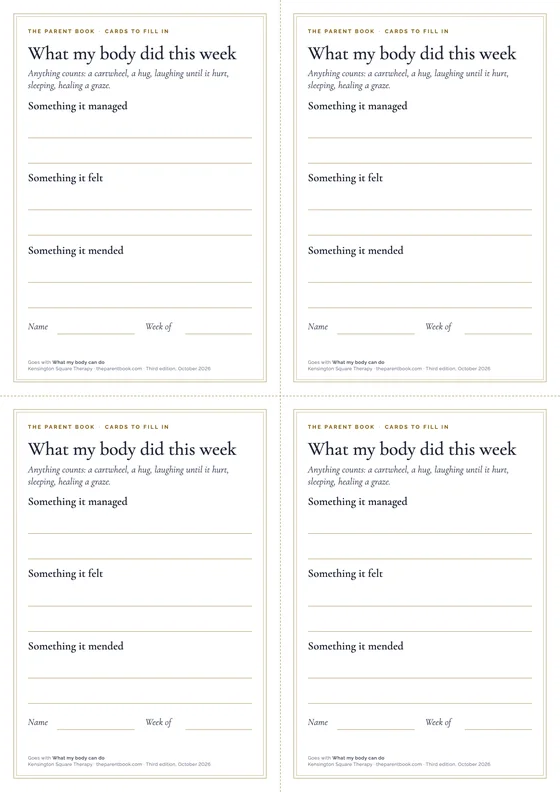 What my body can do
Cards to fill in · A4, two pages: four cards, and a page for you · With a subscription
What my body can do
Cards to fill in · A4, two pages: four cards, and a page for you · With a subscription
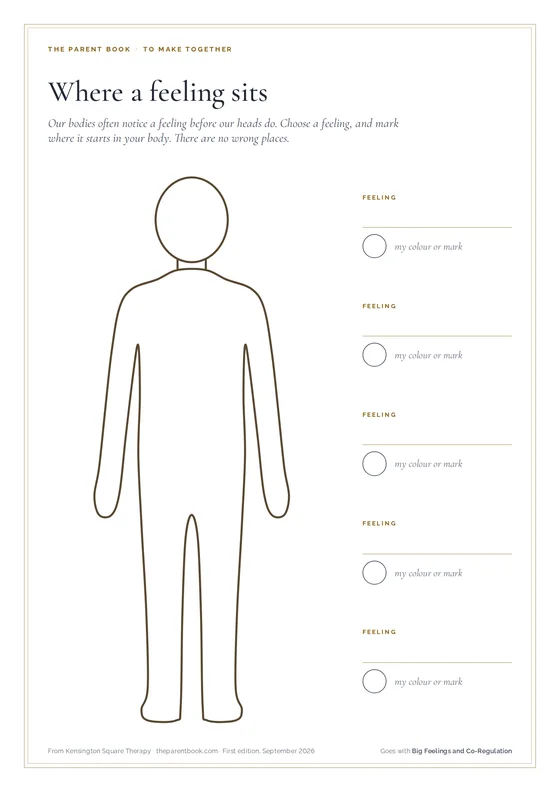 Where a feeling sits
To make together · A4, two sides · With a subscription
Where a feeling sits
To make together · A4, two sides · With a subscription
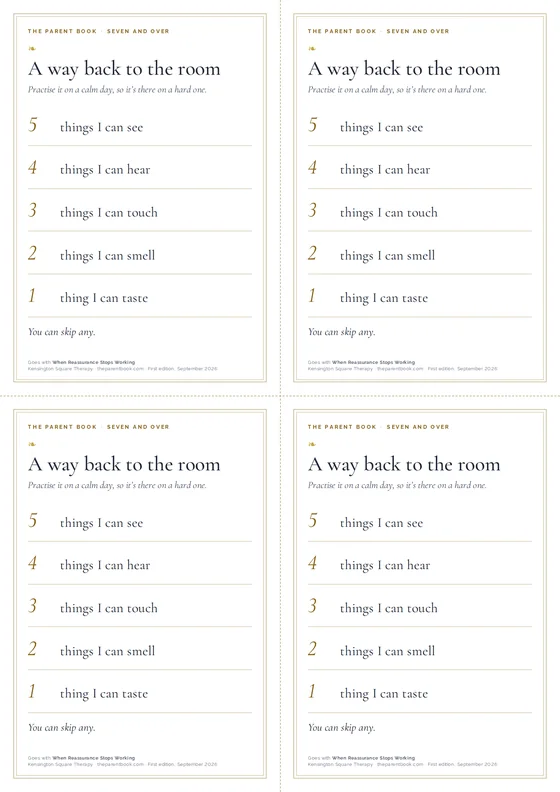 A way back to the room
Pocket card · A4, four cards to cut, two sides · With a subscription
A way back to the room
Pocket card · A4, four cards to cut, two sides · With a subscription
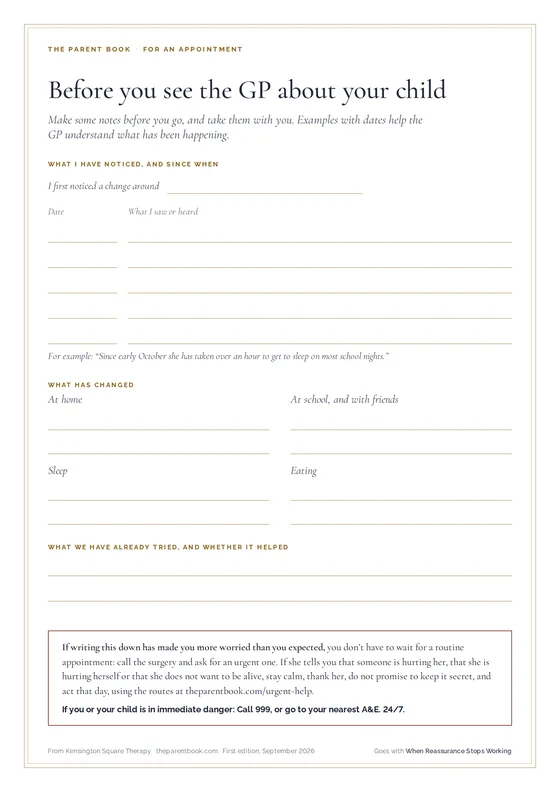 Before you see the GP about your child
For an appointment · A4, two sides · Free
Before you see the GP about your child
For an appointment · A4, two sides · Free
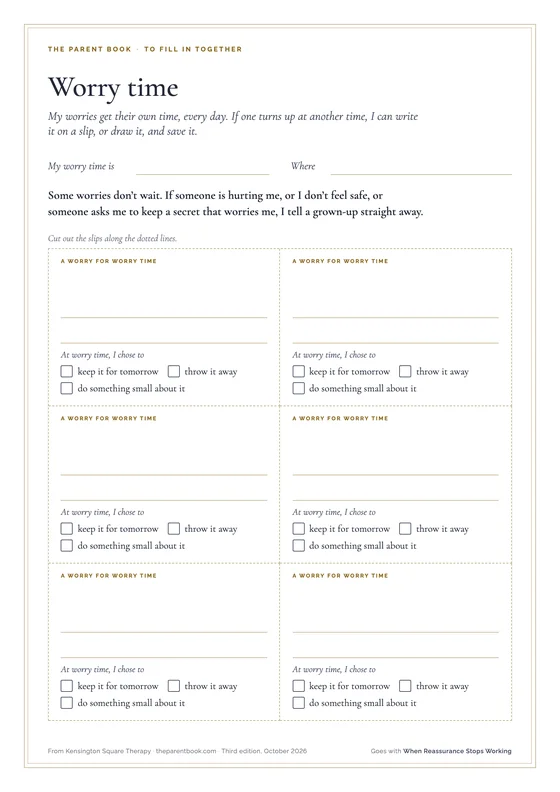 Worry time
To fill in together · A4, two pages · With a subscription
Worry time
To fill in together · A4, two pages · With a subscription
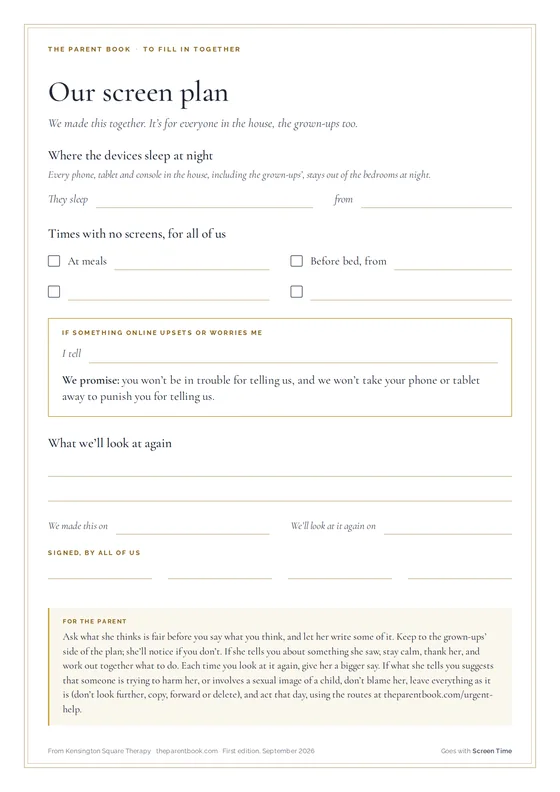 Our screen plan
To fill in together · A4 · With a subscription
Our screen plan
To fill in together · A4 · With a subscription
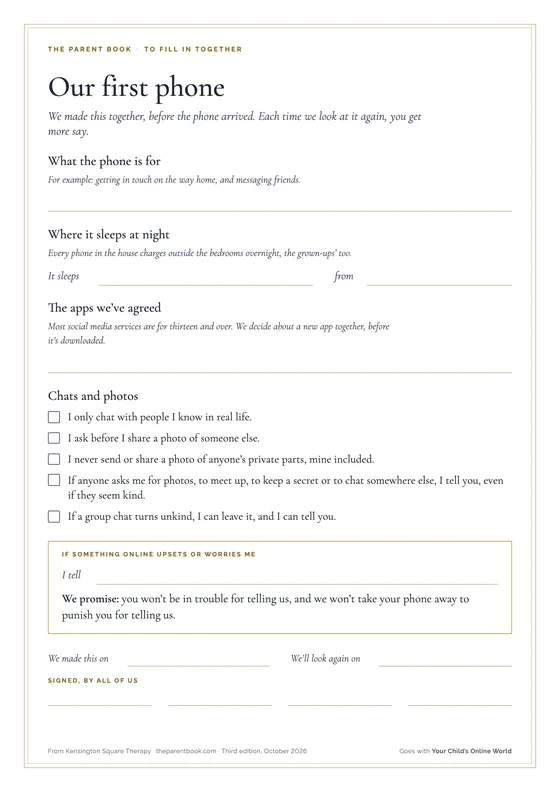 Our first phone
To fill in together · A4, two sides · With a subscription
Our first phone
To fill in together · A4, two sides · With a subscription
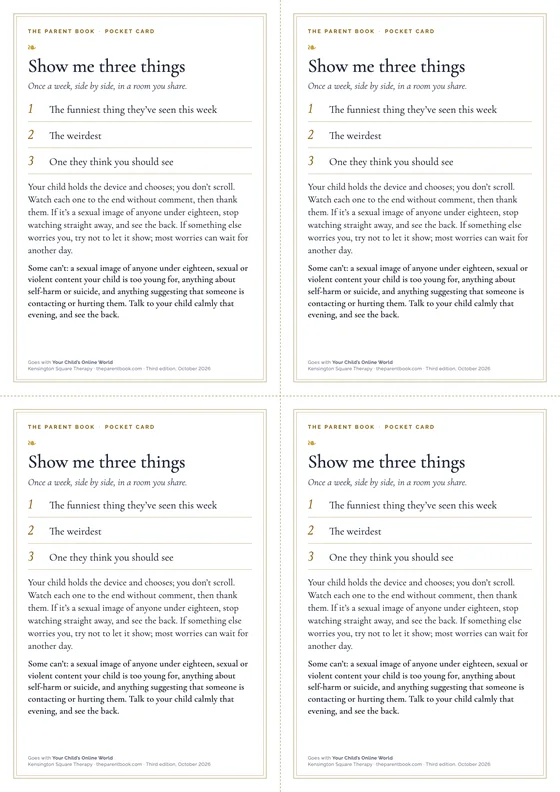 Their online world
Pocket card · A4, four cards to cut, two sides · With a subscription
Their online world
Pocket card · A4, four cards to cut, two sides · With a subscription
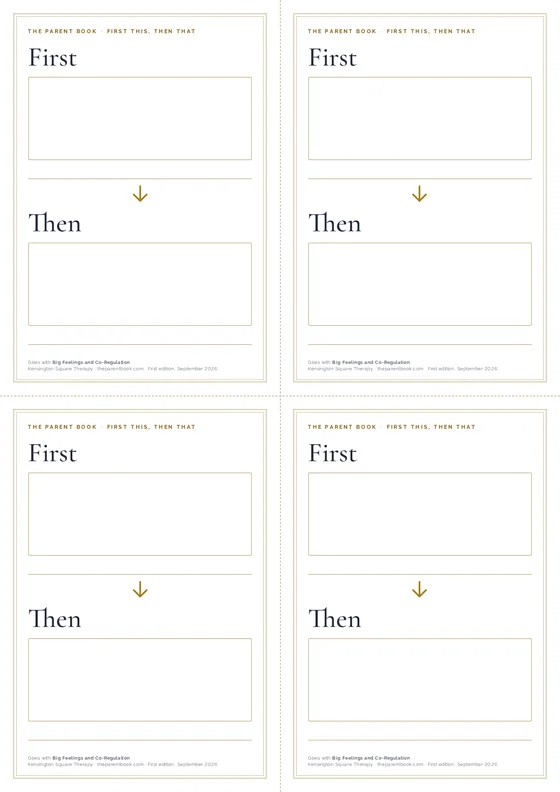 First this, then that
Cards to cut out · A4, four cards to cut, two sides · With a subscription
First this, then that
Cards to cut out · A4, four cards to cut, two sides · With a subscription
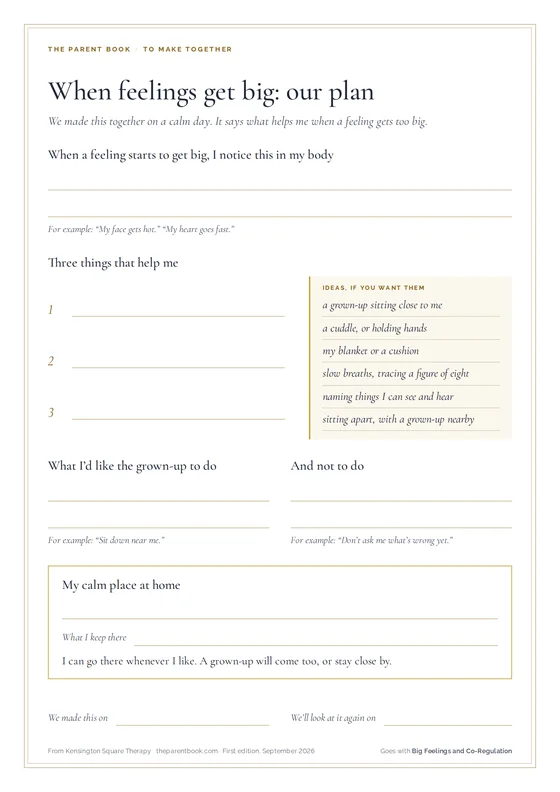 When feelings get big: our plan
To make together · A4, two sides · With a subscription
When feelings get big: our plan
To make together · A4, two sides · With a subscription
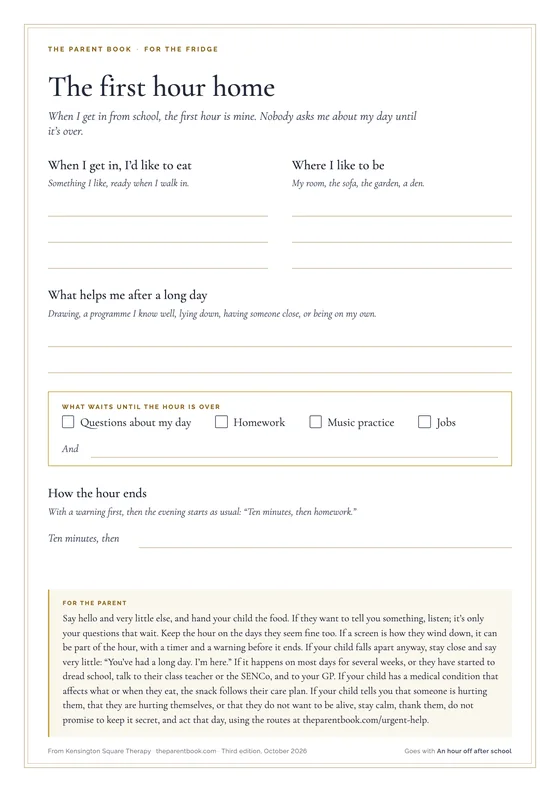 The first hour home
For the fridge · A4 · With a subscription
The first hour home
For the fridge · A4 · With a subscription
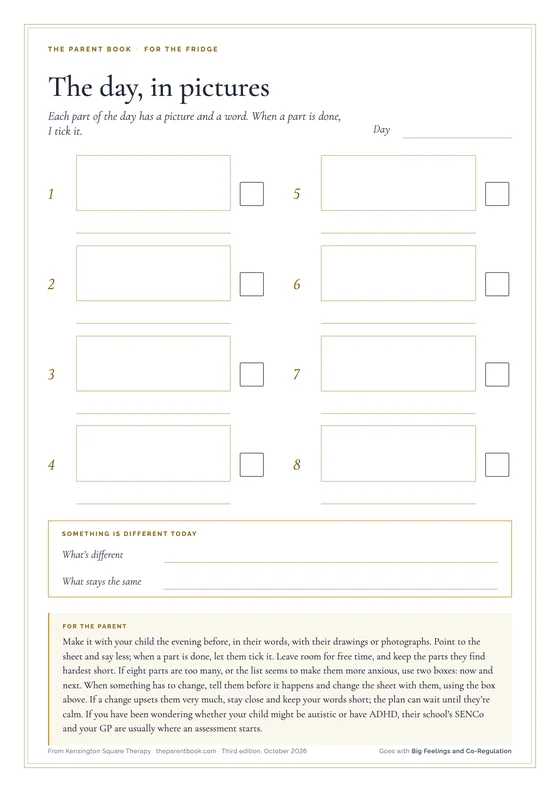 The day, in pictures
For the fridge · A4 · With a subscription
The day, in pictures
For the fridge · A4 · With a subscription
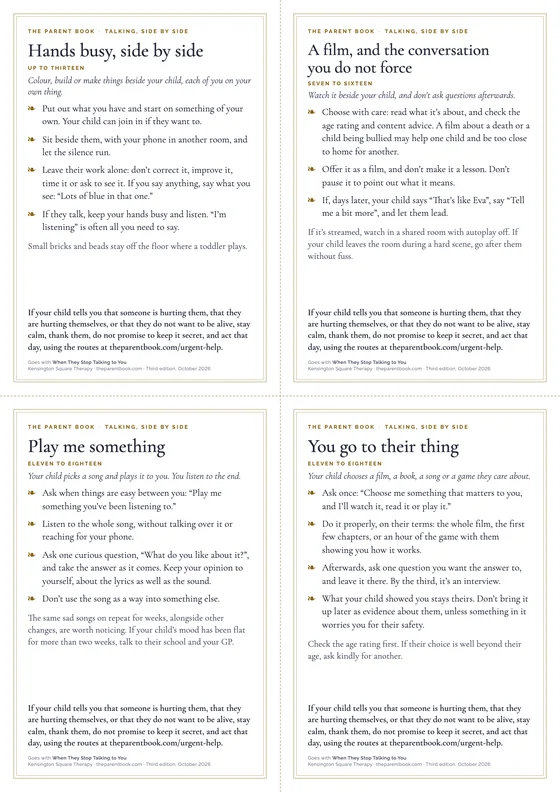 Talking, side by side
Cards to cut out · A4, four cards to cut · With a subscription
Talking, side by side
Cards to cut out · A4, four cards to cut · With a subscription
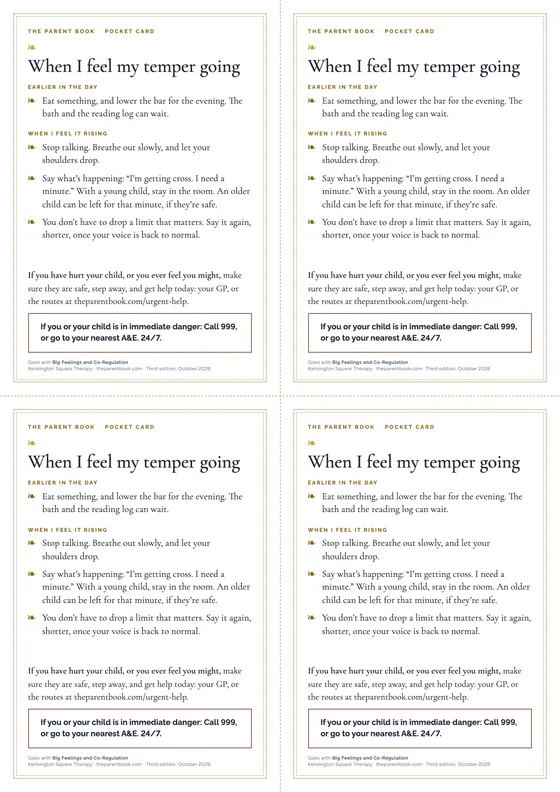 Putting it right
Pocket card · A4, four cards to cut, two sides · With a subscription
Putting it right
Pocket card · A4, four cards to cut, two sides · With a subscription
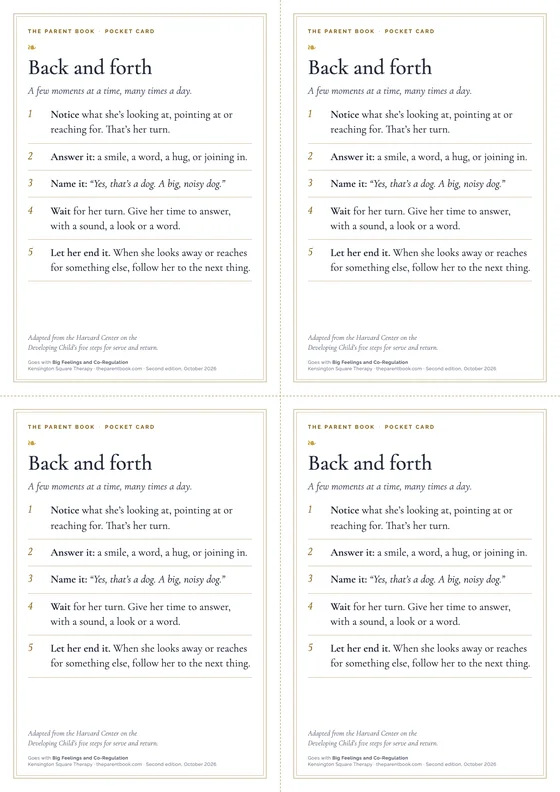 Back and forth
Pocket card · A4, four cards to cut, two sides · With a subscription
Back and forth
Pocket card · A4, four cards to cut, two sides · With a subscription
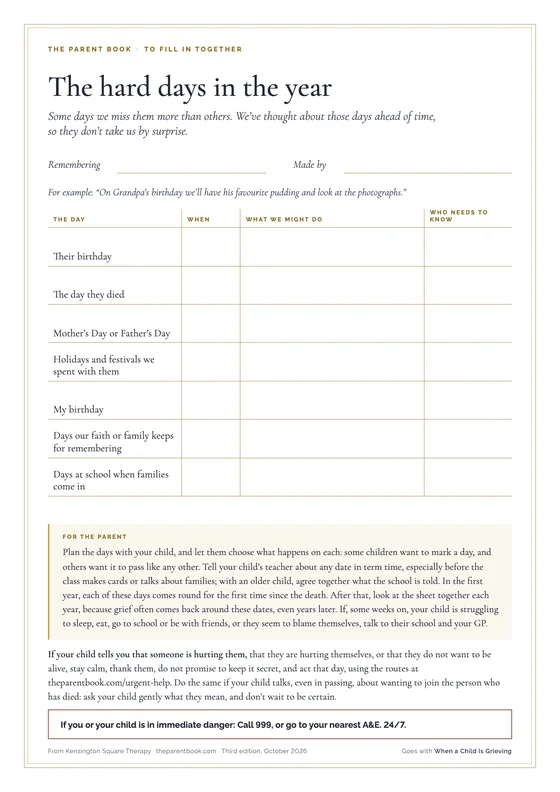 The hard days in the year
To fill in together · A4 · With a subscription
The hard days in the year
To fill in together · A4 · With a subscription
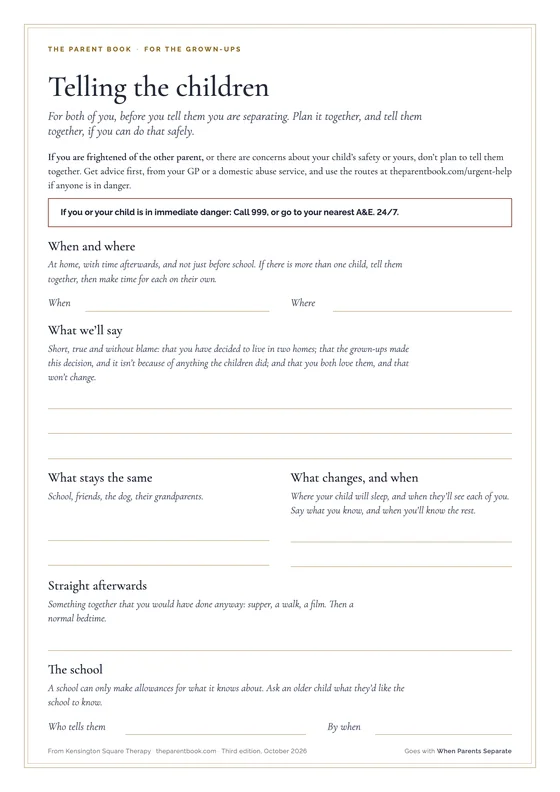 Telling the children
For the grown-ups · A4, two sides · With a subscription
Telling the children
For the grown-ups · A4, two sides · With a subscription
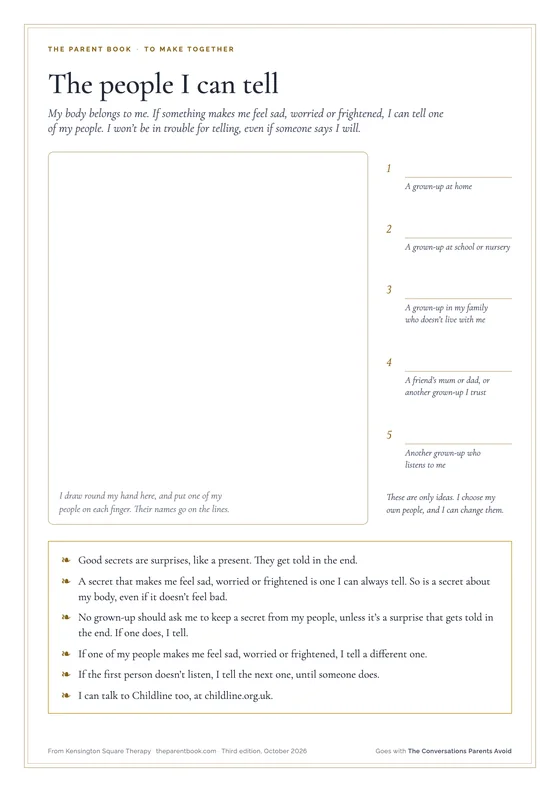 The people I can tell
To make together · A4, two pages · Free
The people I can tell
To make together · A4, two pages · Free
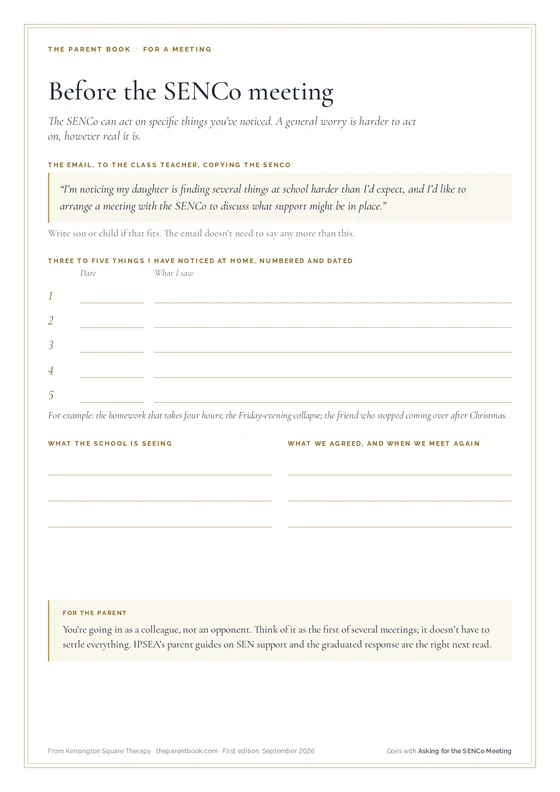 Before the SENCo meeting
For a meeting · A4 · Free
Before the SENCo meeting
For a meeting · A4 · Free
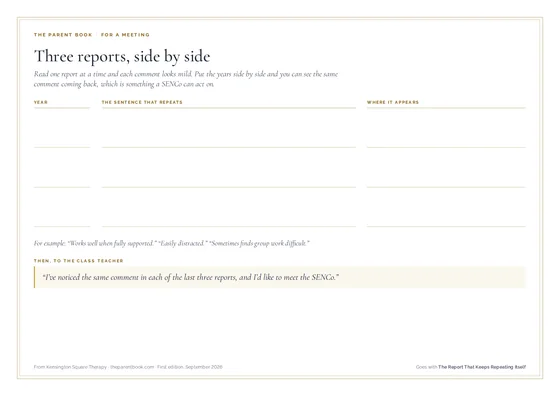 Three reports, side by side
For a meeting · A4 landscape · Free
Three reports, side by side
For a meeting · A4 landscape · Free
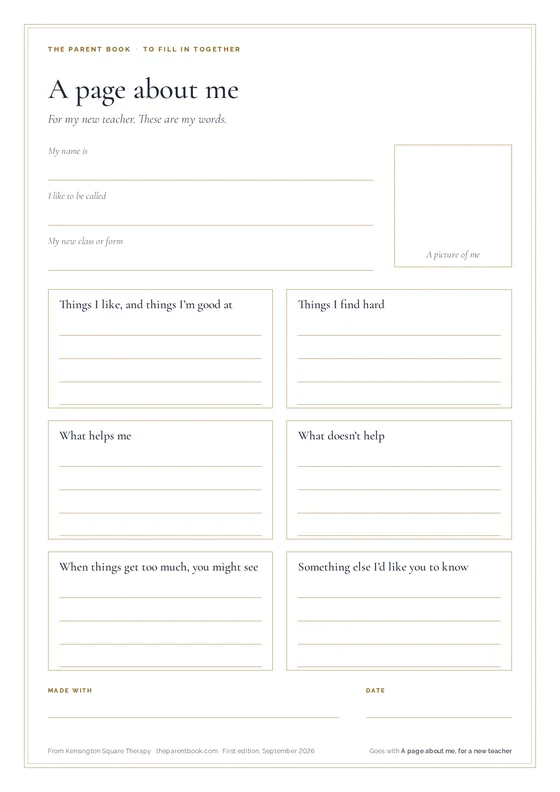 A page about me
To fill in together · A4, two pages · With a subscription
A page about me
To fill in together · A4, two pages · With a subscription
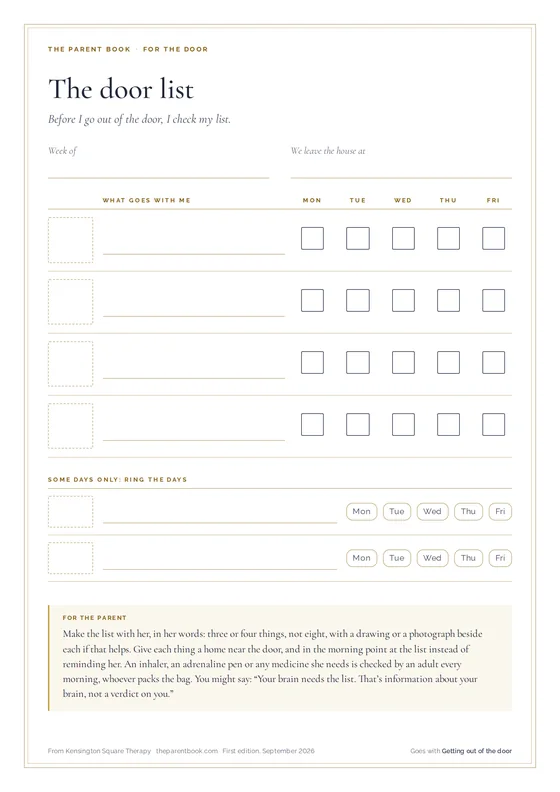 The door list
For the door · A4 · With a subscription
The door list
For the door · A4 · With a subscription
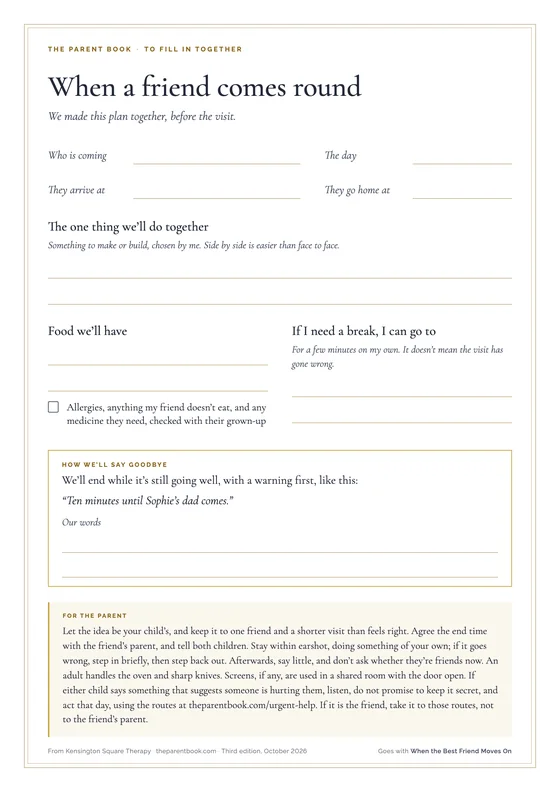 When a friend comes round
To fill in together · A4 · With a subscription
When a friend comes round
To fill in together · A4 · With a subscription
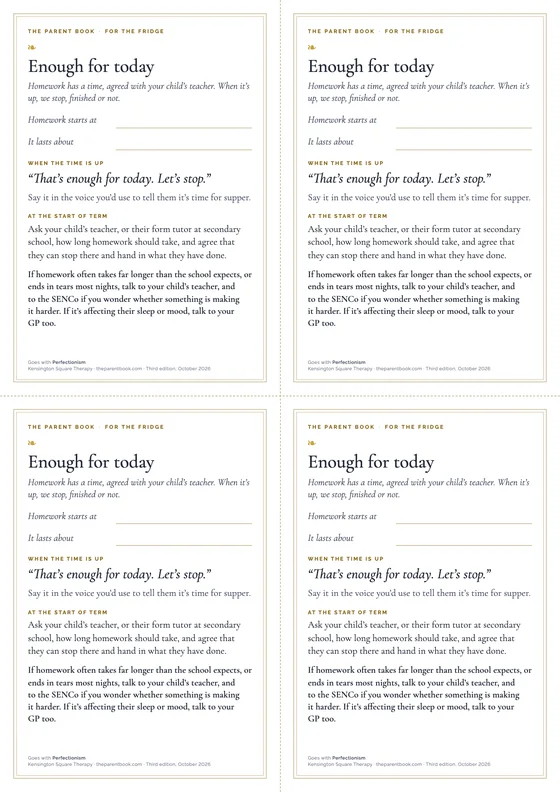 Enough for today
For the fridge · A4, four cards to cut · With a subscription
Enough for today
For the fridge · A4, four cards to cut · With a subscription
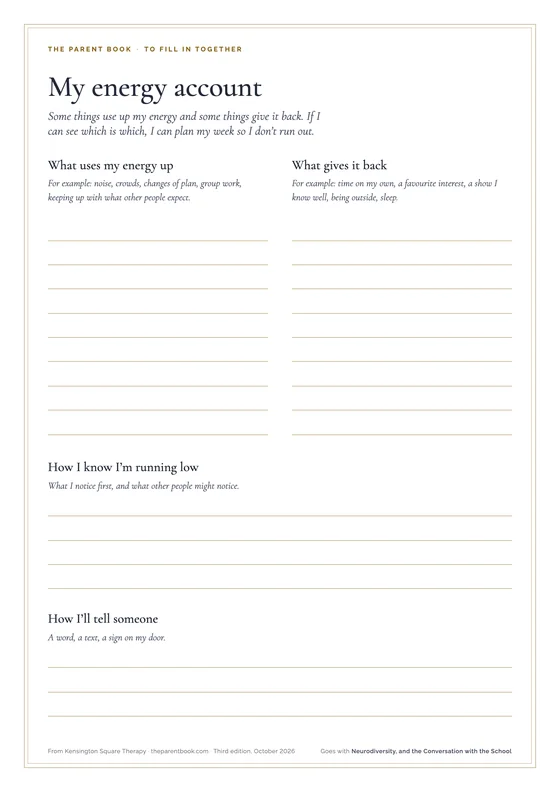 My energy account
To fill in together · A4, two sides · With a subscription
My energy account
To fill in together · A4, two sides · With a subscription
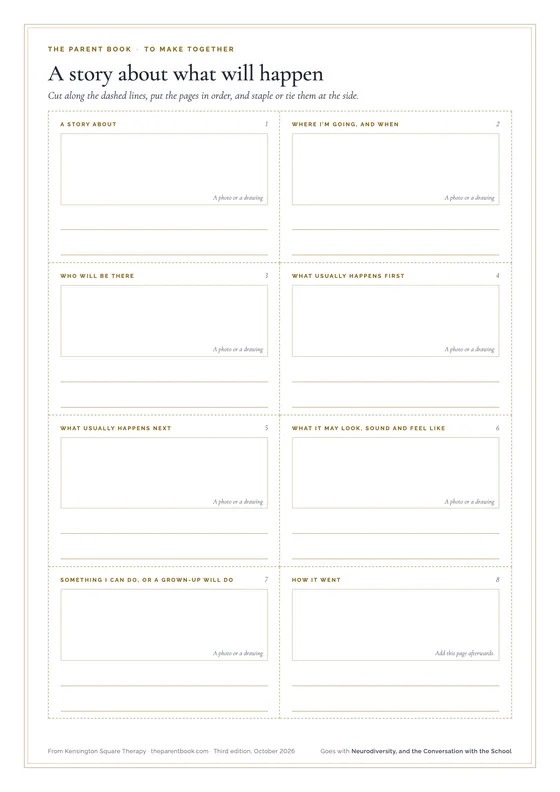 A story about what will happen
To make together · A4, two pages · With a subscription
A story about what will happen
To make together · A4, two pages · With a subscription
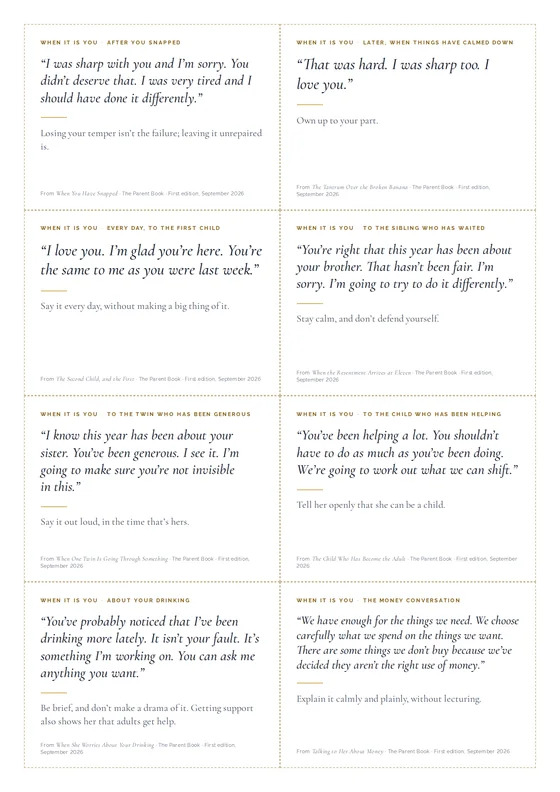 What to say: when it is you
Cards to cut out · A4, eight cards to cut · With a subscription
What to say: when it is you
Cards to cut out · A4, eight cards to cut · With a subscription
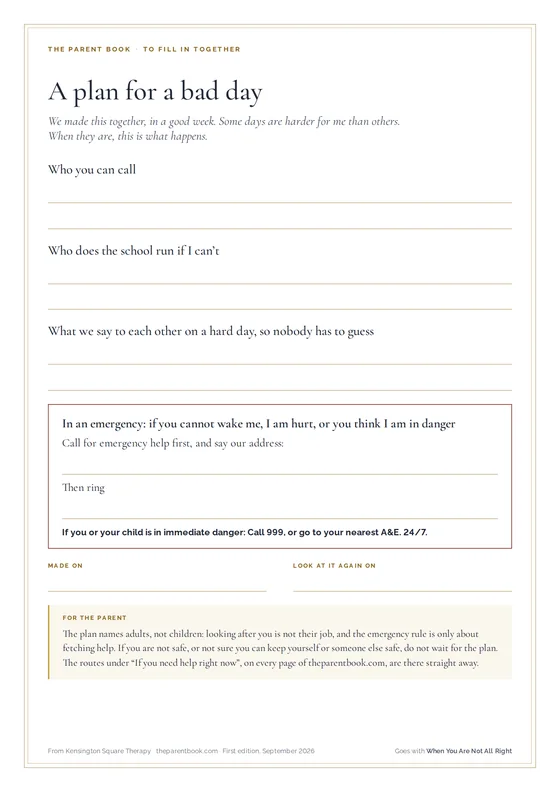 A plan for a bad day
To fill in together · A4 · Free
A plan for a bad day
To fill in together · A4 · Free
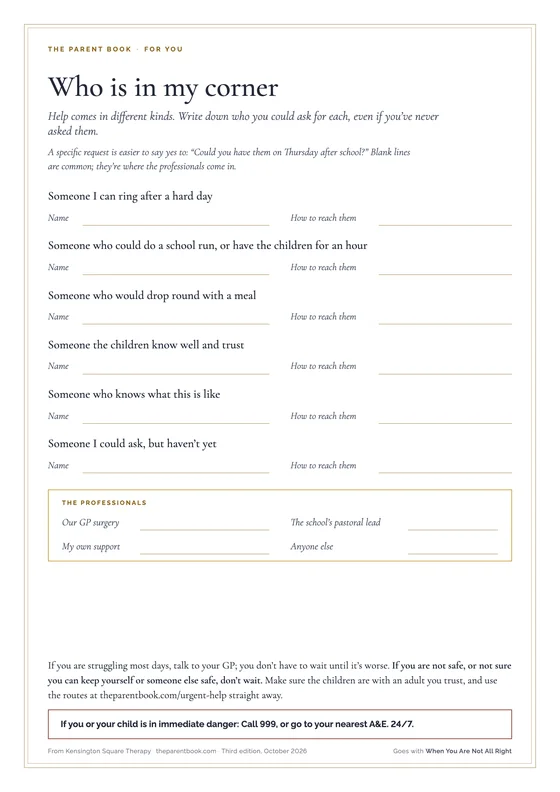 Who is in my corner
For you · A4 · With a subscription
Who is in my corner
For you · A4 · With a subscription
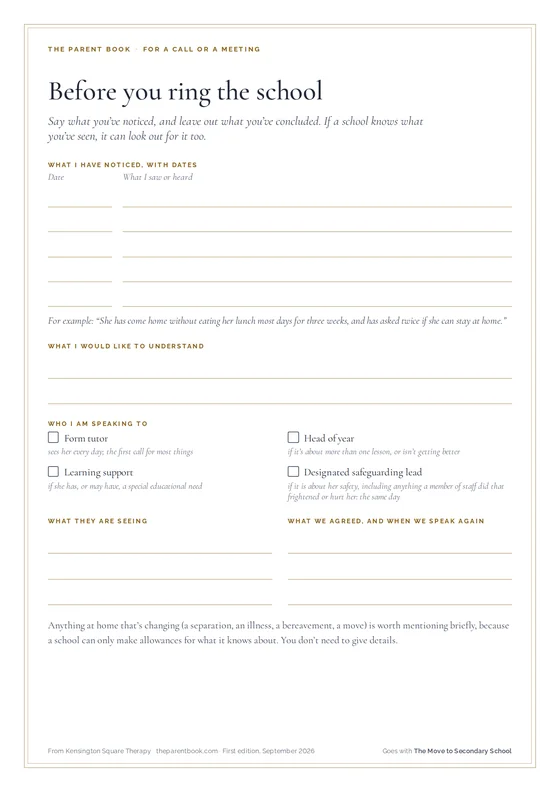 Before you ring the school
For a call or a meeting · A4 · Free
Before you ring the school
For a call or a meeting · A4 · Free
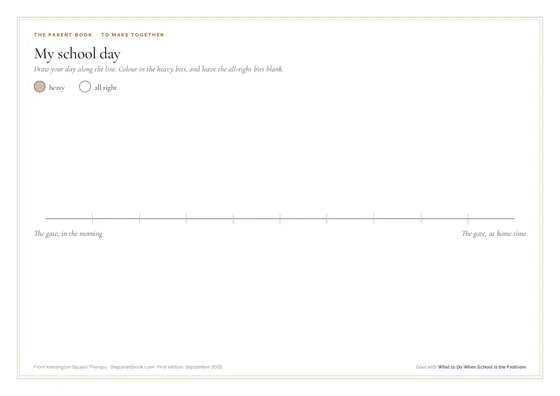 The school day, drawn as a line
To make together · A4 landscape, two pages · With a subscription
The school day, drawn as a line
To make together · A4 landscape, two pages · With a subscription
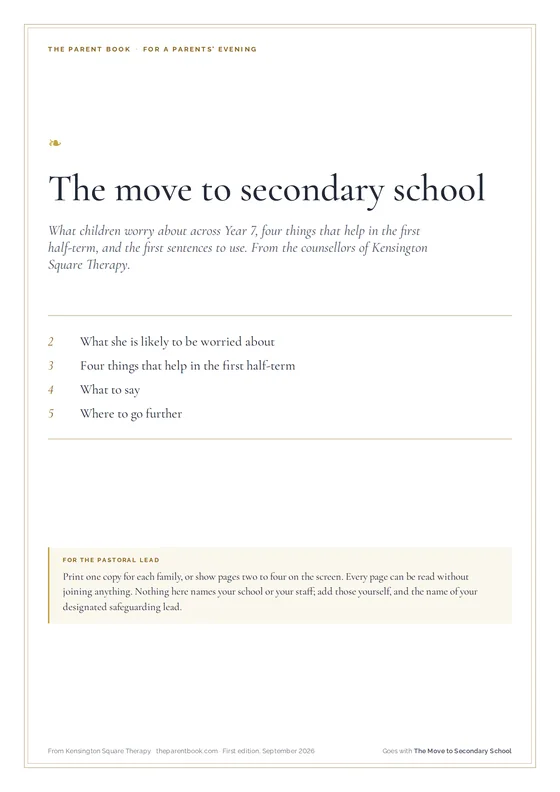 The move to secondary school, for a parents’ evening
For a parents’ evening · A4, five pages · Free
The move to secondary school, for a parents’ evening
For a parents’ evening · A4, five pages · Free
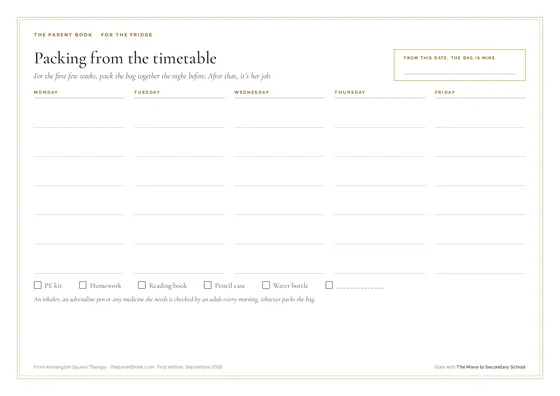 Packing from the timetable
For the fridge · A4 landscape · With a subscription
Packing from the timetable
For the fridge · A4 landscape · With a subscription
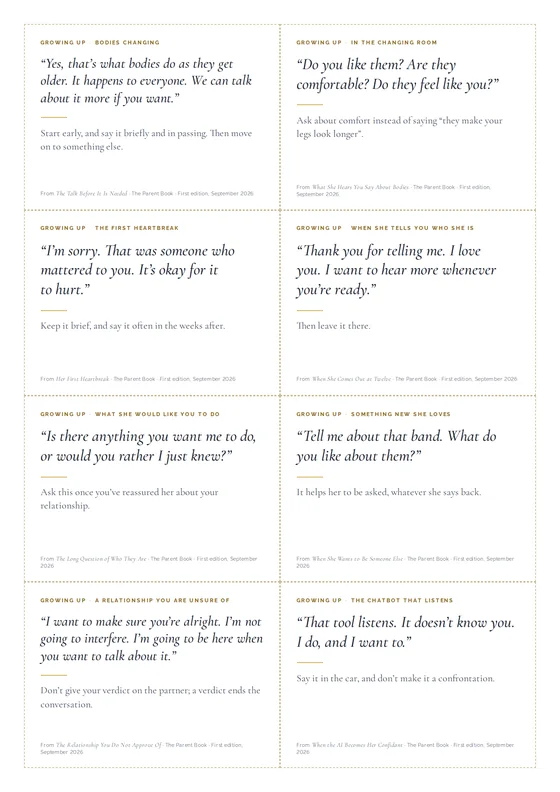 What to say: growing up
Cards to cut out · A4, eight cards to cut · With a subscription
What to say: growing up
Cards to cut out · A4, eight cards to cut · With a subscription
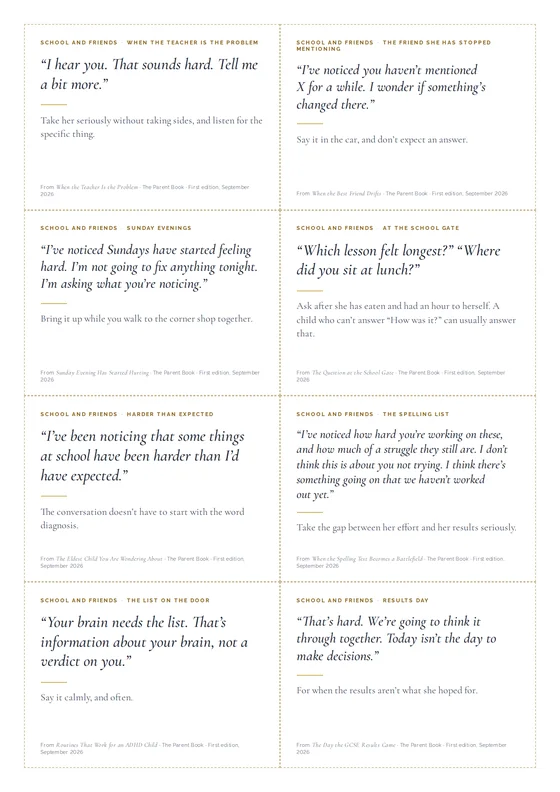 What to say: school and friends
Cards to cut out · A4, eight cards to cut · Free
What to say: school and friends
Cards to cut out · A4, eight cards to cut · Free
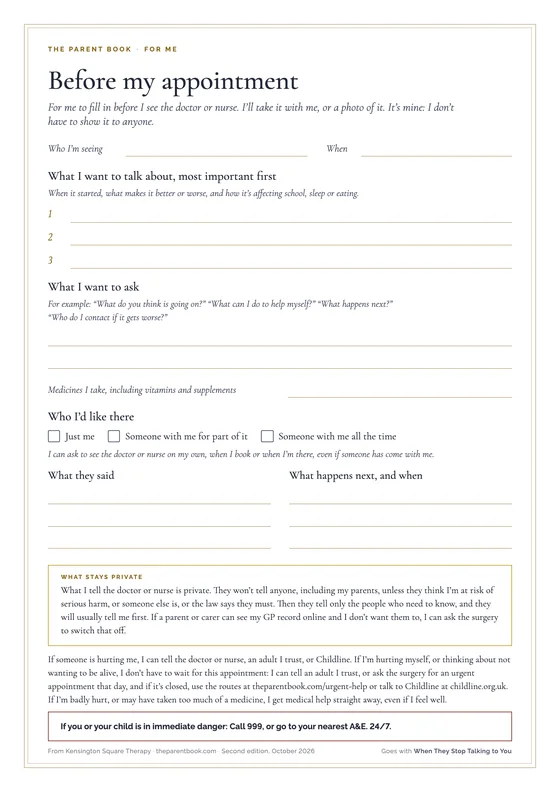 Before my appointment
For an appointment · A4, two pages · With a subscription
Before my appointment
For an appointment · A4, two pages · With a subscription
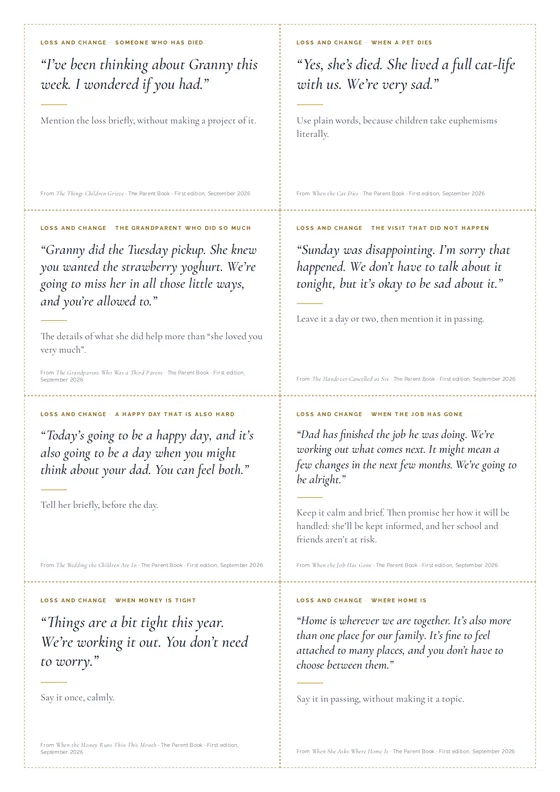 What to say: loss and change
Cards to cut out · A4, eight cards to cut · With a subscription
What to say: loss and change
Cards to cut out · A4, eight cards to cut · With a subscription
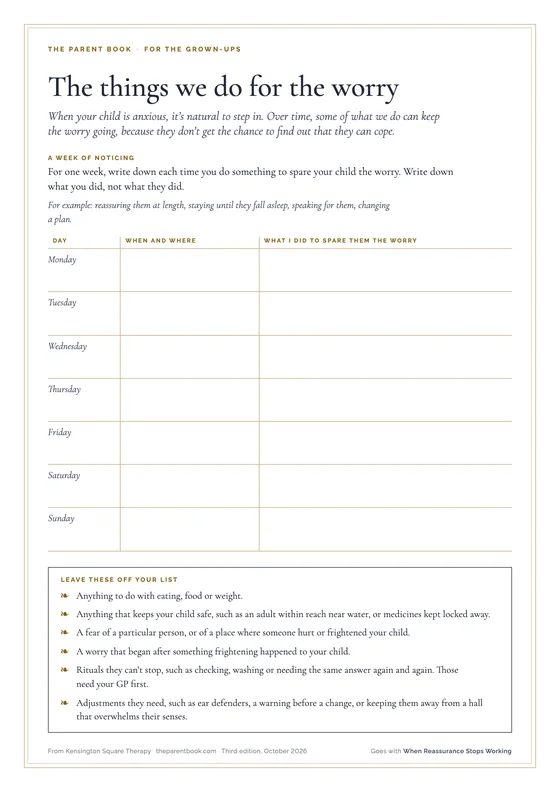 The things we do for the worry
For the grown-ups · A4, two sides · With a subscription
The things we do for the worry
For the grown-ups · A4, two sides · With a subscription
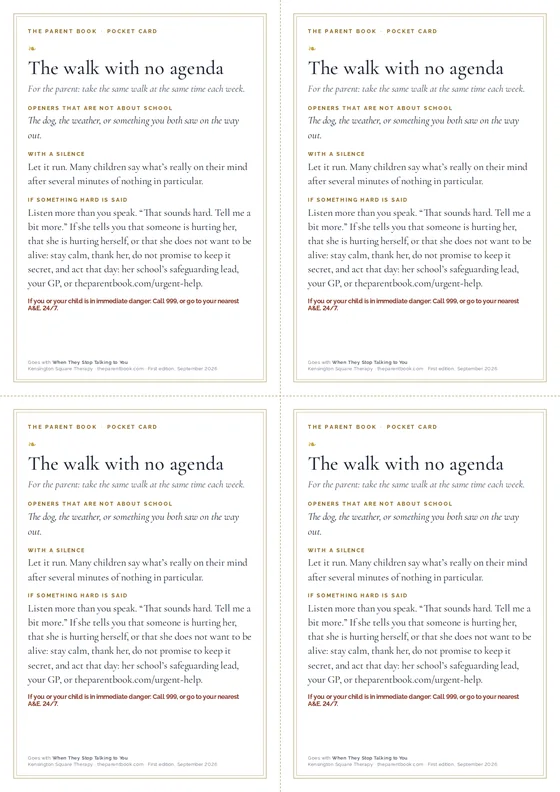 The walk with no agenda
Pocket card · A4, four cards to cut · With a subscription
The walk with no agenda
Pocket card · A4, four cards to cut · With a subscription
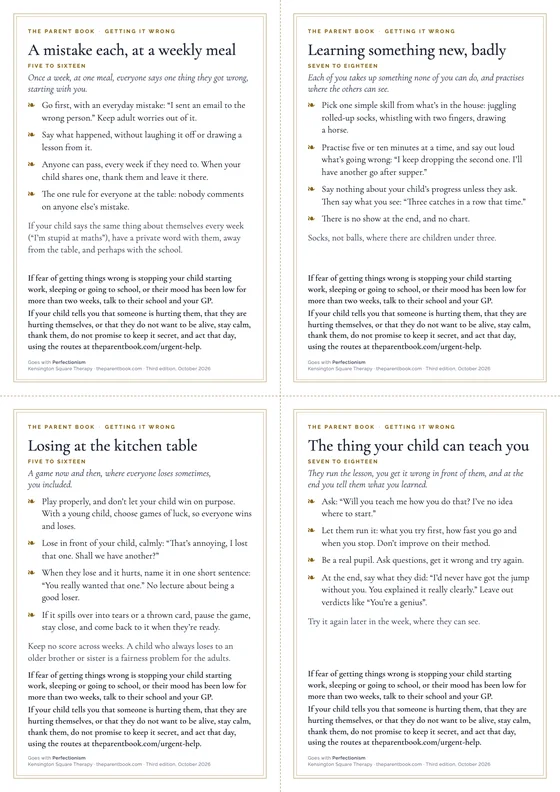 Getting it wrong
Cards to cut out · A4, four cards to cut · With a subscription
Getting it wrong
Cards to cut out · A4, four cards to cut · With a subscription
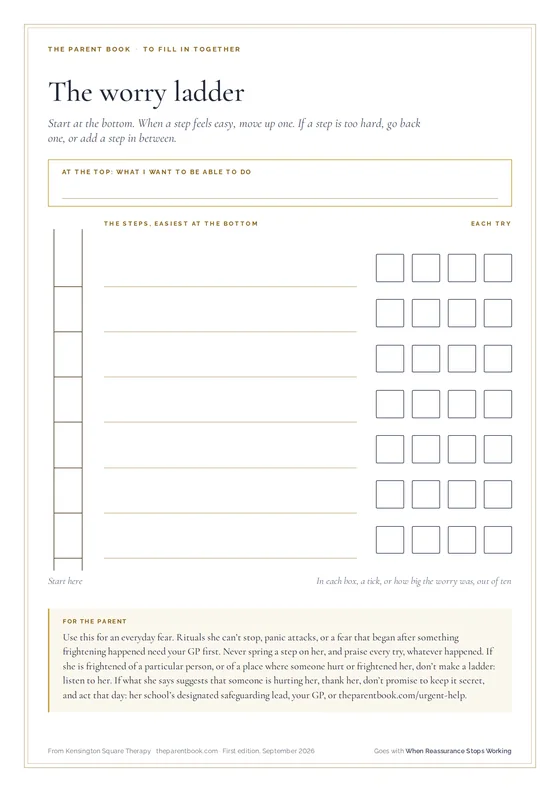 The worry ladder
To fill in together · A4 · Free
The worry ladder
To fill in together · A4 · Free
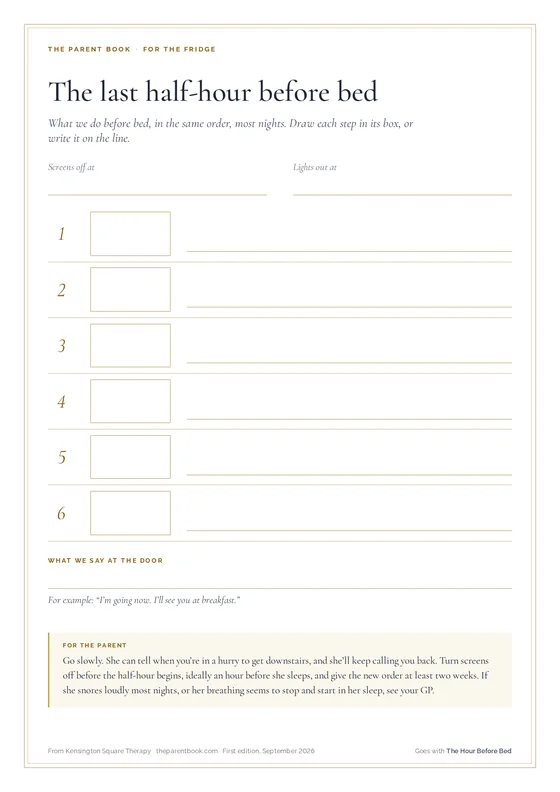 The last half-hour before bed
For the fridge · A4 · Free
The last half-hour before bed
For the fridge · A4 · Free
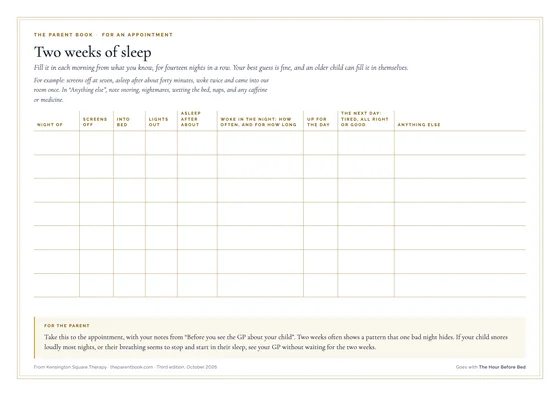 Two weeks of sleep
For an appointment · A4 landscape, two pages · With a subscription
Two weeks of sleep
For an appointment · A4 landscape, two pages · With a subscription
36 on parenting strategy
Chosen by the therapists who write the library: books for you and to read with your child, and pages from organisations we trust.
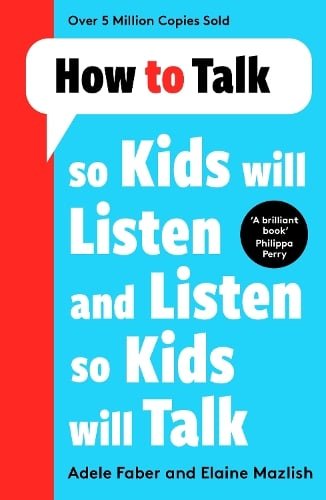
Also on this shelf

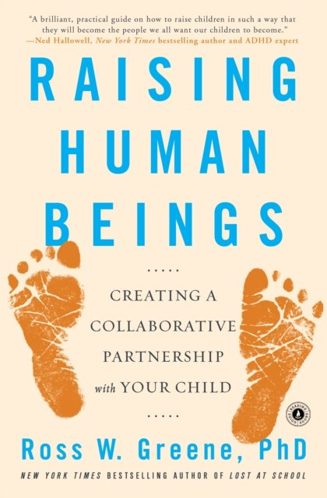
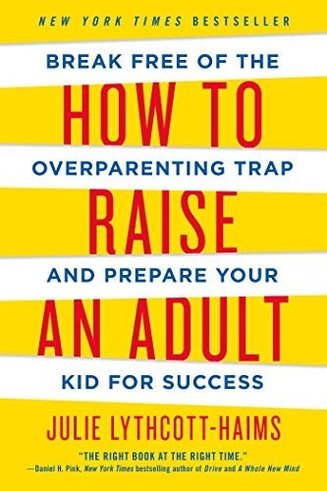
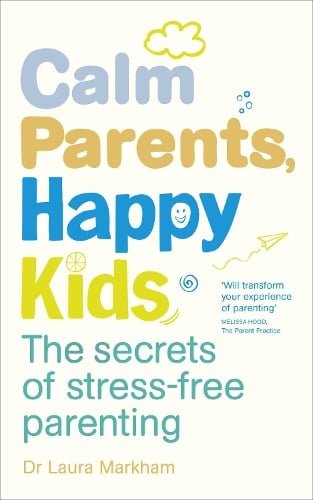
And 23 more. Every book on the shelf, with a therapist’s note on what it is good for, is in the library.
Place2Be
How specific, warm praise and small rewards shape behaviour better than criticism, why it can feel hard to do consistently, and simple activities to build the habit.
Place2Be
Why children feel safer with clear, calm limits, and how to set consequences that are fair, proportionate and followed through without shouting.
Place2Be
A plain introduction to attachment for parents: what a secure relationship is, why it matters for a child’s confidence, and everyday things that build it.
NHS
The NHS basics for toddler and preschool behaviour: be consistent, stay calm, praise the good, avoid smacking, and know when to ask a health visitor for more help.
NSPCC
How to open conversations about divorce, illness, death, drugs, sex and online risks, using books, TV storylines and many small talks rather than one big one.
The Sleep Charity
A calm, practical guide to building a bedtime routine, including a sample evening programme from bath to lights out and a downloadable advice sheet.
NHS
Ten plain rules for talking with a teenager: do not judge, do not assume you know what is wrong, pick your battles, and ask questions that invite more than a shrug.
Child Mind Institute
Ten clear principles, starting with the counterintuitive one: the goal is not to remove a child’s anxiety but to help them manage it, because avoidance makes fear grow.
Nothing on this shelf is written for that age yet.
22 on parenting strategy
Podcast episodes, talks and films, each chosen for a reason.
Get a Grip - Evidence-Based Conversations for Parents and Educators
Clinical psychologist Tara Porter, drawing on more than thirty years of practice, explores what ‘good enough’ parenting means amid modern pressure and parenting ideals, from her book Good Enough.
Also on this shelf
NPR Life Kit
Dr Lisa Damour and Reena Ninan
Feel Better, Live More with Dr Rangan Chatterjee
Dr Kathy Weston, Dr Cassie Rhodes (Tooled Up Education)
And eight more. Every episode on the shelf, with a therapist’s note on what it is good for, is in the library.
YouTube · 2 min
Child Mind Institute, YouTube
Nine brief tips for the pre-teen years, from staying curious about their friendships to giving more independence while keeping clear boundaries.
Also on this shelf
TED · 14 min
Julie Lythcott-Haims, TED
YouTube · 7 min
Philippa Perry, YouTube
TED · 14 min
Dr Becky Kennedy, TED
YouTube
Place2Be, YouTube
And four more. Every film on the shelf, with a therapist’s note on what it is good for, is in the library.
Nothing on this shelf is written for that age yet.
This usually starts at school rather than at the surgery. The adults who see your child every day are the first people to tell, and often the fastest route to a change. The GP is there if it persists or deepens.
Where to start
The pastoral lead, the head of year, or the form tutor. Free, already knows your child, and often the quickest way to get something changed at school.
Before or alongside anything else. A school cannot act on what it has not been told, and what you bring is often what it did not have.
The gateway to everything the NHS offers a child: paediatric assessment, a referral to CAMHS, and support for you as the parent.
Ask for a double appointment. Describe the pattern over weeks rather than the worst single day, and say plainly what you are worried about. Bring a written list; the ten minutes go quickly.
A registered counsellor or psychotherapist, found through the BACP or NCPS directories. Waiting lists are shorter than the NHS and you choose who your child sits with.
When waiting is the problem, or when you want a particular kind of help. What to look for, and what to expect, is set out in our guide to finding a therapist.
For parenting strategy
A free one-to-one webchat with a trained parenting coach, and a library of articles by age on behaviour, sleep, neurodiversity and family life.
When you want to talk it through with someone in writing, this week, without a referral.
Free one-to-one webchat with a parenting coach, Mon-Fri, with evening slots on Mon and Thu; check the site for current times · Parent Talk+ by phone or video for parents of children with additional needs, up to eight free sessions
A free, confidential helpline for any parenting or family worry, by phone, live chat, WhatsApp or email, staffed by trained family support workers.
When you need to talk it through with someone, about your child or about how you are managing, and you do not need a specialist to do it.
Coram Family Lives helpline 0808 800 2222 · Mon-Fri 9am-9pm; weekends 10am-3pm; closed bank holidays · Live chat and WhatsApp 07441 444125 at the same hours; email askus@coramfamilylives.org.uk · Outside those hours the line is closed. Samaritans answer at any hour on 116 123, and Shout answer if you text the word SHOUT to 85258.
www.coramfamilylives.org.uk/how-we-can-help/confidential-helpline
Parenting Smart, written by the child mental health specialists who work in primary schools: short, practical articles and films on friendships, behaviour, worries and routines.
For a child of five to eleven, when you want something you can read in ten minutes and try tonight. Place2Be’s counselling itself is only through partner schools.
Trained volunteers who visit families with young children at home, week by week, and local groups. You can refer yourself.
When the early years are harder than anyone told you and what you need is another adult in the house. What is offered varies by area.
The local branch is the right first call, and can tell you how long the wait is.
Every organisation for parenting strategy, and when each is the right call Finding a therapist