
The chapter to start with
The Child Who Saves It All for Home
A chapter for parents whose child is fine at school and furious at home.
21 min read · Under 18
Read the chapter Your first chapter is free to read in full.
↑ ↓ to moveEnter to openEsc to close
Family life and behaviour

Behaviour is the visible part of what’s going on inside a child: the hitting, the tantrums, the shoes thrown at the wall after school, the child who has stopped doing what they’re asked. We read it as communication, a four-year-old’s body saying what their words can’t yet, and these pages are for the parent trying to work out what lies behind it.
What to do first and who else can help are free to read and to print. So is the first chapter you open.
What the library holds on behaviour
From the therapists
Behaviour is communication before it’s defiance. A child who has come undone has run out of the capacity to cope, not out of manners.
2 on behaviour
The long reads, each on one situation, written by a therapist.
The chapter to start with
A chapter for parents whose child is fine at school and furious at home.
21 min read · Under 18
Read the chapter Your first chapter is free to read in full.
Nothing on this shelf is written for that age yet.
16 on behaviour
Short pieces for the moment in front of you, each with things to try.
Big feelings
In the middle of it your child can’t listen, so the next ten minutes are for getting them safe and calm, and the talking comes later.
Try this
From the tip
If they’re getting more frequent or worse, or your child hurts themselves or someone else, talk to your health visitor or GP, and take the notes with you.
Family dynamics
At fifteen, most of what you know about your teenager’s life is what they choose to tell you, so keep a few rules and let the rest go.
Try this
From the tip
Research on teenagers has found that most of what parents know about their child’s life comes from what the child chooses to tell them, and that teenagers tell more when home feels warm. So when your teenager tells you something you don’t like, keep your first reply short and even. Any consequence can wait until tomorrow, when you are both calm; only something that puts them in danger needs acting on tonight. In a row, say you will talk later and leave the room. Don’t threaten anything you won’t do.
Violence is different. If your teenager hits, pushes or threatens you or anyone else at home, you don’t have to put up with it. Don’t use force yourself. Leave the room, and if that doesn’t make everyone safe, don’t wait. Call 999. Help is free and available at any hour. Many parents hold back for fear of getting their child into trouble; keeping everyone safe comes first. Talk to the school and your GP as well. A national parenting helpline takes calls about teenagers’ behaviour, including aggression at home. Coram Family Lives, 0808 800 2222. Mon-Fri 9am-9pm; weekends 10am-3pm; closed bank holidays. Outside those hours the line is closed. Samaritans answer at any hour on 116 123, and Shout answer if you text the word SHOUT to 85258. Help is free.
If your teenager’s behaviour has changed suddenly, ask yourself whether something is happening to them, such as bullying, low mood, or someone older grooming or exploiting them. If you suspect grooming or exploitation, act that day: a national child protection helpline will talk it through with you and tell you whether it needs to go further. NSPCC, 0808 800 5000. Email help@nspcc.org.uk. Mon-Fri 10am-4pm by phone; email 11am-4pm, seven days a week. An email sent when the service is closed is not received. If the NSPCC service is closed and the concern cannot wait, call the police on 101. You can also contact the child’s local out-of-hours children’s social care, social work or social services team. If a child is in immediate danger, call 999. Help is free.
Bodies & growing up
Most teenagers don’t vape, and most who have tried were given their first one, usually by a friend.
Try this
From the tip
The GP, a pharmacist or the school nurse can help; some nicotine replacement products are licensed from age 12 for young people dependent on vaping.
If your child is selling vapes, or someone older is giving them vapes, money or a phone, someone may be exploiting them, and exploited children are victims first. Don’t confront the people involved yourself. Act that day: a national child protection helpline will talk it through with you and tell you whether it needs to go further. NSPCC, 0808 800 5000. Email help@nspcc.org.uk. Mon-Fri 10am-4pm by phone; email 11am-4pm, seven days a week. An email sent when the service is closed is not received. If the NSPCC service is closed and the concern cannot wait, call the police on 101. You can also contact the child’s local out-of-hours children’s social care, social work or social services team. If a child is in immediate danger, call 999. Help is free.
A vape from a friend, social media or an unofficial seller may not contain what it claims: the government has warned that so-called THC vapes, sold as cannabis, often contain dangerous synthetic cannabinoids, known as spice.
If your child collapses, or is very drowsy or hard to wake, confused, struggling to breathe or having a fit after using a vape, call an ambulance first. Call 999. Help is free and available at any hour.
More quick tips on behaviour
Family dynamics
You and your child’s teacher are both seeing the real child, so the meeting goes best when you compare notes.
2 min read · Ages 5 to 16
Family dynamics
Being hurt by your own child is not a secret to keep, and there is help for both of you.
3 min read · Ages 9 to 18
Bodies & growing up
A child’s relationship with food is almost always about control.
2 min read · Under 11
Family dynamics
Stop it, go to the child who was hurt, and leave the talking until your child has calmed down.
2 min read · Ages 5 to 9
Friendships & social life
Hear the facts first, then be clear with your child that it stops and that they’ll help put it right.
2 min read · Ages 7 to 13
Bodies & growing up
Stop the hit first, then help your child find words for what they were feeling.
2 min read · Under 5
Big feelings
A child who is cross with everything may be low, and the clue is what they have stopped enjoying.
2 min read · Ages 9 to 16
Neurodiversity
By bath time your child has been processing sensory input for eleven hours, and a few changes at home help.
2 min read · Ages 5 to 11
Big feelings
A broken banana is more than a tired three-year-old can take.
2 min read · Under 9
Bodies & growing up
The risks are greatest with daily use of strong cannabis, so ask how often your teenager uses it, and why.
2 min read · Ages 13 to 18
Neurodiversity
An ADHD child needs a routine that’s more visual and more forgiving, with the prompts outside their head.
2 min read · Ages 5 to 11
Neurodiversity
Plan supermarket trips so you leave before the noise and lights become too much for your child.
2 min read · Ages 5 to 11
Bodies & growing up
Crying is how a two-year-old tells you what they can’t yet put into words.
2 min read · Under 5
The rest of each tip, with more to try and why it works, is in the library.
Nothing on this shelf is written for that age yet.
4 on behaviour
Small, repeatable things to do with your child, with what to watch for and when to get help.
To do together · About 20 min
When nobody is upset, pick one problem that keeps causing rows, hear your child’s side of it first, then say yours, and work out a plan you can both keep.
What it is for. A problem that keeps coming back, such as getting up for school or the phone at night, is usually one your child finds hard for a reason. Talking it through when nobody is upset, starting with their view, often finds a plan that holds better than a rule made in the middle of a row.
When to get help. If rows are getting more frequent or turning violent, or your child’s behaviour has changed suddenly, talk to their school and your GP. If what your child tells you about their side suggests that someone is hurting, frightening or pressuring them, stay calm, thank them for telling you, don’t promise to keep it secret, and act that day, using the routes under “If you need help right now”, at the foot of every page. If your child goes missing, if they or anyone at home is in danger, or if your child talks about hurting themselves or not wanting to be alive, act straight away, using the same routes.
The other four steps, and your part in it, are in the library.
More to do together
To do together
A card with two pictures, the thing to do first and the thing that comes next, for a young child who finds it hard to stop one thing and start another.
About 15 min · Under 9 · With a sheet to print
To do together
Ten minutes most days when your child chooses what you play and you follow their lead. You don’t teach, correct or ask questions, and they never have to earn it.
About 10 min · Under 11 · With a sheet to print
To do together
A comfortable corner, chosen with your child, for when a feeling gets too big. While they are small you go there together, and nobody is ever sent there.
About 20 min · Under 9
Nothing on this shelf is written for that age yet.
16 on behaviour
Made to be printed, kept, and handed on.
To print and keep
What to do first, a few things to try and who else can help, together in one guide. Free to print and keep, or to hand to the other parent, a grandparent or the school.
Who else can help with behaviour, on a sheet of its own.
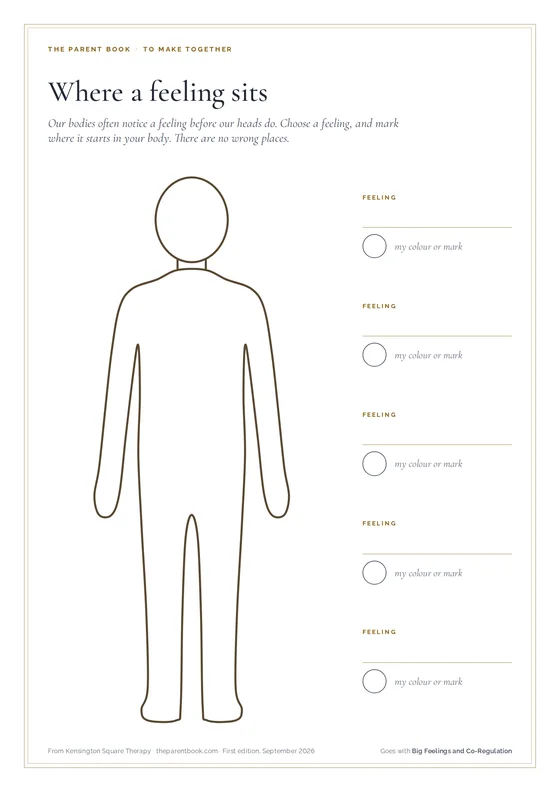 Where a feeling sits
To make together · A4, two sides · With a subscription
Where a feeling sits
To make together · A4, two sides · With a subscription
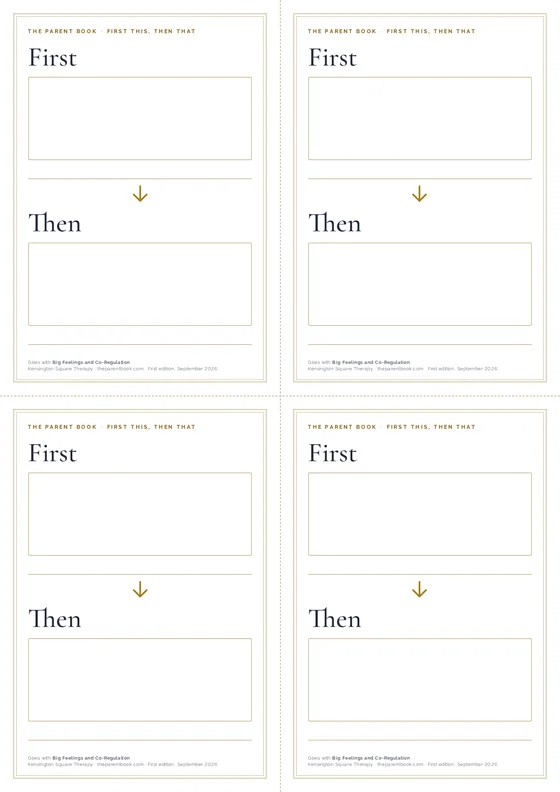 First this, then that
Cards to cut out · A4, four cards to cut, two sides · With a subscription
First this, then that
Cards to cut out · A4, four cards to cut, two sides · With a subscription
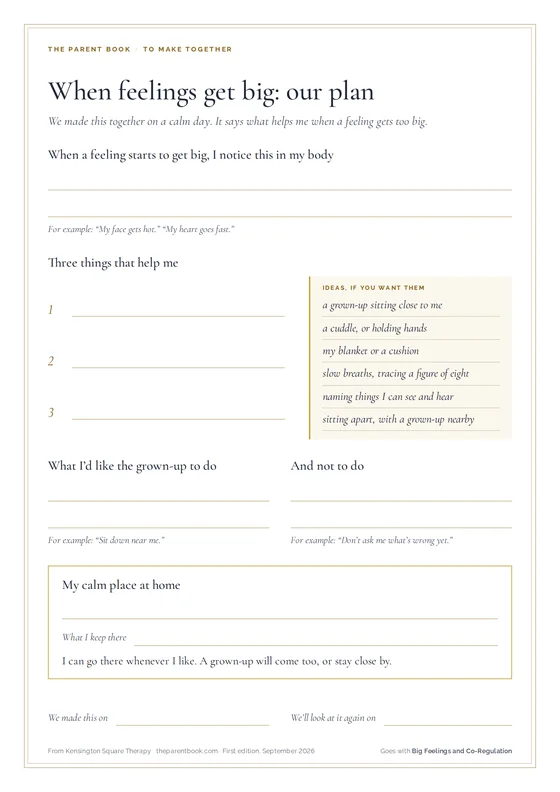 When feelings get big: our plan
To make together · A4, two sides · With a subscription
When feelings get big: our plan
To make together · A4, two sides · With a subscription
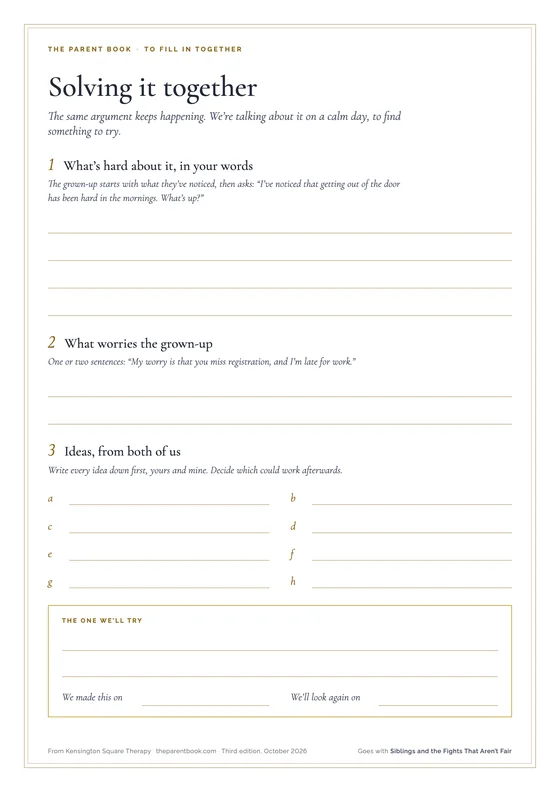 Solving it together
To fill in together · A4, two sides · With a subscription
Solving it together
To fill in together · A4, two sides · With a subscription
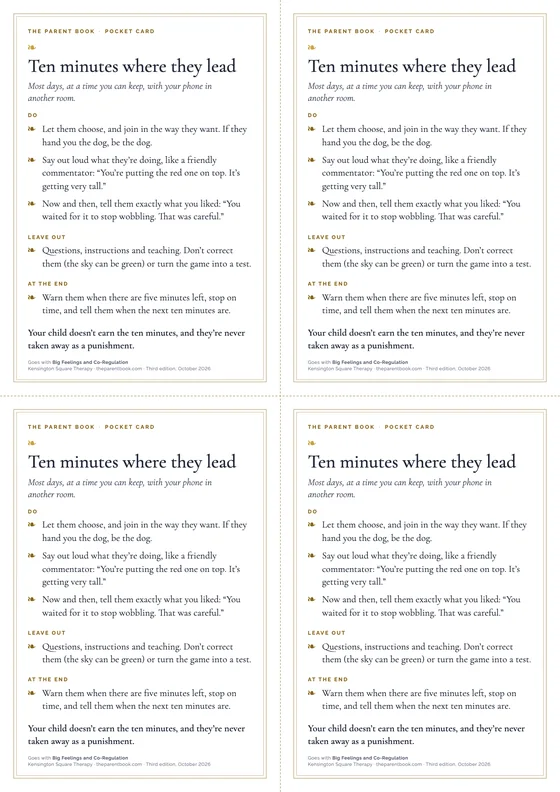 Ten minutes where they lead
Pocket card · A4, four cards to cut, two sides · With a subscription
Ten minutes where they lead
Pocket card · A4, four cards to cut, two sides · With a subscription
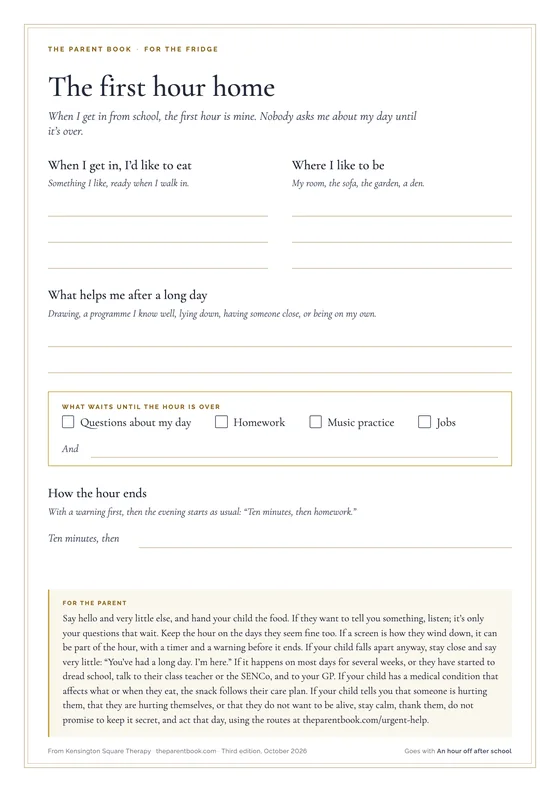 The first hour home
For the fridge · A4 · With a subscription
The first hour home
For the fridge · A4 · With a subscription
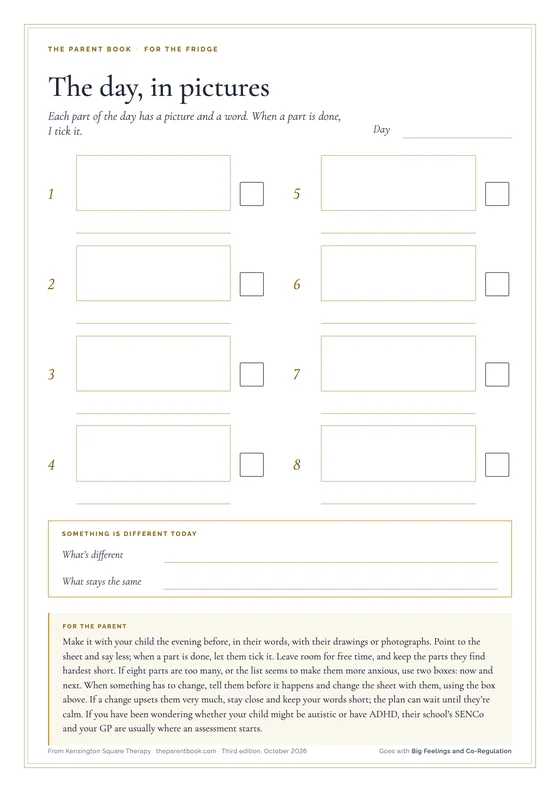 The day, in pictures
For the fridge · A4 · With a subscription
The day, in pictures
For the fridge · A4 · With a subscription
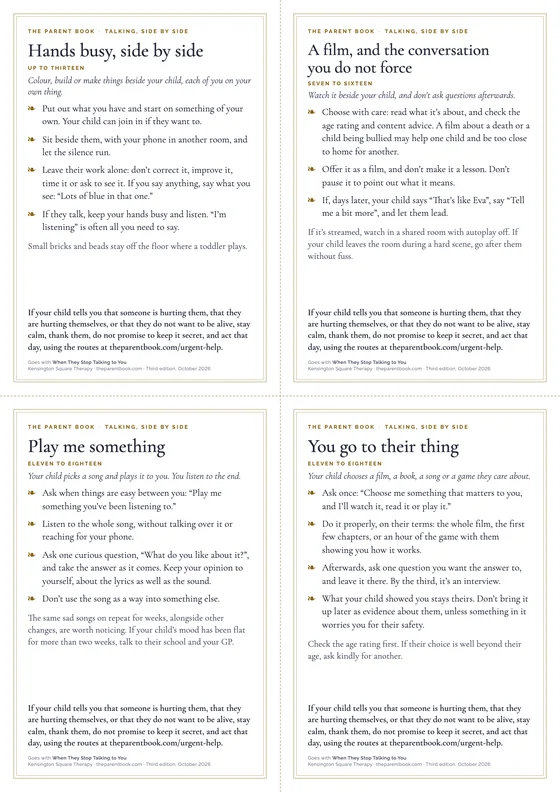 Talking, side by side
Cards to cut out · A4, four cards to cut · With a subscription
Talking, side by side
Cards to cut out · A4, four cards to cut · With a subscription
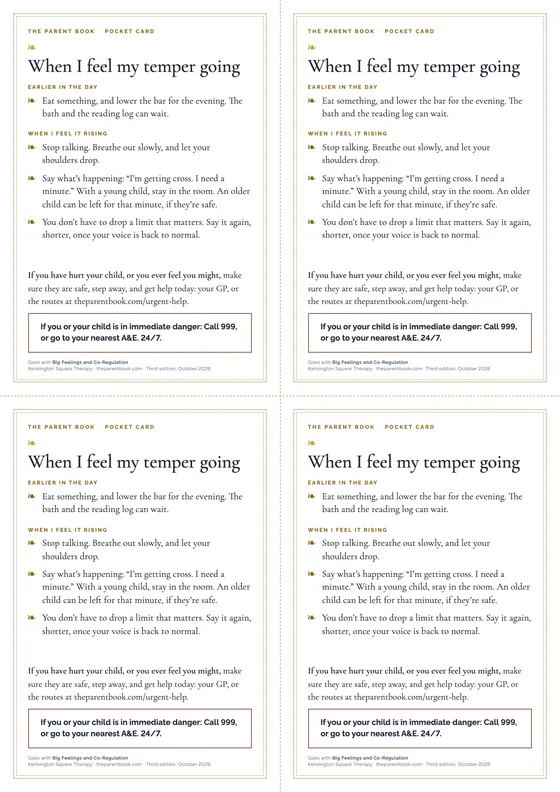 Putting it right
Pocket card · A4, four cards to cut, two sides · With a subscription
Putting it right
Pocket card · A4, four cards to cut, two sides · With a subscription
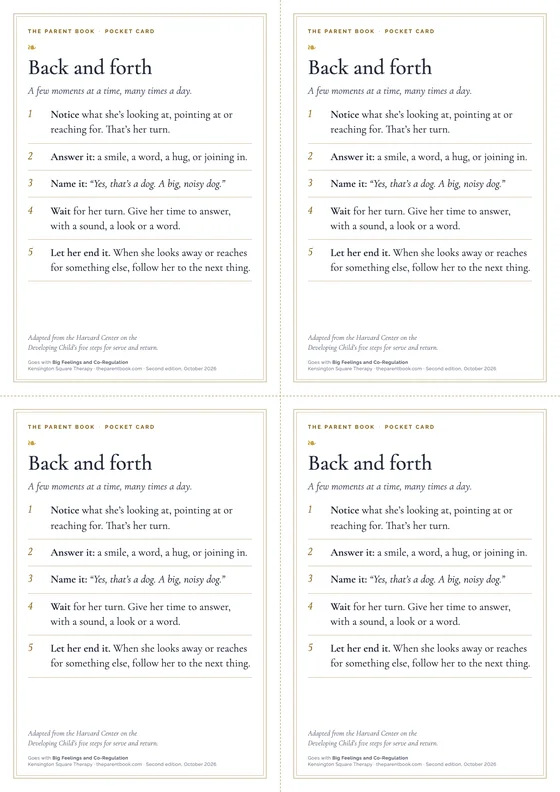 Back and forth
Pocket card · A4, four cards to cut, two sides · With a subscription
Back and forth
Pocket card · A4, four cards to cut, two sides · With a subscription
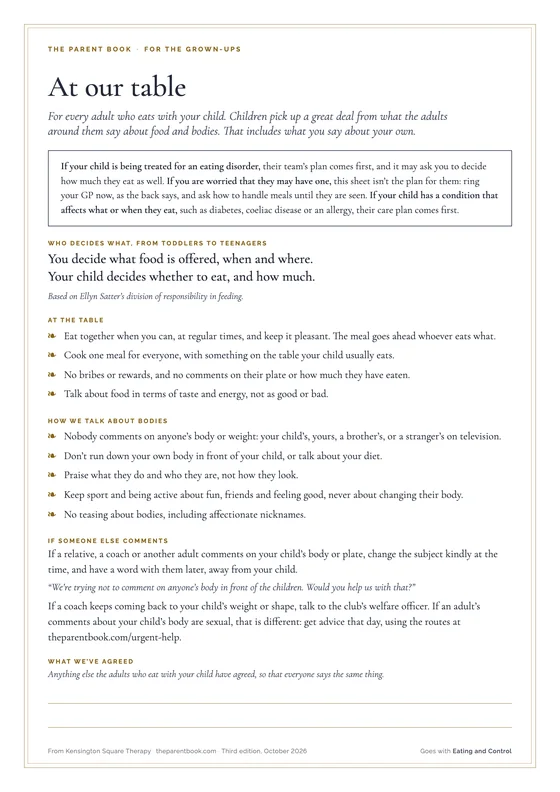 At our table
For the grown-ups · A4, two sides · With a subscription
At our table
For the grown-ups · A4, two sides · With a subscription
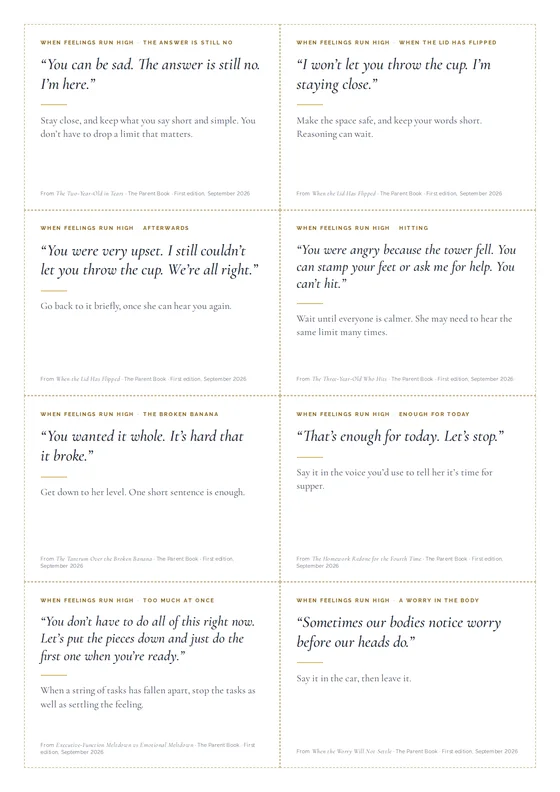 What to say: when feelings run high
Cards to cut out · A4, eight cards to cut · With a subscription
What to say: when feelings run high
Cards to cut out · A4, eight cards to cut · With a subscription
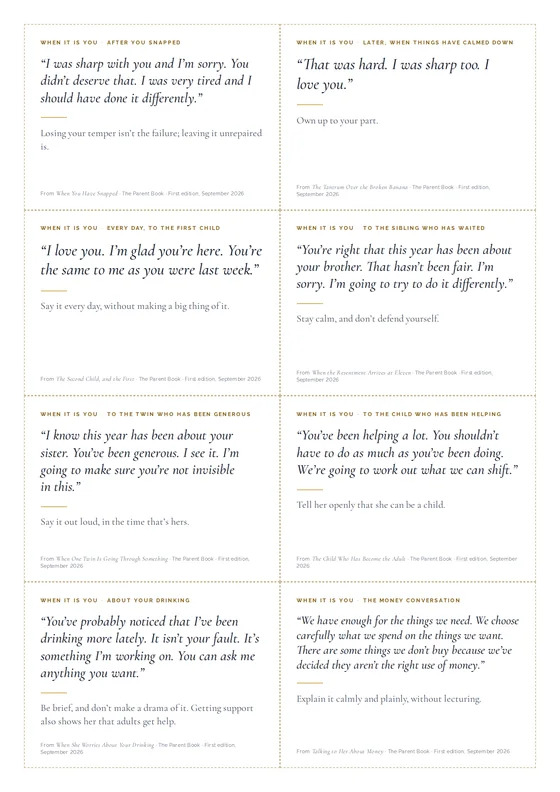 What to say: when it is you
Cards to cut out · A4, eight cards to cut · With a subscription
What to say: when it is you
Cards to cut out · A4, eight cards to cut · With a subscription
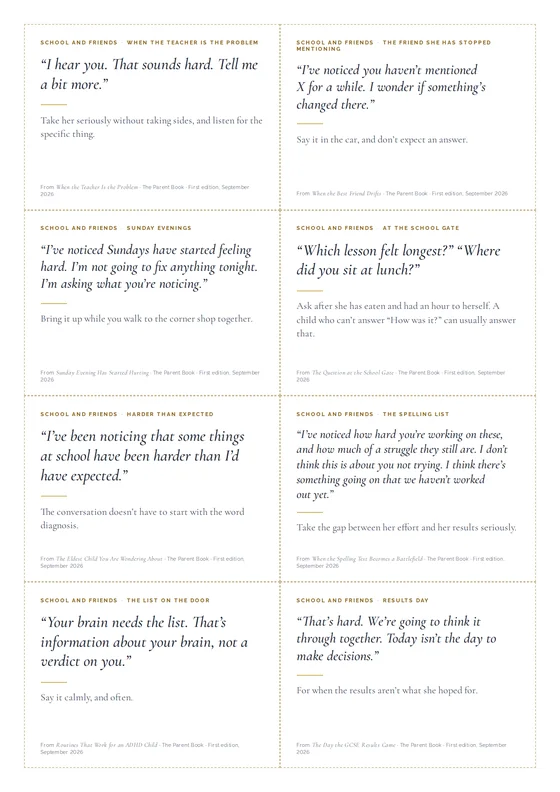 What to say: school and friends
Cards to cut out · A4, eight cards to cut · Free
What to say: school and friends
Cards to cut out · A4, eight cards to cut · Free
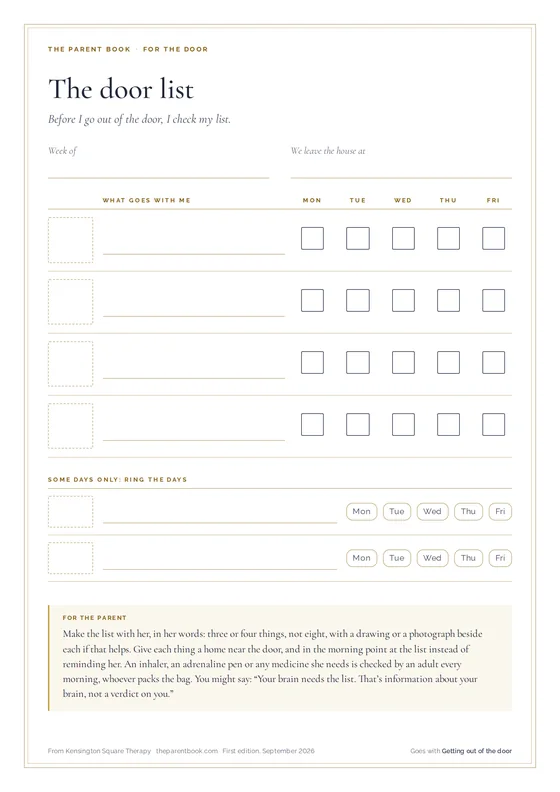 The door list
For the door · A4 · With a subscription
The door list
For the door · A4 · With a subscription
44 on behaviour
Chosen by the therapists who write the library: books for you and to read with your child, and pages from organisations we trust.

Also on this shelf
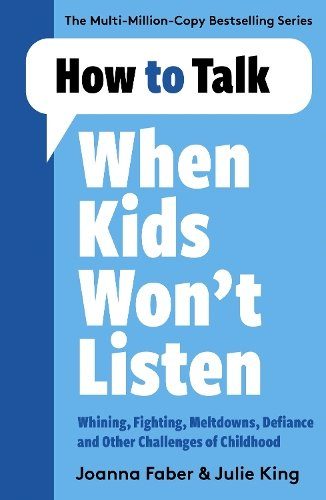
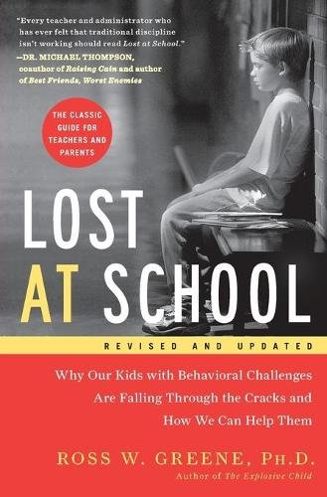


And 22 more. Every book on the shelf, with a therapist’s note on what it is good for, is in the library.
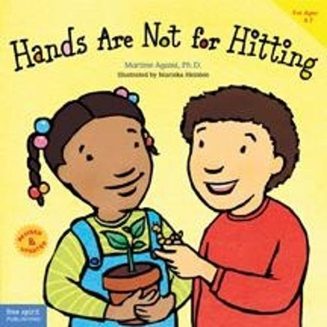
Also on this shelf

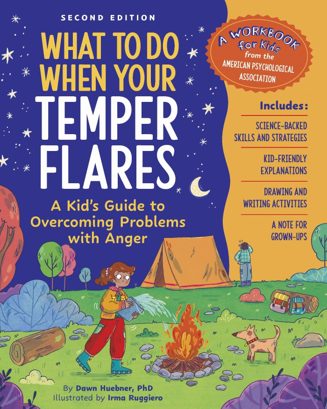
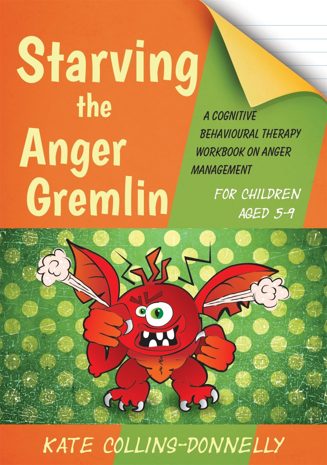
Every book on the shelf, with a therapist’s note on what it is good for, is in the library.
Royal College of Psychiatrists
The Royal College of Psychiatrists’ leaflet on persistent behaviour problems: what counts as normal, possible causes, how parenting programmes help, and when to seek assessment.
YoungMinds
Why a child might be behaving this way, spotting patterns and triggers, the roles of neurodiversity and racism, and when to seek professional help.
NHS
The NHS basics for toddler and preschool behaviour: be consistent, stay calm, praise the good, avoid smacking, and know when to ask a health visitor for more help.
Child Mind Institute
Looks past the outburst to what might be driving it, such as anxiety, ADHD, sensory difficulties or learning problems, and explains why giving in tends to make meltdowns more frequent.
Place2Be
How specific, warm praise and small rewards shape behaviour better than criticism, why it can feel hard to do consistently, and simple activities to build the habit.
Place2Be
Looks at the feelings that often hide behind angry outbursts, such as fear or shame, and offers calming techniques to use with a child before, during and after.
Place2Be
For the parent who gets the call from school: staying calm, understanding what lies behind the behaviour, and helping a child take responsibility and repair things.
Coram Family Lives
For parents frightened by a teenager’s aggression towards them. It names child-to-parent abuse clearly, explains early warning signs and how to de-escalate, and where to get support.
Place2Be
Why children feel safer with clear, calm limits, and how to set consequences that are fair, proportionate and followed through without shouting.
Child Mind Institute
A clinical psychologist’s approach to constant sibling conflict: praise the cooperation you see, set clear rules for shared things, and explain that fair does not always mean equal.
Place2Be
Walks through the escalation cycle, why both adult and child get caught in it, and specific ways to stay calm and bring the temperature down.
National Autistic Society
Explains how an autistic meltdown differs from a tantrum, what to do during one, and how to reduce triggers such as sensory overload and changes in routine.
Nothing on this shelf is written for that age yet.
18 on behaviour
Podcast episodes, talks and films, each chosen for a reason.
Janet Lansbury
Janet Lansbury answers listeners’ letters about toddlers and young children: hitting, bedtime, separation, a new sibling. Her calm, respectful approach helps parents hold limits without anger or long explanations.
Also on this shelf
Dr Becky Kennedy
Ask Lisa: Untangling Family Life
Raising Good Humans
ADHD Experts Podcast
And one more. Every episode on the shelf, with a therapist’s note on what it is good for, is in the library.
YouTube · 6 min
NSPCC, YouTube
NSPCC advice on why toddlers have tantrums, how to stay calm yourself, and simple ways to prevent and ride out the hardest moments without shouting or smacking.
Also on this shelf
YouTube · 5 min
Dr Ross Greene, YouTube
YouTube · 5 min
Child Mind Institute, YouTube
YouTube · 2 min
Dr Mona Delahooke, YouTube
YouTube · 2 min
Place2Be, YouTube
And seven more. Every film on the shelf, with a therapist’s note on what it is good for, is in the library.
Nothing on this shelf is written for that age yet.
This usually starts at school rather than at the surgery. The adults who see your child every day are the first people to tell, and often the fastest route to a change. The GP is there if it persists or deepens.
Where to start
The pastoral lead, the head of year, or the form tutor. Free, already knows your child, and often the quickest way to get something changed at school.
Before or alongside anything else. A school cannot act on what it has not been told, and what you bring is often what it did not have.
The gateway to everything the NHS offers a child: paediatric assessment, a referral to CAMHS, and support for you as the parent.
Ask for a double appointment. Describe the pattern over weeks rather than the worst single day, and say plainly what you are worried about. Bring a written list; the ten minutes go quickly.
A registered counsellor or psychotherapist, found through the BACP or NCPS directories. Waiting lists are shorter than the NHS and you choose who your child sits with.
When waiting is the problem, or when you want a particular kind of help. What to look for, and what to expect, is set out in our guide to finding a therapist.
For behaviour
Parenting Smart, written by the child mental health specialists who work in primary schools: short, practical articles and films on friendships, behaviour, worries and routines.
For a child of five to eleven, when you want something you can read in ten minutes and try tonight. Place2Be’s counselling itself is only through partner schools.
A free one-to-one webchat with a trained parenting coach, and a library of articles by age on behaviour, sleep, neurodiversity and family life.
When you want to talk it through with someone in writing, this week, without a referral.
Free one-to-one webchat with a parenting coach, Mon-Fri, with evening slots on Mon and Thu; check the site for current times · Parent Talk+ by phone or video for parents of children with additional needs, up to eight free sessions
A free, confidential helpline for any parenting or family worry, by phone, live chat, WhatsApp or email, staffed by trained family support workers.
When you need to talk it through with someone, about your child or about how you are managing, and you do not need a specialist to do it.
Coram Family Lives helpline 0808 800 2222 · Mon-Fri 9am-9pm; weekends 10am-3pm; closed bank holidays · Live chat and WhatsApp 07441 444125 at the same hours; email askus@coramfamilylives.org.uk · Outside those hours the line is closed. Samaritans answer at any hour on 116 123, and Shout answer if you text the word SHOUT to 85258.
www.coramfamilylives.org.uk/how-we-can-help/confidential-helpline
The UK’s young people’s mental health charity, with a free Parents Helpline, webchat and email, and a plain A to Z of the things parents worry about.
When you want to talk through a worry about your child with someone who has heard it before, or read a clear first explanation of a named concern. Not a crisis line.
Parents Helpline 0808 802 5544 · Mon, Thu, Fri 9.30am-4pm; Tue, Wed 9.30am-6pm · Webchat Mon-Fri 9.30am-4pm; email parents@youngminds.org.uk · Outside those hours the parents line is closed. The urgent routes on this page are open when it is not.
Every organisation for behaviour, and when each is the right call Finding a therapist