
The chapter to start with
Anxiety, by Age
For parents of a child whose worry has started to make decisions for them, with what helps at each age and when to ask for help.
15 min read · Ages 11 to 18
↑ ↓ to moveEnter to openEsc to close
Growing up and identity

Children grow into people slowly, and these pages cover each stage: attachment in the early years, the magical thinking of the preschool child, learning to get on with others in middle childhood, and the long process of becoming a separate person in adolescence. They’re for parents who want to know what stage of development lies behind a question.
What to do first and who else can help are free to read and to print.
What the library holds on child development
From the therapists
Development is uneven by nature. Children get to things in a different order and in a different month, and most of what looks like a delay is within the normal range.
3 on child development
The long reads, each on one situation, written by a therapist.
The chapter to start with
For parents of a child whose worry has started to make decisions for them, with what helps at each age and when to ask for help.
15 min read · Ages 11 to 18
Nothing on this shelf is written for that age yet.
39 on child development
Short pieces for the moment in front of you, each with things to try.
Bodies & growing up
Long before their first words, your baby is taking turns: answer their sounds and faces, name what they look at, and leave a gap for their reply.
Try this
From the tip
If you’re worried about your child’s talking or understanding, or they don’t seem to react to sounds or voices, speak to your health visitor or GP.
Bodies & growing up
If your child is three and not talking like other children, there is an established route to help.
Try this
From the tip
You can reach the health visitor, the GP and the local authority’s speech and language therapy service through a referral from the nursery or one you make yourself.
Family dynamics
Some children run out of social energy long before the party ends, and going home is how they recover.
Try this
More quick tips on child development
Bodies & growing up
Toilet training works when your child’s body and brain are ready, whatever the timetable says.
2 min read · Under 7
Big feelings
A young child rarely has words for something hard; give them a simple phrase for what their body feels.
2 min read · Under 7
Friendships & social life
Many young children take a while to warm up; stay close, let your child answer in their own way, and don’t call them shy.
2 min read · Under 7
Bodies & growing up
Once your son’s voice starts to crack, have a short, matter-of-fact talk with him about puberty.
1 min read · Ages 9 to 16
Bodies & growing up
Give a brief, accurate answer when your child asks how babies are made, then stop.
1 min read · Ages 5 to 11
Family dynamics
An extroverted parent often mistakes an introverted child’s temperament for shyness or low confidence.
2 min read · Ages 5 to 13
Bodies & growing up
Take your daughter’s question about a first bra seriously, and treat the shopping as an everyday errand.
1 min read · Ages 7 to 13
Bodies & growing up
Aim for eighteen short conversations about puberty over two or three years, starting early.
2 min read · Ages 7 to 11
Home And Belonging
If your child used to answer you in Urdu and now answers only in English, keep speaking Urdu to them.
2 min read · Ages 7 to 13
Bodies & growing up
When your daughter’s first period starts at school, take her home and treat the rest of the afternoon as normal.
1 min read · Ages 9 to 13
Home And Belonging
Keep speaking your heritage language at home; the research supports it.
2 min read
Bodies & growing up
A child who suddenly wants privacy is growing up, and knocking first tells them that their body is theirs.
2 min read · Ages 9 to 16
Bodies & growing up
Some of what a boy needs to know about puberty is awkward to ask, so tell him before he has to.
2 min read · Ages 9 to 16
Bodies & growing up
In a girl, puberty at eight is within the normal range, and girls who feel prepared and accepted at home tend to fare better.
2 min read · Ages 7 to 11
Neurodiversity
Your child experiences the world differently from you, and it helps to find out how.
2 min read
Family dynamics
Teach your child that surprises get told in the end, and that a secret that worries them is one they can always tell you.
2 min read · Under 9
Bodies & growing up
Go back to your toddler before they get up, and when they do get up, take them back to bed without a conversation.
2 min read · Under 5
Health and difference
Build the medication into something the family already does, and give your child ownership of the routine in stages.
2 min read · Ages 5 to 13
Big feelings
When a child is overwhelmed, a few words usually reach them better than a lot.
2 min read · Under 7
Friendships & social life
Trying out new tastes and opinions is how a child starts to work out who they are.
2 min read · Ages 11 to 18
Bodies & growing up
Your teenager’s body clock has moved later; a fixed time to get up, morning light and phones out of the bedroom can help them fall asleep sooner.
2 min read · Ages 13 to 18
Family dynamics
At this age nobody can reliably tell whether these feelings will last, so listen, and keep their options open.
2 min read · Ages 5 to 11
Big feelings
Young children usually show trauma in their bodies and behaviour before they can put it into words.
2 min read · Under 7
Health and difference
A twelve-year-old doing the family’s supermarket shop needs to hear that they can still be a child.
2 min read · Ages 9 to 16
Bodies & growing up
Stop the hit first, then help your child find words for what they were feeling.
2 min read · Under 5
Bodies & growing up
Crying is how a two-year-old tells you what they can’t yet put into words.
2 min read · Under 5
Family dynamics
Early-years twins are more exhausting than most people realise, so cut back on everything else.
2 min read · Under 7
Big feelings
Boredom can be a sign of low mood when it takes in almost everything, friends included, and lasts a fortnight or more.
2 min read · Ages 7 to 11
Health and difference
Around eight, your child will notice that their family is different from their friends’ families, so be ready for it.
2 min read · Ages 7 to 11
Online life
At four, treat the tablet as yours, lent to your child for short stretches with you nearby.
2 min read · Under 7
Neurodiversity
Your child’s brain needs structure from outside, and you’re the one who has to provide it.
2 min read
Parent wellbeing
Money is something you can talk about with your child, though most families don’t.
2 min read · Ages 7 to 13
Health and difference
In the days after a diagnosis, tell your child often that the condition doesn’t change who they are.
2 min read · Ages 5 to 13
Bodies & growing up
A teenager needs to be able to try out a thought aloud before they know whether it fits.
2 min read · Ages 11 to 18
Home And Belonging
A visit to the country you left can unsettle a second-generation child; don’t make it a test they can fail.
1 min read · Ages 7 to 16
Home And Belonging
A child who has moved between countries may ask where home is; answer with more than one place.
2 min read · Ages 9 to 16
The rest of each tip, with more to try and why it works, is in the library.
Nothing on this shelf is written for that age yet.
2 on child development
Small, repeatable things to do with your child, with what to watch for and when to get help.
To do together · About 5 min
When your child looks, points, babbles or reaches, answer it, name it and wait for their turn: a few moments of back and forth, many times a day.
What it is for. Babies and toddlers learn to talk, and learn that they are heard, through back and forth with the people who look after them: a child makes a sound, a face or a point, and an adult answers. These everyday exchanges are linked with how children’s language develops, and they fit into moments you already have.
Safety. If your child’s crying ever makes you feel you might lose control, put them in their cot or pram, make sure they are safe, close the door and go into another room to calm yourself down. However frustrated you feel, never shake them.
When to get help. Children learn to talk at different ages. If you’re worried about your child’s talking or understanding, or they don’t seem to react to sounds or voices, speak to your health visitor or GP, or contact your local speech and language therapy service. Tell them too if your child rarely responds to their name or rarely shows you what they are interested in. If you find it hard to enjoy your child or to feel close to them, or you feel low most days, talk to your health visitor or GP: it is common, and they can help. If you have thoughts of harming yourself or your child, or of not wanting to be alive, act that day: ask the surgery for an urgent appointment, and if it is closed, use the routes under “If you need help right now”, at the foot of every page. If you think someone is harming your child, or your child tells you something that worries you, stay calm, thank them if they have told you, don’t promise to keep it secret, and act that day, using the same routes; if the person lives in your home or your child’s other home, go straight to children’s social care or the police.
The other four steps, and your part in it, are in the library.
More to do together
To do together
Cook one dish together each week, side by side, and give your child a real job. If they want to talk, they can do it while they chop.
About 45 min · Under 18 · With a sheet to print
Nothing on this shelf is written for that age yet.
22 on child development
Made to be printed, kept, and handed on.
To print and keep
What to do first, a few things to try and who else can help, together in one guide. Free to print and keep, or to hand to the other parent, a grandparent or the school.
Who else can help with child development, on a sheet of its own.
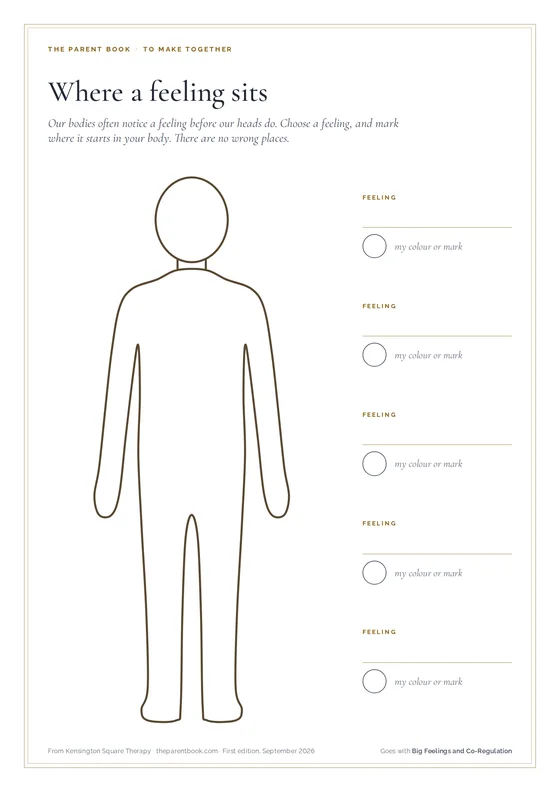 Where a feeling sits
To make together · A4, two sides · With a subscription
Where a feeling sits
To make together · A4, two sides · With a subscription
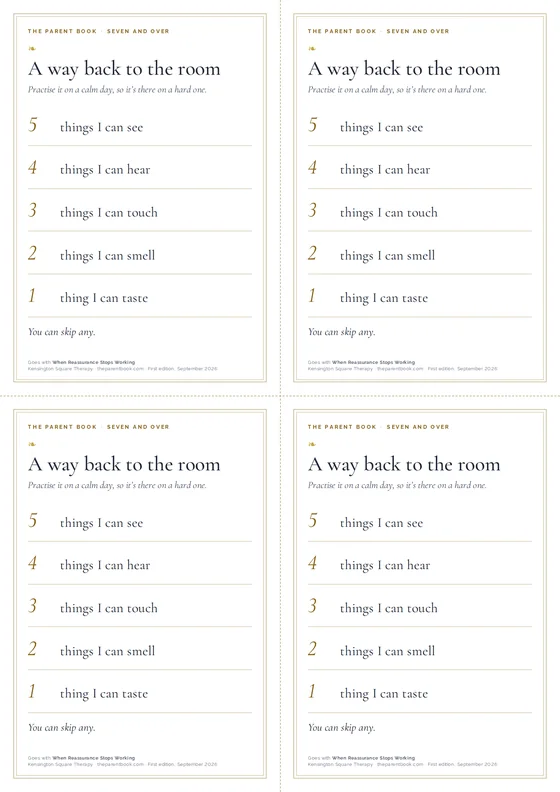 A way back to the room
Pocket card · A4, four cards to cut, two sides · With a subscription
A way back to the room
Pocket card · A4, four cards to cut, two sides · With a subscription
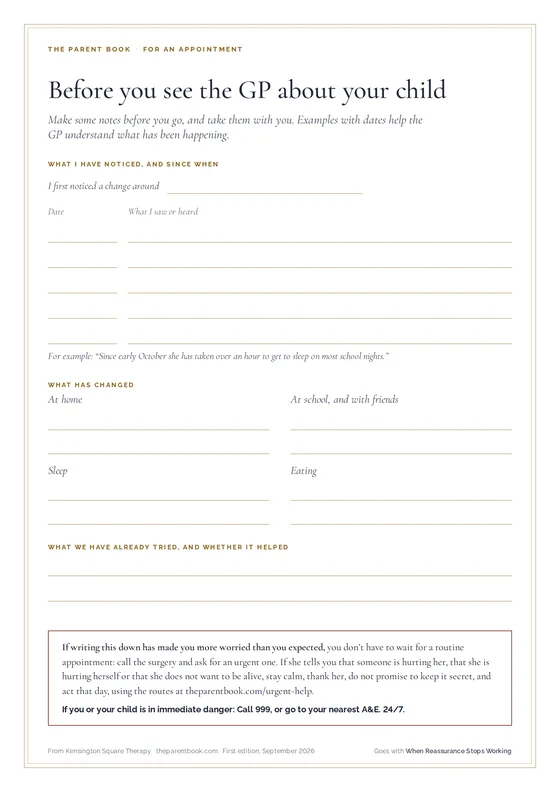 Before you see the GP about your child
For an appointment · A4, two sides · Free
Before you see the GP about your child
For an appointment · A4, two sides · Free
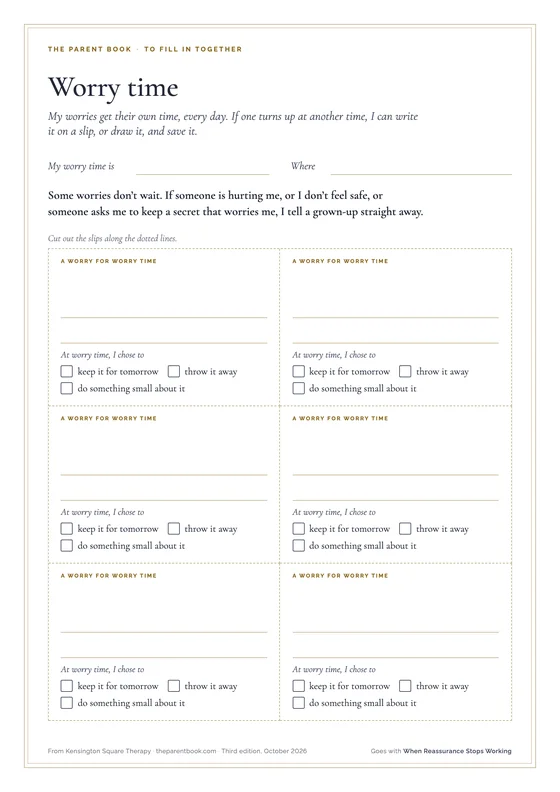 Worry time
To fill in together · A4, two pages · With a subscription
Worry time
To fill in together · A4, two pages · With a subscription
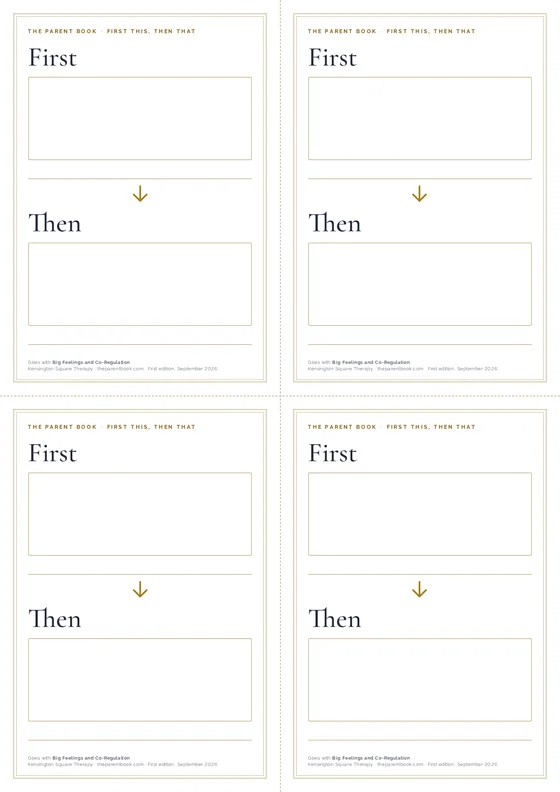 First this, then that
Cards to cut out · A4, four cards to cut, two sides · With a subscription
First this, then that
Cards to cut out · A4, four cards to cut, two sides · With a subscription
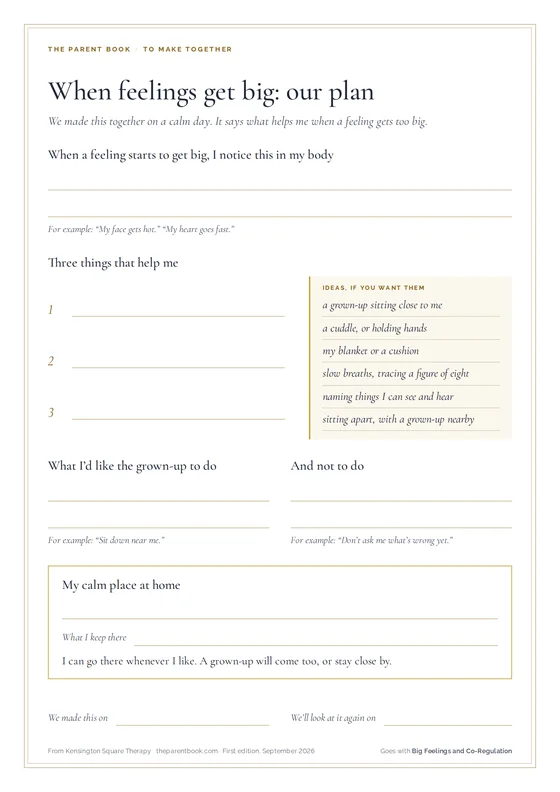 When feelings get big: our plan
To make together · A4, two sides · With a subscription
When feelings get big: our plan
To make together · A4, two sides · With a subscription
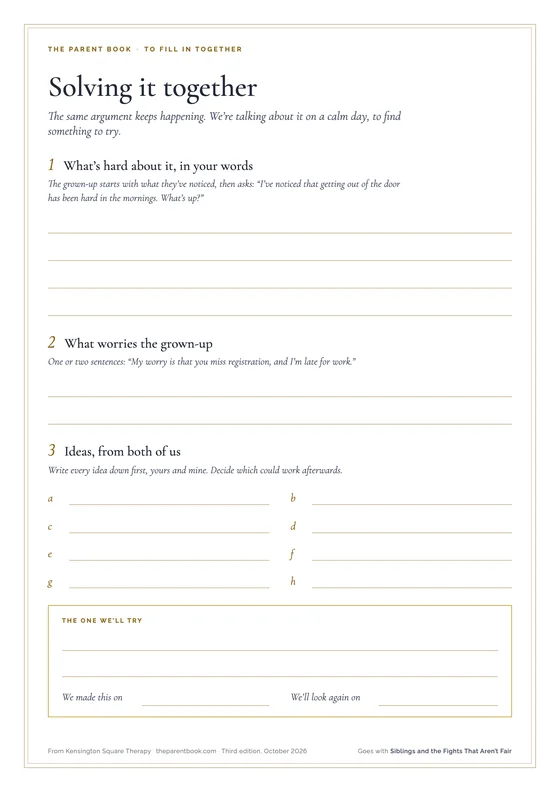 Solving it together
To fill in together · A4, two sides · With a subscription
Solving it together
To fill in together · A4, two sides · With a subscription
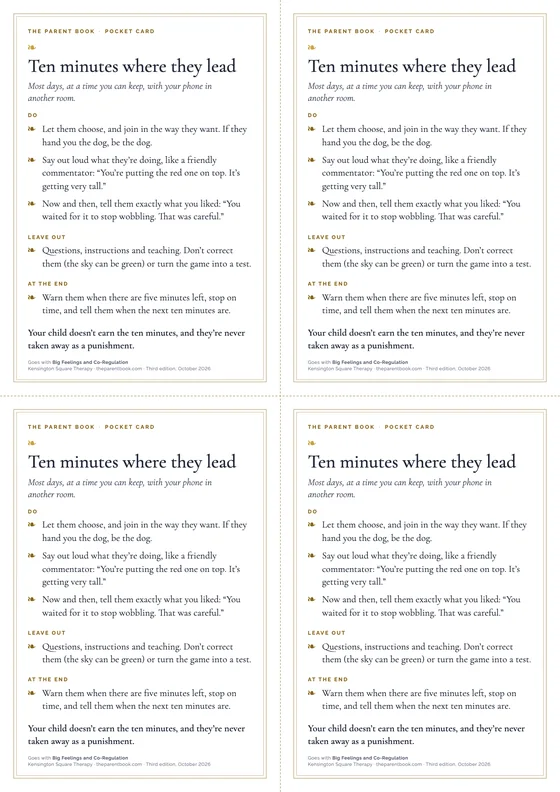 Ten minutes where they lead
Pocket card · A4, four cards to cut, two sides · With a subscription
Ten minutes where they lead
Pocket card · A4, four cards to cut, two sides · With a subscription
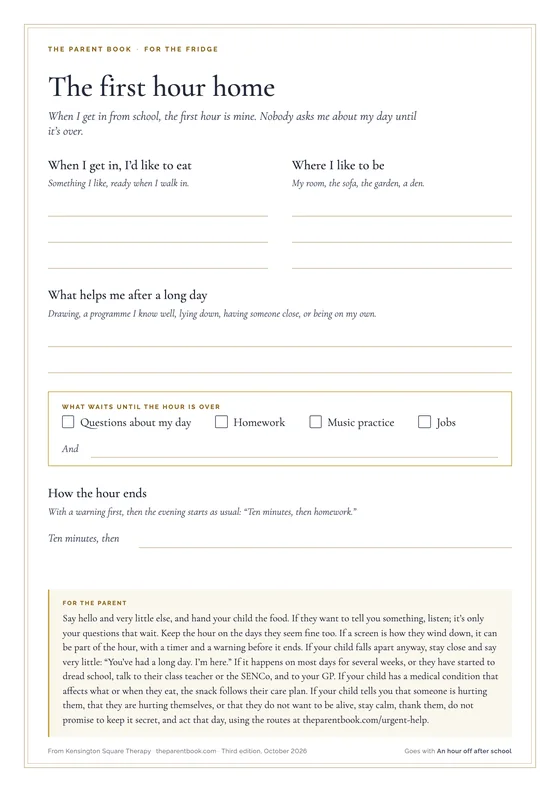 The first hour home
For the fridge · A4 · With a subscription
The first hour home
For the fridge · A4 · With a subscription
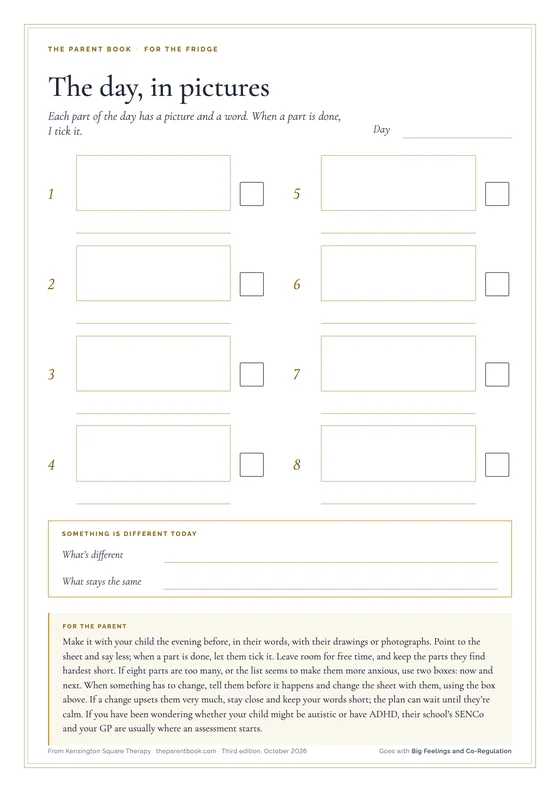 The day, in pictures
For the fridge · A4 · With a subscription
The day, in pictures
For the fridge · A4 · With a subscription
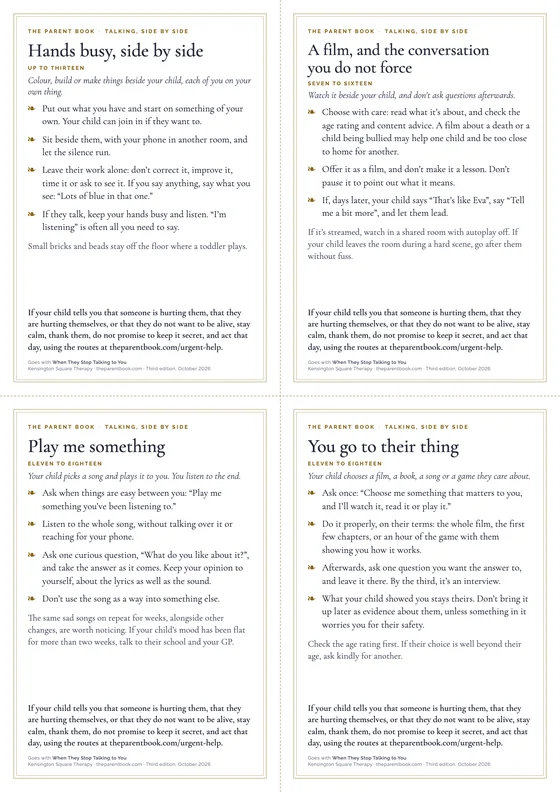 Talking, side by side
Cards to cut out · A4, four cards to cut · With a subscription
Talking, side by side
Cards to cut out · A4, four cards to cut · With a subscription
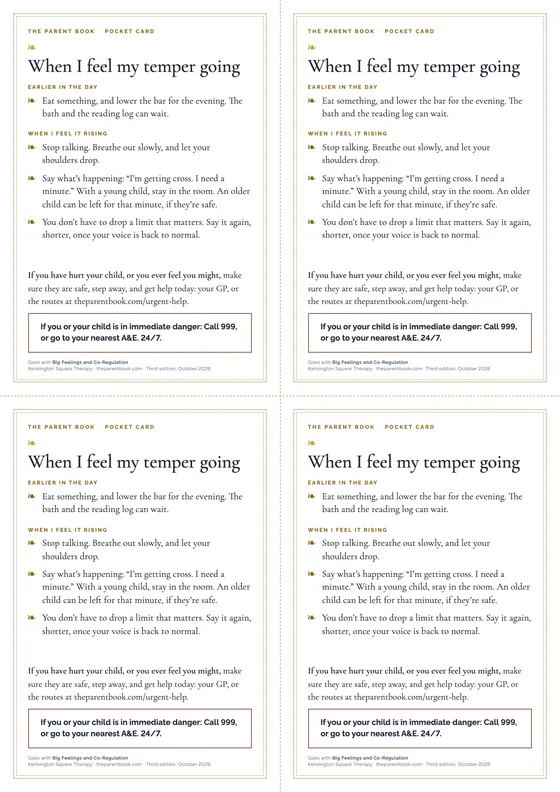 Putting it right
Pocket card · A4, four cards to cut, two sides · With a subscription
Putting it right
Pocket card · A4, four cards to cut, two sides · With a subscription
 Back and forth
Pocket card · A4, four cards to cut, two sides · With a subscription
Back and forth
Pocket card · A4, four cards to cut, two sides · With a subscription
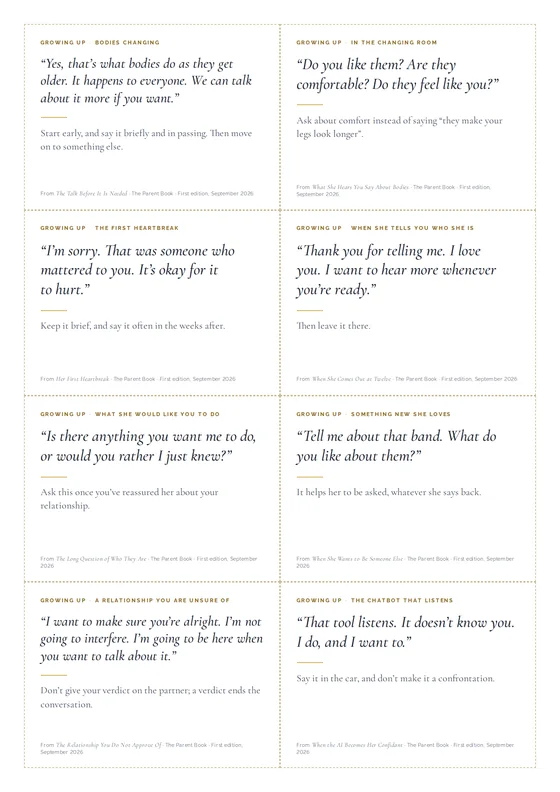 What to say: growing up
Cards to cut out · A4, eight cards to cut · With a subscription
What to say: growing up
Cards to cut out · A4, eight cards to cut · With a subscription
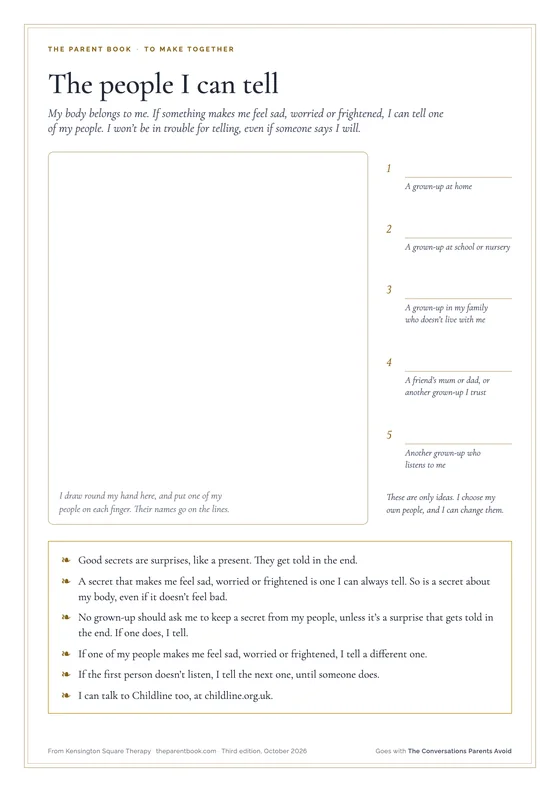 The people I can tell
To make together · A4, two pages · Free
The people I can tell
To make together · A4, two pages · Free
 What to say: when feelings run high
Cards to cut out · A4, eight cards to cut · With a subscription
What to say: when feelings run high
Cards to cut out · A4, eight cards to cut · With a subscription
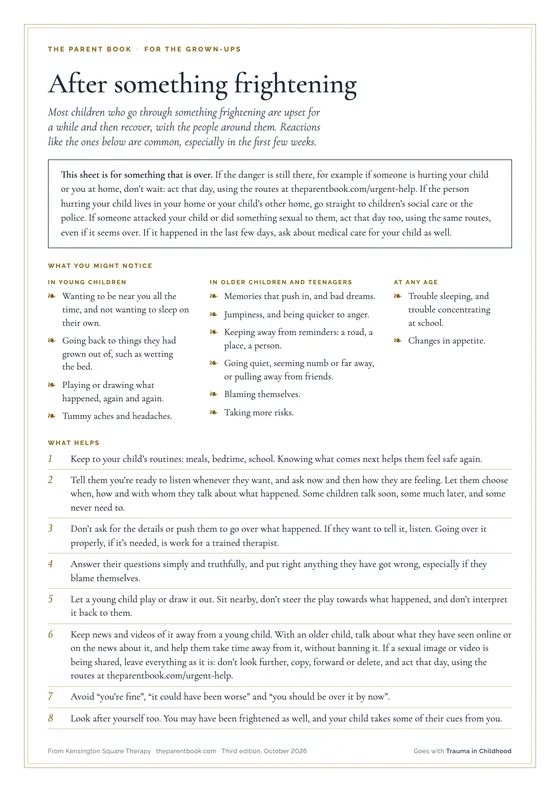 After something frightening
For the grown-ups · A4, two sides · With a subscription
After something frightening
For the grown-ups · A4, two sides · With a subscription
 What to say: when it is you
Cards to cut out · A4, eight cards to cut · With a subscription
What to say: when it is you
Cards to cut out · A4, eight cards to cut · With a subscription
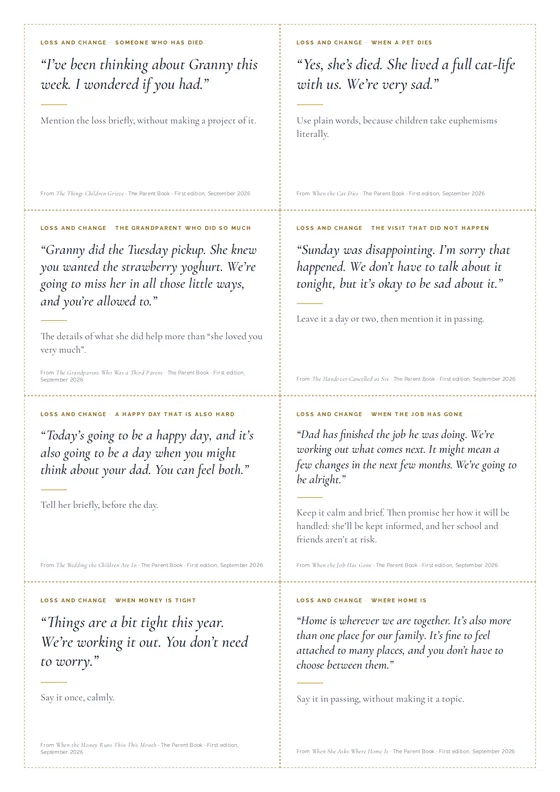 What to say: loss and change
Cards to cut out · A4, eight cards to cut · With a subscription
What to say: loss and change
Cards to cut out · A4, eight cards to cut · With a subscription
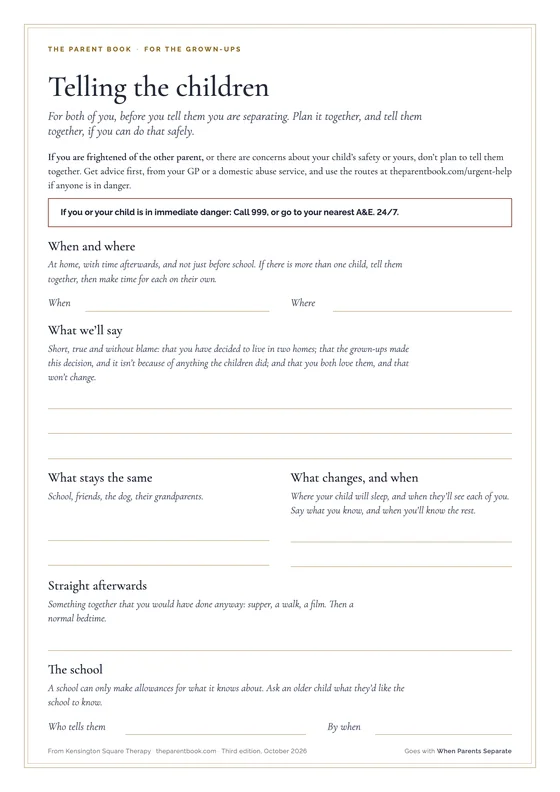 Telling the children
For the grown-ups · A4, two sides · With a subscription
Telling the children
For the grown-ups · A4, two sides · With a subscription
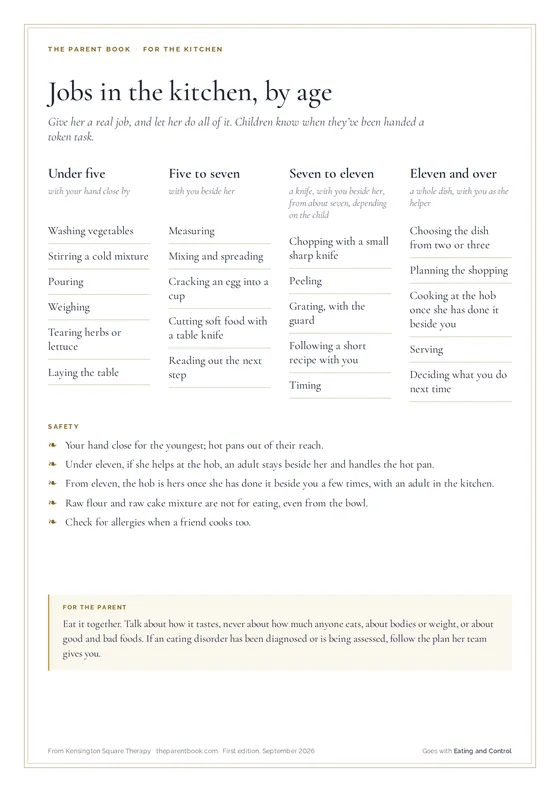 Jobs in the kitchen, by age
For the kitchen · A4 · With a subscription
Jobs in the kitchen, by age
For the kitchen · A4 · With a subscription
39 on child development
Chosen by the therapists who write the library: books for you and to read with your child, and pages from organisations we trust.

Also on this shelf



And 21 more. Every book on the shelf, with a therapist’s note on what it is good for, is in the library.

Also on this shelf

And three more. Every book on the shelf, with a therapist’s note on what it is good for, is in the library.
Harvard Center on the Developing Child
Harvard’s clear explanation of how everyday back-and-forth between a baby and an adult builds brain architecture, with five simple steps any parent can practise.
Child Bereavement UK
Age by age, from toddlers to teenagers, what children understand about death and how grief may show up in their behaviour.
Place2Be
What to expect at each stage, from toddlers touching themselves to puberty, how to respond calmly, and how to talk about sex and sexuality at the right level.
GOV.UK (Early Years Screen Time Advisory Group)
The UK government’s independent review of the evidence on screens in the under-fives, chaired by the Children’s Commissioner and Professor Russell Viner, with recommendations for parents.
NSPCC
Helps parents tell the difference between the ordinary, healthy sexual behaviour of growing up and behaviour that may signal a problem, and what to do about it.
Nothing on this shelf is written for that age yet.
14 on child development
Podcast episodes, talks and films, each chosen for a reason.
MQ Open Mind
Cambridge neuroscientist Sarah-Jayne Blakemore explains how the adolescent brain develops, why friends and social belonging matter so much to teenagers, and what this means for families and schools.
Also on this shelf
Get a Grip - Evidence-Based Conversations for Parents and Educators
Dr Kathy Weston, Dr Cassie Rhodes (Tooled Up Education)
Every episode on the shelf, with a therapist’s note on what it is good for, is in the library.
YouTube · 2 min
Center on the Developing Child at Harvard University, YouTube
A short animation explaining that the brain is built over time, from the bottom up, and that early relationships and experiences shape whether that foundation is sturdy or fragile.
Also on this shelf
YouTube · 6 min
Center on the Developing Child at Harvard University, YouTube
TED · 14 min
Prof Sarah-Jayne Blakemore, TED
BBC
BBC, BBC
YouTube
Center on the Developing Child at Harvard University, YouTube
And six more. Every film on the shelf, with a therapist’s note on what it is good for, is in the library.
Nothing on this shelf is written for that age yet.
For almost everything, the NHS is the right first move, and it costs nothing.
Where to start
The gateway to everything the NHS offers a child: paediatric assessment, a referral to CAMHS, and support for you as the parent.
Ask for a double appointment. Describe the pattern over weeks rather than the worst single day, and say plainly what you are worried about. Bring a written list; the ten minutes go quickly.
The pastoral lead, the head of year, or the form tutor. Free, already knows your child, and often the quickest way to get something changed at school.
Before or alongside anything else. A school cannot act on what it has not been told, and what you bring is often what it did not have.
The council’s children’s services and SEND team. They hold statutory assessment, the Local Offer, and early help for families who need more than a school can give.
When school-level support has been tried and is not enough, or when you want to know what your area actually provides.
For child development
The NHS’s pages for pregnancy, babies and toddlers: feeding, sleep, bonding, potty training, early learning and school readiness, plus your local Family Hub.
For the under-fives, as the first place to check.
The early-years charity. Calm, evidence-based pages on toddlers, sleep and development, local groups, and a daily infant feeding line.
For the under-fives. The phone line is for feeding questions; everything else is on the site and in the groups.
Charged at your standard call rate, not free.
NCT Infant Feeding Line 0300 330 0700 · Every day 8am-midnight
A free one-to-one webchat with a trained parenting coach, and a library of articles by age on behaviour, sleep, neurodiversity and family life.
When you want to talk it through with someone in writing, this week, without a referral.
Free one-to-one webchat with a parenting coach, Mon-Fri, with evening slots on Mon and Thu; check the site for current times · Parent Talk+ by phone or video for parents of children with additional needs, up to eight free sessions
The Anna Freud Centre’s family wellbeing resources: careful, research-led reading on children’s emotional development, separation, self-care for parents, and supporting a child through treatment.
When you want depth from a clinical source rather than a quick explainer. Reading only; there is no helpline.
Every organisation for child development, and when each is the right call Finding a therapist