
The chapter to start with
Screen Time
For parents who have lost the argument about screen hours, and suspect it was never quite the right argument to have.
8 min read · Ages 4 to 18
↑ ↓ to moveEnter to openEsc to close
Screens and online life

Most friendships now happen on social media as well as in the playground. These pages cover group chats, follows, who’s in and who’s out, and the constant comparison going on in the background of an eleven-year-old’s evening. They’re for you if you’re trying to be neither naive nor panicked about the part of your child’s life you can’t see.
What to do first, what helps and who else can help are free to read and to print.
What the library holds on social media
From the therapists
The feed is designed by people whose job is to keep a child’s attention, and your child is thirteen. If they can’t put it down, that isn’t a flaw in their character.
From the chapters
Charge devices in the kitchen overnight, including yours. What you do counts as much as the rule you set.
The brain needs to wind down before it can sleep. Use the time for reading, a bath or talking together.
4 on social media
The long reads, each on one situation, written by a therapist.
The chapter to start with
For parents who have lost the argument about screen hours, and suspect it was never quite the right argument to have.
8 min read · Ages 4 to 18
Nothing on this shelf is written for that age yet.
6 on social media
Short pieces for the moment in front of you, each with things to try.
Online life
Before your child joins the class group chat, tell them they will never be in trouble for showing you something that upset them.
Try this
From the tip
If anyone sends your child a nude or semi-nude picture, tell your child not to pass it on. Never ask them to send it to you, and never view, copy, print, share, store or save it; a screenshot is a copy. Don’t delete anything until you have advice from the school’s safeguarding lead. If a picture of your child has been shared, tell them it is not their fault; they can report it themselves to have it taken down. Report Remove (from Childline and the IWF). Online at https://www.childline.org.uk/info-advice/bullying-abuse-safety/online-mobile-safety/report-remove/. If an adult sent it, or anyone is pressuring your child to send pictures, report it to the police. CEOP (the police’s online child protection command). Report at https://www.ceop.police.uk/safety-centre/.
Online life
Keep pictures of your child to people you know, and once they’re old enough to have a view, ask them first.
Try this
From the tip
Some parents now worry about AI tools that can alter ordinary photos. The advice from the National Crime Agency and the Internet Watch Foundation is to keep pictures of children to people you know and to use privacy settings, not to stop sharing altogether. If a picture of your child has been altered or misused, don’t go looking for it, don’t pass it on, and don’t delete anything until you have had advice. If it has been made sexual, never view, copy, print, share, store or save it; a screenshot is a copy. Report it to the police. CEOP (the police’s online child protection command). Report at https://www.ceop.police.uk/safety-centre/. If it is on a website, you can also report it to have it taken down. Internet Watch Foundation. Report at https://www.iwf.org.uk/en/uk-report/.
Online life
If your child’s feed is full of diets and bodies, reset it with them and explain how it works.
Try this
More quick tips on social media
Online life
The platform chooses what’s in your child’s feed to keep them watching, and it can leave them feeling flat.
2 min read · Ages 11 to 16
Online life
Being curious without blame can help your son see you as someone to talk to, so ask what he likes about them first.
2 min read · Ages 11 to 16
Online life
If your child confides in a chatbot, tell them what it is and keep them talking to real people.
1 min read · Ages 11 to 18
The rest of each tip, with more to try and why it works, is in the library.
Nothing on this shelf is written for that age yet.
2 on social media
Small, repeatable things to do with your child, with what to watch for and when to get help.
To do together · About 10 min
Once a week your child shows you three things: the funniest they have seen, the weirdest, and one they think you should see. You watch without comment.
What it is for. In our experience, what is on your child’s screen matters more than how long they spend on it. A weekly look, on their terms, lets you be curious without checking up on them, and makes you someone they might tell if something goes wrong.
Safety. Most social media services are for thirteen and over. Every phone charges outside the bedrooms overnight, the adults’ included.
When to get help. If you learn of an adult contacting your child, anyone asking them for pictures or personal details, or a sexual image of a child, stay calm, do not blame your child, and leave everything as it is (do not reply, look further, copy, forward or delete). Act that day, using the routes under “If you need help right now”, at the foot of every page, and tell the school’s designated safeguarding lead. If what your child is shown keeps turning to bodies, food or self-harm, or their mood or eating changes, talk to their school and your GP.
The other step, and your part in it, are in the library.
More to do together
To do together
Every phone in the house charges overnight in one place outside the bedrooms, on a rule agreed with your teenager. Yours goes there first.
About 10 min · Ages 11 to 18
Nothing on this shelf is written for that age yet.
7 on social media
Made to be printed, kept, and handed on.
To print and keep
What to do first, what helps, a few things to try and who else can help, together in one guide. Free to print and keep, or to hand to the other parent, a grandparent or the school.
Who else can help with social media, on a sheet of its own.
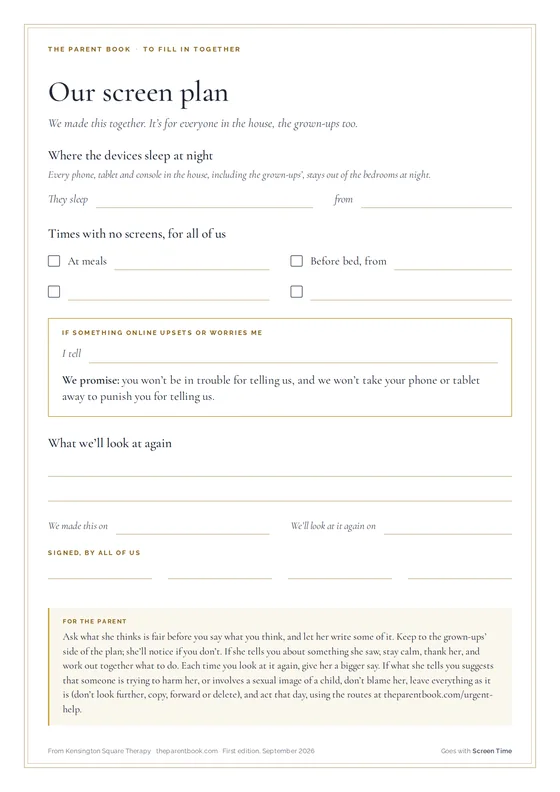 Our screen plan
To fill in together · A4 · With a subscription
Our screen plan
To fill in together · A4 · With a subscription
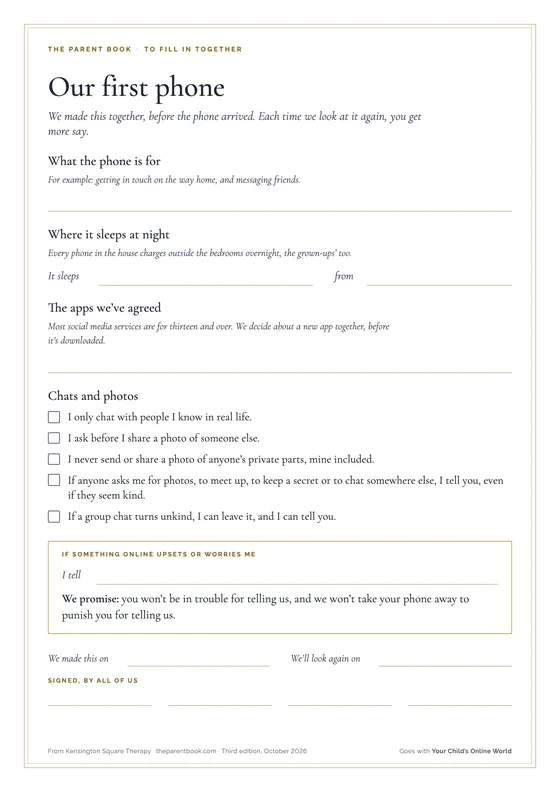 Our first phone
To fill in together · A4, two sides · With a subscription
Our first phone
To fill in together · A4, two sides · With a subscription
 Their online world
Pocket card · A4, four cards to cut, two sides · With a subscription
Their online world
Pocket card · A4, four cards to cut, two sides · With a subscription
 What my body can do
Cards to fill in · A4, two pages: four cards, and a page for you · With a subscription
What my body can do
Cards to fill in · A4, two pages: four cards, and a page for you · With a subscription
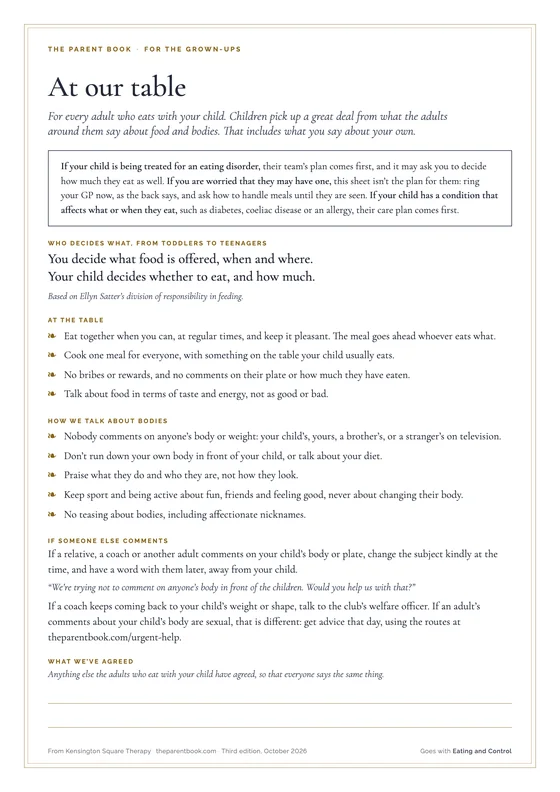 At our table
For the grown-ups · A4, two sides · With a subscription
At our table
For the grown-ups · A4, two sides · With a subscription
 What to say: growing up
Cards to cut out · A4, eight cards to cut · With a subscription
What to say: growing up
Cards to cut out · A4, eight cards to cut · With a subscription
18 on social media
Chosen by the therapists who write the library: books for you and to read with your child, and pages from organisations we trust.
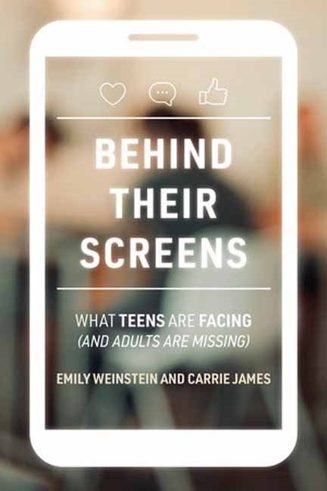
Also on this shelf
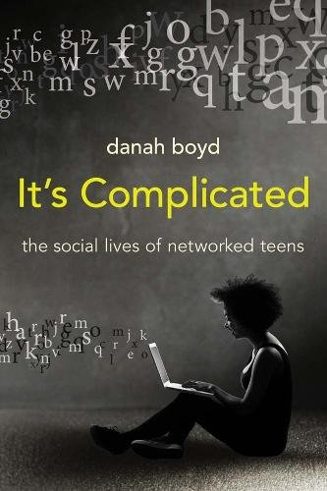



And four more. Every book on the shelf, with a therapist’s note on what it is good for, is in the library.
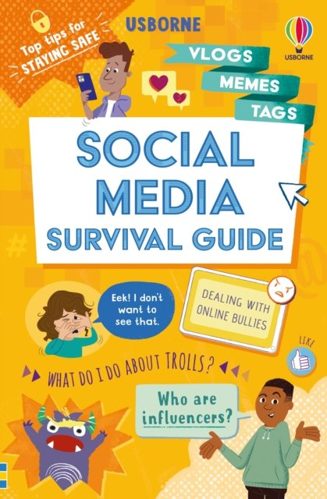
Also on this shelf

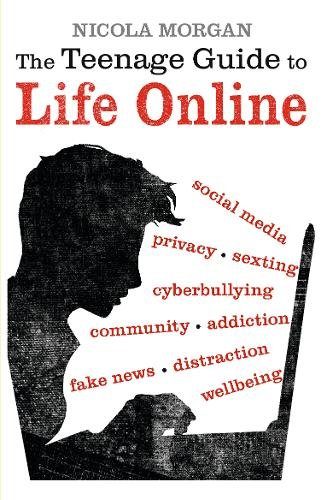

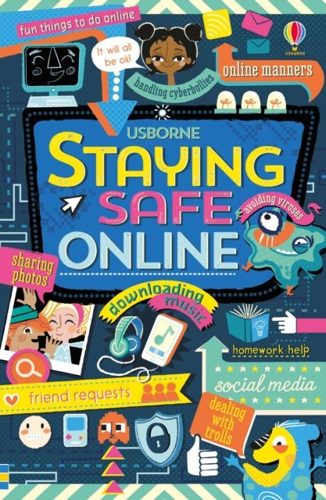
And one more. Every book on the shelf, with a therapist’s note on what it is good for, is in the library.
NSPCC
The benefits and risks of the platforms children use, how to review privacy settings together, and what to do when a child sees something harmful.
Place2Be
Thinking through the first-phone decision: readiness, agreeing rules before the phone arrives, and keeping talking once it does.
YoungMinds
How to talk to your child about life online, set realistic boundaries, and respond to sexting and bullying calmly, with frank advice on consent and pressure.
Nothing on this shelf is written for that age yet.
12 on social media
Podcast episodes, talks and films, each chosen for a reason.
Ask Lisa: Untangling Family Life
What age is right for social media, and practical ways to limit the harm, from the research and from clinical practice.
Also on this shelf
Get a Grip - Evidence-Based Conversations for Parents and Educators
Prof Pete Etchells and Prof Andy Przybylski
Thriving Kids
Speaking of Psychology
And two more. Every episode on the shelf, with a therapist’s note on what it is good for, is in the library.
YouTube · 36 min
Dr Amy Orben, YouTube
Cambridge psychologist Amy Orben sets out what the research does and does not show about screens and adolescent mental health, and why ‘screen time’ is too blunt a measure.
Also on this shelf
TED · 12 min
Prof Candice Odgers, TED
YouTube · 2 min
Place2Be, YouTube
YouTube · 6 min
Child Mind Institute, YouTube
YouTube · 4 min
Child Mind Institute, YouTube
Every film on the shelf, with a therapist’s note on what it is good for, is in the library.
Nothing on this shelf is written for that age yet.
This usually starts at school rather than at the surgery. The adults who see your child every day are the first people to tell, and often the fastest route to a change. The GP is there if it persists or deepens.
Where to start
The pastoral lead, the head of year, or the form tutor. Free, already knows your child, and often the quickest way to get something changed at school.
Before or alongside anything else. A school cannot act on what it has not been told, and what you bring is often what it did not have.
The gateway to everything the NHS offers a child: paediatric assessment, a referral to CAMHS, and support for you as the parent.
Ask for a double appointment. Describe the pattern over weeks rather than the worst single day, and say plainly what you are worried about. Bring a written list; the ten minutes go quickly.
For social media
Step-by-step guides to the settings on every device and app, advice by age from nought to eighteen, and guides to AI tools and gaming.
When you need to actually change something on a phone tonight. The most practical online safety source in the UK.
Guides to having the conversation, by age, on gaming, sharing images, online bullying and where the line is, from one of the charities behind the UK Safer Internet Centre.
When the settings are done and the talking is the hard part.
Help getting something taken down when you have reported it to the platform and nothing has happened: bullying, threats, impersonation, content about self-harm.
After the in-app report has failed. They reply within three days.
The UK’s young people’s mental health charity, with a free Parents Helpline, webchat and email, and a plain A to Z of the things parents worry about.
When you want to talk through a worry about your child with someone who has heard it before, or read a clear first explanation of a named concern. Not a crisis line.
Parents Helpline 0808 802 5544 · Mon, Thu, Fri 9.30am-4pm; Tue, Wed 9.30am-6pm · Webchat Mon-Fri 9.30am-4pm; email parents@youngminds.org.uk · Outside those hours the parents line is closed. The urgent routes on this page are open when it is not.
Every organisation for social media, and when each is the right call Finding a therapist