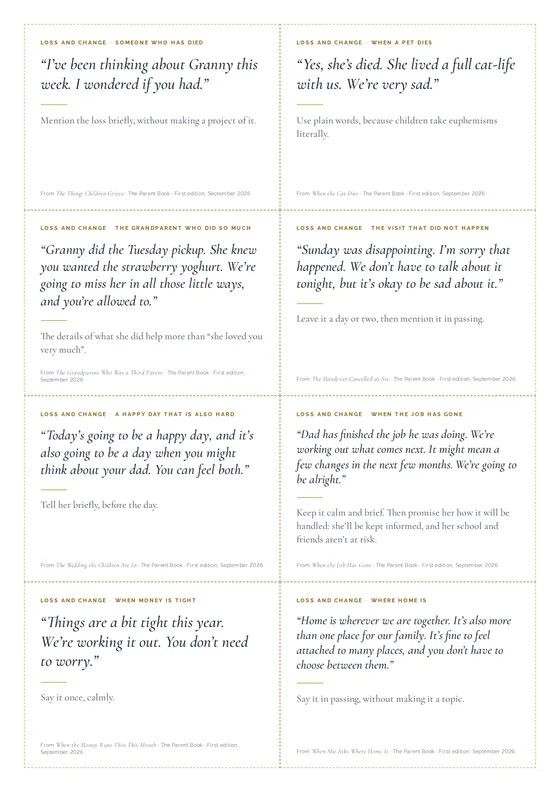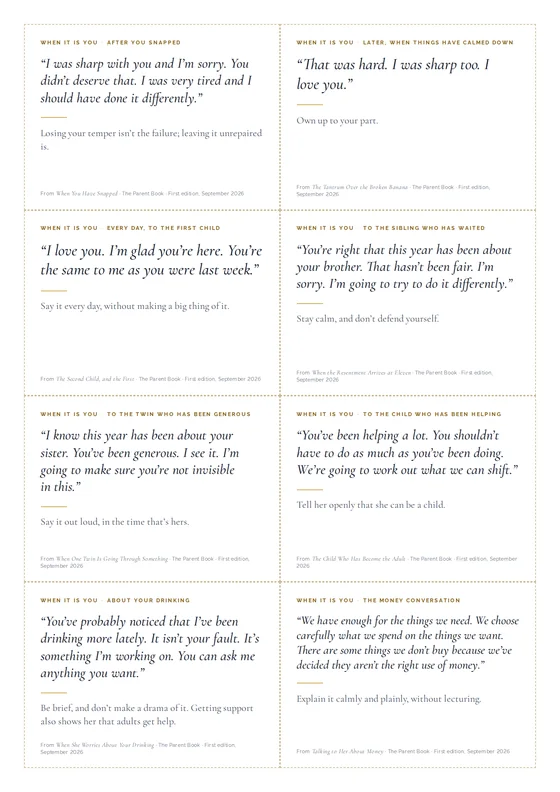
The chapter to start with
When Money Is Tight
For parents whose family is under financial strain, and for any parent wondering how much to tell a child about money.
27 min read · Under 18
Read the chapter Your first chapter is free to read in full.
↑ ↓ to moveEnter to openEsc to close
Family life and behaviour
Children notice when money is short, usually through what it does to the adults around them. These pages are about what to tell your child, what protects them while things are hard, the school fees and the friends whose families have more, and how children learn about money themselves. They aren’t financial advice, and they name the free services that are.
What to do first and who else can help are free to read and to print. So is the first chapter you open.
What the library holds on money worries
From the therapists
Money worries usually reach children through what they do to the adults around them. Much of what protects children costs nothing, and free debt advice is available in every part of the UK.
1 on money worries
The long reads, each on one situation, written by a therapist.
The chapter to start with
For parents whose family is under financial strain, and for any parent wondering how much to tell a child about money.
27 min read · Under 18
Read the chapter Your first chapter is free to read in full.
Nothing on this shelf is written for that age yet.
10 on money worries
Short pieces for the moment in front of you, each with things to try.
Family dynamics
Give it regularly, let your child decide how to spend it, and let the mistakes happen.
Try this
Family dynamics
Bursaries are limited and every school sets its own rules, so the conversation with the bursar is best had early.
Try this
From the tip
If the money worry has spread beyond the fees, free debt advice is the next step. A national debt charity gives free, regulated advice online or by phone across the UK. StepChange Debt Charity, 0800 138 1111. Mon-Fri 8am-8pm; Sat 9am-2pm. Outside those hours the line is closed. Samaritans answer at any hour on 116 123, and Shout answer if you text the word SHOUT to 85258. Help is free.
School & pressure
Ask the school about help with the cost before you say no, and plan for the week the others are away.
Try this
From the tip
If a change in your child’s mood or behaviour lasts for several weeks, gets worse, or begins to affect sleep, eating or school, talk to their school and your GP.
More quick tips on money worries
Friendships & social life
Take the envy or embarrassment seriously, and don’t run the other family down to make it better.
2 min read · Ages 7 to 16
Online life
Have the money conversation, and set the controls, before your child plays a game with a shop in it.
2 min read · Ages 7 to 13
Parent wellbeing
Children notice when a job or income is lost, so give them a short, honest explanation.
2 min read · Ages 7 to 16
Parent wellbeing
A calm “We can’t afford that” gives your child a way to talk about money that they’ll keep.
2 min read · Ages 5 to 13
Parent wellbeing
Money is something you can talk about with your child, though most families don’t.
2 min read · Ages 7 to 13
Family dynamics
Answer truthfully and briefly when your child asks why their friend is going skiing and they aren’t.
1 min read · Ages 9 to 16
Family dynamics
When money gets tight, get help with the numbers and decide what the children will be told.
1 min read · Ages 5 to 16
The rest of each tip, with more to try and why it works, is in the library.
Nothing on this shelf is written for that age yet.
1 on money worries
Small, repeatable things to do with your child, with what to watch for and when to get help.
To do together · About 10 min
Two jars, a regular amount and one thing to save for, so that your child learns to choose, to wait, and to live with what they chose.
What it is for. Children learn about money by handling it: choosing, waiting, and finding that money once spent is gone. Two jars and a regular amount give your child that experience every week, with sums low enough that a mistake costs very little. It needs no extra money, so it suits any family, including one where money is tight, and it gives your child something about money that is theirs to decide.
Safety. If there are children under five in the house, keep the jars, the coins and any buttons out of their reach.
When to get help. If your child has hurt themselves, or talks about not wanting to be alive, stay calm, thank them if they have told you, don’t promise to keep it secret, and act that day: help them ask the surgery for an urgent appointment, and if it is closed, use the routes under “If you need help right now”, at the foot of every page. If your child tells you that someone is hurting them, stay calm, thank them for telling you, don’t promise to keep it secret, and act that day, using those routes; if the person hurting your child lives in your home or your child’s other home, go straight to children’s social care or the police. A child protection helpline, listed under “If you need help right now”, at the foot of every page, will talk it through with you. If your child is badly hurt, or may have taken too much of a medicine, get medical help straight away, even if they seem well. If a change in your child’s mood or behaviour lasts for several weeks, gets worse, or begins to affect sleep, eating or school, talk to their school and your GP. If worry about money has become more than you can manage yourself, start with free debt advice, and if you have thoughts of not wanting to be alive, use the routes under “If you need help right now” straight away.
The other four steps, and your part in it, are in the library.
Nothing on this shelf is written for that age yet.
3 on money worries
Made to be printed, kept, and handed on.
To print and keep
What to do first, a few things to try and who else can help, together in one guide. Free to print and keep, or to hand to the other parent, a grandparent or the school.
Who else can help with money worries, on a sheet of its own.
8 on money worries
Chosen by the therapists who write the library: books for you and to read with your child, and pages from organisations we trust.
Also on this shelf
Every book on the shelf, with a therapist’s note on what it is good for, is in the library.
Also on this shelf

Every book on the shelf, with a therapist’s note on what it is good for, is in the library.
StepChange
The debt charity StepChange on saying no to something your child wants: being honest and calm, avoiding put-downs such as ‘money doesn’t grow on trees’, and saving up together. A companion to our quick tip “When We Cannot Afford It”; StepChange’s free debt advice is on the same site.
MoneyHelper
The government-backed money guidance service on starting to talk about money from about three, since children’s money habits begin to form by about seven, and on keeping it simple and involving children in real choices. Reassuring for the parent who thinks they must have their own finances in order first.
YoungMinds
YoungMinds’ guide for parents on money worries and a family’s mental health: how to talk to your child about money, what helps when worries are affecting everyone, and where to find practical support. A good first page for a family under financial pressure.
Nothing on this shelf is written for that age yet.
Start with free debt advice, and Citizens Advice for benefits, housing and work; then tell the school, which sees your child every day; and see the GP if you are still feeling worried, anxious or low after a few weeks, or, in England, refer yourself to NHS Talking Therapies.
Where to start
The government-backed free money guidance service, including a debt advice locator.
When money is part of what is happening at home. Children read household stress long before anyone explains it to them.
Free, independent advice on the practical layer: housing, benefits, debt, employment, and your rights when a family separates.
When the worry is partly a practical problem wearing an emotional coat. Solving the practical part often lowers the temperature at home more than anything else will.
The pastoral lead, the head of year, or the form tutor. Free, already knows your child, and often the quickest way to get something changed at school.
Before or alongside anything else. A school cannot act on what it has not been told, and what you bring is often what it did not have.
The gateway to everything the NHS offers a child: paediatric assessment, a referral to CAMHS, and support for you as the parent.
Ask for a double appointment. Describe the pattern over weeks rather than the worst single day, and say plainly what you are worried about. Bring a written list; the ten minutes go quickly.
Free NHS therapy for adults in England, for anxiety and low mood. You can refer yourself; you do not need to go through your GP first.
For the parent. A great many of the parents we sit with are carrying something of their own, and waiting for someone to ask.
www.nhs.uk/service-search/mental-health/find-an-NHS-talking-therapies-service
For money worries
Free debt advice by phone or online, and a short guide to telling children what the household cannot afford.
When money is part of what is happening at home. Start online if the phone queue is long.
For wider money guidance, MoneyHelper is the other place to look.
StepChange Helpline 0800 138 1111 · Mon-Fri 8am-8pm; Sat 9am-2pm · Outside those hours the line is closed. Samaritans answer at any hour on 116 123, and Shout answer if you text the word SHOUT to 85258.
You get free, confidential debt advice from a charity, by phone or webchat, or at any hour through its online tool, My Money Steps, with a library of sample letters.
When bills or debts have fallen behind and you want a plan, and you live in England, Wales or Scotland.
National Debtline 0808 808 4000 · Mon-Fri 9am-8pm; Sat 9.30am-1pm · Outside those hours the line is closed. Samaritans answer at any hour on 116 123, and Shout answer if you text the word SHOUT to 85258.
Free, confidential advice on benefits, work, debt, housing and family matters, by phone, webchat or at your local Citizens Advice, in England and Wales.
When you need to know what help you are entitled to, or what to do first about rent, council tax or energy bills you cannot pay.
Adviceline (England) and Advicelink (Wales) 0800 144 8848 · England Adviceline Mon-Fri 9am-5pm; Wales Advicelink Mon-Fri 8am-7pm, Sat 9am-1pm; debt helpline Mon-Fri 9am-8pm, Sat 9.30am-1pm; closed public holidays · Outside those hours the line is closed. Samaritans answer at any hour on 116 123, and Shout answer if you text the word SHOUT to 85258.
A free benefits calculator and a search for charitable grants your family may be entitled to, including grants for a child with a disability.
When money has tightened and you do not know what help exists.
A free, confidential helpline for any parenting or family worry, by phone, live chat, WhatsApp or email, staffed by trained family support workers.
When you need to talk it through with someone, about your child or about how you are managing, and you do not need a specialist to do it.
Coram Family Lives helpline 0808 800 2222 · Mon-Fri 9am-9pm; weekends 10am-3pm; closed bank holidays · Live chat and WhatsApp 07441 444125 at the same hours; email askus@coramfamilylives.org.uk · Outside those hours the line is closed. Samaritans answer at any hour on 116 123, and Shout answer if you text the word SHOUT to 85258.
www.coramfamilylives.org.uk/how-we-can-help/confidential-helpline
A free one-to-one webchat with a trained parenting coach, and a library of articles by age on behaviour, sleep, neurodiversity and family life.
When you want to talk it through with someone in writing, this week, without a referral.
Free one-to-one webchat with a parenting coach, Mon-Fri, with evening slots on Mon and Thu; check the site for current times · Parent Talk+ by phone or video for parents of children with additional needs, up to eight free sessions
Every organisation for money worries, and when each is the right call Finding a therapist